Blog
10 Panel vs 12 Panel Drug Test: Which Do You Need?


A 12-panel test screens for everything a typical 10-panel does, plus two more drug classes. Those usually come from the opioid and ecstasy families. If your policy, program or court order doesn’t name those extra classes, the 10-panel is usually enough. If it does, or if you’re seeing prescription opioid misuse locally, the 12-panel earns its place. The catch is that “10-panel” and “12-panel” aren’t standardized names, so you have to read the drug list on the product, not the number on the box.
TL;DR
- A 10-panel adds prescription-type drugs (benzodiazepines, barbiturates, methadone and similar) to the classic 5-panel core. A 12-panel typically adds extended opioids and ecstasy on top of that.
- Panel numbers aren’t a legal standard. Two “12-panel” cups from different makers can test different drugs, so compare the printed drug list against your policy.
- Outside federally regulated roles, there’s no rule that says a private employer must use a 10 or a 12-panel. You choose based on risk and legal requirements.
- A rapid cup or dip card is a preliminary screen. A non-negative result needs laboratory confirmation before anyone makes a decision.
- More drugs means more chances of a presumptive positive from legitimate prescriptions, so don’t buy a bigger panel just because it’s bigger.
Table of Contents
- What the number actually means
- What a 10-panel usually covers
- What a 12-panel adds
- Side-by-side comparison
- Do you need the extra two?
- Why a bigger panel isn’t automatically a safer one
- Cup or dip card?
- How to choose in five steps
- Our perspective
- Find your panel
- FAQ
- Sources
What the number actually means
The number counts the drug classes or substances a single test checks for. One occupational health provider explains that a 5-panel is the most basic option and a 10-panel is a step up in the number of drug families covered. Each additional “panel” is another test line on the cup or card, with its own cutoff concentration.
That last point is where the confusion starts. There is no single body that defines what goes into a 10-panel or a 12-panel for commercial rapid tests. Makers choose the combination. Most follow a familiar pattern, which is why the comparisons below hold in general, but you should always check the product insert.
What a 10-panel usually covers
The 5-panel core most people know is marijuana (THC), cocaine, opiates, amphetamines/methamphetamine and PCP. The 10-panel keeps those and adds prescription-oriented classes. Mobile Health’s panel guide describes the 10-panel as usually adding benzodiazepines, barbiturates, Quaaludes, propoxyphene and methadone.
So a typical 10-panel list looks like this:
- Marijuana (THC)
- Cocaine
- Opiates (morphine, codeine)
- Amphetamines
- Methamphetamine
- PCP
- Benzodiazepines
- Barbiturates
- Methadone
- Methaqualone or propoxyphene (varies by maker)
Some 10-panels list amphetamine and methamphetamine separately, others fold them together and add something else. That’s the variation to watch for. Propoxyphene was withdrawn from the US market years ago, which is one reason some newer configurations substitute other analytes.
What a 12-panel adds
A drug panel comparison summarizes the build-up this way: the 10-panel adds prescription drugs and barbiturates to the core, and the 12-panel adds extended opioids and ecstasy. In practice, the two extra lines are often:
- Ecstasy (MDMA), a party drug that the standard 5-panel doesn’t catch.
- An extended opioid line, such as oxycodone, buprenorphine or tramadol, depending on the maker. Standard “opiates” lines are designed around morphine and codeine and can miss semi-synthetic opioids.
For a concrete real-world example of a 12-panel’s makeup, an FDA 510(k) decision summary for one at-home 12-drug test lists amphetamines, barbiturates, benzodiazepines, cocaine, ecstasy (MDMA), methadone and methamphetamine among its targets. It’s one device, not a standard, but it shows how the list can be assembled.
Our own 12-panel products are on the 12 panel dip card page and the 12 panel cup page. Each lists its exact analytes and cutoffs, which is what you should compare against your policy.
Side-by-side comparison
| 5-panel | 10-panel | 12-panel | |
|---|---|---|---|
| Core five classes (THC, cocaine, opiates, amphetamines, PCP) | Yes | Yes | Yes |
| Benzodiazepines, barbiturates, methadone | No | Yes | Yes |
| Ecstasy (MDMA) | Rarely | Varies | Usually |
| Extended opioids (oxycodone, buprenorphine, tramadol) | No | Varies | Often |
| Typical use | Routine employment screening | Clinics, treatment programs, courts, safety-sensitive roles | Programs that need broader coverage of opioids and party drugs |
| Risk of presumptive positives from prescriptions | Lower | Moderate | Higher |
The “varies” cells aren’t hedging. They’re the honest answer, because the makers differ. If you want a quick feel for how the lower tiers stack up, our 5 panel vs 10 panel guide covers that step, and the urine drug test panels comparison lays out more configurations.
Do you need the extra two?
The 12-panel isn’t “better” by default. It’s broader. Whether broader helps depends on who you are.
Employers
For most private employers, the panel is a policy choice. The SAMHSA Model Plan for a federal drug-free workplace program, dated March 2026, describes testing types such as applicant, random and reasonable-suspicion testing for federal agencies. The guidance we reviewed doesn’t mandate a 10 or 12-panel configuration for private employers outside specific regulated safety-sensitive roles. In unregulated settings you define the panel, as long as collection, chain of custody and confirmation of non-negative results follow established legal and procedural standards.
If you’re subject to Department of Transportation rules, the panel is fixed by regulation, and neither a 10 nor a 12-panel substitutes for the required testing. Check with your designated employer representative or a third-party administrator before changing anything. Talk to employment counsel too, since state law on marijuana and on testing notices varies.
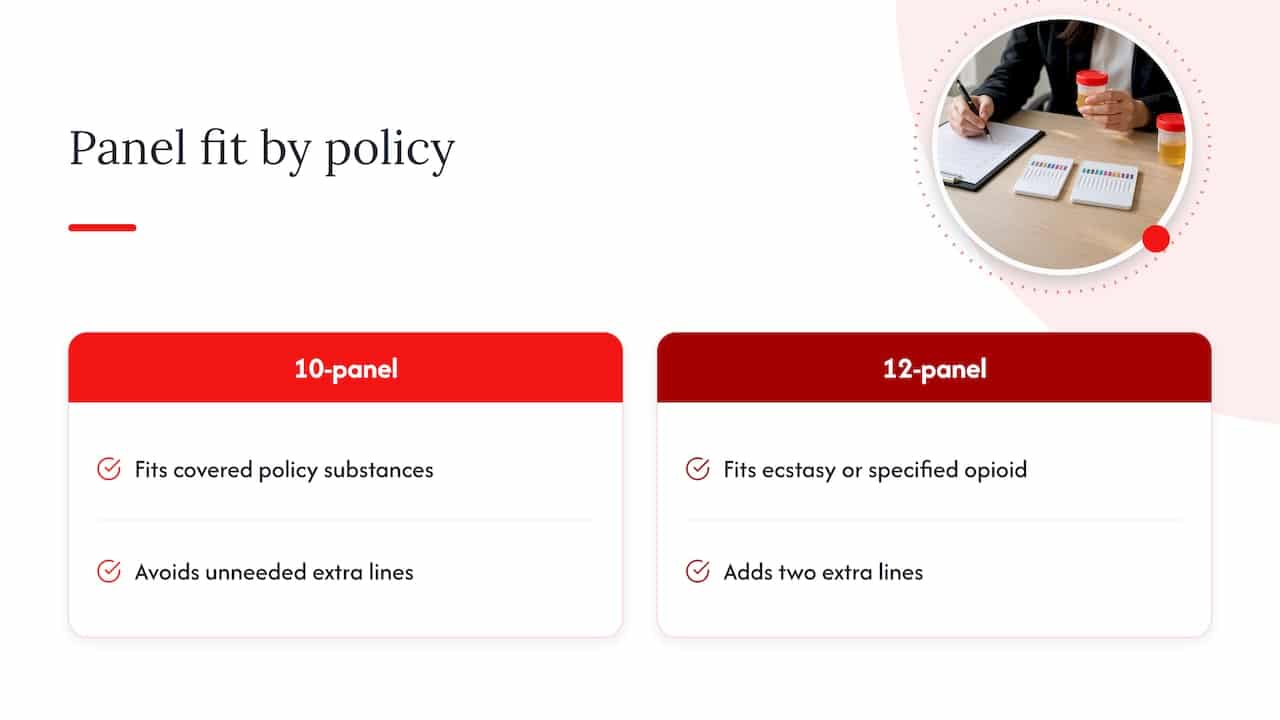
A practical test: write down the substances your policy names. If every one is on the 10-panel, buying the 12 gives you two extra lines you can’t act on, and extra chances of a result you then have to explain. If your policy names ecstasy or a specific prescription opioid, the 12 is the clean fit.
Clinics and treatment programs
Treatment and outpatient programs often need to see prescription opioid and benzodiazepine use, which is where the 10-panel already helps and the 12-panel may help more. The right choice depends on the patient population and what you’ll do with the result. Match the panel to the screening purpose rather than defaulting to the longest list. A guide to matching psychiatry follow-up visits to risk and lab rules is a useful read for thinking about how screening frequency and visit cadence fit together.
For federal context, SAMHSA’s Drug Testing Advisory Board minutes from 2020 describe the HHS panel as cocaine, amphetamines, marijuana, phencyclidine and opioids, with fentanyl and methadone as proposed additions. It’s a reminder that the drug list itself changes over time. Anything you decide today may need review.
Law enforcement and probation
Court or agency requirements win. If a probation order names specific substances, buy the panel that includes them and nothing less. Where the order is silent, a 10-panel is the common baseline, and a 12-panel makes sense when your caseload includes ecstasy or non-morphine opioid concerns.
Individuals
If you’re testing yourself or a family member, you don’t need to match an employer’s list. Pick the panel that covers what you’re worried about. If it’s a prescription opioid like oxycodone, check that the product lists it, because plain “opiates” lines often won’t. If it’s fentanyl, none of the standard 10 or 12-panels may cover it, and you’d look at a dedicated fentanyl test or a panel that lists fentanyl explicitly.
Why a bigger panel isn’t automatically a safer one
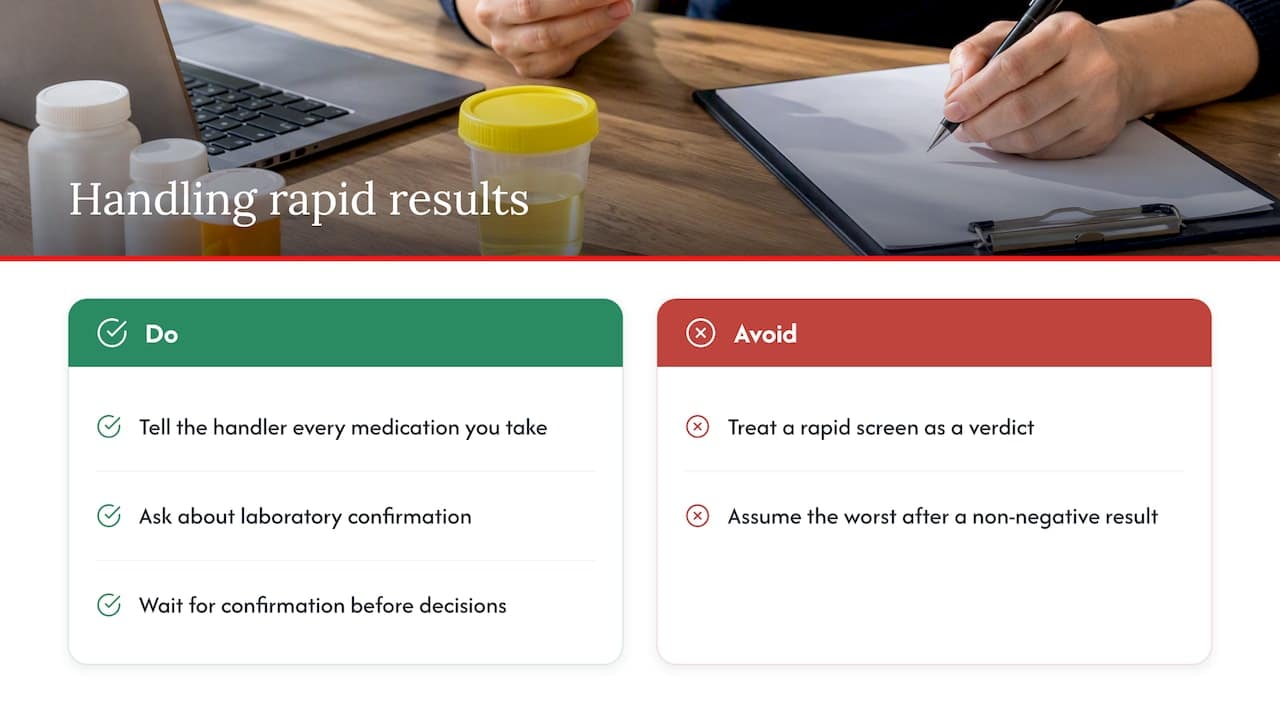
Every added line is another place a legitimate medication can cause a presumptive positive. That’s why the research we reviewed stresses that a rapid cup or card is a screen, not a verdict. A non-negative result is a trigger for laboratory confirmation by a method such as GC/MS or LC/MS, and professional decisions should wait until that confirmation is complete. The same SAMHSA Model Plan frames testing around established collection, chain of custody and confirmation steps.
For regulated testing, the process has a human step too. Under DOT rules, 49 CFR 40.131 requires the medical review officer to contact the employee directly and confidentially after a confirmed positive, adulterated, substituted or invalid result. A rapid test can’t replace that.
If you’re an employee or patient who got a non-negative rapid result, don’t assume the worst. Tell the person handling the test about every prescription and over-the-counter medicine you take, and ask about confirmation testing. A medical review officer or your prescriber is the right professional to talk to.
Cup or dip card?
The panel count and the format are separate decisions. Cups collect and hold the specimen with a built-in temperature strip on many models, which suits supervised collection. Dip cards are compact and cost-efficient for high-volume screening. Both come in 10 and 12-panel versions in our catalog: see the 10 panel dip card, the 10 panel cup, and our cup vs dip card comparison.
How to choose in five steps
- List what your policy or order requires. Name the substances, not the panel number.
- Read the analyte list on the product. Look for the extended opioid line and ecstasy if you want a true 12.
- Check cutoffs. A drug on the list at a high cutoff may miss lower-level use.
- Plan the confirmation path. Know which lab you’ll send non-negative specimens to before you test.
- Decide on adulterants. If specimen tampering is a concern, look at cups with built-in adulterant strips, such as our 15 panel cup or 18 panel cup, which add substances beyond the standard 12.
Our perspective
We’re a family business, and most of the questions we get aren’t “which is better.” They’re “I bought a 12-panel and my policy doesn’t mention half of it.” The pattern is consistent: buyers choose by the number and then discover the drug list doesn’t match what they needed.
Our advice is to work backwards. Start with the drugs you actually have to detect, find the smallest panel that covers all of them, and only move up if a real risk justifies it. A 10-panel is the right answer for a great many clinics, programs and employers. A 12-panel is the right answer when ecstasy or non-morphine opioids are on your list. And if neither fits, we’d rather you look at the full range or ask us for a custom quote than buy something that doesn’t match your policy.
We also tell every buyer the same thing: the cup gives you a presumptive result. Plan your confirmation testing first.
— Justin
Find your panel
We stock 10-panel and 12-panel cups and dip cards, plus 5, 6, 8, 13, 15, 16 and 18-panel options, with bulk discounts and custom quotes. Start with the 12 panel dip cards or browse every test cup, dip card and strip in the shop.
FAQ
Does a 12-panel test include everything in a 10-panel?
Usually, yes. The 12-panel typically keeps the 10-panel classes and adds extended opioids and ecstasy. Because there’s no universal standard, confirm by reading the analyte list on the specific product.
Is a 10-panel or 12-panel required for a job?
Generally not by federal rule for private employers outside regulated safety-sensitive roles. The employer defines its own panel within legal and procedural standards. DOT-regulated positions follow a fixed federal panel instead.
Will a 12-panel catch fentanyl?
Not necessarily. Fentanyl is a separate analyte, and many standard 10 and 12-panels don’t include it. Look for a product that lists fentanyl on its label, such as our 13 panel cup with FYL.
Is a positive rapid test result final?
No. A rapid cup or card is preliminary. A non-negative result should go to a laboratory for confirmation, and legitimate prescriptions can trigger presumptive positives, so decisions should wait for the confirmed result.
Sources
- SAMHSA Model Plan for a Comprehensive Federal Drug-Free Workplace Program (March 2026)
- SAMHSA DTAB open session minutes, September 1, 2020
- FDA 510(k) decision summary, 12-drug at-home test
- DOT 49 CFR 40.131
- Drug Test Panels Compared, DrugPanels
- Drug Panel Choices, Mobile Health
- Difference Between 10 and 12 Panel Drug Test, Health Street