Blog
Bath Salts Drug Test: What Detects Them and What Doesn’t


Most standard drug tests do not look for bath salts. A routine 5, 10 or 12 panel screen checks for drugs such as THC, cocaine, opiates and amphetamines, and a negative result on those panels does not rule out synthetic cathinones, the chemical family behind “bath salts.” To detect them you need a test that targets them on purpose: a specialized lab panel, or a screening product built for specific cathinones such as MDPV.
This guide explains what “bath salts” means in testing terms, which methods work, how long detection lasts, where screening goes wrong, and how employers, clinics and treatment programs can build a sensible plan.
TL;DR
- Bath salts are synthetic cathinones. They are not routinely included in standard drug-of-abuse panels, so a clean standard panel says nothing about them.
- Reliable identification usually takes a lab method such as LC-MS/MS, ordered specifically. Point-of-care screens can flag certain cathinones, but they only cover the compounds they target.
- Detection in urine is short, generally up to several days after exposure.
- Any preliminary positive is a screening result only. It needs confirmation before anyone acts on it.
- Check specimen validity too. A diluted or tampered sample can hide any drug, including this one.
Table of Contents
- What “bath salts” means in a drug test
- Why standard panels miss them
- Ways to test for bath salts
- How long bath salts can be detected
- False positives, false negatives and why confirmation matters
- Check the specimen, not only the drug
- Perspective: how we would build a screening plan
- Choosing products for your program
- Where to find the right supplies
- FAQ
- Sources
What “bath salts” means in a drug test
The name has nothing to do with the crystals you put in a tub. Street “bath salts” are synthetic cathinones: lab-made stimulants chemically related to cathinone, the active compound in the khat plant. Products sold under this label have contained mephedrone, methylone, MDPV, alpha-PVP and many others, and the mix changes from batch to batch.
That variability is the core testing problem. A review of detection methods for synthetic cannabinoids and cathinones describes how many analogs circulate and how they keep changing. Sellers alter molecular structures, and an assay built for last year’s compound may miss this year’s. Practitioners often describe it as a cat-and-mouse game: the chemistry moves faster than the standard panels.
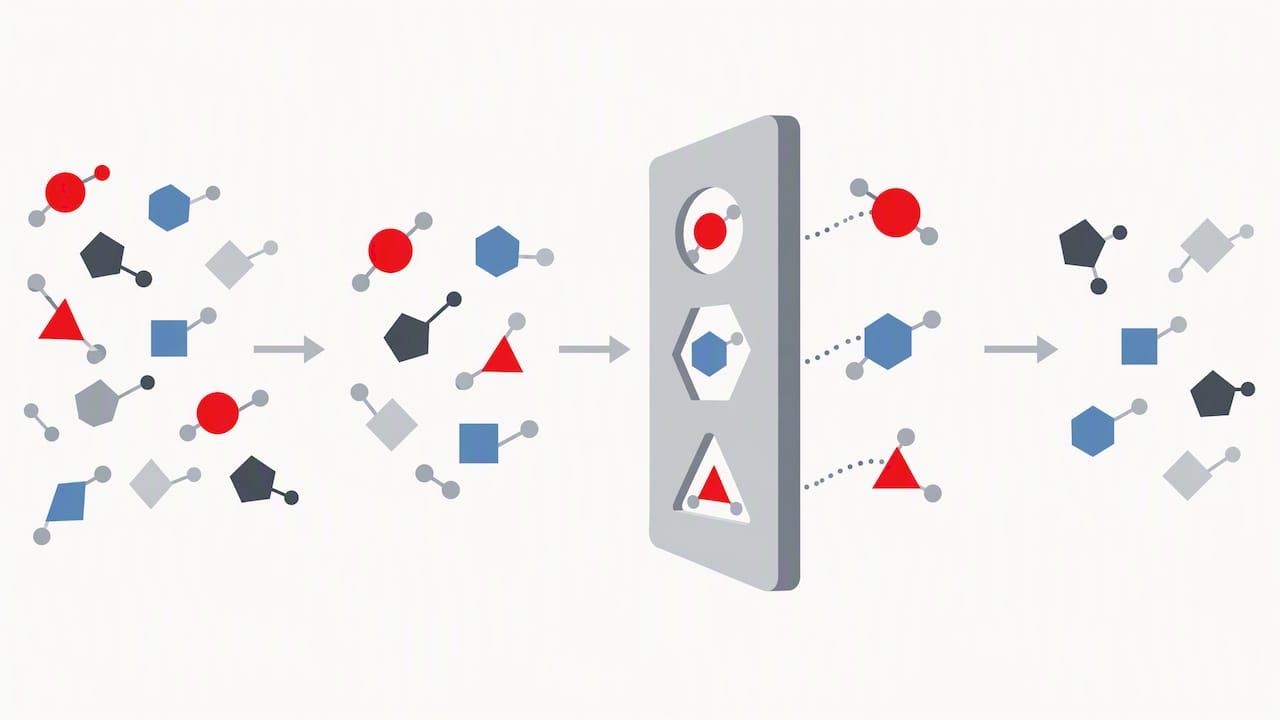
So when someone asks for a “bath salts drug test,” the first question is always: which compounds do you need to find, and in what setting?
Why standard panels miss them
A typical urine cup or dip card uses immunoassay technology. Antibodies bind to a drug or its metabolite, and a visible line shows the result. Each lane is built for one drug class. The amphetamine lane is designed around amphetamine and methamphetamine, not around cathinones, which have a different structure.
Two consequences follow:
- A negative standard panel is not a negative for bath salts. Per the ARUP Laboratories test directory, laboratories do not typically run these tests unless they are specifically ordered.
- Cross-reactivity is unreliable. Some cathinones may occasionally trigger a neighboring lane, but you cannot count on it, and you cannot interpret it as proof of anything.
This is why a cup that says “12 panel” or “18 panel” should be read line by line. Check the drug list on the product, not the number on the box. Panels differ widely, and cathinones are usually absent unless the product names them.
Ways to test for bath salts
Specialized laboratory panels
The most dependable route is a send-out lab test. ARUP’s NPS Stimulants (Bath Salts) panel for urine is one example of this category, listed as useful for assessing exposure up to several days afterward. These panels use mass spectrometry, which separates and identifies compounds by their molecular signature rather than by antibody binding.
Published methods show how far this can go. One quantitative LC-MS/MS method was developed to measure 16 synthetic cathinones and 10 metabolites in clinical and forensic urine samples. Mass spectrometry also handles confirmation, which matters for the reasons covered below.
The tradeoffs are cost, turnaround time and the need for a physician or lab order. For an emergency department or a forensic case, those are acceptable. For routine screening of dozens of people a week, they are not.
Immunoassays aimed at cathinones
Immunoassays for cathinones do exist, but the field is thin. A validation study of a biochip immunoassay described it as the only commercially available immunoassay for synthetic cathinones in urine at the time, built with two cathinone antibodies. It was designed for high-throughput lab use, not for a cup on a clinic counter.
The lesson holds for any cathinone screen, lab-based or not: it covers the compounds its antibodies recognize, and newer analogs can fall outside that coverage.
Point-of-care strips for specific compounds
For first-pass screening where speed and cost matter, single-analyte strips are the practical tool. We carry MDPV drug test strips, which target one of the best-known bath salt compounds. A strip like this answers a narrow question: is that compound likely present above the strip’s cutoff? It does not answer “did this person use any bath salt,” because other cathinones may not register.
Use these strips as a screen, and handle a positive as preliminary. Read the package insert for the cutoff and cross-reactivity data before you rely on the product.
Reagent kits for seized material
Some investigators use color-reaction field kits on suspect powders and tablets. That is a different job from testing a person’s urine, and it falls under forensic identification rather than screening. If your question is about a powder rather than a donor, mention it to your lab, because the right method differs.
How long bath salts can be detected
There is no single number, and honest sources avoid giving one. What the evidence supports: in urine, detection is generally short, often up to several days after exposure, and for assessing acute exposure, serum or plasma may serve better than urine.
What changes the window:
- The specific compound. Metabolism and elimination differ across cathinones.
- Dose and frequency. Heavier or repeated use generally lengthens detection.
- The assay’s cutoff. A more sensitive method finds lower concentrations for longer.
- Hydration and kidney function. These alter urine concentration, which is where specimen validity comes in.
Be wary of any chart that promises exact hours for a category with this many members. If a decision depends on timing, such as a clinical assessment, ask the testing lab for guidance on the compound in question.
False positives, false negatives and why confirmation matters
Screening results are preliminary by design. The FDA’s page on drugs of abuse home use tests explains that these tests indicate whether drugs may be present in urine, and that a positive needs a more specific lab analysis.
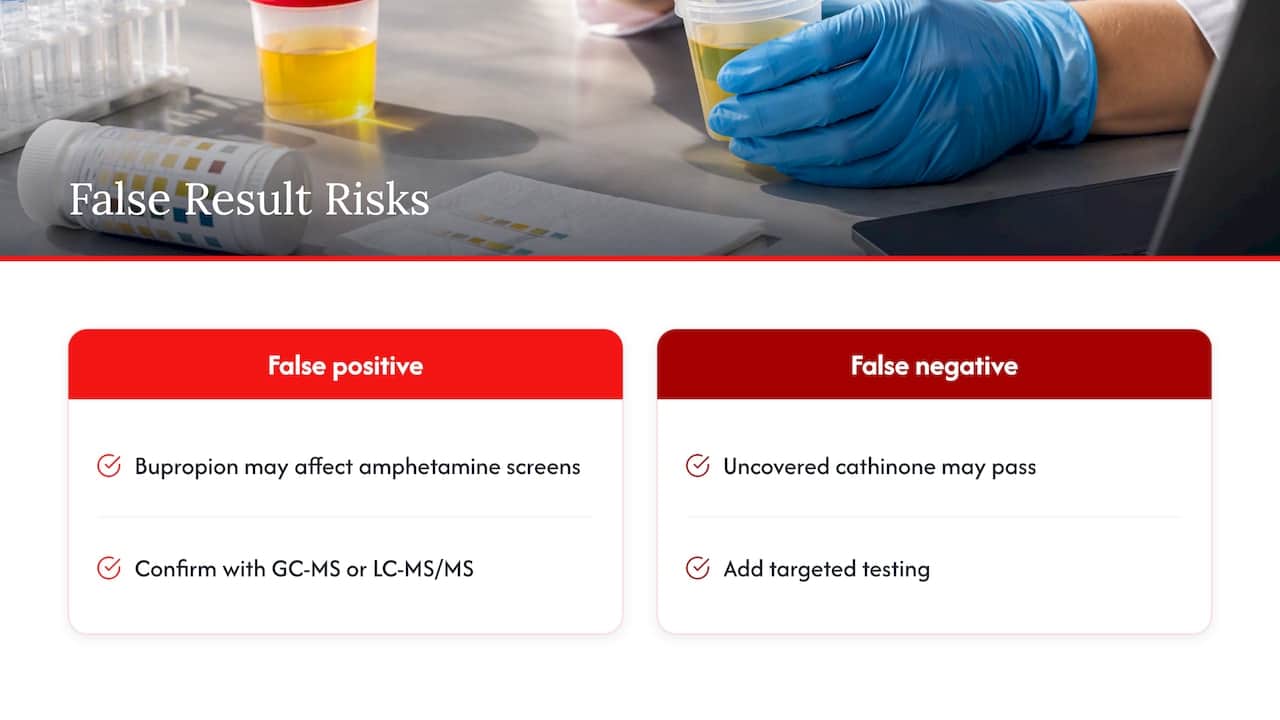
False positives are real. A prescribing label for bupropion notes that false-positive urine immunoassay screens for amphetamines have been reported in patients taking it. If someone on that medication shows an amphetamine-lane positive, the right move is confirmation by GC-MS or LC-MS/MS, not an accusation. Our guide on how to identify false positives on a drug test walks through the common causes.
False negatives are the bigger risk with bath salts. A donor who used a cathinone not covered by your panel will pass, and nothing in the result will say otherwise. For high-stakes programs, that gap is the reason to add targeted testing rather than trust a general panel.
Check the specimen, not only the drug
A test is only as good as the sample. Dilution, substitution and adulterants can make a specimen look clean whatever the donor took.
Federal workplace programs treat this seriously. Under SAMHSA’s validity testing requirements, per SAMHSA materials on urine biomarkers, labs check pH (4.5 to 9.0) and creatinine (above 20 mg/dL), and run specific gravity testing on samples with low creatinine. Values outside the expected physiological ranges point to dilution or substitution. The SAMHSA MRO Guidance Manual adds that laboratories can run additional tests when a specimen looks unusual, for example by odor, color or unexpected behavior during screening.
Synthetic urine is a particular concern. SAMHSA’s National Laboratory Certification Program presentation reports that many synthetic urine products were not detectable by typical validity checks, which is why labs keep adapting their methods.
For non-federal programs, these are good benchmarks. Our resources cover the practical side:
- Urine specimen validity: ensuring integrity in drug testing
- What SAMHSA requires for urine specific gravity testing
- How to prevent sample adulteration: a checklist for test administrators
- Detecting adulterants step by step
Employers under DOT rules should also read about the one-retest limit for dilute urine drug tests, since a dilute result triggers a specific process.
A note on the question people keep asking: does any drink make a test come back negative? Neither labs nor regulators recognize one. Dilution shows up as low creatinine and low specific gravity, and it can cost a donor a refusal-to-test outcome rather than a pass. MROs are trained to weigh donor explanations against objective physiological criteria.
Perspective: how we would build a screening plan
We sell drug testing supplies to clinics, treatment programs, employers and labs, and the same mistake comes up again and again: buyers choose a cup by panel count and assume it covers everything dangerous. It doesn’t. A panel count tells you how many lanes there are, not which drugs they detect.
Here is how we would approach bath salts:
- Decide what question you are asking. A pre-employment screen, a treatment monitoring program and a forensic investigation need different tools.
- Start with the standard panel that fits your program, then add targeted testing where your population or region gives you a reason. Our piece on why to test for synthetic drugs and emerging drug trends can help you judge that.
- Treat every preliminary positive as a lead, not a verdict. Send it for confirmation.
- Protect the specimen. Controlled collection and built-in adulterant checks do more for your results than adding another lane.
- Review your menu every year. Synthetic drugs change, and a plan written once goes stale. See our reasoning on testing for emerging substances.
If you are unsure, a short call with your medical review officer or laboratory beats guessing.
— Justin
Choosing products for your program
Start with the setting.
| Situation | What to consider |
|---|---|
| Routine workplace or clinic screening | A standard multi-panel cup or dip card, with adulterant checks where your policy requires them |
| Concern about a specific cathinone | Single-compound strips such as MDPV, with lab confirmation of any positive |
| Clinical suspicion of bath salt exposure | A specialized lab panel ordered by the treating clinician; serum or plasma may be better for acute cases |
| Forensic or legal matter | Accredited lab testing with documented chain of custody |
If you are comparing formats, our cup vs dip card comparison explains the differences, and the top urine drug test cups comparison helps you narrow the choice.
Where to find the right supplies
We stock multi-panel cups, dip cards, single-drug strips and specimen collection supplies for professional and personal use, with bulk ordering and custom quotes for larger programs. For a broader panel that includes synthetic cannabinoid, tramadol, ethyl glucuronide and fentanyl lanes, look at the 18 panel cup with adulterant checks. For a targeted screen, see the MDPV test strips. You can browse everything in our shop, and ask for a quote if you are buying in volume. Confirm the drug list and cutoffs on each product page against your policy before ordering.
FAQ
Does a 10 panel drug test detect bath salts?
No, not as a rule. Standard 10 panel tests target drug classes such as THC, cocaine, opiates and amphetamines, and synthetic cathinones are not routinely part of those panels. A negative result tells you nothing about bath salts unless the product explicitly lists cathinones such as MDPV.
How long do bath salts stay in your system?
In urine, detection is generally limited to several days after exposure, though the exact window depends on the compound, dose, frequency and test sensitivity. Serum or plasma can be more useful for acute exposure. A lab or medical professional can advise on a specific case.
Can bath salts cause a false positive for amphetamines?
It is possible for structurally related compounds to interact with an immunoassay, but it is not dependable, and other things, such as bupropion, are better documented as causes of amphetamine false positives. Any amphetamine-lane positive should go to confirmation by GC-MS or LC-MS/MS.
What confirms a bath salts result?
Liquid chromatography with tandem mass spectrometry is the standard approach. Published LC-MS/MS methods can quantify many cathinones and their metabolites in urine, which makes them suitable for clinical and forensic confirmation.
Sources
- ARUP Laboratories: NPS Stimulants (Bath Salts Panel), Urine
- A Quantitative LC-MS/MS Method for 16 Synthetic Cathinones and 10 Metabolites (PMC)
- Validation of an immunoassay for synthetic cathinones in urine (PMC)
- Comprehensive review of detection methods for synthetic cannabinoids and cathinones (PMC)
- FDA: Drugs of Abuse Home Use Test
- FDA-hosted bupropion prescribing label
- SAMHSA: urine biomarkers for validity testing
- SAMHSA: Medical Review Officer Guidance Manual 2024
- SAMHSA: Synthetic urines and adulterants
- SAMHSA: 2025 MRO Case Studies, Urine