Blog
Why test for emerging substances: protecting public health


Standard drug tests are failing. Not occasionally, not in edge cases, but systematically, across clinics, courtrooms, and field operations nationwide. Standard immunoassays fail to detect many emerging substances, producing false negatives that leave healthcare providers guessing, law enforcement without evidence, and substance abuse programs flying blind. The drug supply has evolved faster than the testing infrastructure designed to monitor it. This article breaks down what emerging substances are, where current panels fall short, and what you can do right now to close the gap.
Table of Contents
- What are emerging substances and why are they a challenge?
- Common pitfalls of standard drug testing panels
- Benefits of testing for emerging substances: Clinical, forensic, and public health impact
- How to keep testing protocols effective: Best practices for catching emerging substances
- Effective solutions for comprehensive substance testing
- Frequently asked questions
Key Takeaways
| Point | Details |
|---|---|
| Emerging substances evade detection | Most new drugs are invisible to standard screening, posing risks to health, safety, and legal certainty. |
| Upgraded protocols are vital | Regularly updating drug test panels and using advanced methods fills dangerous gaps in detection. |
| Real-world impact is significant | Comprehensive testing prevents costly overdoses, enables better public health alerts, and supports legal outcomes. |
| Quarterly reviews are best practice | Lab and clinical protocols should target high-priority NPS and update their scopes at least every three months. |
What are emerging substances and why are they a challenge?
Emerging substances, formally called novel psychoactive substances (NPS), are synthetic drugs engineered specifically to sidestep existing drug controls. Chemists tweak molecular structures just enough to create something technically legal, pharmacologically active, and completely invisible to standard testing panels. That’s not a loophole. That’s a strategy.
The challenge for labs and clinics is threefold. First, the chemical landscape shifts constantly. A compound that didn’t exist in a reference database six months ago may now be showing up in overdose cases. Second, reference materials for new substances are scarce, making it hard to validate new assays quickly. Third, toxicology screening protocols built around legacy drugs simply weren’t designed to catch what wasn’t known when they were written.
Here’s what that looks like in practice:
- Metonitazene: A synthetic opioid far more potent than morphine, increasingly found in overdose cases
- Bromazolam: A designer benzodiazepine not detected by standard benzo immunoassays
- Nitazenes as a class: Multiple analogs emerging faster than reference standards can be produced
- Synthetic cannabinoids: Hundreds of variants, most invisible to standard THC panels
- Novel stimulants: Cathinone derivatives and amphetamine analogs with unpredictable toxicity profiles
The scale of the problem is staggering. In 2023, the US recorded over 100,000 overdose deaths, driven heavily by the opioid and NPS crisis. Standard immunoassays lack cross-reactivity for NPS, meaning a patient presenting with a synthetic opioid overdose may test completely negative on a standard panel. That false negative isn’t just a data error. It’s a clinical emergency waiting to happen.
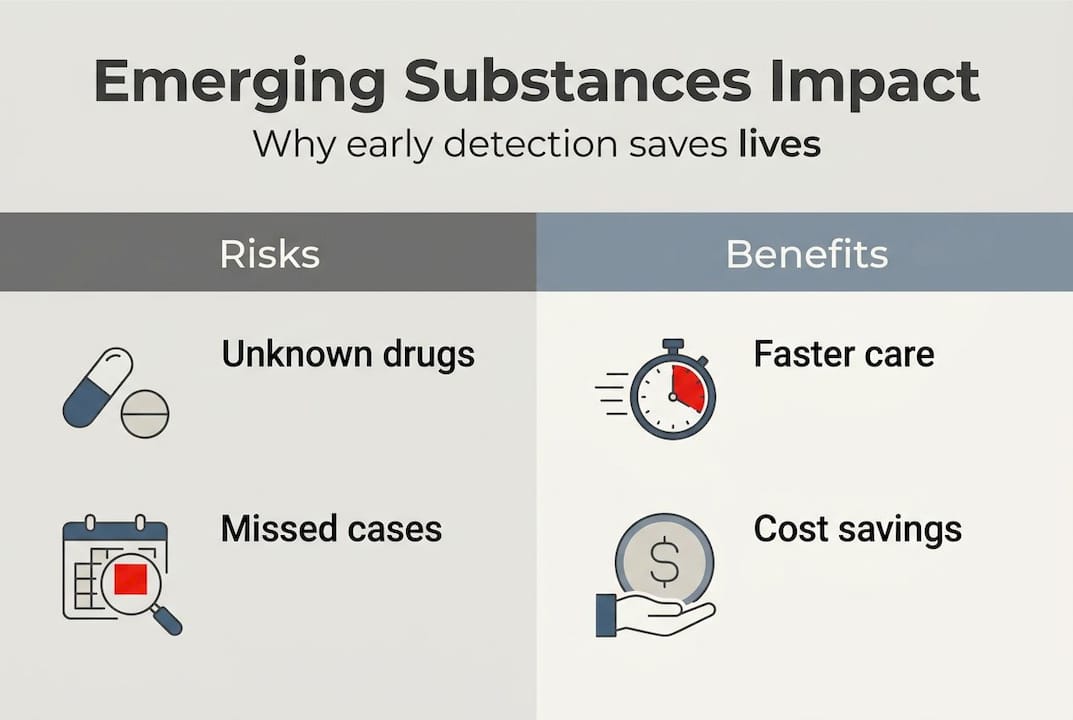
The innovations in drug testing emerging from forensic and clinical labs are beginning to address this, but adoption across the field remains uneven.
Common pitfalls of standard drug testing panels
Traditional immunoassay panels were built for a different era. They detect specific antibody-antigen reactions for known substances. When a new compound doesn’t trigger that reaction, it simply doesn’t register. No flag. No alert. A clean result.
The gap between what immunoassays catch and what high-resolution mass spectrometry (HRMS) finds is not small. In a real-world study, standard immunoassays missed 67 compounds in 919 samples that were subsequently detected by LC-QTOF-MS, a form of HRMS. That’s not a rounding error. That’s a systemic failure.
| Detection method | Substances detected | NPS coverage | Speed | Cost |
|---|---|---|---|---|
| Standard immunoassay | 5 to 12 common drugs | Very limited | Fast | Low |
| Extended immunoassay | 15 to 25 drugs | Partial | Fast | Moderate |
| LC-QTOF-MS (HRMS) | 100+ substances | Broad | Slower | High |
| Rapid field methods | Varies by panel | Emerging | Very fast | Low to moderate |
The forensic and clinical consequences of missed detections are serious. A patient treated for a suspected opioid overdose who actually ingested a nitazene analog may not respond to standard naloxone dosing. A legal case built on a negative drug screen may collapse when HRMS later reveals the presence of a controlled analog. Over 700 positive results were missed in one real cohort study, each representing a patient, a case, or a public health data point that simply vanished.
“Retrospective reanalysis of stored samples using HRMS has revealed the presence of NPS that were entirely missed at the time of original testing, fundamentally changing clinical and forensic interpretations.”
Pro Tip: If your lab stores specimens, consider running retrospective HRMS reanalysis on a sample set from the past 12 months. You may find substances that were present but never flagged, which can inform your current rapid screening methods and update your panel priorities.
The new drug screening protocols being adopted by forward-thinking labs combine initial immunoassay screening with confirmatory HRMS, giving you speed at the front end and accuracy at the back.
Benefits of testing for emerging substances: Clinical, forensic, and public health impact
When testing catches what’s actually in a patient’s system, everything downstream improves. Treatment is faster and more targeted. Legal evidence is stronger. Public health data becomes actionable.
Here’s how comprehensive testing delivers value across three domains:
- Clinical care: Accurate identification of the substance means the right antidote, the right monitoring protocol, and fewer repeat ED visits. A patient who tests positive for bromazolam gets a very different treatment plan than one flagged for standard benzodiazepines.
- Forensic and legal: Prosecutors and defense attorneys both need accurate toxicology. Identifying a specific NPS in a DUI case or a drug-facilitated assault changes the legal outcome. Labs that can identify emerging substances provide evidence that holds up.
- Public health surveillance: When labs report what they’re finding, public health agencies can issue faster alerts, target harm reduction resources, and track supply chain shifts in real time. Drug checking informs harm reduction and reduces downstream healthcare costs.
The cost argument is compelling on its own. An emergency department visit averages $533, while an inpatient admission runs $4,353. Catching a dangerous substance early, before a second exposure or a more severe overdose, keeps patients out of the hospital and keeps costs down. The opioid crisis alone costs the US an estimated $2.7 trillion per year when you factor in healthcare, lost productivity, and criminal justice expenses.
| Setting | Benefit of comprehensive testing | Cost impact |
|---|---|---|
| Emergency department | Faster, accurate diagnosis | Reduces repeat visits |
| Substance abuse program | Identifies relapse substances accurately | Lowers treatment failure rates |
| Law enforcement | Stronger forensic evidence | Supports prosecution |
| Public health agency | Real-time supply surveillance | Reduces outbreak response costs |
Pro Tip: Include metabolite panels alongside parent compound testing. Many NPS metabolize quickly, and testing only for the parent compound means you’ll miss cases where the substance has already been processed by the body. Alpha-Hydroxy Bromazolam, for example, is the primary metabolite of bromazolam and a far more reliable detection target in urine.
For substance abuse treatment centers, comprehensive testing also means better program outcomes. Knowing exactly what a client is using allows counselors to tailor interventions rather than guessing. For law enforcement, it means evidence that can actually be used. NIST and DEA guidelines provide a framework for labs looking to expand their NPS detection capabilities.
How to keep testing protocols effective: Best practices for catching emerging substances
The drug supply doesn’t wait for your next annual review. Here’s how to build a testing workflow that keeps pace.
Update your scope quarterly, not annually. Expert bodies like CFSRE recommend quarterly NPS scope updates, with Tier 1 substances like bromazolam and metonitazene prioritized based on current prevalence data. A set-it-and-forget-it panel is a liability.
- Prioritize Tier 1 NPS: Focus first on substances with confirmed prevalence in your region. Bromazolam and metonitazene are currently at the top of that list nationally.
- Upgrade your confirmation technology: HRMS, Fourier-transform infrared spectroscopy (FTIR), and paper spray mass spectrometry give you broader detection with fewer false negatives.
- Expand your matrices: Urine is standard, but oral fluid and blood testing catch substances and metabolites that urine misses, especially in acute cases.
- Integrate field-deployable tools: Rapid field methods allow law enforcement and first responders to get preliminary results on scene, improving triage and officer safety.
- Build a feedback loop: When your lab identifies a new substance, that data should flow back into your panel update process immediately.
Pro Tip: Work with your reference lab to establish a standing order for quarterly panel reviews tied directly to CFSRE and DEA emerging threat reports. This removes the administrative burden of manual tracking and keeps your drug screening workflow current without requiring a policy overhaul every time a new compound appears.
For programs that test multiple substances across different populations, multi-substance testing frameworks allow you to customize panels by risk profile rather than applying a one-size-fits-all approach.
Effective solutions for comprehensive substance testing
Knowing the best practices is step one. Having the right tools to execute them is step two. For labs, clinics, and enforcement agencies looking to expand their detection capabilities without overhauling their entire workflow, multi-panel testing products offer a practical starting point.
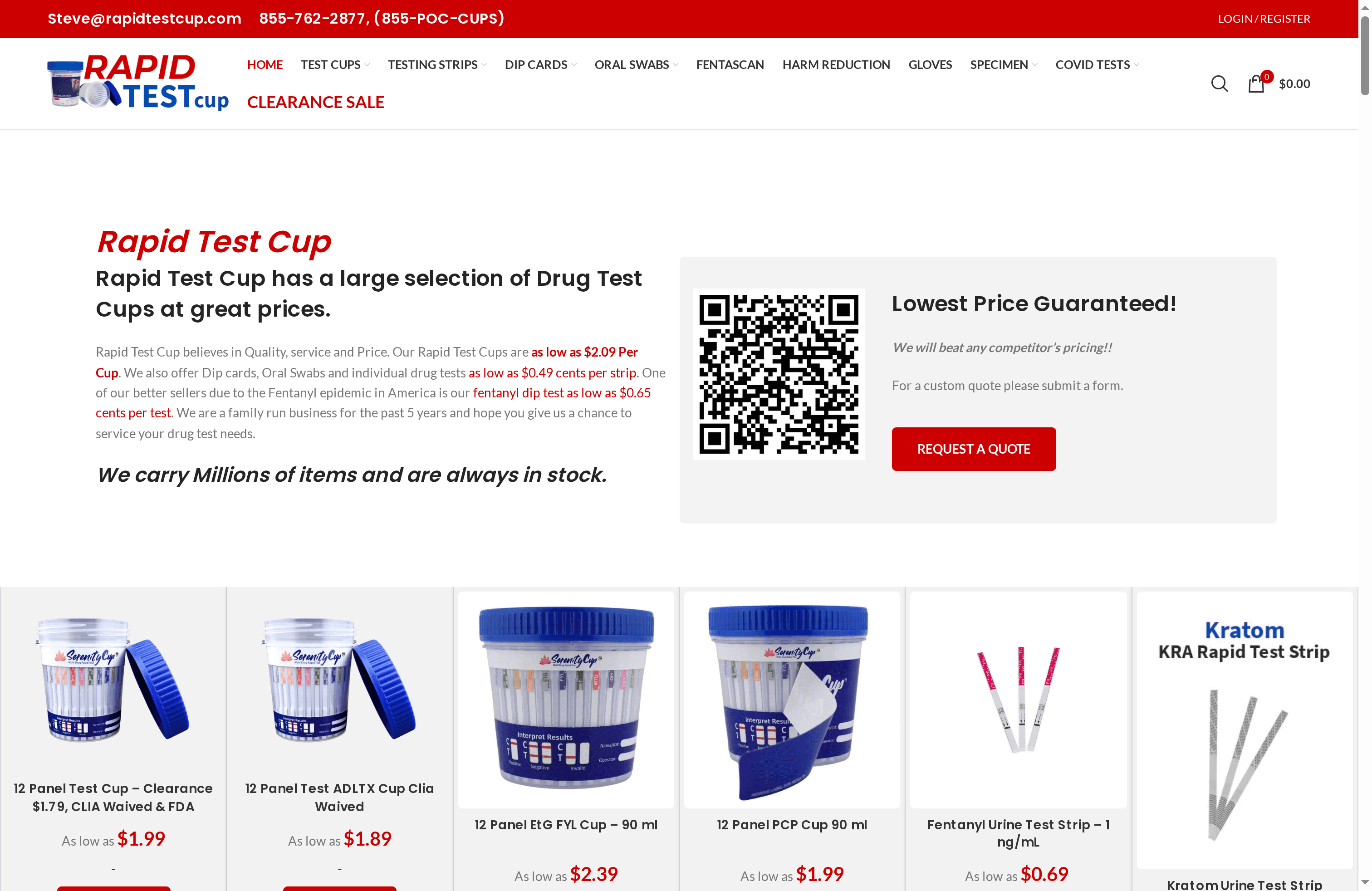
The 22-panel drug test from rapidtestcup.com covers both legacy substances and newer compounds including Zaza, a street name associated with tianeptine and other emerging opioid-adjacent substances, along with built-in adulterant checks. It’s a strong front-line tool for substance abuse programs and clinical settings that need broader coverage without waiting for lab confirmation. Pair that with the forensic drug testing checklist to make sure your collection and chain-of-custody procedures hold up under legal scrutiny. And if you’re evaluating which strip-based tools fit your workflow, the guide to urine test strip types breaks down your options clearly. Updating your protocols starts with knowing what’s available.
Frequently asked questions
Why don’t standard drug tests detect emerging substances?
Standard immunoassays are calibrated for specific known drugs and don’t recognize the structural variations found in newer synthetic substances, so NPS simply don’t trigger a positive result.
Which emerging substances are most important to test for in 2026?
Labs should prioritize Tier 1 NPS including bromazolam and metonitazene, as recommended by CFSRE and supported by NIST guidance, based on current national prevalence data.
How often should drug testing panels be updated?
At minimum, panels should be reviewed and updated every quarter. CFSRE guidance ties these updates to real-time NPS trend data, not fixed annual schedules.
Are there cost savings to testing for emerging substances?
Yes. Early identification of dangerous compounds prevents costly emergency and inpatient admissions, and drug checking programs have demonstrated measurable reductions in downstream healthcare spending.
What rapid methods can help detect emerging substances on site?
HRMS and rapid screening technologies like paper spray MS and multi-panel urine tests provide real-time NPS detection that standard immunoassays cannot match, making them valuable for both field and clinical settings.