Blog
Urine Creatinine Levels in Drug Tests: What the Numbers Mean


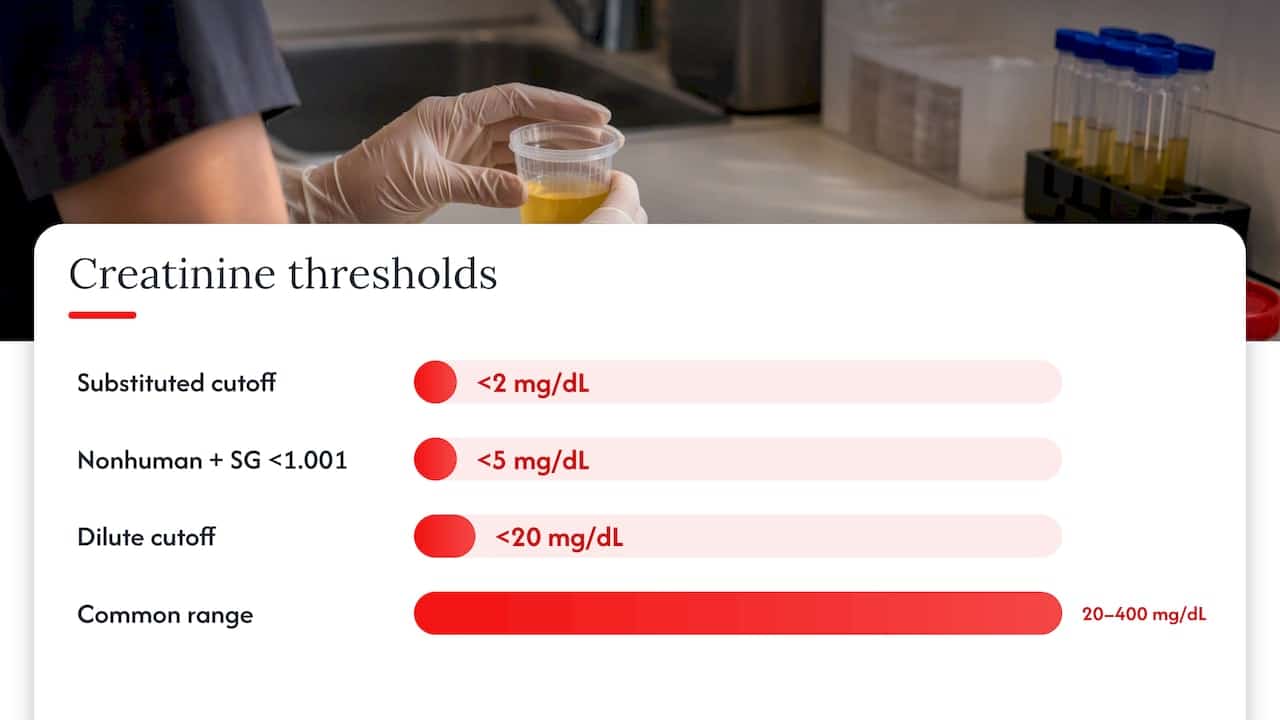
On a drug test, urine creatinine is a validity check. It does not look for drugs. It tells the lab whether the sample looks like normal, undiluted human urine. Under federal rules, a creatinine reading of 20 mg/dL or more is generally expected. A reading below 20 mg/dL points to dilute urine, and a reading below 2 mg/dL can mean the sample was not real urine at all.
This guide covers what creatinine measures, the cutoffs that matter, how creatinine and specific gravity work together, what a low result means, and what happens next. It is written for employers, clinic staff, treatment programs and anyone who has to read a validity result.
TL;DR
- Creatinine is released into urine at a fairly steady rate, so a very low level suggests the sample was watered down or replaced.
- Under U.S. DOT rules, a specimen is dilute at 2 mg/dL up to (but not including) 20 mg/dL creatinine, with specific gravity above 1.0010 and below 1.0030.
- A specimen is substituted when creatinine is below 2 mg/dL and specific gravity is at or below 1.0010 or at or above 1.0200, confirmed on two separate aliquots.
- Dilute is not the same as tampered. Heavy fluid intake, diuretics and some medical conditions can produce it, which is why labs read creatinine together with specific gravity and pH.
- A dilute positive still counts as a positive. A dilute negative may require a recollection, depending on the creatinine level.
Table of Contents
- What urine creatinine tells you about a drug test sample
- The cutoffs: dilute, substituted and normal
- Creatinine vs. specific gravity
- Why creatinine can be low without any cheating
- What happens when a sample is dilute
- How labs use creatinine to spot adulteration
- When urine integrity is in doubt, consider another specimen
- Our perspective
- Choosing a test cup with validity checks
- Practical steps for collectors and employers
- FAQ
- Sources
What urine creatinine tells you about a drug test sample
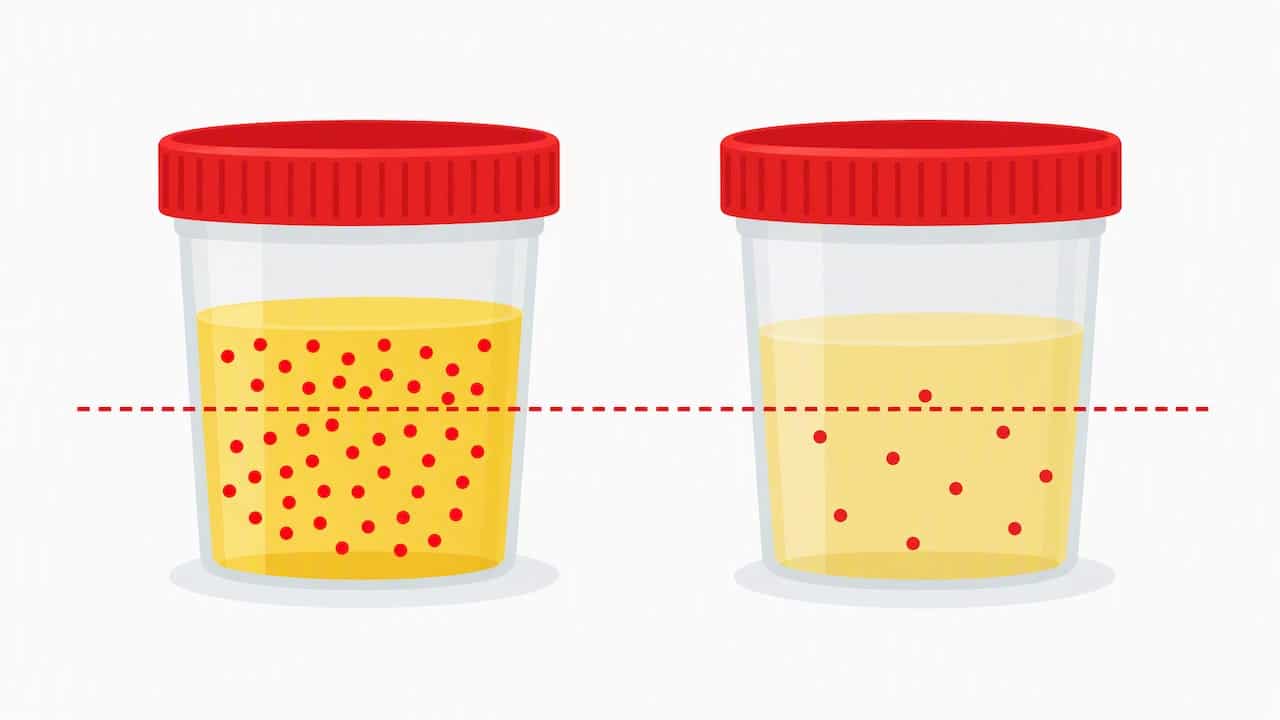
Creatinine is a waste product of muscle metabolism. The body excretes it in urine at a relatively constant rate. That steadiness is what makes it useful. Labcorp’s drugs of abuse reference guide explains that creatinine is tested because unusually large fluid intake can substantially lower creatinine along with the other urine constituents, including drugs and their metabolites.
In practice, creatinine works as a yardstick for concentration. If it is low, everything else in the sample is probably low too, and a drug that was present may fall below the screening cutoff. A negative result on a very dilute sample therefore tells you less than a negative on a normally concentrated one.
This is a different use from the medical creatinine test your doctor orders to assess kidney function. A clinical urine creatinine test is read against reference ranges for 24-hour collections. A drug-testing lab only cares whether the concentration in a single sample is physiologically plausible.
The cutoffs: dilute, substituted and normal
The clearest numbers come from federal regulation. 49 CFR 40.88 sets the criteria DOT-regulated laboratories use. The table below summarizes them.
| Result | Creatinine | Specific gravity | Testing needed |
|---|---|---|---|
| Dilute | 2 mg/dL or more, but under 20 mg/dL | Above 1.0010 and below 1.0030 | Single aliquot |
| Substituted | Under 2 mg/dL | At or below 1.0010, or at or above 1.0200 | Initial and confirmatory tests on two separate aliquots |
The federal criteria were redesignated on May 2, 2023, so check the current text of the regulation if you work under DOT rules.
Outside the DOT framework, clinicians often use a general reference range. A peer-reviewed practical guide to urine drug monitoring reports 20 to 400 mg/dL as a commonly used range for creatinine in a valid urine specimen. It stresses that creatinine and specific gravity are interpreted together. Separately, a Mayo Clinic Proceedings review notes that creatinine below 20 mg/dL indicates dilute urine. It adds that creatinine below 5 mg/dL with specific gravity below 1.001 is not consistent with human urine.
The cutoff your own program uses may differ. A workplace policy, a treatment program or a court order can set its own thresholds. Read the policy that applies to you before acting on a number.
Creatinine vs. specific gravity
People often ask which of the two is better. The honest answer is that neither is used alone for validity decisions.
- Creatinine reflects how much of a muscle-derived waste product is in the sample. It is the first screen.
- Specific gravity reflects the overall density of the urine, meaning the total dissolved solids. It is the cross-check.
They catch different problems. A sample with low creatinine and a low but not extreme specific gravity looks like someone drank a lot of water. Low creatinine with a specific gravity at or below 1.0010, or at or above 1.0200, looks like something other than urine, or urine with something added. Under 49 CFR 40.87, when creatinine is below 20 mg/dL the lab also determines specific gravity. The SAMHSA guidance for federal programs says the same: HHS-certified laboratories test creatinine and pH on every federal agency urine specimen, and run specific gravity when creatinine is under 20.0 mg/dL.
Labcorp’s specimen validity FAQ describes the same flow: creatinine under 20 mg/dL reflexes to specific gravity, and the two results together identify dilute, substituted or invalid specimens.
The two measures are also used outside drug testing to correct for urine concentration. One academic comparison found creatinine and specific gravity to be valid and interchangeable correction standards for urinary cotinine in a community study of smokers. That finding concerns research adjustment, not validity rules, but it shows why the two track each other so closely.
If you collect specimens and want to understand the density side in more detail, our page on what SAMHSA requires for urine specific gravity testing goes through it for buyers.
Why creatinine can be low without any cheating
A low reading is not proof of tampering. The practical guide cited above lists several reasons a urine specimen can be dilute: drinking excessive fluid, water added after collection, renal tubular dysfunction and diuretic use. The Mayo review adds that unusual urine parameters can come from hydration, medications, foods or disease states.
So the same number can have very different explanations:
- Heavy hydration before the test. The most common and most benign cause. People told to “drink plenty of water” before a screen sometimes overdo it.
- Medication. Diuretics increase urine volume and lower concentration.
- Medical conditions. Some kidney conditions affect how well urine is concentrated.
- Water added to the sample. This is the case collection procedures are designed to prevent.
- Substitution. A sample that is not urine, which shows up as creatinine and specific gravity both far outside the physiological range.
A collector cannot tell these apart by looking at the cup. The lab results, and in regulated programs the medical review officer, do that work.
What happens when a sample is dilute
What follows depends on the program and the result. For DOT-regulated testing, 49 CFR 40.197 sets the path:
- A dilute positive is treated as a verified positive. Dilution does not cancel a positive result.
- A dilute negative with creatinine of at least 2 mg/dL but no more than 5 mg/dL: if the MRO directs it, the employer must immediately arrange a recollection under direct observation.
- A dilute negative with creatinine above 5 mg/dL: the employer may direct another test immediately.
For employers who want a plain-language walkthrough of the retest rules, see our guide to the DOT rule on dilute urine drug tests.
Non-DOT employers and programs set their own policies. Many copy the federal approach, but they are not required to. A written policy that says in advance what a dilute result triggers protects both the employer and the donor.
How labs use creatinine to spot adulteration
Creatinine is one piece of a larger set of validity checks. The SAMHSA MRO guidance manual describes labs using creatinine, pH and specific gravity, along with screening for oxidants like nitrites and other substances. If any validity parameter falls outside the expected physiological range, or the specimen looks abnormal, the lab runs confirmatory tests on a second aliquot.
Nuclear power licensees follow a similar sequence. Under 10 CFR 26.131, testing facilities check each urine specimen for creatinine, pH and one or more oxidizing adulterants. Specimens with creatinine below 20 mg/dL go to an HHS-certified laboratory for further testing.
What gets added to urine matters too. The practical guide lists household adulterants such as vinegar, detergent, sodium chloride, hydrogen peroxide, eye or nose drops, soda and ammonia. Commercial products may contain peroxide or peroxidase, sodium or potassium nitrate, pyridinium chlorochromate or glutaraldehyde. Some of these barely change creatinine, which is why labs also check pH and oxidants. For a deeper look, see our explainers on what urine adulteration is and how it is detected and detecting adulterants step by step.
When urine integrity is in doubt, consider another specimen
If tampering is suspected, the practical guide notes that collecting a blood sample is one approach, and hair follicle testing is another. Each has different detection windows and different practical limits. If you are dealing with a legal matter, it helps to understand how breath, blood and urine testing differ before deciding how to respond to a questioned sample. Oral fluid is a collection option that is easier to observe, and it needs no creatinine check.
Our perspective
Most questions we get about creatinine come from two sides: the collector who has a pale sample and does not know what to do, and the donor who drank a lot of water and now has a “dilute” on the report. Both are usually avoidable.
We sell drug test cups, dip cards, strips and oral swabs to labs, clinics, treatment programs, employers and individuals, and the lesson is consistent. A rapid screen tells you whether drugs are above a cutoff. It does not tell you the sample is genuine unless the device also checks validity. That is why many of the multi-panel cups we carry include adulterant checks, and why we point buyers to them when specimens are collected without direct supervision.
Our advice, from handling a lot of specimen questions:
- Write your dilute-result policy before you need it. Decide in advance whether you retest, when, and under what observation.
- Record the collection conditions: time, temperature check, who was present. A pale sample with good documentation is easy to resolve. One with none is not.
- Do not treat low creatinine as an accusation. Many dilute samples are simply over-hydrated donors.
- Use validity checks as a flag for follow-up, and send anything regulated to a certified lab.
We are a family business, and we would rather you buy the right device once than the wrong one twice.
— Justin
Choosing a test cup with validity checks
If you screen on site and want some assurance about the sample as well as the drugs, look for cups with adulterant strips built in. Two examples from our catalog are the 15 panel cup with adulterant checks and the 18 panel cup with adulterants. You can also browse the full range of test cups, dip cards, strips and oral swabs, and ask for a custom quote on larger orders. Bulk pricing is available.
For how to run the collection itself so adulteration is harder, our checklist for test administrators covers the steps.
Practical steps for collectors and employers
The numbers matter less than what you do at the moment of collection. A short routine reduces dilute and invalid results.
- Check the specimen on the spot. Note color, temperature and any odd smell or foam. Follow your protocol for temperature windows.
- Limit access to water and soap in the collection area. Unsupervised access is the easiest route to adding water to a sample.
- Record everything. Time of collection, any fluids the donor reports drinking, and any medication they mention.
- Send questionable specimens for laboratory validity testing. A point-of-care adulterant strip is a flag, not a verdict.
- Apply your written policy consistently. Treat every donor the same way.
For donors, the advice is simple. Drink normally in the hours before a test, not in large amounts. Tell the collector about any diuretic or medical condition affecting urine concentration. If you get a dilute result, ask what your program’s policy says about retesting.
FAQ
What is a normal urine creatinine level on a drug test?
For validity, a creatinine of 20 mg/dL or higher is generally treated as not dilute. A commonly cited general reference range for a valid specimen is 20 to 400 mg/dL, according to a peer-reviewed practical guide. Your program’s cutoffs may differ.
What does low creatinine mean on a drug test?
Low creatinine means the urine is dilute or, at very low levels, possibly not urine. Under DOT rules, 2 to under 20 mg/dL with the right specific gravity is dilute, and under 2 mg/dL with extreme specific gravity is substituted. Hydration, diuretics and some medical conditions can also cause low values.
Is a creatinine adulteration test the same as a dilution test?
Not quite. Creatinine is a dilution and substitution marker. Adulteration, meaning something was added to the sample, is checked with pH, oxidant and other adulterant tests, often alongside creatinine.
Can a dilute sample still produce a positive result?
Yes. Under DOT rules, a dilute specimen with a positive drug result is treated as a verified positive. Dilution only makes a negative less reliable.
What creatinine level requires a recollection?
Under DOT rules, a dilute negative with creatinine of at least 2 mg/dL but no more than 5 mg/dL requires an immediate observed recollection if the MRO directs it. Above 5 mg/dL, the employer may direct another test.
Sources
- eCFR, 49 CFR 40.88: criteria laboratories use
- eCFR, 49 CFR 40.197: what happens when an employer receives a dilute result
- 49 CFR 40.87: validity tests laboratories must conduct
- eCFR, 10 CFR 26.131: cutoff levels for validity testing
- SAMHSA Medical Review Officer Guidance Manual
- A Practical Guide to Urine Drug Monitoring (PMC)
- Clinical Interpretation of Urine Drug Tests (Mayo Clinic Proceedings)
- Creatinine vs. specific gravity to correct urinary cotinine (PMC)
- Labcorp Drugs of Abuse Reference Guide
- Labcorp specimen validity testing FAQ