Blog
DOT Urine Collection Kit Requirements: What a Compliant Kit Needs


A DOT urine collection kit has to hold a single-use collection container, two capped specimen bottles for a split specimen, tamper-evident seals, absorbent material and a leak-resistant shipping bag, and the collection must be documented on the Federal Custody and Control Form (CCF). The rules sit in 49 CFR Part 40 and in DOT’s urine collection guidelines. This guide walks through each component, what the site must provide on top of the kit, and how to check your supplies before a collection day.
TL;DR
- The kit’s contents are set out in 49 CFR Part 40 Appendix A: a collection container, two bottles, separate packaging for the bottles, a two-pouch leak-resistant bag, absorbent material and shipping protection.
- Every DOT collection is a split-specimen collection: at least 30 mL in the primary bottle and at least 15 mL in the split bottle.
- The CCF, a clean writing surface, a compliant restroom setup and storage and shipping capability belong to the collection site, not necessarily to the physical kit.
- DOT’s current urine collection guidelines carry an effective date of June 30, 2026, so check your kit supplier’s specifications against them.
Table of Contents
- Where the requirements come from
- What a DOT urine collection kit must contain
- What the site provides separately from the kit
- A pre-collection checklist
- DOT kits versus other drug testing supplies
- Our perspective
- Stocking your collection supplies
- FAQ
- Sources
Where the requirements come from
Three layers of rules apply. The first is 49 CFR Part 40, the Department of Transportation’s regulation for workplace drug testing. Appendix A of Part 40 lists what a collection kit contains. The second is the set of DOT Operating Administration rules (FMCSA, FAA, FRA, FTA, PHMSA and the Coast Guard), which decide who is tested and when. The third is DOT’s own Urine Specimen Collection Guidelines, which state an effective date of June 30, 2026 and are meant to be read alongside Part 40 and the applicable Operating Administration rules.
In practice, you build a kit to the Part 40 appendix, you run the collection to the Part 40 procedures, and you use the guidelines as your day-to-day reference. If a collector, a clinic or an employer’s third-party administrator asks “is this kit DOT-ready,” the Appendix A list is the checklist.
What a DOT urine collection kit must contain
According to Appendix A, a kit includes these items:
| Component | What the rule requires |
|---|---|
| Collection container | Single-use plastic container, sealed or tamper-evident |
| Specimen bottles | Two capped bottles with 30 mL and 15 mL markings |
| Bottle packaging | Packaging that keeps the bottles separate from the collection container |
| Shipping bag | Two-pouch leak-resistant bag |
| Absorbent material | Material to absorb a leak in transit |
| Shipping protection | Suitable protection for the package |
| Seals | CCF seals that fit the bottles without damage when initialed, or that conceal printed information |
The sections below cover the pieces that most often cause questions.
The collection container
The container must be a single-use plastic container that can easily catch and hold at least 55 mL, with graduated markings that clearly show 45 mL and above, as stated in Appendix A. It must arrive sealed or tamper-evident, so the donor and collector can both see that it has not been opened or used.
Two practical points follow from that wording. First, the 55 mL capacity is a minimum, so larger cups work as long as the markings are readable at the volume that matters. Second, a container with no clear graduations above 45 mL leaves the collector guessing whether the donor has given enough to fill both bottles.
If you are stocking collection containers, our urine specimen cups and the specimen cup with a temperature strip are the products to compare against this list. Note that the temperature strip on that cup is included and must be applied to the cup manually.
Two bottles for a split specimen
The kit holds two capped bottles with 30 mL and 15 mL markings. That reflects how 49 CFR 40.71 works: DOT collections are split-specimen collections. At least 30 mL of urine goes into the primary bottle and at least 15 mL into the split bottle. The split bottle exists so the employee can later request a test of the second portion at a different laboratory if the first result is verified positive or adulterated.
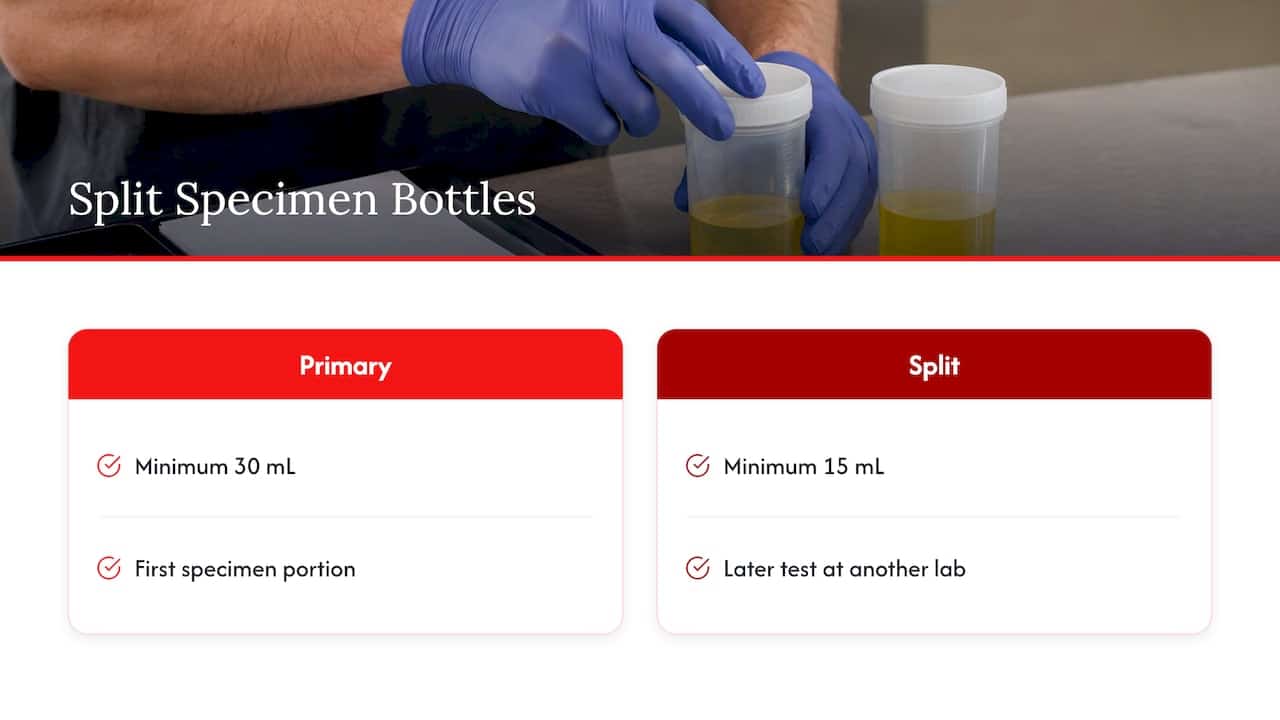
Because both bottles have to be filled from one void, the kit’s packaging matters too. Appendix A calls for packaging that keeps the bottles separate from the collection container, so a sealed bottle set is not exposed to the container before the collection starts.
Seals and labels
Seals do more work than they appear to. Under 40.71, the collector, not the employee, secures the bottle caps, places the tamper-evident seals over the caps and down the sides of the bottles, dates the seals and gets the employee’s initials. If the employee refuses to initial, the collector notes it in the CCF remarks and completes the collection.
SAMHSA’s guidance for using the 2020 CCF adds a useful quality test for the physical labels. A tamper-evident label or seal should:
- Show visible evidence if it is removed and replaced.
- Resist smearing or smudging that could make the specimen ID illegible.
- Not tear when the donor initials it or the collector dates it.
The Appendix A wording on the seals points the same way: they must fit the bottles without damage when initialed, or conceal printed information. A seal that tears under a ballpoint pen is a seal that can cost you a collection.
Bags, absorbent material and shipping protection
The kit includes a two-pouch leak-resistant bag, absorbent material and suitable shipping protection. The usual setup is one pouch for the sealed bottles and one for the paperwork, with absorbent material placed so a leak is contained. Check that the pouches close securely and that your shipping box suits the courier you use.
What the site provides separately from the kit
A kit is not the whole collection. The Subpart D rules on collection sites require the site to have:
- the Federal CCF,
- suitable personnel and supervision,
- a clean writing surface,
- temporary storage and shipping capability,
- a compliant urination facility.
Site supplies and controls include a blue toilet, secured water sources and tamper-evident seals. Not all of these are in the physical kit, so a purchasing list should cover both the kit and the site.
The Federal CCF
The Federal Drug Testing Custody and Control Form documents every DOT urine collection. Part 40 identifies it as a five-part carbonless manifold form. Each copy goes to a different party, and the bottle seals carry the same specimen ID as the form. A non-DOT form does not replace it on a DOT test. For a closer look at the form itself, see our guide to the chain of custody form.
The restroom setup
The urination facility is part of the site, not the kit. The blue toilet water and the control of water sources are there to reduce the chance of dilution or tampering. If a donor cannot provide a specimen, a separate procedure applies, covered in our page on the shy bladder procedure.
A pre-collection checklist
Use this list before the first donor arrives:
- Container: sealed or tamper-evident, single-use, holds at least 55 mL, readable graduations from 45 mL up.
- Bottles: two capped bottles marked at 30 mL and 15 mL, packaged apart from the collection container.
- Seals: fit the bottles, show evidence of removal, resist smudging and survive initialing.
- Bags: two-pouch leak-resistant bag and absorbent material, plus shipping protection.
- Form: a current Federal CCF with all five parts.
- Site: a clean writing surface, a compliant restroom with a blue toilet and secured water sources, storage and a shipping plan.
- Staff: a collector who has met Part 40 qualification requirements.
For the step-by-step flow of the collection itself, our step by step drug test collection guide and the drug specimen collection guide for professionals follow the sequence from donor check-in to shipment.
DOT kits versus other drug testing supplies
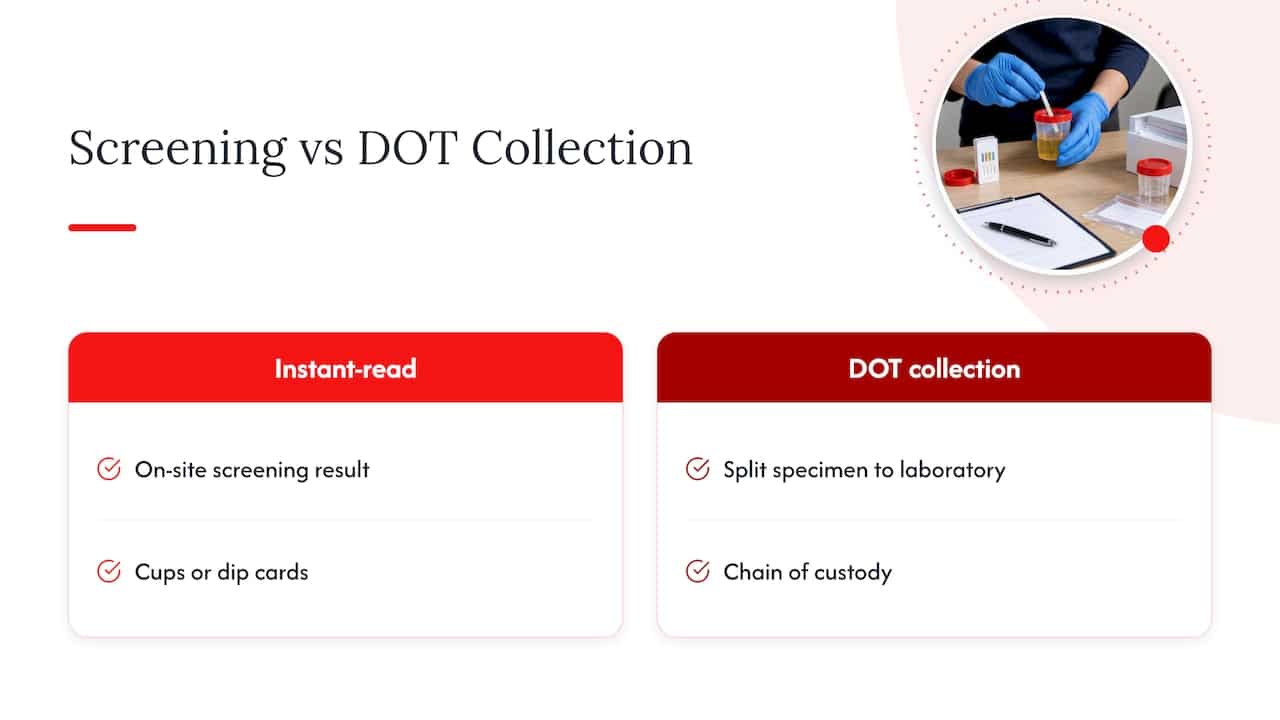
Not every drug testing product is a DOT collection kit. Many workplace and personal programs use instant-read cups or dip cards, which give an on-site screening result. A DOT collection, by contrast, is built to send a split specimen to a laboratory under chain of custody. Both have a place, but they are different tools, and the purchasing decision depends on which program you run. Our comparison of cups versus dip cards explains the screening side, and the piece on how collection methods shape drug test validity explains why the collection step matters so much.
The same logic applies to product status. The FDA and CLIA labels that matter for screening devices are a separate question from the DOT collection requirements, and a product sold for research use only follows different rules than a cleared device; this overview of FDA approval and RUO materials shows how that distinction works for lab products.
Our perspective
Most of the collection problems we hear about are not exotic. They are a seal that smeared, a bottle set with no clear markings, a missing pouch, or a site that treated the kit as the whole requirement and forgot the form, the writing surface or the shipping plan.
We run Rapidtestcup as a family business, and our approach is to make supplies easy to stock in volume. That means a large inventory kept in stock, same-day shipping and bulk discounts, so a clinic or employer can keep enough specimen cups and collection supplies on the shelf that nobody improvises on collection day.
Our advice is simple: write down the Appendix A list, stock a full set for every scheduled donor plus spares, and keep your collection supplies in one place. Then use the rest of your attention on the part only a person can do well, which is following the procedure carefully.
Justin
Stocking your collection supplies
If you collect specimens regularly, buying in bulk saves you reordering mid-week. At Rapidtestcup we carry specimen cups, temperature-strip cups, vacuum cups and a full range of screening cups, dip cards and strips, with bulk pricing and custom quotes available. Start with the urine specimen cups page, or browse the whole shop for everything else your program needs.
If your program also screens on site, our 10 panel dip card and multi-panel cups sit in the same shop, so one order covers both.
FAQ
Does a DOT urine collection require a split specimen?
Yes. Under 49 CFR 40.71, DOT collections are split-specimen collections. At least 30 mL goes into the primary bottle and at least 15 mL into the split bottle, so a kit needs two bottles marked at those volumes.
Is the CCF part of the collection kit?
The CCF is required for every DOT urine collection, and Part 40 describes it as a five-part carbonless manifold form. The collection site must have it available, so plan to stock it alongside the kit even if your supplier does not bundle it.
How much urine must the collection container hold?
The container must catch and hold at least 55 mL, with graduated markings that clearly show 45 mL and above, according to Appendix A. It must also be a single-use plastic container.
Who applies the seals to the bottles?
The collector does. Under 40.71, the collector secures the caps, applies the tamper-evident seals over the caps and down the bottle sides, dates them and gets the employee’s initials. If the employee refuses to initial, the collector records it in the remarks and completes the collection.
Which document should I check for current collection guidance?
Start with DOT’s Urine Specimen Collection Guidelines, which state an effective date of June 30, 2026. Read them together with Part 40 and the rules of your DOT Operating Administration.
Sources
- DOT Rule 49 CFR Part 40 Appendix A
- DOT Rule 49 CFR Part 40 Section 40.71
- DOT Urine Specimen Collection Guidelines
- eCFR: 49 CFR Part 40 Subpart D, Collection Sites
- Subpart D: Collection Sites, Forms, Equipment and Supplies (govinfo)
- SAMHSA guidance for using the 2020 CCF