
Blog
Benefits of Bulk Testing Supplies for Lab Managers


TL;DR:
- Bulk purchasing high-volume testing supplies can reduce per-unit costs by up to 25% and improve operational efficiency. Proper inventory management, quality control, and strategic sourcing from secondary distributors are essential for maximizing savings and ensuring compliance. Labs that analyze consumption data and plan bulk orders carefully benefit from consistent product quality, lower administrative burden, and enhanced supply chain reliability.
Procurement decisions in clinical and forensic testing environments carry real financial weight. When your lab runs hundreds of drug screens per week, the cost and logistics of keeping testing supplies stocked can quietly erode your budget and your team’s time. The benefits of bulk testing supplies go well beyond simple savings: they reshape how you manage inventory, maintain compliance, and keep operations running without interruption. This listicle breaks down the most practical advantages, with the specifics your purchasing decisions actually require.
Table of Contents
- Key takeaways
- 1. Measurable cost savings on high-volume test supplies
- 2. Inventory management and operational efficiency
- 3. Product quality and test consistency
- 4. Comparison of bulk vs. regular ordering strategies
- 5. Access to secondary distributor discounts
- 6. Best practices for maximizing bulk purchase value
- My perspective on bulk testing supply strategy
- Rapidtestcup: your bulk testing supply source
- FAQ
Key takeaways
| Point | Details |
|---|---|
| Significant per-unit savings | Targeting high-volume supplies in bulk can reduce costs by 15 to 25% compared to standard ordering. |
| Operational efficiency gains | Fewer orders mean less administrative burden, fewer stockouts, and more predictable supply availability. |
| Consistent product quality | Ordering from the same product lot reduces testing variability and supports accreditation compliance. |
| Storage and waste risk is real | Bulk buying requires expiration date tracking and consumption forecasting to avoid tying up capital in expired stock. |
| Secondary distributors unlock deeper discounts | Specialty bulk distributors often offer 20 to 25% discounts versus the 3 to 8% typical from large wholesalers. |
1. Measurable cost savings on high-volume test supplies
The most direct benefit of bulk testing supplies is the reduction in per-unit cost. For labs running consistent, high-volume testing programs, like workplace drug screening or substance abuse treatment monitoring, the math is straightforward. Buy more per order, pay less per unit.
Research shows that 15 to 25% savings are achievable when organizations focus bulk purchasing on three to five high-use product types rather than attempting to bulk-order their entire supply catalog. For testing supplies specifically, that means prioritizing your most-used formats: multi-panel test cups, urine dip strips, and specimen collection kits.
There is also a less-discussed tactic worth knowing. Short-dated stock with 6 to 12 months before expiration can be purchased at 20 to 30% discounts. If your lab’s consumption rate is high enough to use that inventory before the expiration date, the savings are real without any compromise in test reliability.
Pro Tip: Before committing to short-dated stock, calculate your lab’s average monthly consumption for that specific product. Divide remaining shelf life in months by your monthly usage. If the result is greater than one, you will use it up in time.
One risk worth managing: bulk orders require significantly more upfront capital. Buying in bulk often requires 15 to 25% more working capital than routine ordering, so cash flow planning is not optional. Build your purchasing calendar around billing cycles and revenue inflows to keep liquidity stable.
2. Inventory management and operational efficiency
Every order your purchasing department places comes with overhead: requisitions, approvals, vendor communications, receiving logs, and invoice reconciliation. When you order in smaller batches more frequently, that overhead multiplies. One of the clearest bulk testing advantages is the compression of that administrative cycle.
Here is how bulk ordering reshapes day-to-day inventory operations:
- Reduced order frequency means fewer purchase orders, fewer vendor touchpoints, and less staff time spent on reordering tasks each month.
- Fewer stockout events protect against test delays caused by supply gaps, which matters especially in clinical settings where testing cannot wait.
- Consolidated invoicing simplifies accounting and gives your finance team cleaner data for budget forecasting.
- Improved supply chain reliability is built into the model. When you hold more inventory on hand, a single vendor delay does not shut down your testing program.
- Easier compliance tracking becomes possible when you receive supplies in larger, consistent lots. One lot number covers more tests, which simplifies chain-of-custody documentation and internal audits.
Research on testing programs in resource-limited settings confirms that pooling and bulk strategies expand testing access sustainably without sacrificing diagnostic accuracy, a principle that applies directly to labs managing tight capacity.
Pro Tip: Set a reorder point in your inventory management system at roughly 30% of your bulk order quantity. This gives you a buffer to place the next order and receive it before you hit zero, without keeping excess stock for months.
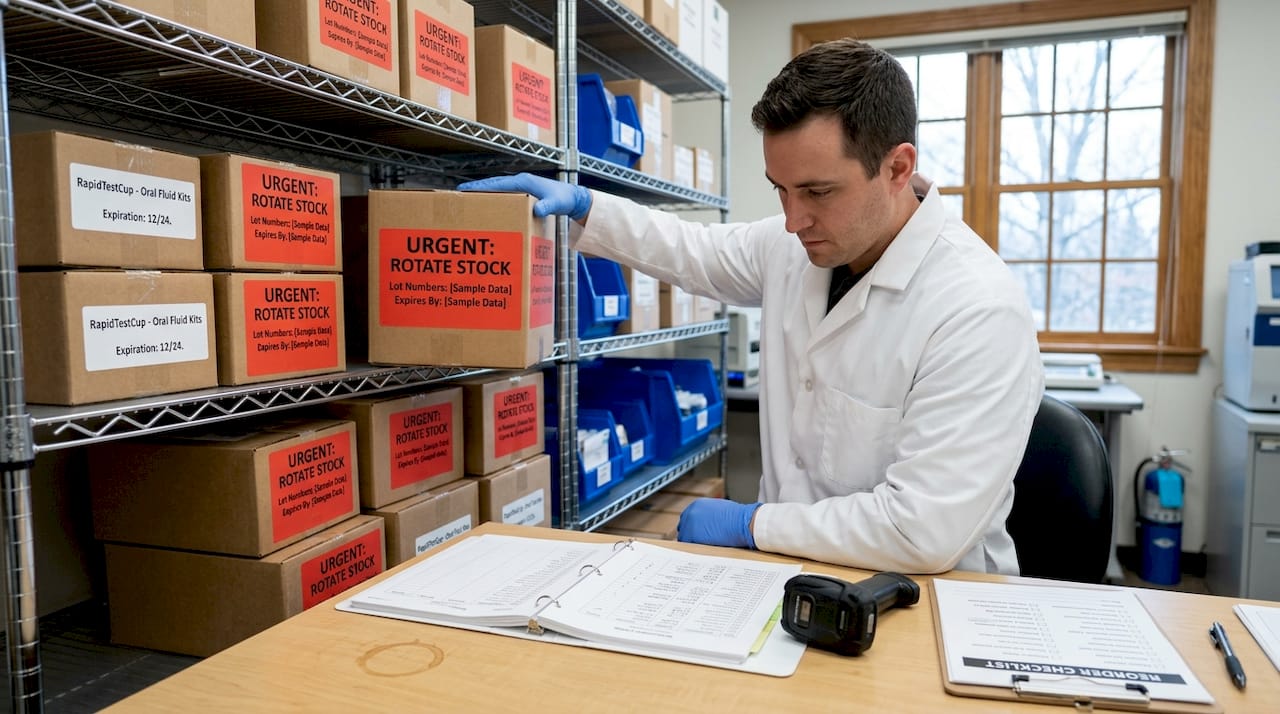
Expiration date management is the part most labs underestimate. Clinics dedicating 5 to 10 hours per month to active inventory tracking achieve 95 to 98% utilization of their bulk stock. That is not a dramatic time investment, and the reduction in waste pays for itself quickly.
3. Product quality and test consistency
When your lab orders drug test cups or urine strips in large quantities from a single lot, every test in that batch shares the same manufacturing parameters. Reagent concentrations, sensitivity thresholds, and cutoff levels are uniform across the entire order. That consistency is not incidental. It is a quality assurance advantage that smaller, fragmented orders cannot reliably deliver.
Key quality benefits of the bulk testing materials benefits approach include:
- Lot-to-lot consistency: Running the same product lot for an extended period eliminates variability introduced when new lots arrive with slightly different sensitivity profiles.
- Reduced false positive and false negative risk from reagent variability across mixed lots.
- Simpler quality control documentation for accreditation audits. CLIA-waived labs benefit from clean lot records that span a longer testing period.
- Trusted supplier reliability: Establishing a recurring bulk relationship with a vetted supplier means you are not repeatedly vetting new sources for compliance documentation.
Standardizing on proven product formats, like multi-panel drug test cups with built-in adulteration detection, makes this consistency even more defensible when results are reviewed for forensic or legal purposes.
4. Comparison of bulk vs. regular ordering strategies
Not every product in your supply chain belongs in a bulk order. The decision is strategic, and a clear-eyed comparison helps.
| Factor | Bulk ordering | Regular ordering |
|---|---|---|
| Cost per unit | 15 to 30% lower with volume discounts | Standard retail or catalog pricing |
| Upfront capital required | Higher, 15 to 25% more working capital needed | Lower per order cycle |
| Order frequency | Low, quarterly or semi-annual | High, monthly or as needed |
| Stockout risk | Very low with proper planning | Higher during supply disruptions |
| Expiration waste risk | Higher if consumption rates are miscalculated | Lower due to smaller quantities |
| Administrative burden | Lower over time | Higher ongoing |
| Best suited for | High-volume, consistent-use supplies | Low-use, specialty, or rapidly changing products |
Bulk buying is not effective for low-use or specialty test types, and discounts can disappear entirely during supply shortages. The FDA tracked 298 active generic drug shortages in 2023, a reminder that bulk strategies need backup sourcing plans. Supply diversification across primary wholesalers and secondary distributors is the most practical way to maintain continuity when the primary source tightens.
5. Access to secondary distributor discounts
Most lab managers are familiar with their primary wholesaler. Far fewer use secondary distributors strategically, which is where some of the most significant savings in bulk purchasing are hiding.
Secondary distributors specialize in bulk, short-dated, and overstocked inventory, and they offer discounts of 20 to 25% compared to the 3 to 8% typical from large wholesalers. For testing supplies with a relatively stable formulation and a reasonable shelf life, this is a straightforward way to reduce cost without sacrificing quality. The tradeoff is the need for tighter expiration management, but for labs with robust inventory tracking, that is a manageable process.
It is also worth understanding how rebate structures affect realized savings. Only 50 to 70% of rebate money from manufacturers actually reaches the end buyer. The rest is retained by intermediaries. Buying directly from secondary distributors or negotiating direct volume pricing with suppliers bypasses some of that value leakage.
6. Best practices for maximizing bulk purchase value
Getting the most from a bulk purchasing strategy requires more than placing a large order. Labs that do it well treat bulk buying as a managed program, not a one-time decision. Key practices that separate effective bulk buyers from those who end up with expired stock and storage headaches:
- Start with consumption data. Pull 12 months of usage records for each supply type before setting order quantities. Bulk buying requires careful assessment of consumption rates to avoid tying up capital in unused stock.
- Pilot before scaling. Order a mid-size bulk quantity to confirm your usage rate before committing to a full-volume purchase.
- Track expiration dates actively. Use inventory software or even a shared spreadsheet with expiration alerts. First-in, first-out rotation is mandatory.
- Negotiate beyond price. Ask vendors for extended payment terms, free shipping thresholds, or guaranteed lot consistency. These terms matter as much as the unit price.
- Segment your bulk candidates. Only bulk-order supplies used consistently and in large quantities. Reserve standard ordering for low-volume or specialized test formats. Review the bulk drug test ordering guide for a practical framework on assessing usage rates.
- Balance storage capacity realistically. A discount is not a savings if it requires you to rent additional storage space. Calculate your true cost-per-test including storage overhead.
My perspective on bulk testing supply strategy
I have seen labs approach bulk purchasing the same way they approach any cost-cutting measure: reactively and with too much focus on the initial price tag. The mistake is treating bulk buying as a procurement tactic rather than an operational strategy.
What I have learned working with clinical and forensic testing environments is that the labs benefiting most from bulk purchasing are the ones who know their consumption numbers cold. They do not guess. They pull data, model three-month and six-month forward projections, and build their bulk orders around those numbers. The financial upside is real, but it only materializes with that discipline behind it.
I am also watching secondary distributors become a more significant part of the conversation in 2026. As primary wholesaler pricing continues to compress margins, labs that develop relationships with reputable secondary sources are finding meaningful cost differences without quality trade-offs. That is a trend worth following closely.
One more thing: do not let the bulk buying conversation stop at price. The consistency benefits for accreditation, chain-of-custody documentation, and QC recordkeeping are undervalued by most managers. When your external auditor asks about lot traceability, having three months of tests from a single bulk lot is a much cleaner answer than explaining six different partial orders from four vendors.
— Justin
Rapidtestcup: your bulk testing supply source
Rapidtestcup offers lab managers and healthcare procurement teams a direct path to the bulk testing supplies and pricing structures this article describes. Whether you need a high-volume option like the 12-panel ADLTX Cup, a reliable strip format like the MET drug test strip, or a broad-panel forensic kit, Rapidtestcup carries FDA-approved, CLIA-waived products with bulk pricing built in. Orders are fulfilled quickly, documentation is clean, and the product catalog covers everything from standard urine screens to adulteration detection. For labs that want to put the strategies in this article to work right away, Rapidtestcup is a practical starting point.
FAQ
How much can bulk testing supplies reduce per-unit costs?
Labs targeting high-volume, consistent-use supplies in bulk typically achieve 15 to 25% savings per unit compared to standard ordering, with secondary distributor pricing pushing savings as high as 30% on short-dated stock.
What supplies are best suited for bulk purchasing?
High-volume, consistently used items like multi-panel drug test cups, urine dip strips, and specimen collection kits are the strongest candidates. Specialty or low-use test formats are better ordered in standard quantities to avoid expiration waste.
How do labs avoid expiration waste when buying in bulk?
Labs that dedicate 5 to 10 hours per month to active inventory tracking and use first-in, first-out rotation consistently achieve 95 to 98% utilization of their bulk stock, keeping waste minimal.
Is bulk ordering suitable for all testing environments?
No. Bulk purchasing delivers the most value in high-volume settings like clinical labs, workplace screening programs, and substance abuse treatment centers. Low-volume or specialty testing programs often see fewer advantages and greater expiration risk.
What is the biggest financial risk of bulk testing supply orders?
The primary risk is the upfront capital requirement. Bulk orders can require 15 to 25% more working capital than routine purchasing, so labs need to align bulk order timing with their cash flow and billing cycles.