Blog
Drug Test Selection Checklist for Compliance Pros

TL;DR:
- Choosing the wrong drug test can lead to legal liability, invalid results, and failed audits. A structured checklist helps evaluate specimen types, detection windows, and compliance factors upfront, ensuring a robust program. Selecting the appropriate test method aligns with regulatory requirements, specimen logistics, and detection needs for effective workplace drug screening.
Choosing the wrong drug test doesn’t just cost money. It can expose your organization to legal liability, invalidate results, or fail a regulatory audit entirely. A structured drug test selection checklist cuts through that risk by giving you a consistent framework for evaluating specimen types, detection windows, regulatory requirements, and cost factors before you ever order a single kit. Whether you’re building an employee drug testing checklist from scratch or refining a policy that hasn’t been updated in years, the criteria you use to select tests will directly determine whether your program holds up under scrutiny.
Table of Contents
- Key takeaways
- 1. Your drug test selection checklist starts with purpose
- 2. Regulatory requirements and certifications
- 3. Specimen type selection
- 4. Detection windows and what they actually tell you
- 5. Comparison of testing methods
- 6. Cost and turnaround time considerations
- 7. Legal protections and the split specimen process
- 8. The role of the Medical Review Officer
- 9. Documentation and chain of custody
- 10. When to expand or upgrade your testing panel
- My honest take on drug test selection
- Find the right test kits for your program at Rapidtestcup
- FAQ
Key takeaways
| Point | Details |
|---|---|
| Match test to purpose | Pre-employment, random, and post-accident testing each have different regulatory and specimen requirements. |
| Urine is the default standard | The 5-panel urine test is federally required for DOT safety-sensitive roles and remains the most widely accepted format. |
| Detection windows are estimates | Individual factors like metabolism and BMI affect how long drugs remain detectable, so no window figure is absolute. |
| Certified labs and MROs matter | Medical Review Officers prevent false positives by verifying results against medical history before employment action is taken. |
| Know your split specimen rights | Donors have a federally protected 72-hour window to request a Bottle B retest after MRO notification of a positive result. |
1. Your drug test selection checklist starts with purpose
Before you compare panels or prices, you need to define why you are testing. The testing purpose shapes every downstream decision, from specimen type to which regulatory framework applies to you.
Pre-employment testing typically allows more flexibility in panel selection, while random testing programs governed by the Department of Transportation must follow tightly defined rules. Post-accident testing often requires faster turnaround than pre-employment, which shifts the conversation toward rapid on-site tests rather than lab-confirmed results alone. Reasonable suspicion testing benefits from documented behavioral evidence, and a well-structured reasonable suspicion checklist that captures objective signs like slurred speech or erratic behavior is your legal protection if the result is ever challenged.
Pro Tip: Document the testing purpose on every collection chain-of-custody form. If results are ever disputed, that documentation proves the test was administered for a legitimate, policy-defined reason.
2. Regulatory requirements and certifications
Regulated industries do not get to choose their drug test criteria freely. If your employees fall under DOT jurisdiction, the 5-panel urine test under 49 CFR Part 40 is the mandatory standard, covering THC, cocaine, opioids, amphetamines, and PCP. No substitutions.
Non-DOT employers have more latitude, but they still need to confirm their chosen test is CLIA waived or FDA cleared for the context in which they use it. HHS-certified laboratories are required for federally mandated programs. Using a non-certified lab in a regulated setting effectively voids your results. Your drug testing checklist should include a column to confirm lab certification status before finalizing any vendor relationship.
3. Specimen type selection
Specimen type is one of the most consequential decisions on your how-to-choose-drug-test checklist. Each specimen captures a different time window of drug exposure, and each carries different collection logistics.
- Urine is the most widely used specimen type. It is non-invasive, cost-effective, and accepted across virtually every regulatory framework.
- Oral fluid is convenient and suited for direct observation collection, reducing adulteration concerns, but oral fluid testing currently lacks the two HHS-certified labs required to implement it as a DOT replacement for urine testing.
- Hair offers the longest detection window, approximately 90 days of use history, making it useful for lifestyle screening, though DOT has not yet approved it for regulated testing.
- Blood is the most accurate measure of active impairment but is invasive and typically reserved for post-accident scenarios in clinical settings.
Your selection here should be driven by your regulatory obligations first, then by collection logistics and detection window requirements.
4. Detection windows and what they actually tell you
Detection windows are one of the most misunderstood elements in drug test criteria. The published ranges are estimates, not guarantees. Individual factors like BMI and metabolism meaningfully affect how long a substance stays detectable, which means two people using the same substance in the same amount may produce very different results on the same day.
That said, understanding the general ranges is still necessary for choosing the right test for your use case. Oral fluid detects recent use within minutes to roughly 48 hours, which makes it a strong choice for post-accident or reasonable suspicion testing where current impairment is the question. Urine covers several days to weeks depending on the drug and frequency of use, making it suitable for pre-employment and random testing where recent use patterns matter.
5. Comparison of testing methods
Use this table as a reference when working through what to consider for drug tests across your program’s different testing scenarios.
| Method | Detection window | DOT approved | Best use case | Relative cost |
|---|---|---|---|---|
| Urine | Days to weeks | Yes | Pre-employment, random, post-accident | Low |
| Oral fluid | Minutes to 48 hours | Pending lab cert. | On-site, reasonable suspicion | Low to moderate |
| Hair | Up to 90 days | No | Lifestyle/history screening | High |
| Blood | Hours | No (standard programs) | Clinical post-accident | High |
| Rapid/instant | Minutes (presumptive) | Varies | Initial screening, on-site | Very low |
Pro Tip: Rapid tests give you a presumptive result fast, but a non-negative result must always be sent to a certified lab for confirmation before any employment action is taken. Treating a rapid screen as a final answer is a compliance and legal error.
6. Cost and turnaround time considerations
Cost is not just the price per cup or strip. The full cost of a drug test program includes lab confirmation fees, Medical Review Officer review charges, collection site fees, and administrative time. A cheap rapid test that requires lab confirmation for every non-negative result can end up costing more per resolved case than a lab-based test run from the start.
Turnaround time matters differently by test type. Pre-employment testing can often tolerate a 24 to 48 hour confirmation window. Post-accident testing in regulated industries may require documented results quickly enough to inform return-to-duty decisions. Build your testing timeline into the selection decision, not as an afterthought.
7. Legal protections and the split specimen process
If a donor tests positive and the result is MRO-verified, they have a federally protected right to request that Bottle B be tested at an independent secondary lab. The 72-hour window to make that request begins at the time of MRO notification, not when the employer receives the result. Your program needs to be operationally ready for that request the moment you inform the donor.
Critically, a split specimen retest does not suspend the employer’s obligation to remove a safety-sensitive employee from duty. The employee must be removed immediately upon verified positive result. These two processes run in parallel, not sequentially. Your legal compliance framework should make this timeline explicit for supervisors and HR staff.
8. The role of the Medical Review Officer
An MRO is not optional in regulated testing programs. They are the independent gatekeeper between a laboratory result and an employment decision. MROs evaluate positive results against the donor’s medical history and any legitimate prescription use before confirming a positive finding. This step prevents a donor who legally uses a prescribed opioid from being wrongfully terminated.
For non-DOT employers, using an MRO is technically voluntary but practically wise. A confirmed positive that bypasses MRO review is far more vulnerable to legal challenge than one that went through proper medical verification. Your employee drug testing checklist should include MRO engagement as a required step for any program that carries employment consequences.
9. Documentation and chain of custody
Chain-of-custody documentation is not bureaucracy. It is what makes your test result legally defensible. Every step from collection to laboratory analysis to MRO review needs a documented handoff. If a single link in that chain is missing or illegible, a challenged result can be thrown out entirely.
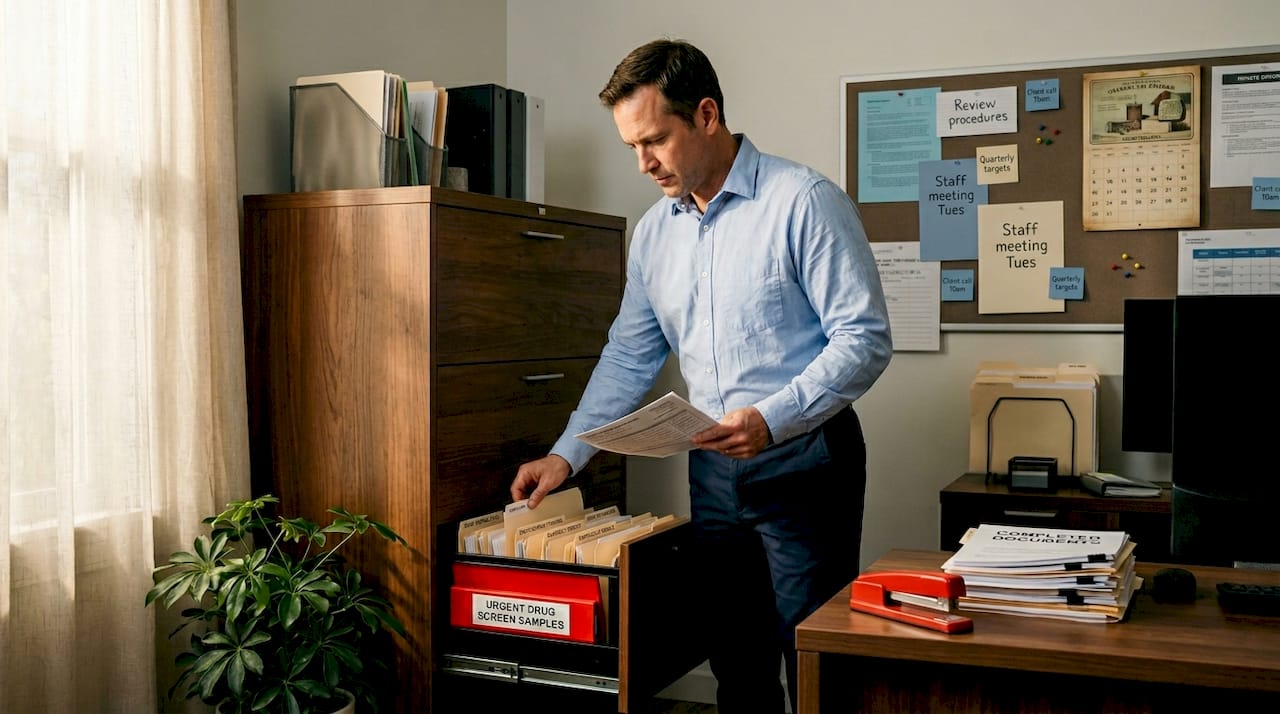
A well-managed drug testing program keeps completed chain-of-custody forms organized by donor, test date, and test purpose. Supervisors need to know where those records are stored and how long to retain them. Most compliance frameworks recommend a minimum of five years for safety-sensitive employee records.
10. When to expand or upgrade your testing panel
The standard 5-panel test covers the most commonly abused controlled substances, but it misses a growing list of substances that are increasingly present in workplace drug use data. Synthetic opioids, kratom, fentanyl analogs, and benzodiazepines are not included in a basic 5-panel screen. If your workforce operates in a high-risk environment or your industry data suggests these substances are relevant, a limited panel is a compliance gap.
An effective workplace drug-free program is not just about passing audits. It is about building a policy that actually reflects the substances your employees are likely to encounter. Upgrading to a 10, 12, or even broader panel is a straightforward decision if the risk profile justifies it.
My honest take on drug test selection
I’ve spent years reviewing workplace drug testing programs that technically meet regulatory requirements but functionally miss the point. The most common failure I see is organizations that treat the DOT 5-panel as a ceiling rather than a floor. They pass their audits. They also miss fentanyl, synthetic cannabinoids, and emerging substances that are actively affecting their workforce.
The second issue I keep encountering is over-reliance on detection window ranges as if they’re precise. They’re not. Detection windows are population-level estimates, not individual guarantees, and building a policy around them as if they’re hard cutoffs creates both false confidence and unnecessary disputes.
What I’ve found actually works is a layered approach: a certified lab-confirmed test with MRO review as the backbone, supplemented by rapid tests for on-site initial screening where speed matters. MROs serve as independent gatekeepers and their role is underutilized in non-DOT programs. That’s the gap most organizations leave open.
Oral fluid testing has real promise for reasonable suspicion and post-accident scenarios once the certified lab infrastructure catches up. But betting on it now for DOT compliance is premature. Keep watching, but don’t substitute it yet.
— Justin
Find the right test kits for your program at Rapidtestcup
Once your drug test selection checklist is finalized, the next step is sourcing test kits that match your panel requirements, compliance standards, and budget. Rapidtestcup carries a catalog built for professionals, from standard multi-panel cups to expanded detection kits with adulterant testing built in.
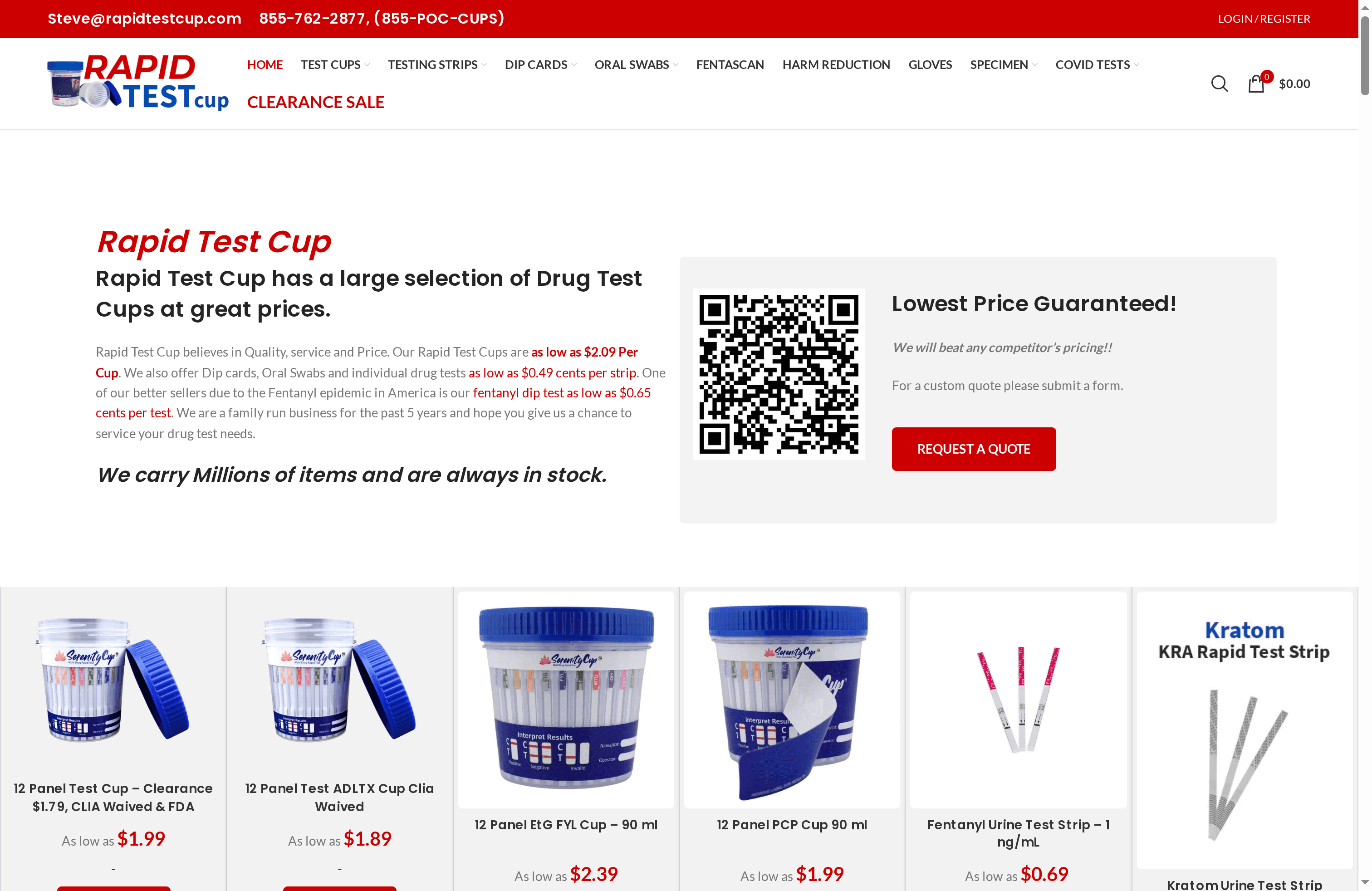
For comprehensive workplace screening, the 12-panel ADLTX cup is a strong starting point, covering the core substances plus common adulterants in a CLIA waived format. If your program requires broader detection of emerging substances, the 22-panel test with adulterants covers kratom, fentanyl analogs, Zaza, xylazine, and adulterant markers in a single collection cup. Bulk pricing, quick shipping, and detailed product specs are available directly on each product page to help you match kits to your specific regulatory and operational needs.
FAQ
What is a drug test selection checklist?
A drug test selection checklist is a structured set of criteria used to evaluate and choose the most appropriate drug testing method for a given program. It typically covers testing purpose, specimen type, detection windows, regulatory requirements, and legal compliance considerations.
Which drug test is required for DOT programs?
The 5-panel urine test regulated under 49 CFR Part 40 is required for DOT safety-sensitive positions. It screens for THC, cocaine, opioids, amphetamines, and PCP, with urine as the mandatory specimen type.
How long do drugs stay detectable in urine vs. oral fluid?
Detection windows differ significantly by specimen. THC is detectable in urine for 3 to 30 or more days depending on use frequency, while oral fluid typically detects THC for only 4 to 24 hours, making each specimen better suited for different testing scenarios.
Can an employee contest a positive drug test result?
Yes. Under federal rules, a donor has 72 hours from MRO notification to request a split specimen retest of Bottle B at an independent certified laboratory. This right applies in all federally regulated programs.
Do non-DOT employers need a Medical Review Officer?
MRO review is not legally required for non-DOT programs, but it is strongly advisable. An MRO verifies results against the donor’s medical history before any employment action is taken, which significantly reduces legal exposure from wrongful termination claims.