

Blog
Test Accuracy Metrics: A Clinical Interpretation Guide


TL;DR:
- Test accuracy alone can be misleading because it does not reflect the test’s ability to identify true disease or rule it out effectively. Sensitivity and specificity provide a clearer picture by measuring true positive and true negative rates, but their importance depends on clinical context. Predictive values vary significantly with disease prevalence, making them unreliable indicators across different populations without considering pre-test probability.
Test accuracy is defined as the proportion of correct test results, both true positives and true negatives, out of all cases tested. For healthcare professionals, understanding test accuracy means knowing that this single number rarely tells the full story. Sensitivity, specificity, predictive values, and likelihood ratios each reveal a different dimension of diagnostic performance. Relying on accuracy alone, especially in low-prevalence populations, can mask serious diagnostic failures. This guide breaks down each metric, explains how they interact, and shows you how to apply them in clinical decision-making.
What are sensitivity and specificity, and why do they matter?

Sensitivity and specificity are the two foundational metrics in diagnostic test accuracy. Sensitivity measures the proportion of true disease cases that a test correctly identifies as positive. Specificity measures the proportion of disease-free cases that a test correctly identifies as negative.
The formulas are direct:
- Sensitivity = True Positives / (True Positives + False Negatives)
- Specificity = True Negatives / (True Negatives + False Positives)
These two metrics describe intrinsic test characteristics. They do not change when you apply the same test to a different population. That stability makes them the starting point for any rigorous test evaluation.
The critical clinical reality is that sensitivity and specificity trade off against each other. Lowering a detection threshold increases sensitivity but reduces specificity. Raising it does the opposite. No single cutoff maximizes both simultaneously.
Choosing which to prioritize depends on the clinical consequences of error:
- Prioritize sensitivity when a missed diagnosis carries severe consequences. HIV screening, tuberculosis detection, and cancer triage all demand high sensitivity. A false negative in these contexts delays treatment and worsens outcomes.
- Prioritize specificity when a false positive triggers harmful or costly interventions. Confirmatory testing for rare genetic conditions or invasive surgical workups require high specificity to avoid unnecessary procedures.
- Balance both when treatment risk and disease severity are moderate. Drug testing in workplace or clinical programs often requires this balance, since both false positives and false negatives carry real consequences.
Pro Tip: Start with pre-test probability before selecting a cutoff. In a high-risk population, a moderately sensitive test may suffice. In a low-risk population, you need high specificity to avoid flooding downstream care with false positives. The sensitivity-specificity relationship shifts in clinical weight depending on who you are testing.
How do predictive values depend on disease prevalence?
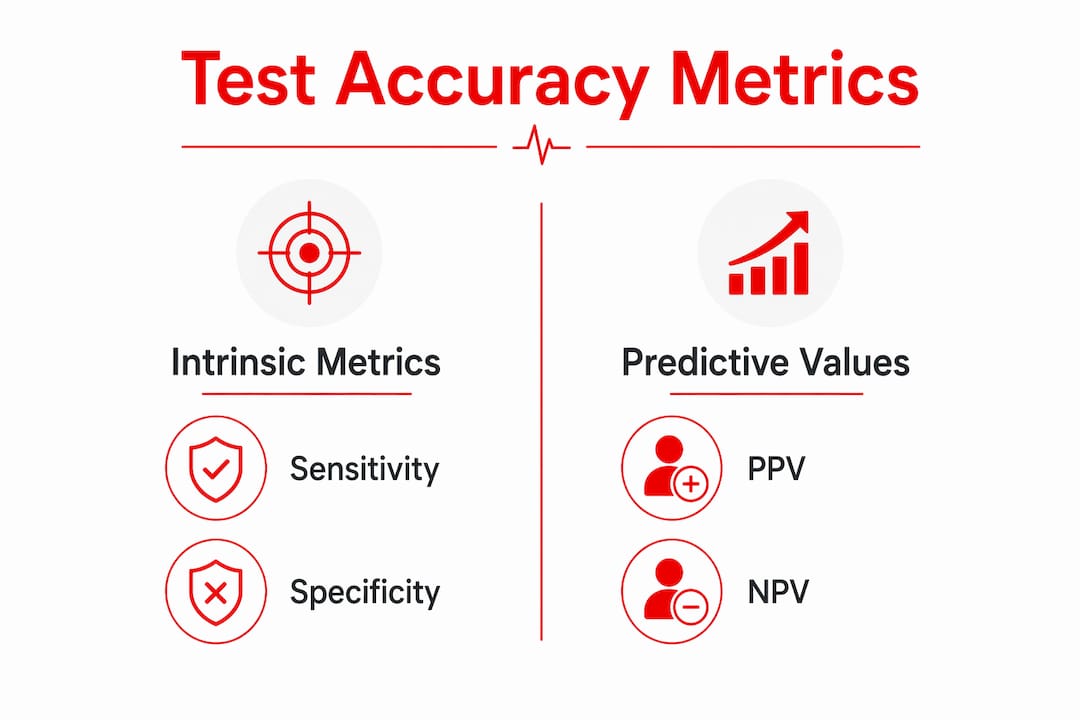
Positive Predictive Value (PPV) and Negative Predictive Value (NPV) answer the questions clinicians actually ask at the bedside: “If this test is positive, how likely is the patient to have the disease?” and “If it is negative, how confident can I be that they do not?”
The formulas:
- PPV = True Positives / (True Positives + False Positives)
- NPV = True Negatives / (True Negatives + False Negatives)
Unlike sensitivity and specificity, predictive values depend heavily on prevalence. The same test with identical sensitivity and specificity will produce dramatically different PPV and NPV when applied to a high-prevalence versus a low-prevalence population.
Consider a test with 95% sensitivity and 95% specificity applied to two populations:
- In a population where 30% have the disease, the PPV is high. Most positive results reflect true disease.
- In a population where 1% have the disease, the PPV drops sharply. The majority of positive results are false positives, even though the test itself has not changed.
This is the prevalence trap. Clinicians who interpret a positive result without knowing the underlying prevalence of disease in their patient population will systematically overestimate the probability of disease in low-prevalence settings. The false positive risk is highest precisely where clinicians are least likely to expect it.
NPV follows the inverse pattern. In low-prevalence populations, NPV is very high because most people do not have the disease regardless of the test result. Clinicians should not interpret a high NPV as evidence of a highly discriminating test. It may simply reflect a low-prevalence population.
Pro Tip: Always ask what the disease prevalence is in the population you are testing before interpreting PPV or NPV. A positive result in a low-prevalence screening program requires confirmatory testing. A negative result in a high-prevalence clinical population may not be sufficient to rule out disease.
What are likelihood ratios and how do they improve test interpretation?
Likelihood ratios (LRs) are the most clinically powerful accuracy metrics that most clinicians underuse. A positive likelihood ratio (LR+) tells you how much more likely a positive test result is in a person with the disease compared to a person without it. A negative likelihood ratio (LR) tells you how much less likely a negative result is in a diseased person.
The formulas:
- LR+ = Sensitivity / (1 – Specificity)
- LR = (1 – Sensitivity) / Specificity
The decisive advantage of likelihood ratios is prevalence independence. Unlike PPV and NPV, LRs remain stable across populations with different disease prevalence. You can apply them using Bayesian reasoning to convert pre-test probability into post-test probability, regardless of the setting.
An LR+ above 10 provides strong evidence for disease. An LR below 0.1 provides strong evidence against it. Values between 0.5 and 2.0 offer minimal diagnostic shift and should prompt you to question whether the test adds meaningful information.
Here is how the three core metric types compare:
| Metric | Prevalence-dependent? | Clinical use |
|---|---|---|
| Sensitivity / Specificity | No | Intrinsic test characteristics; test selection |
| PPV / NPV | Yes | Bedside interpretation; varies by population |
| Likelihood Ratios | No | Bayesian probability updating; cross-population use |
Pro Tip: Use a Fagan nomogram or a simple online LR calculator to convert pre-test probability and LR into post-test probability at the point of care. This takes under 60 seconds and prevents the most common error in test interpretation: treating a positive result as confirmation of disease without accounting for prior probability.
Why is overall accuracy often misleading?
Overall accuracy is calculated as (True Positives + True Negatives) / Total Population. The formula is intuitive, but the metric is frequently misleading in clinical practice, particularly in low-prevalence screening scenarios.
The clearest illustration: in a population where only 3% of individuals have a disease, a test that labels every single person as disease-free achieves 97% accuracy. It misses every true case. The accuracy figure looks excellent. The clinical performance is catastrophic.
This problem intensifies with imbalanced datasets. When disease prevalence is very low, the large pool of true negatives dominates the accuracy calculation and obscures the test’s complete failure to detect disease. Relying solely on accuracy in these settings masks diagnostic failures that sensitivity and specificity analysis would immediately expose.
Clinicians and researchers evaluating test performance should supplement accuracy with:
- Sensitivity and specificity to understand detection rates for diseased and non-diseased cases separately
- ROC AUC (Area Under the Curve) to assess overall discriminatory ability across all possible thresholds
- Calibration metrics to confirm that predicted probabilities match observed event rates
One important nuance: AUC measures ranking ability but not probability calibration. A test with a perfect AUC can still produce misleading risk scores if its predicted probabilities are poorly calibrated. For clinical decision support tools and machine learning diagnostics, calibration is as important as discrimination. Reviewing why lab accuracy matters beyond headline numbers is a discipline that separates rigorous diagnostic practice from superficial evaluation.
Key Takeaways
Diagnostic test accuracy is best understood through a combination of sensitivity, specificity, predictive values, and likelihood ratios, not through any single metric in isolation.
| Point | Details |
|---|---|
| Accuracy alone misleads | A 97% accurate test can miss every true case in a 3% prevalence population. |
| Sensitivity vs. specificity trade-off | Prioritize sensitivity to rule out disease; prioritize specificity to rule it in. |
| Predictive values shift with prevalence | PPV and NPV change dramatically across populations, even when the test does not. |
| Likelihood ratios are prevalence-independent | LRs provide stable, cross-population evidence for updating disease probability. |
| Supplement accuracy with AUC and calibration | High accuracy and high AUC do not guarantee well-calibrated clinical predictions. |
What I have learned from applying these metrics in practice
The most common error I see is treating a single metric as the verdict on a test. Clinicians report a sensitivity of 92% and conclude the test is reliable. Researchers cite an accuracy of 96% and declare the diagnostic tool validated. Neither conclusion holds without the full picture.
The metric that changes my interpretation most often is pre-test probability. Two patients can receive the same positive result from the same test and have very different post-test disease probabilities, simply because their clinical risk profiles differ. Integrating pre-test probability through Bayesian reasoning is not a theoretical exercise. It is the difference between appropriate follow-up and unnecessary intervention.
The second lesson I keep returning to is that no test is perfectly accurate. Every test involves trade-offs, and those trade-offs must be managed with attention to clinical context and patient risk. The clinician who understands this does not search for a perfect test. They select the test whose error profile best fits the clinical question they are trying to answer.
Likelihood ratios remain underutilized in most clinical settings, and that gap has real consequences. When I see clinicians interpret a positive drug test result without accounting for the prevalence of use in the tested population, the predictable result is a wave of false positives that erodes trust in the testing program. The best practices for reliable results always start with understanding the metrics behind the result, not just the result itself.
The field is also evolving. Machine learning diagnostics introduce a new layer of complexity, where training accuracy overestimates real-world performance due to overfitting. Evaluating a diagnostic model on new, independent data is the only way to know whether it generalizes. The principles of sensitivity, specificity, and calibration apply to algorithmic tools just as they do to lateral flow assays.
— Justin
Rapidtestcup products built for accurate lab diagnostics
Accurate diagnostics depend on tests that are designed with known, validated sensitivity and specificity profiles. Rapidtestcup supplies CLIA waived, FDA-approved drug testing products built for clinical, forensic, and laboratory settings where test performance is not negotiable.
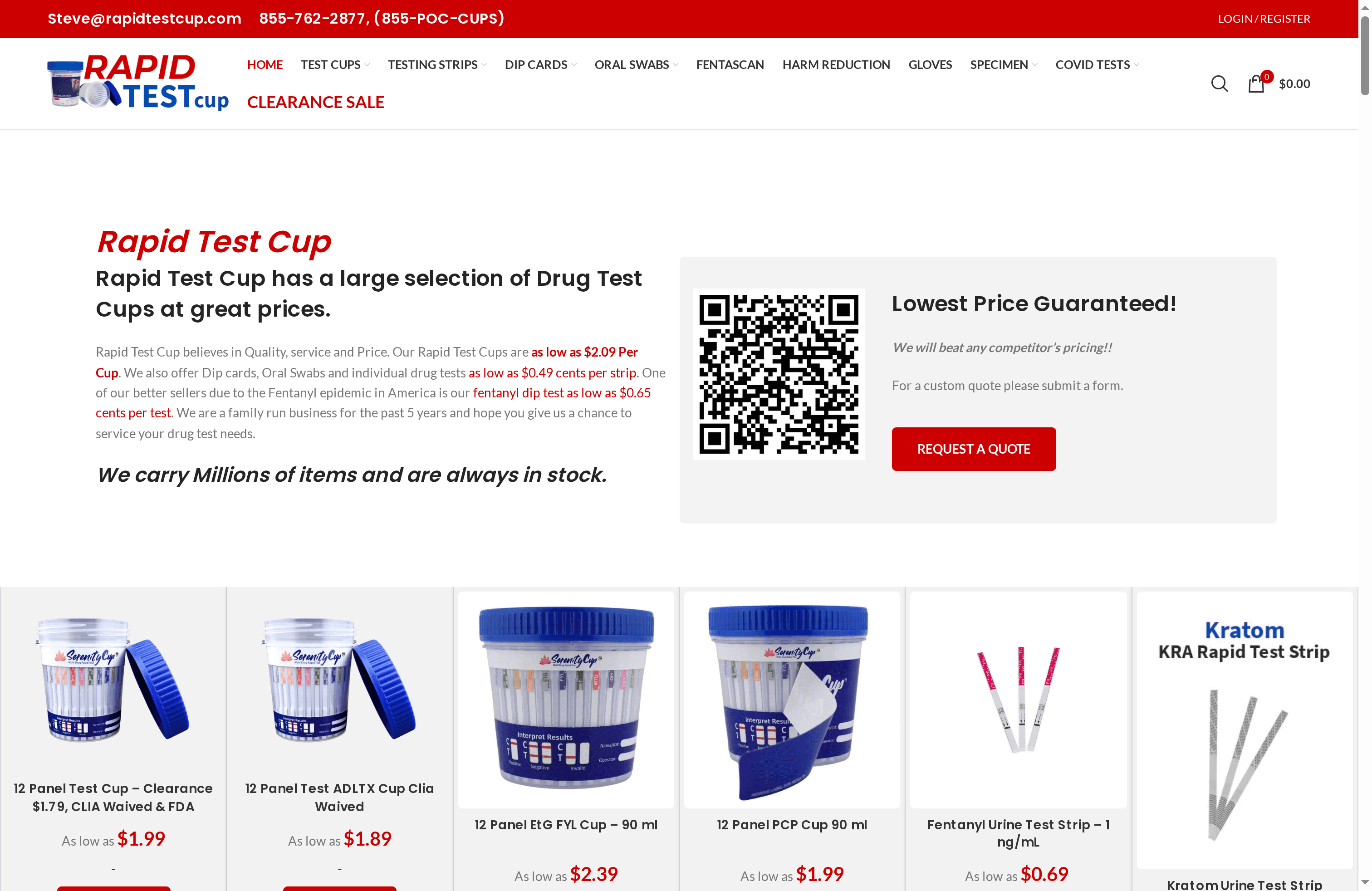
The top drug testing products for labs in the Rapidtestcup catalog include multi-panel test cups, dip cards, and urine test strips with documented cutoff levels and performance characteristics. Each product is selected to give labs the sensitivity and specificity data they need to interpret results with confidence. Healthcare professionals and program administrators can browse the full catalog at Rapidtestcup to find testing solutions matched to their clinical and compliance requirements.
FAQ
What is the difference between sensitivity and specificity?
Sensitivity measures how well a test detects true disease cases, while specificity measures how well it correctly identifies disease-free cases. Increasing one typically reduces the other, so the optimal balance depends on the clinical consequences of false negatives versus false positives.
Why does PPV change between populations?
PPV depends on disease prevalence in the tested population. A test with fixed sensitivity and specificity will produce a much lower PPV in a low-prevalence population because false positives outnumber true positives, even when the test itself performs consistently.
What is a likelihood ratio and when should I use it?
A likelihood ratio quantifies how much a test result shifts the probability of disease, independent of prevalence. Use LRs when applying a test across populations with different baseline disease rates, or when you need to combine pre-test probability with test results using Bayesian reasoning.
When is overall accuracy a misleading metric?
Accuracy is misleading in low-prevalence populations, where a test that labels everyone as disease-free can achieve very high accuracy while missing every true case. Always supplement accuracy with sensitivity, specificity, and calibration metrics for a complete performance picture.
How do I choose between prioritizing sensitivity or specificity?
Prioritize sensitivity when missing a true case carries severe consequences, such as in cancer screening or infectious disease triage. Prioritize specificity when a false positive triggers costly or harmful interventions. Start from pre-test probability and clinical risk to guide the decision.