
Blog
How to streamline drug testing in clinics for results


TL;DR:
- Proper preparation and workflow organization are essential for accurate, efficient clinic drug testing.
- Confirmatory testing is crucial for positive results affecting significant clinical decisions.
- Strong quality control practices reduce retests, errors, and improve overall testing efficiency.
Slow, disorganized drug testing doesn’t just frustrate clinic staff — it creates real risks for patient safety and regulatory compliance. When specimen collection is inconsistent, documentation is incomplete, or results are misinterpreted, the downstream consequences range from avoidable retests to audit failures. Clinics running high patient volumes cannot afford those gaps. This guide walks through everything from pre-analytical preparation and rapid screening workflows to confirmatory testing protocols and clinical integration, giving your team a practical, evidence-based roadmap to faster, more defensible drug testing outcomes.
Table of Contents
- Essential preparation before drug testing
- Step-by-step workflow for efficient drug screening
- Confirmatory testing and avoiding errors
- Integrating results with clinical decision-making
- Why the true secret to efficiency is relentless QC (not just faster tests)
- Get started with the most reliable rapid test kits
- Frequently asked questions
Key Takeaways
| Point | Details |
|---|---|
| Preparation is vital | Proper tools, staffing, and documentation are the foundation for fast and accurate clinic drug testing. |
| Follow a proven workflow | A stepwise process using immunoassay screening with confirmatory testing optimizes efficiency and compliance. |
| Quality control boosts speed | Relentless attention to pre-analytical and QC steps prevents costly errors and delays. |
| Clinical integration is essential | Results must be considered alongside patient assessment and history, not used in isolation. |
Essential preparation before drug testing
Getting drug testing right starts long before the first sample is collected. Most workflow failures trace back to the pre-analytical stage, where small inconsistencies compound into significant downstream problems. Clinics that invest time in preparation see fewer retests, cleaner documentation, and stronger compliance records.
Tools and supplies to have ready
Before any screening session, verify that your supply station includes the following:
- Approved specimen collection cups with tamper-evident seals
- Properly printed and pre-labeled chain of custody forms
- Calibrated point-of-care (POC) testing devices checked against manufacturer specifications
- Positive and negative quality control (QC) samples for each test lot in use
- Biohazard disposal containers and personal protective equipment
Every missing item at this stage causes a delay that ripples across the entire shift. If a staff member has to search for a form mid-collection, that is time spent away from patients and a window for documentation errors to occur.
Assign clear staff roles
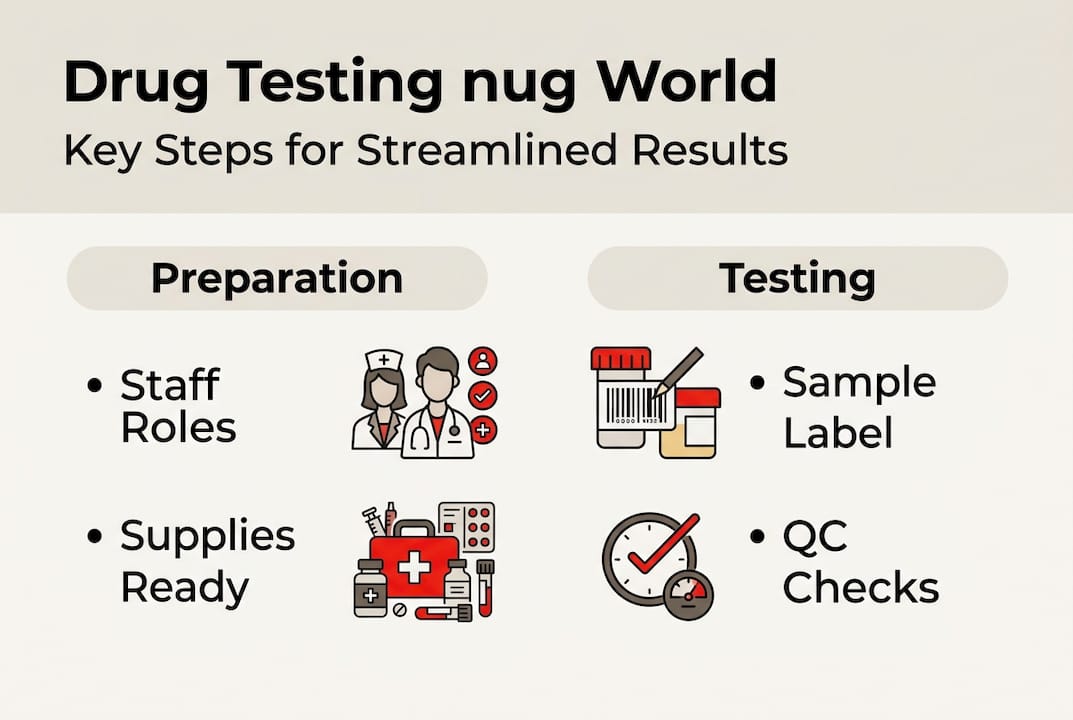
Ambiguity in staff responsibility is one of the most underrated efficiency killers in clinic drug testing. Assign distinct roles: one person handles patient intake and form completion, another manages specimen collection and labeling, and a third reviews and documents results. When everyone knows their lane, bottlenecks shrink and accountability improves.
| Tool/Item | Purpose | Documentation Required |
|---|---|---|
| Urine collection cup | Primary specimen container | Chain of custody form |
| POC immunoassay device | Rapid screening on-site | Result log with lot number |
| QC samples (pos/neg) | Device calibration validation | QC run record with date/lot |
| Refrigerated storage | Specimen holding before confirmatory test | Temperature log |
| Batch/lot tracking sheet | Expiration and lot management | Monthly audit record |
Following drug testing best practices also means treating your POC setup as a formal quality system. POCT should be treated like a quality system, not just a “dip card.” The pre-analytical stage is the most controllable variable in the entire testing process. Lot tracking, expiration checks, calibration, and QC frequency are core components of efficiency because any retest avoided through reliable QC reduces downstream delays.
Pro Tip: Run a brief pre-shift checklist every morning. Confirm that QC was run, devices passed, expiration dates are valid, and forms are stocked. This five-minute habit eliminates the majority of mid-shift interruptions.
Systemizing a thorough quality control workflow is not optional for clinics seeking to hold up under audits. Every form completed, every lot number recorded, and every QC run documented is a piece of evidence in your favor if results are ever challenged.
Step-by-step workflow for efficient drug screening
Once your tools and documentation system are in place, the next priority is executing each test in a consistent, time-smart sequence. A structured workflow prevents staff from improvising steps, which is where most errors occur.
The core screening sequence
- Patient intake and identification. Verify patient identity against photo ID and match to the request form. Record the date, time, and collector’s initials.
- Pre-collection briefing. Inform the patient of the collection procedure, required volume, and temperature verification. This reduces invalid specimens caused by misunderstanding.
- Specimen collection. Direct the patient to the collection area. Ensure no water access that could allow adulteration. Seal the cup in view of both parties and confirm the temperature strip reads within the acceptable range (90 to 100°F).
- Initial labeling. Apply the pre-printed label to the specimen cup in the presence of the patient, then both parties initial the chain of custody form.
- Immunoassay screening. Run the specimen through your POC device. For routine clinic drug testing, screening by immunoassay for speed followed by confirmatory testing using mass spectrometry (GC-MS or LC-MS) for specificity is the standard methodology.
- Result review and documentation. Record the raw result, device lot number, test time, and reviewer initials into the result log. Flag any reactive or invalid results immediately.
- Specimen retention. If confirmation is needed, transfer the specimen to a sealed secondary container and log into the refrigerated storage record.
Where clinics lose the most time
The single biggest time drain is not the test itself, it is the disorganized minutes before and after. Pre-labeling forms and setting up supplies at the start of each shift can save between 10 and 20 minutes per batch. Applied across a high-volume testing day, that adds up to hours of recovered staff time each week.

Pro Tip: Build a standard operating procedure (SOP) document for each step in this sequence. Laminate it and post it at every collection station. New staff can follow it independently, and it proves procedural consistency during inspections.
The drug test workflow guide approach of scripting each step also supports audit-readiness. Every handoff, every signature, and every time stamp contributes to a defensible paper trail. Immunoassays are favored in clinic settings for their rapid turnaround and lower per-test cost, but they are only as reliable as the process surrounding them. Using validated rapid screening methods within a structured workflow gives you both speed and confidence in your results.
Confirmatory testing and avoiding errors
Initial screening is your first line of defense, not your last. Immunoassays are powerful tools for triage, but their limitations are well-documented and must be managed deliberately.
When to escalate to confirmatory testing
Not every positive result requires GC-MS or LC-MS confirmation, but several situations make it mandatory:
- Positive results that will influence a significant clinical decision (such as treatment enrollment or discharge)
- Patient disputes a positive result
- The substance in question is a synthetic or novel compound outside standard immunoassay panels
- Results are inconsistent with the patient’s reported medication list
| Factor | Immunoassay | GC-MS / LC-MS Confirmatory |
|---|---|---|
| Turnaround time | Minutes (on-site) | Hours to days (lab) |
| Cost per test | Low | High |
| Specificity | Moderate | Very high |
| False positive risk | Present | Minimal |
| Novel substance detection | Limited | Strong with targeted methods |
| Best clinical use | Initial screening | High-stakes decisions |
Common immunoassay errors and how to prevent them
- Cross-reactivity errors: Certain over-the-counter medications (such as dextromethorphan or ibuprofen) can trigger false positives. Always review the patient’s current medications before interpreting results.
- Dilute specimens: Specimens below the creatinine and specific gravity thresholds are reported as dilute and may produce false negatives. Check specimen validity at collection.
- Expired reagents: Using an expired test panel is one of the most preventable sources of invalid results. Batch-lot checks prevent this entirely.
- Temperature mishandling: Specimens stored outside the required range before testing can produce unreliable results. Log temperatures at each transfer.
- Reader interpretation errors: Faint lines on lateral flow tests are frequently misread by untrained staff. Train to manufacturer specifications and use digital readers where possible.
Important: Immunoassays may fail for specific drug classes (producing false negatives) or miss novel and synthetic substances entirely. Definitive confirmatory testing using LC-MS/MS is strongly recommended when results will drive high-stakes patient decisions or when screening limitations are a concern. Never rely solely on initial screening for major care decisions.
Understanding the confirmatory testing importance for certain clinical scenarios protects both patients and your clinic. A structured approach to false positive prevention — built into your SOP — turns potential liability into a demonstrable quality control standard.
Integrating results with clinical decision-making
Accurate lab data is only useful when it informs clinical decisions thoughtfully. The final step in any drug testing workflow is turning results into appropriate, documented, patient-centered action.
Drug test results in context
A positive urine screen for opioids means something very different for a chronic pain patient on a stable buprenorphine prescription than for a patient with no known opioid history. Context is everything. Results should always be interpreted alongside patient history, self-report, medications, and psychosocial factors — not in isolation.
ASAM guidance states that drug testing should be included at intake and as routine ongoing assessment, used in conjunction with self-report, psychosocial evaluation, and physical exam. Test selection should be individualized based on detection capabilities and the substances of clinical concern for each patient.
Recommended steps for clinical integration
- Review results against the patient’s medication list. Check for expected substances (prescribed medications) and flag unexpected findings.
- Cross-reference with self-report. Compare reported use against the screen to identify discrepancies and open a clinical conversation.
- Apply appropriate detection window knowledge. THC can remain detectable for weeks in heavy users; cocaine metabolites clear in days. Window differences matter for interpretation.
- Consult a medical review officer (MRO) for ambiguous or disputed results. Especially relevant for employment-related testing or cases with significant clinical implications.
- Document the interpretation and clinical rationale. Record what the result showed, how it was interpreted, and what action was taken and why.
Documentation essentials for compliance
- Patient identifier and test date on every record
- Lot number and device type for the screening panel used
- Result (reactive or non-reactive) with interpreter initials
- Clinical notes summarizing how the result was incorporated into care
- Any referral for confirmatory testing and the outcome
Caution: Drug test results should never be the sole determinant of a patient care decision. Using a screen result in isolation — without clinical judgment, patient history, or appropriate confirmatory follow-up — exposes your clinic to liability and risks patient harm.
Maintaining a reliable compliance workflow around documentation means your clinic can demonstrate its decision-making process at any audit. Strong reporting best practices also support continuity of care across providers and settings, giving the full picture of a patient’s testing history in a usable format.
Why the true secret to efficiency is relentless QC (not just faster tests)
Here is the uncomfortable insight that most clinic administrators miss: chasing faster test technology without fixing your quality control infrastructure is like adding a lane to a highway that ends in a bottleneck. You move nothing faster.
The clinics that actually achieve faster drug testing turnaround times are not the ones with the newest panels. They are the ones that have eliminated avoidable retests through airtight QC. Calibration, QC frequency, lot tracking, and expiration checks are core to efficiency because every retest avoided through reliable QC reduces downstream delays. One invalid result from an expired test lot can trigger a patient callback, a repeat collection, and additional staff time — potentially tripling the cost of that single test.
Investing in quality control for efficiency means scheduling regular QC audits, automating calibration reminders, and building lot tracking into your standard workflow rather than treating it as an afterthought. The clinics that do this consistently report fewer errors, less wasted labor, and stronger audit performance — even using standard, off-the-shelf test panels. Speed comes from removing friction, and friction almost always lives in the QC gaps.
Get started with the most reliable rapid test kits
Putting these workflow improvements into practice requires the right tools from the start. Selecting quality-tested, CLIA waived, FDA-approved rapid test kits designed for professional clinic settings ensures your team can execute every step of this guide with confidence.
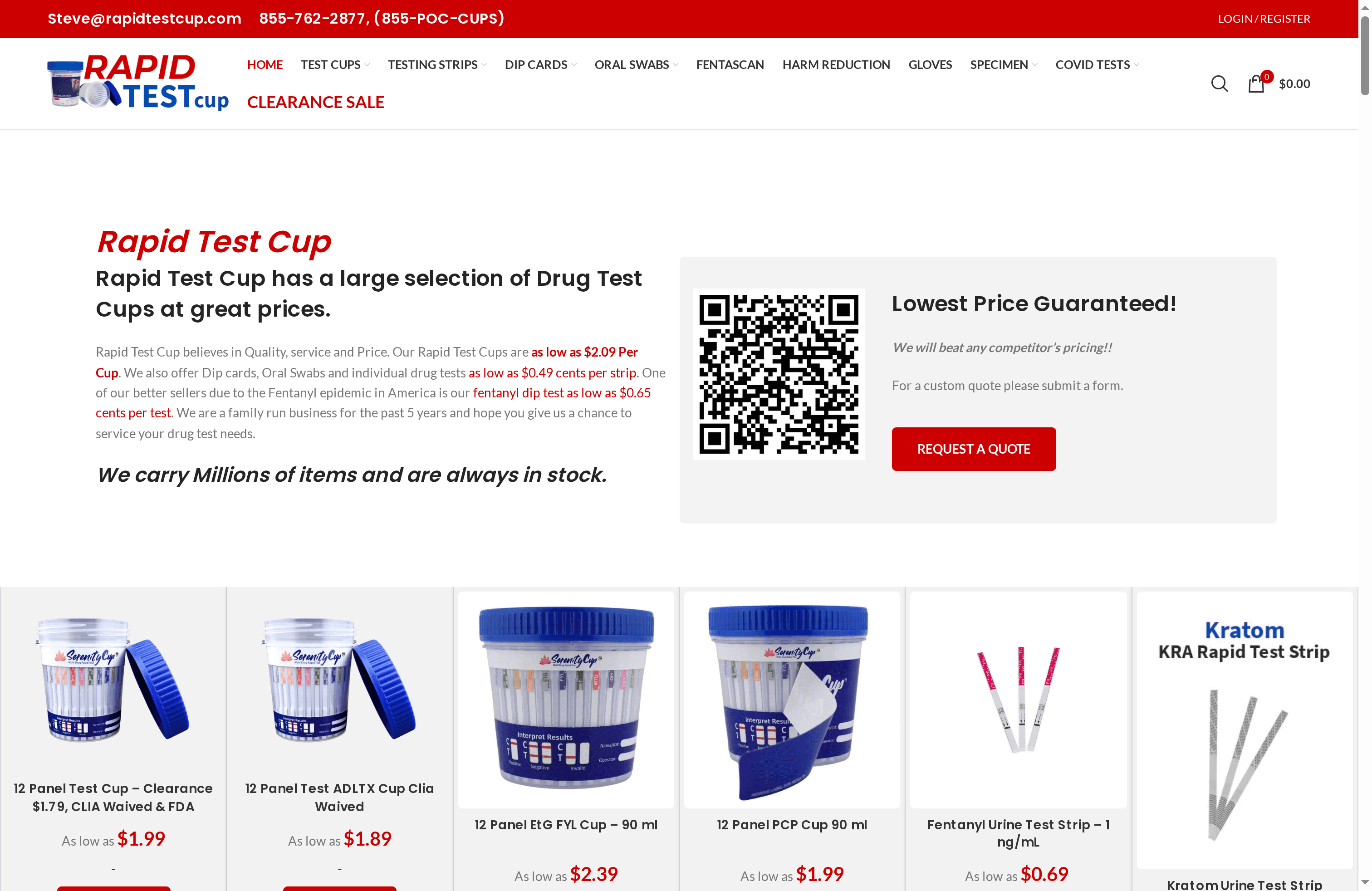
At rapidtestcup.com, clinics can compare urine drug test kits across panel configurations, sensitivity levels, and price points to find the best fit for their specific testing program. Whether you are running a substance abuse program, a pain management clinic, or a general practice, the drug test kit selection guide walks you through the exact criteria — detection windows, panel coverage, chain of custody compatibility — that matter most for compliance and clinical defensibility. Bulk pricing and fast shipping make it easy to maintain adequate stock without overextending your supply budget.
Frequently asked questions
What are the most common drug testing methods used in clinics?
Immunoassays are most common in clinics due to rapid turnaround and lower cost, while GC-MS and LC-MS confirmatory methods are used when higher specificity is needed for significant clinical decisions.
How can clinics avoid false positives in drug testing?
Clinics should run QC checks on every lot, cross-reference results against patient medications, and send reactive results for confirmatory testing using GC-MS or LC-MS before acting on them in high-stakes situations.
Should drug test results be the only factor in patient care decisions?
No. Drug testing should not be the sole determinant of patient care; results must be interpreted alongside clinical evaluation, self-report, and individualized test selection to support defensible, patient-centered decisions.