

Blog
Split specimen testing: methods, procedures, and verification

TL;DR:
- Split specimen testing involves dividing a single sample into two sealed parts at collection, allowing for independent retesting upon employee request. It serves as a crucial safeguard against lab errors and disputes, ensuring legal compliance in federally regulated workplace drug testing programs. The employee must actively request a split test within 72 hours, and the second specimen is analyzed by a different HHS-certified lab to verify results independently.
Most people assume that contesting a positive workplace drug test simply means asking the same lab to run the sample again. That assumption is wrong, and the gap between what employees and employers think happens versus what federal regulations actually require creates real legal exposure. Split specimen testing is the federally mandated safeguard built into DOT and SAMHSA-regulated programs precisely to address that gap, ensuring a separate, independent analysis by a different certified laboratory. Understanding the full process protects organizations from legal liability and protects employees from unfair outcomes.
Table of Contents
- What is split specimen testing?
- How the split specimen process works
- When is split specimen testing used, and who requests it?
- Split specimen testing vs. confirmation testing: understanding the difference
- Reconfirmation testing procedures for split specimens
- Why independent split specimen testing matters more than ever
- Simplify compliant drug testing with advanced specimen solutions
- Frequently asked questions
Key Takeaways
| Point | Details |
|---|---|
| Dual-sample safeguard | Split specimen testing divides a collected sample into two containers, enabling independent verification in case of disputed results. |
| Strict regulatory process | Federal and DOT programs specify unique labs, timing, and cutoffs for split specimen tests to ensure fairness and legal compliance. |
| Employee rights matter | Employees may request the split B container test within 72 hours of a positive, adulterated, or substituted finding. |
| Not just retesting | Split specimen analysis is independent and differs from standard confirmatory testing, adding vital legal protection. |
| Timely, documented steps | Employers and labs must follow precise, documented procedures to ensure all chain of custody and legal requirements are met. |
What is split specimen testing?
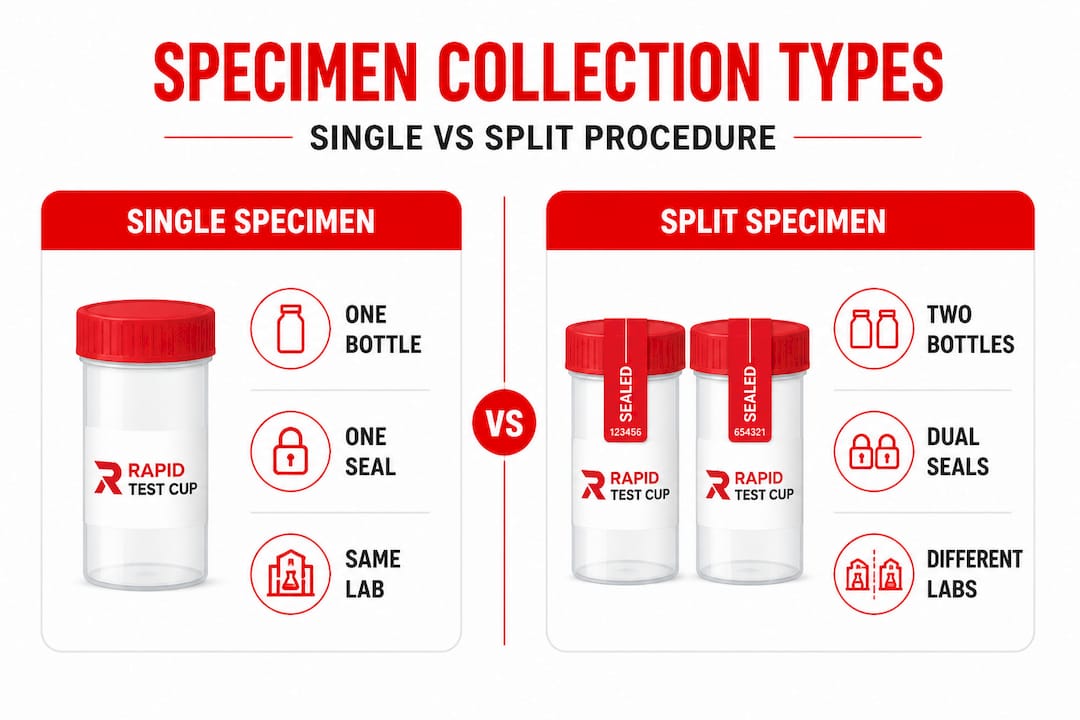
Split specimen testing is not a retest of leftovers. It is a deliberate, structured division of a single collected specimen into two separately sealed containers at the moment of collection. Split specimen testing in workplace drug testing refers to collecting one employee specimen and dividing it into two separately identified portions, commonly labeled specimen A (the primary) and specimen B (the split), at the time of collection.
This is fundamentally different from a single specimen collection where only one sealed container is produced. In single specimen programs, there is no preserved sample available for independent retesting if a result is disputed. In federally regulated split specimen programs, bottle B remains sealed and untouched at the original laboratory until the employee formally requests retesting.
The regulatory foundation here is clear. Split specimen testing is specifically part of federal workplace drug testing programs described by SAMHSA’s HHS-certified workplace framework, covering both urine and oral fluid programs, and it includes the employee’s right to a second analysis of container B following Medical Review Officer verification.
The practical significance of this design cannot be overstated. The moment both containers are sealed in front of the employee at the collection site, an independent audit trail begins. For labs, clinics, and HR teams working within practical workplace drug test compliance frameworks, this bifurcated collection process is the bedrock of legal defensibility.
| Feature | Single specimen | Split specimen |
|---|---|---|
| Containers collected | 1 | 2 (A and B) |
| Independent retesting possible | No | Yes |
| Federal program requirement | No | Yes (DOT/SAMHSA) |
| Employee contest right | Limited | Protected by regulation |
| Second laboratory involved | No | Required |
“Split specimen testing provides a built-in check against laboratory error, contamination, and chain of custody disputes. It is the standard of fairness in federally regulated drug testing.”
How the split specimen process works
The process is sequential, time-sensitive, and governed by strict chain of custody rules. Each step matters, because a procedural misstep can invalidate results or expose an employer to legal challenge.
Here is how the process unfolds in practice:
- Collection: The collector produces a single urine or oral fluid sample from the employee and divides it into bottle A (primary, minimum 30 mL for urine) and bottle B (split, minimum 15 mL). Both bottles are sealed and labeled in the employee’s presence.
- Chain of custody documentation: Both containers are logged on a Federal Custody and Control Form (CCF). The employee and collector both sign. This document follows both containers throughout the process.
- Shipment to the primary laboratory: Both sealed containers are shipped to the same HHS-certified laboratory. Bottle B is stored unopened.
- Initial screening and confirmation on bottle A: The primary lab screens and, if the screen is positive, confirms with a secondary method such as gas chromatography-mass spectrometry. Under DOT/federal rules, only the primary container is tested first; the split container is tested only if the Medical Review Officer verifies a positive or certain other results and the employee requests testing within the required window.
- MRO review and notification: The Medical Review Officer reviews the laboratory result, contacts the employee, and gives the employee a chance to explain the outcome.
- Employee request window: The employee has exactly 72 hours from MRO notification to request split specimen testing. This window is firm. Missing it eliminates the right to an independent retest.
- Transfer to second laboratory: The primary lab ships sealed bottle B to a different HHS-certified laboratory. The original lab never tests bottle B.
- Reconfirmation testing: The second lab performs independent confirmatory analysis.
- Reporting: Results are reported back to the MRO, who communicates the outcome to the employer.
Pro Tip: Document the exact time and date of every MRO notification. In contested cases, the 72-hour clock is a frequent point of dispute. A timestamp creates an airtight record that protects everyone in the process.
Following workplace drug testing best practices means training collectors and HR teams on every link in this chain. Even a minor gap in the drug screening workflow can compromise the integrity of an otherwise valid result.
When is split specimen testing used, and who requests it?
Split specimen testing is not triggered automatically by a positive screen. It requires an active request from a specific party under specific circumstances.
Who can request it?
Only the employee can request split specimen testing. Employers and MROs do not initiate this process on their own. After the MRO verifies a positive, adulterated, or substituted result and notifies the employee, the employee must formally request the split analysis within 72 hours.
Scenarios that trigger the right to request:
- MRO-verified positive result for a regulated substance
- Specimen reported as adulterated
- Specimen reported as substituted
The purpose of split specimen testing is to provide independent verification for these specific outcomes by allowing the employee a second analysis through a different HHS-certified laboratory. Importantly, this right exists regardless of whether the employer believes the result is correct.
Employer obligations once the request is made:
- Do not delay shipment of bottle B
- Ensure the second laboratory is notified and receives the sample promptly
- Maintain all chain of custody documentation
Pro Tip: Never place bottle B on hold pending payment disputes or administrative processes. DOT guidance is clear that timing and process obligations are driven by the employee’s request right and the MRO process. Employers must ensure the split test is completed without delay and regardless of who bears the cost.
A few edge cases worth noting for managing workplace drug test results: if bottle B is unavailable, lost, or has an insufficient volume, the MRO cancels the test rather than defaulting to bottle A’s result as final. This outcome is not a negative result; it simply means no valid result can be reported. Understanding this distinction matters deeply for legal drug testing considerations because it affects how adverse employment actions can be defended.
Split specimen testing vs. confirmation testing: understanding the difference
These two terms are not interchangeable, and mixing them up creates serious compliance blind spots.
Routine confirmation testing happens on bottle A within the primary laboratory. When an initial immunoassay screening detects a presumptive positive, the lab confirms it using a more precise analytical method on the same primary specimen. This is a quality control step within a single laboratory, not an independent process.
Split specimen testing uses a physically separate sample, sealed since collection, analyzed by a completely different HHS-certified lab. Confirmation testing of the primary specimen occurs under the Mandatory Guidelines on bottle A; the split specimen test is an additional independent analysis that only happens when the employee requests it following MRO verification.
| Aspect | Confirmation testing (bottle A) | Split specimen testing (bottle B) |
|---|---|---|
| Laboratory | Same as initial screen | Different HHS-certified lab |
| Timing | Automatic after positive screen | Only after employee request |
| Who initiates | Laboratory protocol | Employee |
| Sample used | Primary specimen | Separate sealed split specimen |
| Purpose | Analytical verification | Independent fairness safeguard |
| Chain of custody | Single lab document | New chain from primary lab |
The key difference is independence. Confirmation testing checks the lab’s own work. Split specimen testing checks whether the result holds up under completely independent scrutiny. For employers concerned about the role of confirmatory testing in their programs, recognizing this distinction shapes how legal challenges to results must be handled.
Why does this matter practically?
A positive that survives split specimen reconfirmation at a different accredited lab carries far more legal weight than one that was only confirmed internally. It eliminates the argument that the original lab made a processing error or contaminated the sample, which are the two most common defenses raised in contested drug test litigation.
Reconfirmation testing procedures for split specimens
The second laboratory does not simply rescreen the sample. It performs full confirmatory analysis following the HHS Mandatory Guidelines, using the same rigorous methods and specific cutoff concentrations required for initial confirmation.
Here is how reconfirmation testing works step by step:
- Receipt and verification: The second lab logs receipt of sealed bottle B, verifying the chain of custody documentation matches the container’s seal and label.
- Initial integrity check: Temperature, seal integrity, and specimen appearance are verified before testing begins.
- Confirmatory analysis: The lab applies the appropriate confirmatory method for each substance or adulterant at or above HHS-specified cutoff concentrations.
- Result comparison: The reconfirmation result is compared against the original finding. The second lab must independently confirm the same substance (or adulterant) at or above the required cutoff.
- Escalation if needed: In the DOT regulatory framework, if the second laboratory cannot reconfirm the result, it may send the specimen or an aliquot to another HHS-certified laboratory with the capability to conduct another reconfirmation test.
- Reporting to MRO: The second lab reports directly to the MRO, not to the employer. The MRO then updates the final result accordingly.
If reconfirmation fails at both labs, the MRO reports the test as canceled, not as a negative. This distinction is important for federal safety-sensitive positions, where a canceled test generally requires a new collection.
Pro Tip: When building laboratory workflows, ensure your second-lab contact agreements specify turnaround times for split specimen reconfirmation. Delays can create compliance problems independent of the test result itself.
For programs involving complex adulterant or specimen validity challenges, understanding adulterant detection methods and forensic drug testing methods equips your team to handle unusual reconfirmation scenarios confidently.
Why independent split specimen testing matters more than ever
Here is the uncomfortable reality most compliance training glosses over: split specimen testing is not a bureaucratic formality. It is one of the few procedural safeguards in workplace drug testing that simultaneously protects employees from lab error and protects employers from wrongful termination litigation.
Conventional wisdom treats split specimen testing as an employee-friendly exception built into an otherwise employer-controlled process. That framing is backwards. Organizations that actually internalize the value of independent analysis benefit far more than those that merely tolerate it as a required formality.
Consider what a failed reconfirmation means for an employer. Yes, it feels like losing the case. But if a split specimen test at an independent lab cannot confirm a positive that your primary lab reported, that outcome almost certainly prevented an adverse action against an employee who was clean. It is the system working correctly.
The litigation environment around workplace drug testing has become notably more adversarial. Employees contesting results now commonly challenge chain of custody records, laboratory certifications, and collection procedures simultaneously. A complete, well-documented split specimen process is the single most effective defense against all three lines of attack at once.
Programs that test for multiple substances face even more complexity in contested cases, because a multi-panel positive requires reconfirmation of each specific substance at the second lab. Getting that right demands that your entire workflow, from collection through final MRO report, is airtight before you ever face a legal dispute.
The organizations that use split specimen protocols correctly are not just compliant. They are credible. That credibility matters when a result is challenged in arbitration, an administrative hearing, or court.
Simplify compliant drug testing with advanced specimen solutions
Implementing split specimen protocols correctly starts at the collection stage, and that means using supplies designed for federally regulated workflows.
RapidTestCup offers a full range of urine specimen cups and collection supplies engineered for professional and forensic-grade testing programs. Whether your program needs multi-panel screening tools or bulk collection containers that align with federal custody and control requirements, the catalog is built for labs, clinics, occupational health programs, and HR teams who cannot afford procedural gaps. For initial screening alongside compliant collection, explore the 12 panel drug test cups that combine broad substance coverage with CLIA-waived, FDA-cleared reliability. Fast shipping and bulk pricing mean your program never stalls waiting on supplies when it matters most.
Frequently asked questions
Who pays for split specimen testing if the employee requests it?
Employers must ensure split specimen testing is completed promptly and without delay, regardless of who is ultimately responsible for the cost of the second test.
How long does an employee have to request a split specimen test?
The employee has 72 hours from Medical Review Officer notification to formally request split specimen testing. Missing this window forfeits the right to an independent retest.
Can split specimens be retested at the original laboratory?
No. Bottle B must be tested at a different HHS-certified laboratory entirely, ensuring the independence that makes the result legally meaningful.
What happens if the split specimen cannot reconfirm the original result?
If reconfirmation fails, the specimen may be sent to another HHS-certified laboratory, or the MRO reports the test as not confirmed, which typically results in the test being canceled rather than reported as negative.
Is split specimen testing only required for urine samples?
Split specimen protocols apply to both urine and oral fluid collections under SAMHSA’s federally mandated workplace drug testing guidelines, covering all regulated programs under the HHS framework.