

Blog
How to store test kits for accuracy and easy compliance


TL;DR:
- Proper storage of test kits is critical to maintaining accuracy, compliance, and avoiding invalid results in substance abuse programs.
- Implementing calibrated environmental monitoring, clear documentation, and staff training ensures audit readiness and protects test integrity.
Improper test kit storage is one of the most underestimated risks in substance abuse testing programs. A temperature excursion over a long weekend, a humidity spike from a poorly sealed storage room, or a batch of kits left near a window can quietly invalidate weeks of results before anyone notices. For laboratory managers and healthcare professionals, those failures do not just mean retesting. They can mean failed audits, citations from accrediting bodies, and serious questions about the integrity of your entire testing program. This guide walks you through a practical, audit-ready approach to storage from the tools you need to the daily habits that keep you compliant.
Table of Contents
- What you need for proper test kit storage
- Step-by-step: How to store test kits in your facility
- Common mistakes and how to avoid them
- How to verify compliance and audit readiness
- The uncomfortable truth about test kit storage most labs overlook
- Equip your lab for accurate results and easy audits
- Frequently asked questions
Key Takeaways
| Point | Details |
|---|---|
| Prioritize proper storage | Failing to store test kits as required can invalidate results and cause compliance issues. |
| Use calibrated monitors | Audit-ready logs start with reliable, calibrated monitoring equipment for temperature and humidity. |
| Document daily and act fast | Record all environmental data and respond quickly to any deviations to stay audit-ready. |
| Self-audit for success | Routine internal checks help you avoid compliance failures and ensure process reliability. |
What you need for proper test kit storage
Before you can store drug test kits correctly, you need the right infrastructure in place. This is not about spending a lot of money on equipment. It is about making sure the basics are solid and documented. Familiarizing your team with drug testing regulatory rules before setting up your storage system will save you significant time when inspectors arrive.
Here are the must-have items every facility should have in place before storing any test kits:
- Calibrated temperature and humidity data loggers (not basic thermometers)
- Dedicated storage space with controlled environmental conditions
- Original manufacturer instructions for each test kit product on hand
- Record-keeping system (electronic or paper log with date, time, and initials)
- Corrective action log for any deviations or excursions
- Inventory tracking sheets to manage lot numbers and expiration dates
- Refrigerator or climate-controlled cabinet if kits require cold storage
Your manufacturer’s insert is your first authority. Every kit has defined temperature and humidity ranges, and exceeding those ranges even briefly can degrade the antibody-antigen reactions the tests rely on. Always read the specific storage parameters before placing any product in storage.
The table below summarizes the core tools, why each matters, and what best practices look like in daily use:
| Tool | Why it’s needed | Best practice note |
|---|---|---|
| Calibrated data logger | Continuous monitoring; generates audit records | Calibrate at least annually; replace batteries on schedule |
| Dedicated storage space | Prevents cross-contamination; controls exposure | No chemicals, solvents, or patient samples stored nearby |
| Manufacturer insert | Defines valid storage parameters | Keep a copy filed with each lot’s records |
| Record-keeping system | Documents compliance over time | Maintain logs for a minimum of 2 years |
| Corrective action log | Documents responses to deviations | Fill out immediately after any excursion event |
| Inventory tracking sheet | Links lot numbers to results | Rotate stock by expiration date (first in, first out) |
Following lab testing best practices means treating storage as part of the testing process itself, not an afterthought. The regulatory compliance details governing test kit handling make clear that environment control is a core lab function.
Per CDC guidance, monitoring and documentation of temperature and humidity in storage areas must be performed daily using calibrated devices, with records maintained for audits for at least 2 years per CLIA and CAP standards.
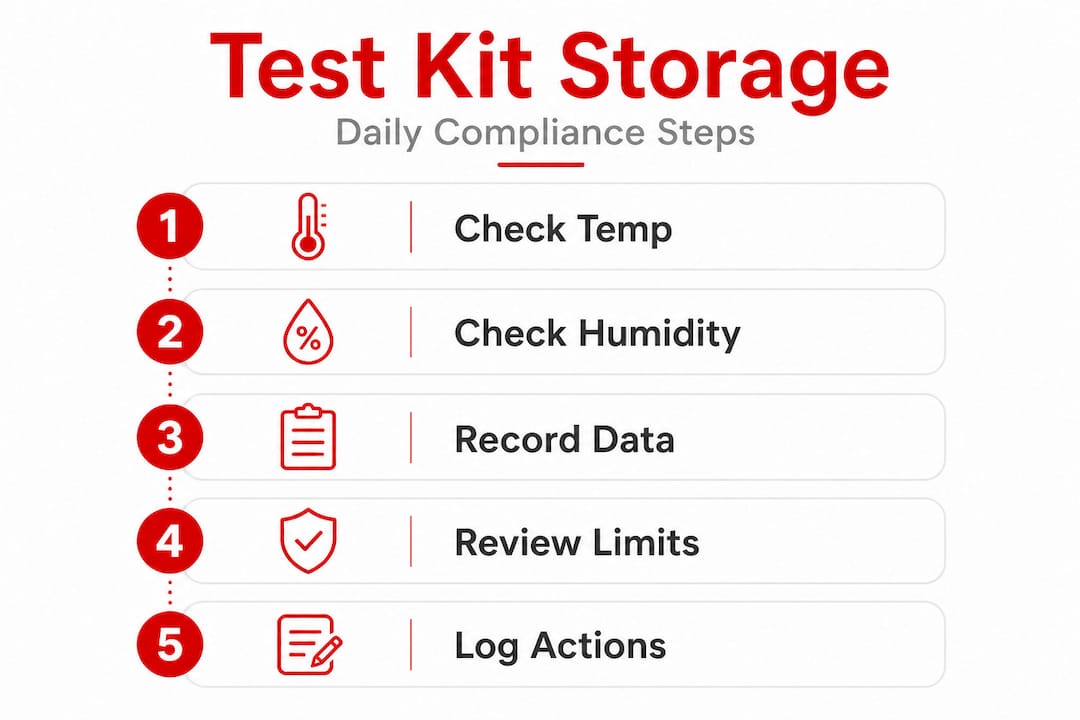
Pro Tip: Place your data loggers at the same level as the test kits themselves, not at the top of the shelf or near a vent. Temperature and humidity can vary significantly within a single storage unit, and a logger positioned incorrectly can give you a false sense of security.
Step-by-step: How to store test kits in your facility
Once tools and requirements are in place, follow this proven process for reliable daily test kit storage and compliance. Having a step-by-step workflow eliminates guesswork, reduces staff errors, and creates the paper trail that auditors expect to see.
-
Receive and inspect shipments immediately. When kits arrive, check packaging for damage, verify lot numbers against the packing slip, and confirm expiration dates are acceptable for your anticipated usage window.
-
Read the manufacturer insert for storage parameters. Before placing anything in storage, confirm the required temperature range, humidity limits, and any special conditions like “protect from light” or “do not freeze.”
-
Log receipt information. Record the lot number, quantity received, expiration date, and receiving staff initials in your inventory system. This creates the starting point for full lab product traceability.
-
Place kits in the designated storage area. Use a first-in, first-out rotation so older stock is used before newer lots. Store kits away from direct sunlight, chemicals, and high-traffic areas where doors are frequently opened.
-
Verify environmental conditions before storing. Check the current temperature and humidity reading in the storage area before adding new stock. If conditions are outside range, do not place kits in that area until the issue is resolved.
-
Document daily monitoring. Every day, review and log the temperature and humidity readings from your data logger. If you use an electronic system, confirm it is generating continuous records with timestamps.
-
Perform lot-specific quality checks. Periodically run a known positive and known negative control sample with a test kit from the active lot to confirm the kits are performing as expected.
-
Review before use. Before issuing kits for testing, staff should confirm the kits are within expiration date, stored correctly, and the package seal is intact. See how using kits accurately from point-of-care to read time is equally critical to getting reliable results.
CLIA and CAP regulations are explicit on this point: labs must define and monitor environmental conditions per manufacturer instructions for reagents and test kits, and must document any excursions and corrective actions taken.
Compliance warning: Any deviation from defined storage conditions, even a brief temperature excursion over a holiday weekend, must be formally documented. Undocumented excursions are treated as compliance failures during CAP and CLIA inspections, regardless of whether kit performance was actually affected.
The table below shows the difference between standard and CLIA/CAP-compliant storage practices:
| Storage element | Standard approach | CLIA/CAP-compliant approach |
|---|---|---|
| Temperature monitoring | Checked when staff remember | Logged daily with calibrated device |
| Humidity monitoring | Rarely tracked | Logged daily alongside temperature |
| Excursion response | Informal verbal note | Documented corrective action within 24 hours |
| Inventory tracking | Basic expiration check | Lot number, receipt date, usage log maintained |
| Record retention | Kept until no longer needed | Minimum 2 years, accessible for audit |
| Manufacturer insert | Filed or discarded | Kept with lot records throughout product life |
Pro Tip: When an environmental deviation occurs, document the corrective action the same day it is discovered. Write down exactly what happened, what action was taken, who was involved, and what the outcome was. A log entry two weeks later is a red flag for auditors.
Common mistakes and how to avoid them
Even following every step, small mistakes can easily undermine your efforts. Here are the most common issues and what to do about them.
Many compliance failures are not caused by deliberate shortcuts. They happen because storage is treated as a routine task rather than a regulated process. The moment staff start treating temperature logs as optional or “someone else’s job,” problems accumulate quietly until an inspector makes them visible.
The most frequent mistakes seen in substance abuse testing facilities include:
- Using uncalibrated or consumer-grade thermometers instead of laboratory-grade monitoring devices, which cannot produce audit-ready records
- Storing kits in unauthorized locations such as supply closets, hallways, or staff rooms without environmental controls
- Skipping humidity logs because staff assume temperature monitoring is sufficient
- Failing to document excursions when a storage area goes out of range, even briefly
- Not rotating stock by expiration date, leading to expired kits being used in patient testing
- Keeping incomplete or illegible records, which are technically treated the same as missing records during audits
- Overlooking manufacturer updates, since storage requirements can change when a supplier revises a product formulation
The consequences are not theoretical. Kits stored outside their validated range can produce false negatives, false positives, or invalid results. Those results can lead to incorrect treatment decisions for patients in substance abuse programs. Beyond patient harm, they expose your facility to regulatory action, decertification, and liability.
For a deeper look at preventing accuracy failures throughout the entire testing process, the guidance on test accuracy tips is worth reviewing alongside your storage protocols. Maintaining diagnostic kit integrity at every stage, from storage to disposal, is what separates programs that perform consistently from those that scramble during inspections.
Records must be kept for at least 2 years for audit readiness. Per CDC requirements, documentation standards for temperature and humidity logs are non-negotiable components of CLIA and CAP compliance.
How to verify compliance and audit readiness
Perfect storage is useless if you cannot prove it. Regular self-checks let you ensure your process stands up to inspector scrutiny. Many labs do excellent work day-to-day but fail audits simply because their documentation does not reflect reality.
Audit readiness is not a one-time event. It is a habit built through consistent monthly reviews and a team that understands what inspectors look for. The following self-audit steps, reviewed monthly at minimum, will keep your program in strong standing:
- Verify that all temperature and humidity logs are complete, with no missing days or illegible entries
- Confirm that data loggers have been calibrated within the required timeframe and certificates are on file
- Review the corrective action log for completeness. Every excursion should have a corresponding documented response
- Check that all test kits in storage are within expiration date and stored within manufacturer-specified conditions
- Confirm that lot numbers in storage match your inventory intake records
- Ensure that staff training records for storage procedures are current
- Review your record retention files to confirm you have a full 2-year archive accessible and organized
Per CDC documentation standards, records for storage monitoring must be maintained for audits for at least 2 years under CLIA and CAP requirements.
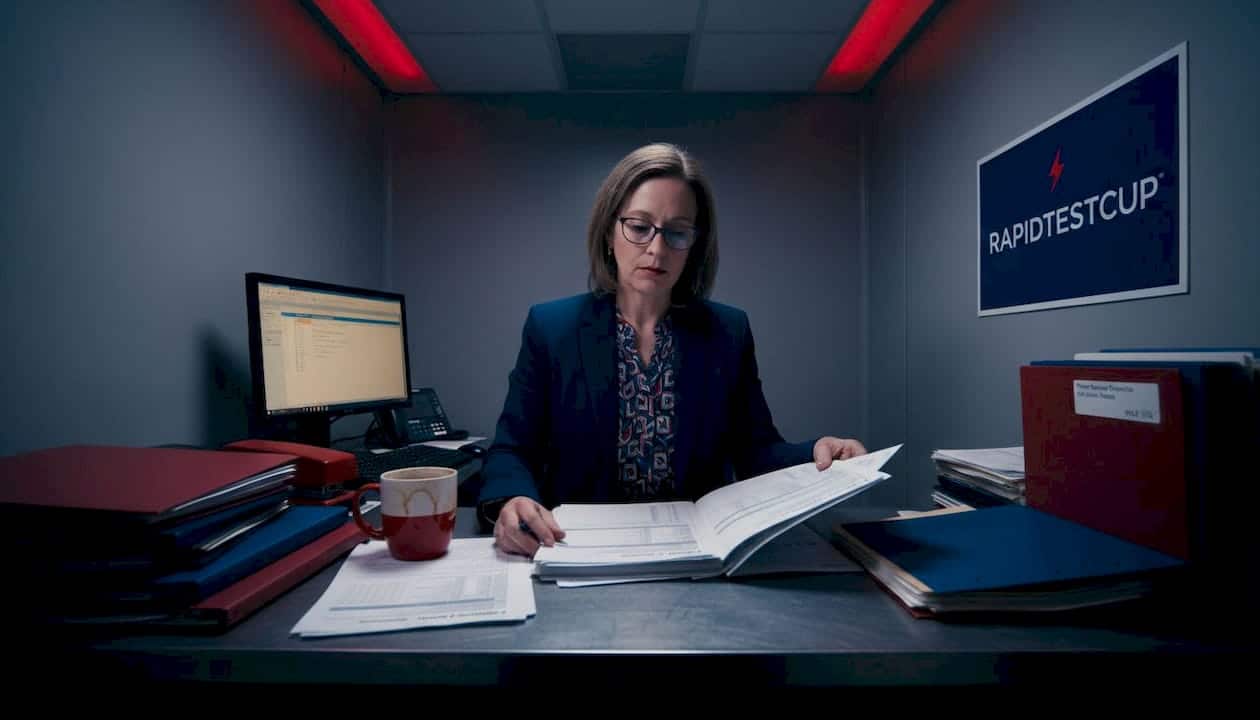
Electronic logging systems offer a significant advantage here. Digital records with automatic timestamps are harder to question than handwritten logs, and they allow faster retrieval when an inspector asks for records from 18 months ago. If your facility is still using paper logs exclusively, this is one area where a modest technology investment pays for itself quickly.
A well-documented efficient compliance workflow does not require complex systems. It requires consistent habits and a clear understanding of what auditors expect to see. Pairing your storage protocols with a broader forensic checklist gives your team a complete audit-preparation framework across all testing functions.
For reference, reviewing lab workflow samples from comparable settings can help you identify gaps in your current process and benchmark against industry standards.
The uncomfortable truth about test kit storage most labs overlook
Here is the thing that rarely gets said plainly: most storage compliance failures are not caused by ignorance. The labs that struggle know what the rules say. They have read the checklists. They have attended the training. What trips them up is something harder to fix than knowledge. It is a culture problem.
In busy substance abuse treatment facilities, testing is seen as urgent and patient-facing. Storage is invisible. Nobody celebrates the fact that the temperature log was completed correctly for the 300th consecutive day. But one missed log entry or one undocumented excursion can unravel months of otherwise solid work during an inspection.
We have seen well-intentioned labs lose accreditation not because they were storing kits in dangerous conditions but because their documentation was inconsistent. The actual storage environment was fine. The paperwork told a different story. Inspectors cannot evaluate what they cannot see in writing.
The culture shift required is genuinely difficult because it asks staff to treat administrative tasks with the same urgency as direct patient care. It means a lab manager who notices a missing log entry on Tuesday needs to treat it with the same seriousness as a chain-of-custody gap. That requires leadership to model the behavior, not just mandate it.
Reviewing best practice strategies regularly as a team, not just during onboarding, is one of the most practical ways to keep standards visible and expectations shared. The facilities that stay consistently compliant are the ones where storage documentation is treated as part of patient care. Because it is.
Equip your lab for accurate results and easy audits
Solid storage protocols are only as effective as the test kits you are starting with. CLIA waived, FDA-cleared products from a trusted supplier eliminate many of the variables that make compliance harder than it needs to be.
At rapidtestcup.com, we supply laboratories and substance abuse treatment centers with high-quality, professionally validated drug testing products designed for exactly this kind of environment. Whether you are evaluating new products or standardizing your existing inventory, our resources make that process straightforward. Use our compare top test kits tool to evaluate panels, cutoff levels, and storage requirements side by side. Or start with our detailed kit selection guide to match the right product to your facility’s specific testing needs and compliance requirements.
Frequently asked questions
How long must I keep temperature and humidity logs for test kit storage?
You must keep these records for at least 2 years to meet CLIA and CAP compliance requirements. Electronic systems make retrieval significantly faster during inspections.
What happens if the storage temperature exceeds manufacturer limits?
You must record the excursion, follow your defined corrective action protocol, and document the outcome in writing to remain compliant with CLIA and CAP standards. Undocumented excursions are treated as violations regardless of actual kit impact.
Do I need a dedicated room for drug test kit storage?
A dedicated, environmentally controlled space is strongly recommended because it allows consistent monitoring, prevents cross-contamination, and makes documentation straightforward. A shared supply closet with uncontrolled conditions is not an acceptable substitute.
Can I use standard household thermometers for storage monitoring?
No. Calibrated laboratory-grade devices are required for compliance. Consumer thermometers do not produce audit-ready records and cannot meet the accuracy standards CLIA and CAP inspectors expect to verify.