Blog
Occupational Health and Drug Testing: 2026 Compliance Guide


TL;DR:
- Workplace drug testing must adhere to strict federal regulations, including certified labs and licensed MROs, for legal defensibility. Proper program implementation requires a comprehensive, documented workflow covering policy, vendor selection, testing triggers, employee training, and regular audits. Common compliance failures stem from inadequate policies, uncertified labs, poor testing distribution, and bypassing MRO review, risking legal and operational consequences.
Occupational health and drug testing is defined as the systematic screening of employees for substance use to protect workplace safety, ensure regulatory compliance, and support employee well-being under federally governed protocols. Known formally as workplace drug testing programs, these systems operate under strict federal frameworks administered by SAMHSA and the Department of Transportation. Getting the protocols right matters more than most employers realize. A single procedural misstep, from using an uncertified lab to skipping Medical Review Officer review, can invalidate results, expose your organization to legal liability, and undermine the safety goals the program was designed to achieve.
What are the key drug testing protocols and regulatory requirements?

Federal workplace drug testing programs are governed by two separate mandatory guidelines: the Urine Mandatory Guidelines (UrMG) and the Oral Fluid Mandatory Guidelines (OFMG). Both are administered by the Department of Health and Human Services and enforced through agency-specific rules from DOT, FMCSA, and other federal bodies.
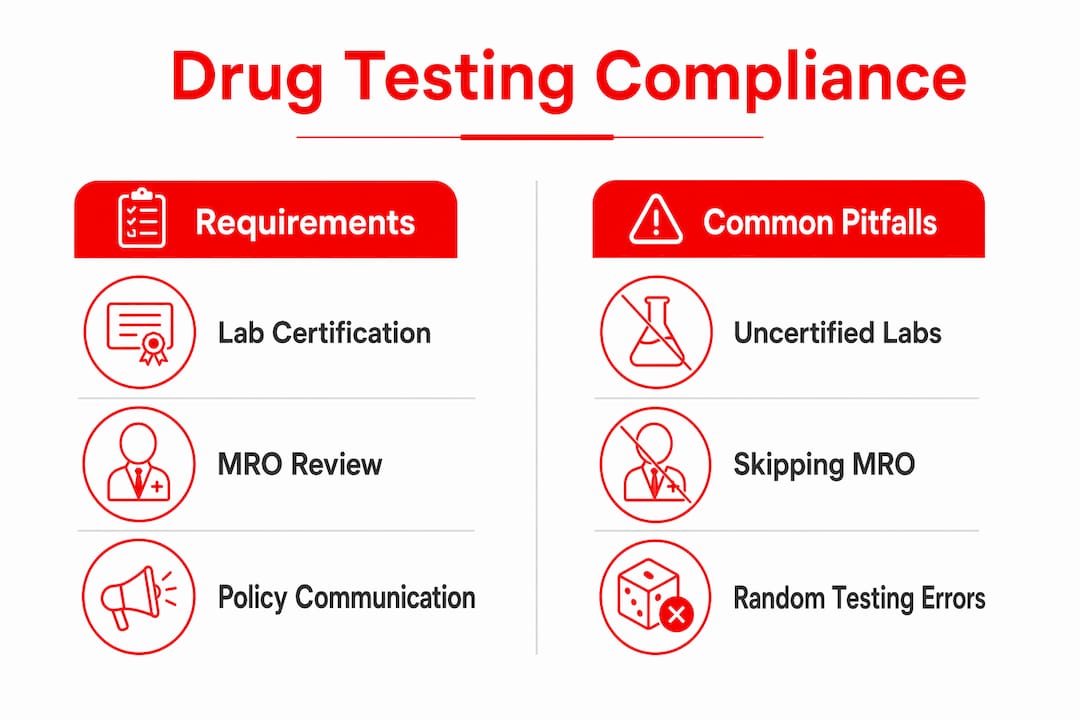
The cornerstone of regulatory compliance is lab certification. HHS-certified laboratories and MROs are mandatory for all federally regulated workplace drug testing programs. This is not a recommendation. It is a legal requirement. Using an uncertified lab produces results that cannot be defended in an audit or legal proceeding.
Medical Review Officers carry equal weight. MRO involvement is not an optional administrative step. It is an essential part of ensuring the accuracy and legal defensibility of federally regulated drug test results. An MRO reviews lab findings alongside the employee’s medical history and conducts a direct interview before confirming any positive result. This process exists specifically to catch legitimate medical explanations that would otherwise produce a false positive.
On the testing panel side, the 2026 Federal Register confirms no revisions to authorized panels and report nomenclature for federal urine and oral fluid drug testing, effective July 7, 2025. The standard Schedule I and II drug panels and biomarker cutoffs remain in place. That said, continuous governance routines are necessary to keep programs aligned with any future updates to testing panels and regulatory requirements.
For DOT-regulated employers, random testing carries specific rate obligations. 49 CFR §382.305 mandates a minimum 50% random drug testing rate annually, with draws spread across the calendar year to prevent bunching. Quarterly draws are the standard mechanism for meeting this distribution requirement.
| Requirement | Standard |
|---|---|
| Lab certification | HHS-certified facility required for all federal programs |
| MRO involvement | Licensed MRO must review and confirm all results |
| Random testing rate | Minimum 50% of average pool annually (DOT/FMCSA) |
| Testing panels | Schedule I and II drugs; no panel changes effective July 2025 |
| Specimen guidelines | Separate UrMG and OFMG standards apply |
Pro Tip: Cross-reference your lab’s credentials against the SAMHSA Certified Laboratory List before signing any vendor contract. Vendor marketing materials are not a substitute for official certification verification.
How do you design and implement an effective drug testing program?
A legally defensible drug testing program follows an 8-step operational workflow that covers policy creation, vendor contracting, MRO engagement, employee training, and audit preparation. Skipping steps does not save time. It creates gaps that surface during regulatory reviews.
Here is the core implementation sequence:
- Develop a written drug-free workplace policy. The policy must specify who is subject to testing, which substances are covered, when testing occurs, where specimens are collected, and what consequences follow a positive result. SAMHSA’s Model Plan is the standard framework for federal programs and a reliable starting point for private employers.
- Select an HHS-certified laboratory. Validate credentials using the official SAMHSA list, not vendor claims. Confirm the lab handles both initial testing and confirmation testing within the required workflow.
- Contract a qualified MRO. The MRO must be a licensed physician with specific training in federal drug testing regulations. Confirm their credentials independently.
- Establish a chain-of-custody process. Every specimen must be tracked from collection through final result. Gaps in chain-of-custody documentation are among the most common reasons results are challenged.
- Define testing triggers. Pre-employment, random, reasonable suspicion, and post-accident testing each carry different procedural requirements. Document the criteria for each trigger type separately.
- Train supervisors. Supervisors who authorize reasonable suspicion tests must be trained on objective, documented behavioral indicators. Training supervisors on objective, documented testing triggers and maintaining confidentiality build trust and reduce legal challenges to drug test results.
- Integrate an Employee Assistance Program. Drug testing programs integrated with EAPs improve outcomes by linking positive cases to support and rehabilitation rather than relying solely on disciplinary action. This also reduces the legal risk of termination-only responses.
- Schedule audits and policy reviews. Regulatory requirements change. Build an annual review cycle into the program calendar.
Pro Tip: Separating policy communication from testing execution reduces disputes about the appropriateness and timing of tests triggered by supervisors or safety concerns. Employees should receive the written policy before any testing begins, with a signed acknowledgment on file.
For detailed documentation workflows, the drug screening workflow guide from Rapidtestcup covers chain-of-custody and record-keeping requirements in practical terms.
What are the common compliance pitfalls and how do you avoid them?
Most compliance failures in workplace drug testing programs fall into three categories: improper lab selection, inadequate random testing distribution, and insufficient MRO engagement. Each carries distinct legal and operational consequences.
Lab selection errors are the most consequential. Employers who contract with non-HHS-certified facilities produce results that are inadmissible in federal proceedings. Selection of laboratories should not rely on vendor marketing claims. Employers must validate certifications using official SAMHSA listings to ensure compliance. The SAMHSA list is updated regularly and distinguishes between full HHS-certified labs and instrumented initial test facilities (IITFs), which serve different roles in the testing workflow.
Random testing distribution failures generate audit citations. Employers receive citations if testing falls below required rates, is poorly scheduled, or lacks proper documentation. The fix is straightforward: use a scientifically valid random selection method, conduct draws quarterly, and test employees immediately after notification with no delay between selection and specimen collection.
MRO shortcutting is a subtler problem. Some employers treat the MRO step as a rubber stamp. MROs assess validity and context before confirming results, evaluating lab findings alongside employee medical history and direct interviews. Bypassing this process or using unqualified reviewers exposes the organization to wrongful termination claims and regulatory sanctions.
The table below contrasts compliant and non-compliant practices across the most common failure points:
| Practice area | Compliant approach | Non-compliant approach |
|---|---|---|
| Lab selection | Verified via SAMHSA certified list | Based on vendor marketing or price alone |
| Random testing | Quarterly draws, 50% annual rate, immediate testing | Annual draws, under-testing, delayed collection |
| MRO review | Licensed physician reviews all results | Results reported directly without MRO involvement |
| Documentation | Chain-of-custody maintained throughout | Gaps in collection or transfer records |
| Policy communication | Written policy distributed and acknowledged | Verbal policy only, no signed acknowledgment |
For employers managing multiple testing vendors, coordinating reporting nomenclature and cutoff levels each year following federal updates is necessary to maintain program consistency and legal defensibility.
What testing methods are used and how do they compare?
Urine testing remains the most widely used specimen type in occupational health drug testing programs, primarily because it is the only modality with a complete federal regulatory framework under the UrMG. Oral fluid testing has gained ground since the OFMG took effect, particularly for post-accident and reasonable suspicion scenarios where observed collection is preferable.
Urine and oral fluid testing follow distinct mandatory guidelines set by HHS, with separate scientific standards and certification requirements for each. This means a lab certified for urine testing is not automatically authorized to process oral fluid specimens. Employers running both modalities must confirm dual certification.
The practical differences between specimen types matter for program design:
- Urine testing offers the longest detection window for most substances, typically 1 to 3 days for most drugs and up to 30 days for cannabis metabolites. It requires a private collection environment and is subject to adulteration attempts, making specimen validity testing a standard component.
- Oral fluid testing detects recent use more precisely, with a detection window of roughly 24 to 48 hours. Collection is observed, which eliminates adulteration risk and simplifies logistics. It is particularly effective for post-accident testing where recency of use is the key question.
- Hair testing provides the longest detection window, up to 90 days, but is not currently authorized under federal mandatory guidelines for DOT-regulated programs. It is used in non-DOT private employer programs.
- Blood testing is the most accurate for current impairment but is invasive, expensive, and rarely used outside of specific forensic or post-accident investigations.
Specimen validity testing is a required component of federal urine programs. Labs must test for creatinine, pH, and specific gravity to detect dilution, substitution, and adulteration. Employers using point-of-collection testing devices should confirm the product includes adulterant detection panels, particularly for high-stakes safety-sensitive roles.
For guidance on managing results across different specimen types, the drug test results management guide from Rapidtestcup covers confidentiality protocols and documentation requirements.
Key takeaways
A compliant occupational health drug testing program requires HHS-certified labs, licensed MRO review, written policies, and properly distributed random testing to be legally defensible and operationally effective.
| Point | Details |
|---|---|
| Lab certification is non-negotiable | Verify every lab against the SAMHSA Certified Laboratory List before contracting. |
| MRO review protects accuracy | Licensed MROs evaluate medical context to prevent false positives and legal challenges. |
| Random testing needs distribution | DOT programs require 50% annual testing rate with quarterly draws, not annual bunching. |
| Written policy precedes testing | Employees must receive and acknowledge the drug-free workplace policy before any test occurs. |
| Specimen type affects program design | Urine and oral fluid follow separate HHS guidelines; confirm lab certification for each modality used. |
Why most programs fail before the first test is ever run
I have reviewed a lot of workplace drug testing programs over the years, and the pattern that keeps appearing is not what most employers expect. The failures are almost never about the testing itself. They are about everything that happens before the specimen cup is opened.
The most common problem is treating the written policy as a formality. Employers draft a policy, file it, and assume the program is covered. But a policy that employees have never read, supervisors cannot explain, and managers apply inconsistently is not a policy. It is a liability document waiting to be used against you.
The second recurring issue is vendor selection based on price or convenience rather than verified compliance credentials. I have seen organizations contract with labs that were not on the current SAMHSA certified list, not because they were careless, but because they trusted the vendor’s self-reported credentials. The fix takes five minutes: check the list directly.
What actually works is integrating drug testing into a broader occupational health framework rather than running it as a standalone HR function. When testing connects to an EAP, when supervisors are trained on behavioral indicators rather than just told to “document everything,” and when employees understand the program as a safety measure rather than a surveillance tool, compliance rates improve and legal challenges drop. The workplace drug testing benefits are real, but they only materialize when the program is built correctly from the start.
Stay current with regulatory updates. The 2026 Federal Register confirmation of unchanged panels is reassuring, but that will not always be the case. Build a review cycle into your calendar and treat it as seriously as any other compliance obligation.
— Justin
Drug testing supplies built for occupational health programs
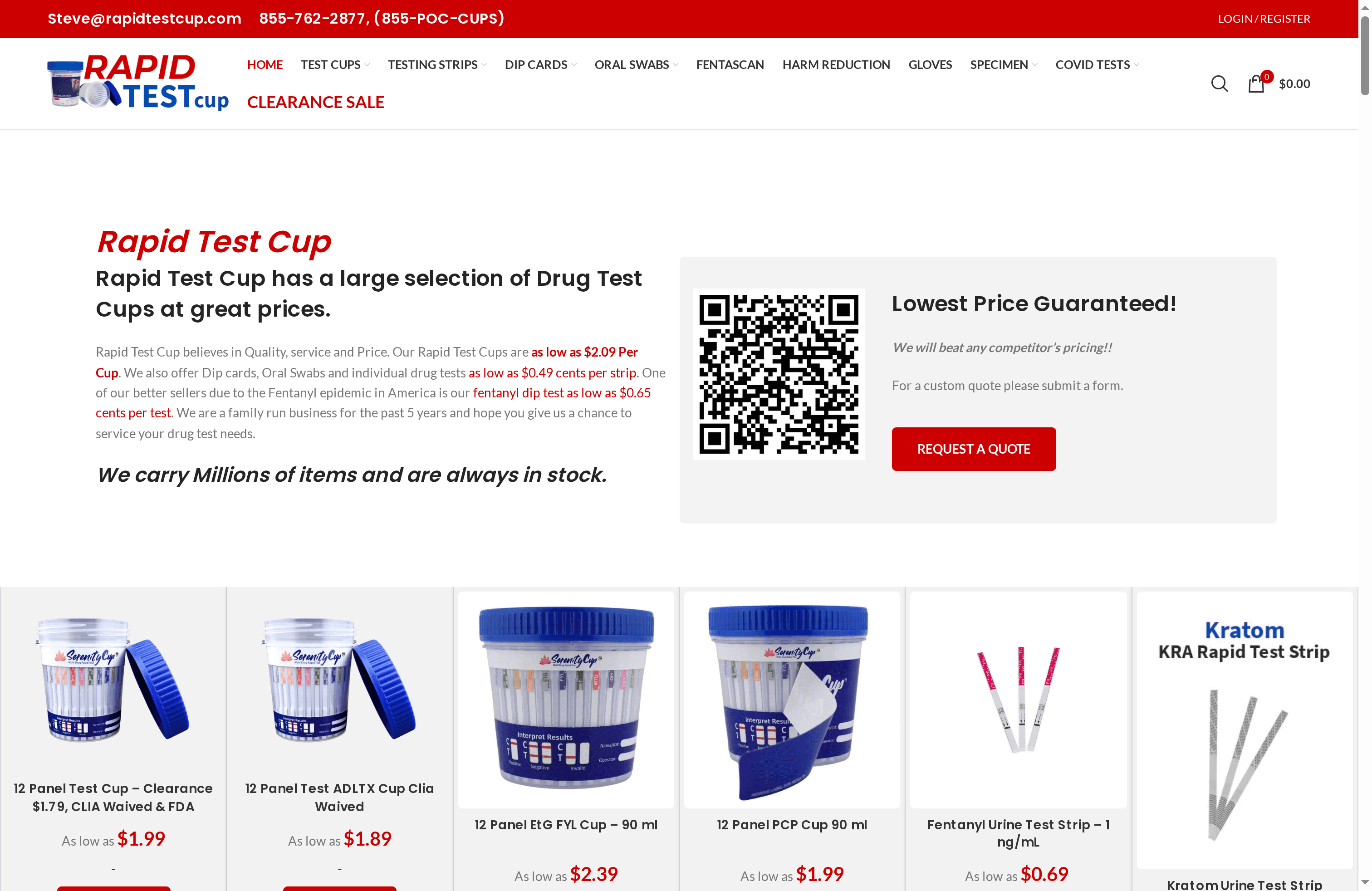
Rapidtestcup supplies occupational health programs, clinics, and employers with CLIA-waived, FDA-approved drug testing products designed for professional use. Whether you need multi-panel urine test cups with built-in adulterant detection or single-analyte strips for targeted screening, the catalog covers the full range of occupational testing needs. The top lab drug testing products page highlights the highest-performing options for 2026, including rapid test cups with panels ranging from 5 to 22 substances. For programs requiring adulterant detection alongside broad-spectrum screening, the 22-panel test with adulterants covers KRA, FYL, Zaza, Xyl, and more. Bulk pricing and fast shipping make Rapidtestcup a practical choice for high-volume occupational health operations.
FAQ
What is the difference between UrMG and OFMG in workplace drug testing?
The UrMG (Urine Mandatory Guidelines) and OFMG (Oral Fluid Mandatory Guidelines) are separate HHS frameworks governing federal workplace drug testing for each specimen type. Labs must hold distinct certifications for each modality, and employers cannot substitute one guideline for the other.
How often must DOT-regulated employers conduct random drug tests?
DOT regulations under 49 CFR §382.305 require employers to test at least 50% of their average driver pool annually, with selections spread across the calendar year through quarterly draws to prevent bunching.
What does a Medical Review Officer actually do?
An MRO is a licensed physician who reviews laboratory drug test results alongside the employee’s medical history and conducts a direct interview before confirming any positive result. This step prevents false positives from legitimate prescriptions or medical conditions.
How do I verify that my drug testing lab is federally certified?
Use the SAMHSA Certified Laboratory List, which is publicly available and updated regularly, to confirm that your lab holds current HHS certification. Do not rely on vendor-provided documentation alone.
Can employers use hair testing for DOT-regulated programs?
Hair testing is not currently authorized under federal mandatory guidelines for DOT-regulated programs. It is permitted for non-DOT private employer programs but operates outside the UrMG and OFMG frameworks.