Blog
Nevada Marijuana Testing Law: What Employers and Applicants Need to Know


Nevada law bars most employers from refusing to hire someone because a pre-employment screening test shows marijuana. The rule is NRS 613.132, and it has applied since January 1, 2020. It has exceptions for safety-sensitive jobs, and it does not make impairment at work acceptable. If you hire in Nevada, the practical answer is to know which of your positions are exempt, test the right people for the right reasons, and keep your screening process documented and consistent. The rest of this guide shows how.
TL;DR
- Under NRS 613.132, a Nevada employer may not fail or refuse to hire an applicant because a screening test indicates marijuana. The law took effect on January 1, 2020.
- Exempt positions: firefighters, emergency medical technicians, jobs that require driving where federal or state law requires screening, and jobs the employer determines could adversely affect the safety of others.
- If you test a new hire within the first 30 days, the employee may take an additional test at his or her own expense to rebut the result, and you must accept and give appropriate consideration to it.
- Off-duty lawful use is protected under NRS 613.333 only when it does not affect job performance or the safety of coworkers. Medical cardholders have a separate accommodation right under NRS 678C.850.
- Employers who test should use a screening process that is documented, consistent and matched to the job. Rapidtestcup supplies the cups, dip cards, strips and oral swabs for that work.
Table of Contents
- What the Nevada law actually says
- Who is exempt from the hiring protection
- Retest rights in the first 30 days
- Current employees: off-duty use, impairment and random testing
- Medical marijuana cardholders
- What this means for your testing program
- Supplies for Nevada employers, clinics and treatment programs
- Our perspective
- FAQ
- Sources
What the Nevada law actually says
The core rule is short. NRS 613.132(1) makes it unlawful for an employer in Nevada to fail or refuse to hire a prospective employee because a screening test indicates the presence of marijuana.
The statute defines a “screening test” in subsection 5. It means a test of a person’s blood, urine, hair or saliva to detect the general presence of a controlled substance or any other drug. That covers the common formats an employer would use: urine cups and dip cards, oral swabs, and laboratory hair or blood panels. The format does not change the rule.
The bill behind it was Assembly Bill 132, passed in the 2019 Legislative Session. The 2019 Statutes of Nevada describe it as an act prohibiting the denial of employment because of the presence of marijuana in a screening test taken by a prospective employee, with certain exceptions, and allowing an employee to rebut the results of a screening test under certain circumstances. The Nevada Labor Commissioner’s AB 132 guide, updated in November 2023, confirms the January 1, 2020 effective date and that the bill added NRS 613.132 to Chapter 613.
What the law does not say
The statute is about hiring. It does not ban drug testing in general, and it does not bar you from testing applicants for other substances such as opioids, amphetamines, cocaine or fentanyl. The prohibition attaches to the hiring decision: you may not turn someone down because of the marijuana result.
It also does not legalize being under the influence on the job. Nothing in NRS 613.132 stops you from setting and enforcing rules on impairment at work. The next sections cover where that line sits.
Who is exempt from the hiring protection
The exceptions matter more to most employers than the rule itself. Under NRS 613.132(2), the prohibition does not apply to four categories of positions:
- Firefighter positions, as defined in NRS 450B.071.
- Emergency medical technician positions, as defined in NRS 450B.065.
- Positions that require operating a motor vehicle, where federal or state law requires screening tests.
- Positions that, in the determination of the employer, could adversely affect the safety of others.
Subsection 4 adds three more situations where the provisions do not apply: to the extent they conflict with an employment contract or collective bargaining agreement, to the extent they conflict with federal law, and for a position funded by a federal grant.
How to read the exemptions
The fourth category is the broadest, because it turns on the employer’s determination. That does not mean every job qualifies. A sensible approach is to decide by position, in writing, before you post the job, and to be able to say why the role could affect the safety of others: heavy equipment, work with vulnerable people, handling hazardous materials, or similar duties.
The driving exemption is narrower. It covers positions where federal or state law actually requires screening. A job that merely involves occasional errands in a personal vehicle is not the same as a commercial driver position under federal rules. If you are unsure which category a role falls into, ask a Nevada employment attorney before you apply a marijuana-based hiring decision.
| Situation | Hiring protection applies? | Basis |
|---|---|---|
| Office, retail or hospitality applicant | Yes | NRS 613.132(1) |
| Firefighter applicant | No | NRS 613.132(2)(a) |
| EMT applicant | No | NRS 613.132(2)(b) |
| Driver role where law requires screening | No | NRS 613.132(2)© |
| Role the employer determines could affect others’ safety | No | NRS 613.132(2)(d) |
| Role funded by a federal grant | No | NRS 613.132(4) |
| Role covered by a conflicting contract or union agreement | To the extent of the conflict | NRS 613.132(4) |
Retest rights in the first 30 days
The law gives new employees a specific tool. NRS 613.132(3) says that if an employer requires an employee to take a screening test within the first 30 days of employment, the employee has the right to take an additional screening test at his or her own expense to rebut the results of the initial test. The employer must accept the results and give them appropriate consideration.
For an employer, this changes how you handle a positive result on a rapid test:
- Treat a positive on a point-of-care device as a preliminary screening result, not a final finding about the person.
- Tell the employee about the right to an additional test, in writing, when you give notice of the result.
- Keep the employee’s rebuttal result with the original in the file, and document how you considered it.
This is also where your choice of device matters. A rapid screen is designed to give a fast, presumptive answer. Confirmation of a presumptive positive normally goes to a laboratory. Our guide to interpreting lab drug test results walks through that step.
Current employees: off-duty use, impairment and random testing
Hiring and employment are governed by different parts of the statute book. For people already on your payroll, the main provision is NRS 613.333. As the Nevada Department of Employment, Training and Rehabilitation explains in its advisory opinion, it is an unlawful employment practice to fail or refuse to hire a prospective employee, or to discharge or otherwise discriminate against any employee, because the employee engages in the lawful use in this state of any product outside the premises of the employer during nonworking hours. The protection applies only if that use does not adversely affect the employee’s ability to perform the job or the safety of other employees.
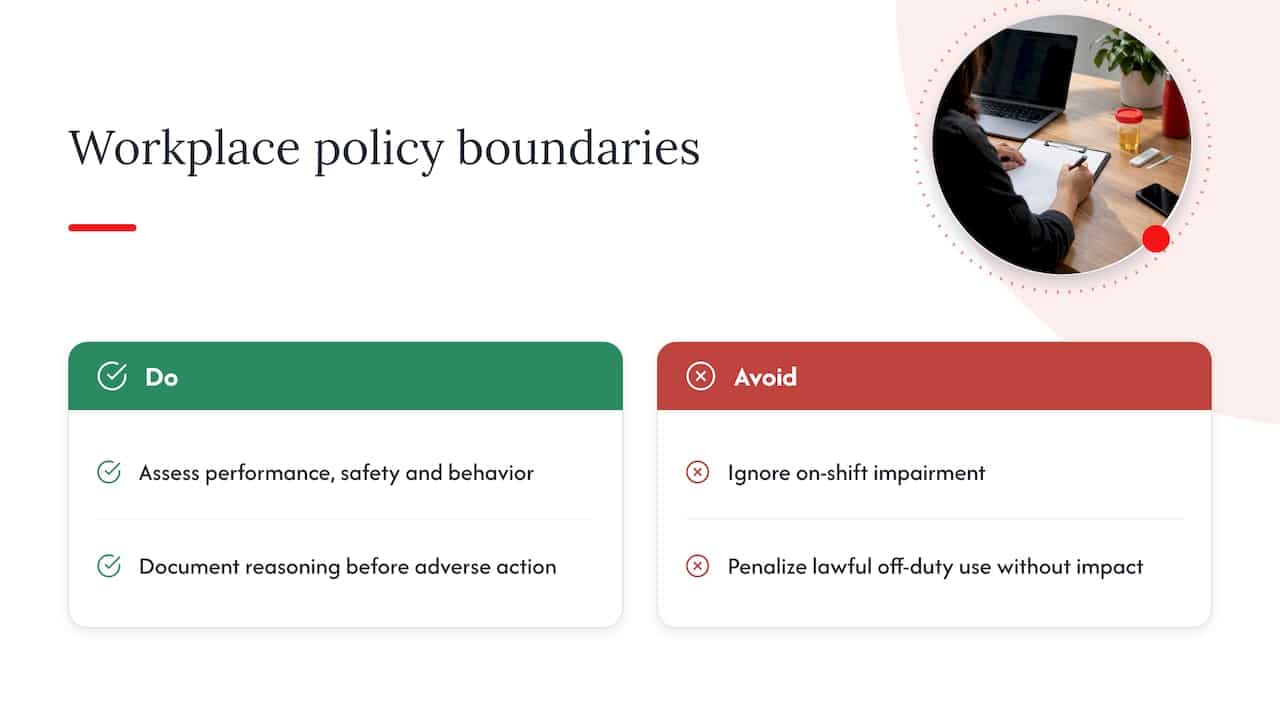
The qualifier is what gives you room to act. You are not asked to tolerate someone who is impaired on shift or whose use affects safety. Your policy should focus on the conditions that matter: performance, safety and behavior at work.
The same advisory opinion notes that under NRS 613.333(3) the court shall award reasonable costs, including court costs and attorney’s fees, to the prevailing party, and that subsection 4 makes this remedy exclusive. That cost-shifting is a reason to document your reasoning before any adverse action.
Random and reasonable-suspicion testing
The statutes cited here do not set a general rule on random testing for private employers. What they do is shape what you can do with a result. A policy that tests for cause, such as after an accident or when a supervisor documents specific signs of impairment, gives you a record tied to job performance and safety. A policy that treats any positive as grounds for dismissal, without that tie, is harder to defend under NRS 613.333. Our pieces on legal considerations for drug testing at work and workplace drug test compliance cover how to build that record.
A marijuana screen also has a built-in limit that fits this law. Common urine screens detect metabolites that can remain after use, so a positive tells you about past exposure, not about impairment right now. Oral fluid tests tend to reflect more recent use. Our comparison of urine and saliva drug tests explains which specimen suits which purpose.
Medical marijuana cardholders
Nevada treats registered medical cannabis patients separately. In Freeman Expositions, LLC v. Eighth Judicial District Court (138 Nev. Adv. Op. 77, December 1, 2022), the Nevada Supreme Court held that NRS 678C.850(3) gives employees a private right of action where an employer does not provide reasonable accommodation for off-site, off-hours medical cannabis use. The court’s opinion also held that NRS 613.333 does not support a discrimination claim for medical cannabis use as a lawful product, because cannabis possession remains illegal under federal law.
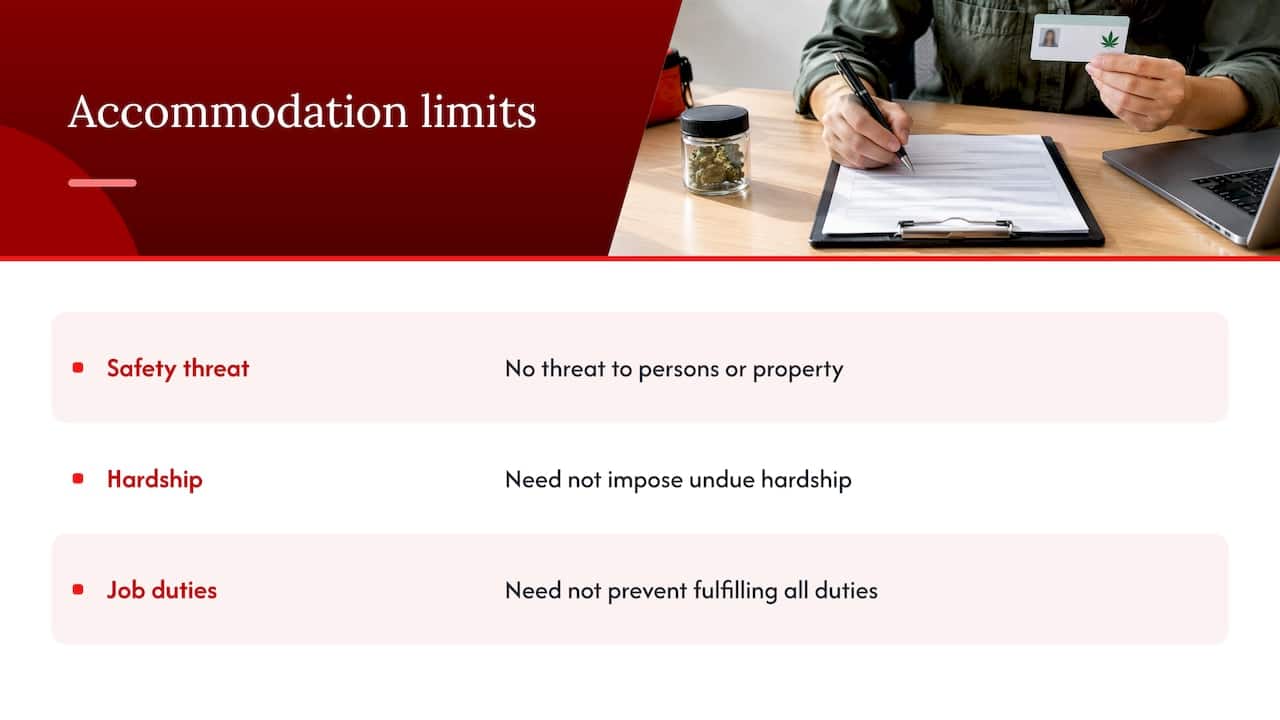
In practice, for a cardholder with a valid registry identification card, the employer must try to make reasonable accommodations for the employee’s medical needs. NRS 678C.850(3) sets limits: the accommodation need not pose a threat of harm or danger to persons or property, impose an undue hardship on the employer, or prevent the employee from fulfilling all job responsibilities. If a cardholder tests positive, the sound response is a documented conversation about accommodation, not an automatic decision. For a specific case, speak to a Nevada employment attorney.
What this means for your testing program
A lawful program in Nevada is mostly a matter of separating decisions. The test tells you what substances are present. The law governs what you may do about each result. Three habits keep the two apart.
Decide by position, in advance
List your roles and mark which fall under the exemptions in NRS 613.132(2) and (4). Record the reason. Applicants for non-exempt roles can still be screened for other substances, but a marijuana-only positive cannot be the reason you decline to hire.
Choose a panel that matches the role
For an exempt role, a standard multi-panel screen that includes THC is appropriate. For a non-exempt role, some employers choose a panel built around the substances they act on. Rapidtestcup sells multi-panel test cups, dip cards, urine test strips and oral swabs, so the panel can match the policy. Our workplace drug testing best practices guide covers panel selection in more detail.
Keep the process consistent and written
Use the same collection steps, the same cutoffs and the same notice language for every candidate in the same job category. Our drug screening workflow guide lays out a sequence from collection to result, and how to manage drug test results in the workplace covers what to do after a presumptive positive. If you collect specimens on site, see how to conduct workplace drug testing effectively.
Supplies for Nevada employers, clinics and treatment programs
Employers, occupational health providers, clinics and treatment programs buying screening supplies can find them in the Rapidtestcup shop. The catalog includes test cups, dip cards, urine test strips, oral swabs, urine specimen cups and fentanyl tests, with CLIA waived and FDA-approved options and bulk pricing. We offer custom quotes for larger orders and state same-day shipping.
For an employer who needs a broad urine screen, a 15 panel cup with adulterant checks is one example. For quick on-site screening, the 10 panel dip card is another, and a 5 panel oral swab suits programs that prefer oral fluid.
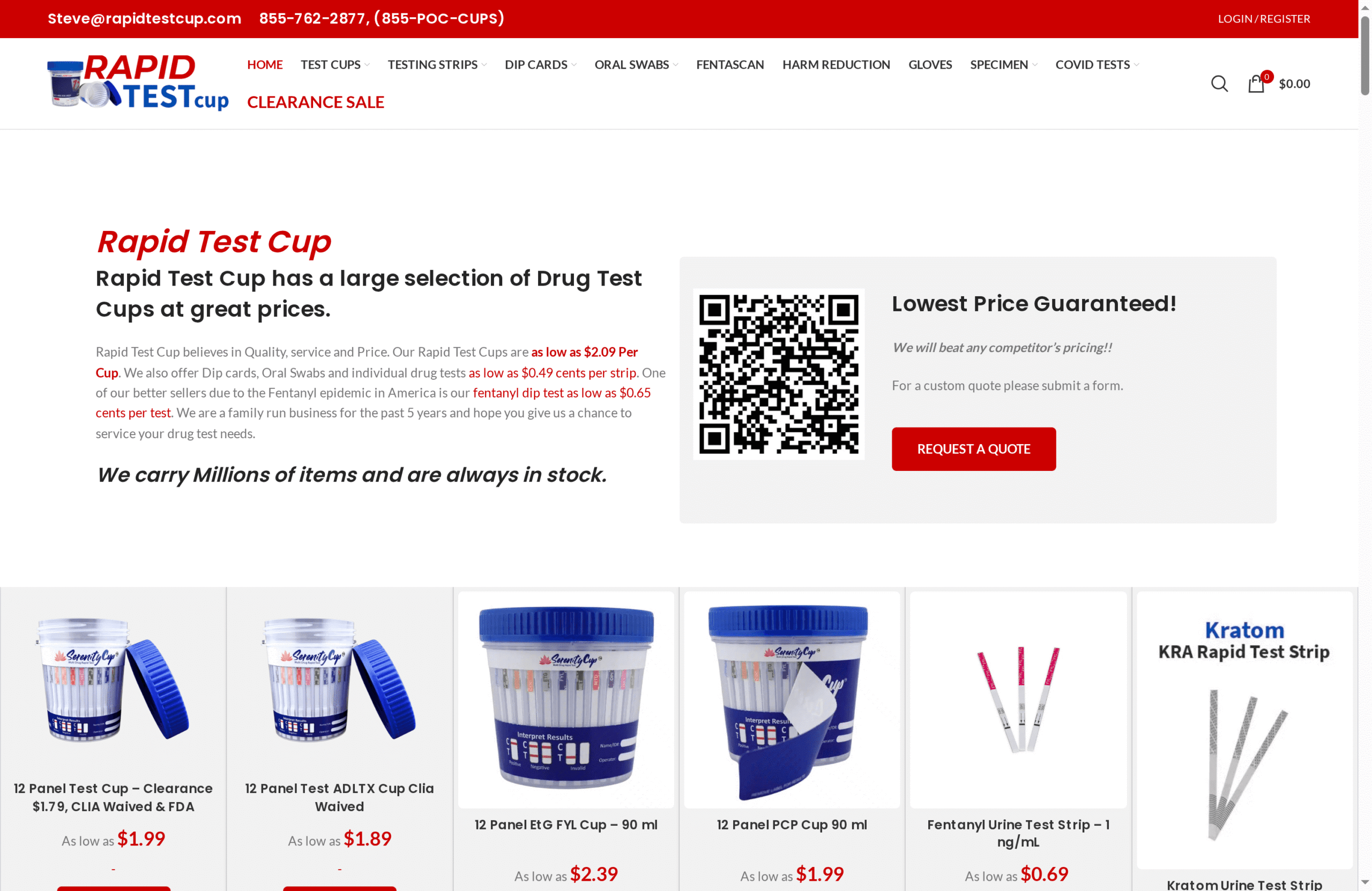
Browse the full range at rapidtestcup.com or ask for a quote on bulk quantities.
Our perspective
Most of the questions we hear about Nevada’s law come down to one worry: does this mean we cannot test anymore? It does not. The law removes one thing, a marijuana-only positive as a reason to refuse an applicant in a non-exempt job. Everything else about a well-run screening program still stands.
What the law rewards is discipline. Decide which roles are exempt before you post them. Choose a panel that fits the policy you can defend. Treat a rapid result as a screen, give new hires the 30-day rebuttal right the statute describes, and write down what you did and why.
That is where good supplies help. A dependable cup, dip card or swab, a clear collection routine and a clean paper trail turn a legal requirement into an ordinary part of hiring. We stock CLIA waived and FDA-approved options across cups, cards, strips and swabs, with bulk pricing, so a clinic or HR team can standardize on one routine and reorder it without fuss.
This article is general information, not legal advice. For a specific hiring decision, a Nevada employment attorney is the right person to ask.
Justin
FAQ
Can a Nevada employer test applicants for marijuana at all?
The statute bars refusing to hire because a screening test indicates marijuana. It does not ban the test itself. Employers also remain free to test for other substances, and exempt positions, such as firefighters and EMTs, are outside the hiring protection.
What if a new hire tests positive in the first 30 days?
Under NRS 613.132(3), an employee tested within the first 30 days may take an additional screening test at his or her own expense to rebut the first result. The employer must accept that result and give it appropriate consideration. Document both results and your review.
Does the law protect medical marijuana cardholders?
Nevada’s NRS 678C.850(3) requires employers to attempt reasonable accommodation for cardholders, within limits such as safety and undue hardship. The Nevada Supreme Court confirmed a private right of action for this in 2022. Each case turns on facts, so involve an employment attorney.
Can I still discipline an employee for being impaired at work?
Yes. NRS 613.333 protects lawful off-duty use only when it does not adversely affect job performance or coworker safety. Impairment on shift, or use that affects safety, falls outside that protection. Record specific observations and the policy you applied.
Sources
- NRS Chapter 613, Employment Practices (Nevada Legislature)
- AB 132 Guide to the Marijuana Testing Bill (Nevada Labor Commissioner)
- 2019 Statutes of Nevada, pages 2625 to 2804
- Advisory Opinion 20-1 (Nevada Department of Employment, Training and Rehabilitation)
- Freeman Expositions v. Eighth Judicial District Court, 138 Nev. Adv. Op. 77