Blog
Urine Oxidants Test: What It Detects and How to Read It


A urine oxidants test checks whether a sample contains a chemical that can destroy or alter drugs and their metabolites, the breakdown products a drug test looks for. Labs run it as one of several specimen validity checks, and a positive result tells you the sample is suspect, not which chemical was used. If you collect urine for screening, the practical answer is to pair your drug panel with adulterant checks at the point of collection, so a tampered sample is flagged before it is accepted. That is why we stock cups and dip cards with built-in adulterant panels alongside standard drug panels.
TL;DR
- Oxidants are chemicals such as nitrite, chromium(VI) compounds, halogens (bleach is one example) and glutaraldehyde that can break down drug molecules in a urine sample.
- In federal workplace testing, every urine specimen gets one or more oxidant validity tests. The current HHS guidelines took effect February 1, 2024.
- A general oxidant test is a nonspecific screen: it signals that an oxidant may be present, but a lab needs a second, specific test before reporting a specimen as adulterated.
- Some substances that are not tampering, such as ascorbic acid and concentrated cranberry extract, can disturb the result, so interpretation matters.
- For on-site collection, choose a cup or dip card that includes adulterant checks, and follow a written collection routine.
Table of Contents
- What an oxidant in urine actually is
- Why oxidants are tested at all: specimen validity testing
- What the rules say, and what applies today
- How a lab runs the test
- Reading a result: what positive and negative mean
- Oxidant checks at the point of collection
- Who needs what
- Our perspective
- Where to get adulterant-equipped tests
- FAQ
- Sources
What an oxidant in urine actually is
In chemistry, an oxidant is a substance that transfers oxygen atoms or accepts electrons. In drug testing, that property is the problem. According to the National Laboratory Certification Program (NLCP), a federal program that oversees certified drug-testing labs, oxidants can change or destroy the molecular structure of drugs and metabolites. They can also interfere with the immunoassay (the antibody-based screening method used by cups and lab analyzers) and with confirmatory testing.
The NLCP’s 2025 overview of specimen validity testing lists nitrite, chromium(VI) compounds, halogens and glutaraldehyde among the oxidizing adulterants known to interfere with drug tests. Common household sources include bleach and some cleaning products. Nitrite-based products are sold specifically to defeat cannabis (THC) testing, because the oxidation makes THC metabolites harder to detect.
Normal urine does not contain meaningful amounts of these chemicals. A person cannot produce a high oxidant reading through diet or normal metabolism, which is why a strongly elevated reading is taken seriously. The sections below explain why it still cannot be read in isolation.
Why oxidants are tested at all: specimen validity testing
A drug screen only means something if the sample is real, undiluted and unaltered. Specimen validity testing (SVT) checks exactly that. The SAMHSA Medical Review Officer Guidance Manual (2024), written for the physicians who review federal drug test results, says federal urine testing includes:
- creatinine and pH on each specimen;
- specific gravity when creatinine is below 20.0 mg/dL;
- one or more oxidant tests.
Creatinine and specific gravity reveal dilution. pH catches strongly acidic or alkaline additives. The oxidant test catches chemicals that chemically attack the drug in the sample. Together they cover the main routes by which people try to alter a specimen: adding water, adding a chemical, or swapping in a substitute.
If you want a plain-language walkthrough of this on the collection side, our guides to urine specimen validity and what urine adulteration is cover the categories in more depth.
What the rules say, and what applies today
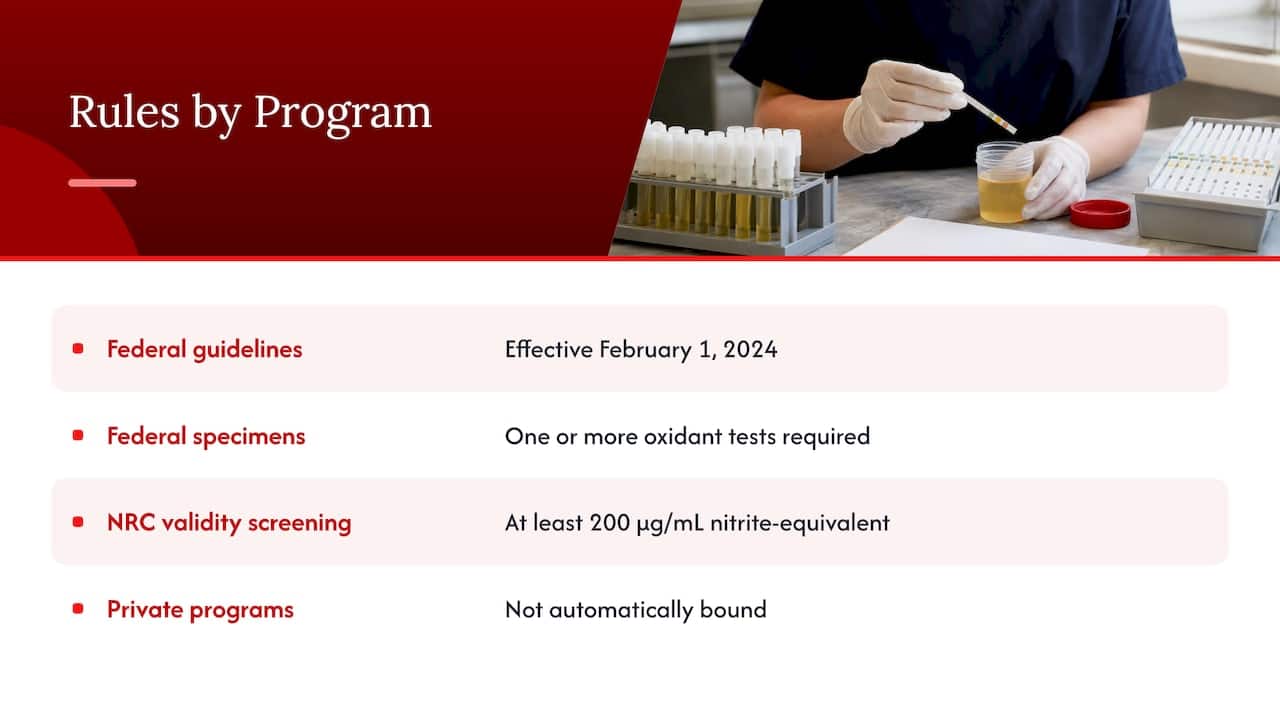
For federal agency testing, the HHS Mandatory Guidelines for Federal Workplace Drug Testing Programs using Urine took effect on February 1, 2024. They require one or more oxidant validity tests on every federal agency urine specimen. They also distinguish oxidant-related findings and set specific initial and confirmatory criteria that must be met before a specimen is reported as adulterated.
Those guidelines are the latest HHS urine guidelines we located, and no source we reviewed shows a newer change to the oxidant requirements. Check the HHS and SAMHSA pages for any update before you write or revise a policy.
Some other regulated programs set their own numbers. The Nuclear Regulatory Commission’s rule at 10 CFR 26.137 says that for covered licensee testing facilities that use validity screening, the oxidant test must determine concentrations at or above 200 µg/mL nitrite-equivalent, and it specifies controls and performance challenges around the applicable cutoffs.
These rules bind federal agencies, certain regulated industries and the labs that serve them. A private employer, clinic or treatment program is not automatically bound by them, but many use them as a model for their own policy because they are well documented and widely accepted.
How a lab runs the test
Lab oxidant testing usually has two stages.
Stage 1: the general oxidant screen. The NLCP describes a common approach as a semiquantitative general-oxidant test run on an autoanalyzer, an automated chemistry instrument. It is usually calibrated with nitrite and reported in nitrite-equivalents, meaning the result says “this sample reacts as strongly as X µg/mL of nitrite,” not that nitrite is necessarily what is there.
The chemistry is a color reaction. Siemens’ assay instructions describe a substituted-benzene reaction that produces a color complex measured by spectrophotometer at about 660 nm. A 2021 peer-reviewed comparison of methods describes general oxidant detection on automated analyzers using a reaction between tetramethylbenzidine and an oxidant.
Stage 2: the specific, quantitative confirmation. To report a specimen as adulterated, the NLCP overview says a different, specific and quantitative test is needed. For nitrite that might be a method that measures nitrite itself. Only when that confirmatory result meets the criteria does the lab report adulteration.
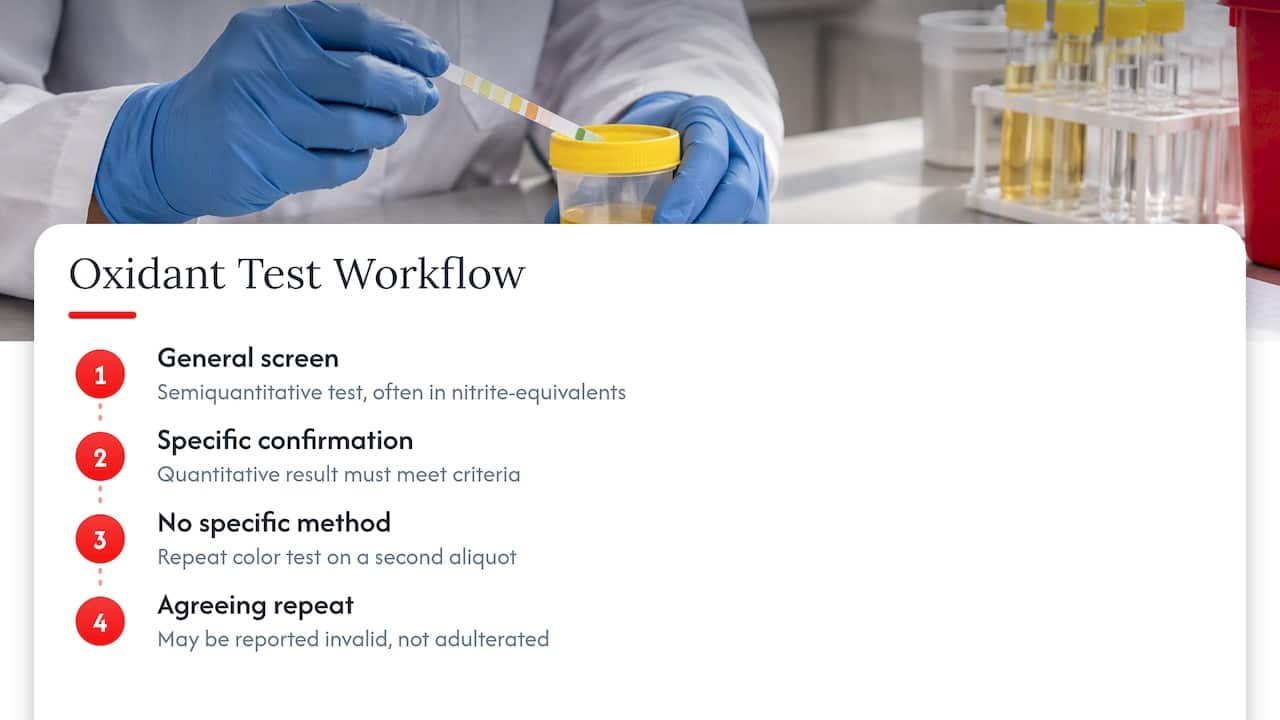
Some labs lack specific confirmation methods. The NLCP notes that these labs may repeat the general oxidant colorimetric test on a second aliquot (a separate portion of the same sample) and, if the findings agree, report the specimen as invalid rather than adulterated. “Invalid” means the specimen could not be tested reliably. It is a different outcome from “adulterated,” and your policy should treat the two differently.
Reading a result: what positive and negative mean
A positive screen is a flag, not a verdict
The general oxidant assay is nonspecific. The NLCP states that a positive screen does not by itself identify which oxidant is present. That is why the confirmation stage exists. In practice, treat a positive oxidant screen as a reason to collect a fresh specimen under direct observation rules your policy allows, or to send the specimen on for confirmation, not as proof of tampering on its own.
Things that can disturb the reading
Siemens’ instructions list several limits worth knowing:
- variation in urinary buffer or other constituents can affect results;
- some oxidants diminish over time, so an old or poorly stored sample may read lower than it did when collected;
- concentrated cranberry extract may cause a positive result;
- ascorbic acid (vitamin C), an antioxidant, interferes with the assay.
The vitamin C point cuts the other way from what people expect. An antioxidant can mask the signal of an oxidant, which is one reason labs validate their methods and run controls. The practical lesson for collectors: record the time of collection, keep the sample sealed, and get specimens to testing promptly.
A negative result
A negative oxidant result means the sample did not react above the test’s threshold. It does not guarantee the sample is clean in every respect, which is why oxidant testing sits alongside creatinine, specific gravity and pH rather than replacing them.
Oxidant checks at the point of collection
Lab SVT happens after the specimen arrives. Many programs, including clinics, treatment centers, probation offices and employers using on-site screening, also want a check at the moment of collection, so a tampered sample is caught while the donor is still there and a recollection is easy.
That is where multi-panel cups and dip cards with adulterant strips help. They put validity checks on the same device as the drug panel, so the person reading the result sees both at once. Our 15-panel cup with adulterants and 18-panel cup with adulterants are examples of that format. If you only need a nitrite reading explained, our page on the nitrite drug test and its cutoffs goes into it, and the nitrite adulterant test workflow follows a sample from cup to bench.
A simple routine that works
- Prepare the collection area. Remove or secure anything the donor could add to the sample, and keep unneeded personal items out of the room.
- Hand over a sealed, unopened cup. The donor sees it opened, so there is no question of a pre-treated container. Our adulteration prevention checklist lays out the full sequence.
- Check the specimen immediately. Read the adulterant section of the device within the time stated in its instructions, along with the drug panel.
- Act on a flag the same day. If an adulterant line looks abnormal, follow your written policy: recollect, send to a lab for confirmation, or both.
- Document. Record time, temperature if your device reads it, who handled the sample, and what was done next.
On step 4, the key point from the lab section holds here too: a device flag is a screening signal. If the result will affect someone’s job, supervision status or treatment plan, send the specimen for lab confirmation and, where your program uses one, have a medical review officer look at it.
Who needs what
| Setting | What matters most | Typical choice |
|---|---|---|
| Federal or federally regulated workplace | Follow HHS or agency rules, certified lab SVT | Certified lab handles the oxidant test |
| Private employer or occupational health | Written policy, consistent collection, confirmation for non-negative results | On-site multi-panel cup with adulterants, then lab confirmation |
| Treatment center or clinic | Frequent testing, fast turnaround, same-visit recollection | Cups or dip cards with adulterant checks |
| Law enforcement and probation | Chain of custody, documentation | Cups with adulterant panel plus lab confirmation |
| Individual testing for yourself | Clear reading, correct sample handling | Standard multi-panel cup |
Whether you choose a cup or a card is mostly about volume and workflow. Our comparison of cups and dip cards walks through it.
Treatment is part of the picture for many programs. Employers and counselors whose people need a referral in California can look at substance use treatment facilities in California as a starting point for options.
Our perspective
We run a family business, and the question we hear most from labs, clinics and employers is simple: how do I know the sample I am testing is the sample I think it is? Oxidants are the clearest example of why that question matters. A drug can be present and still go undetected because something in the cup destroyed it.
Our view is that the best protection is a habit, not a gadget: check validity every time, at collection, with the same care you give the drug result. That is why we put adulterant-equipped panels in our catalog and why our guides explain what each check means. A reader should be able to look at a flagged result and know what the next step is.
We also think this should not be expensive. We stand behind our claim of the lowest prices on drug test cups and supplies, with same-day shipping, a large inventory kept in stock and bulk discounts, because programs that test often should not have to ration validity checks to control costs.
Justin
Where to get adulterant-equipped tests
If you collect urine on site, start with a panel that includes adulterant checks so every screen is also a validity check. We carry multi-panel cups, dip cards, urine strips, oral swabs and specimen collection supplies, including CLIA-waived and FDA-approved options, with bulk pricing and custom quotes for larger programs. A good place to begin is the 15-panel test with adulterants, or browse the full range in our shop.
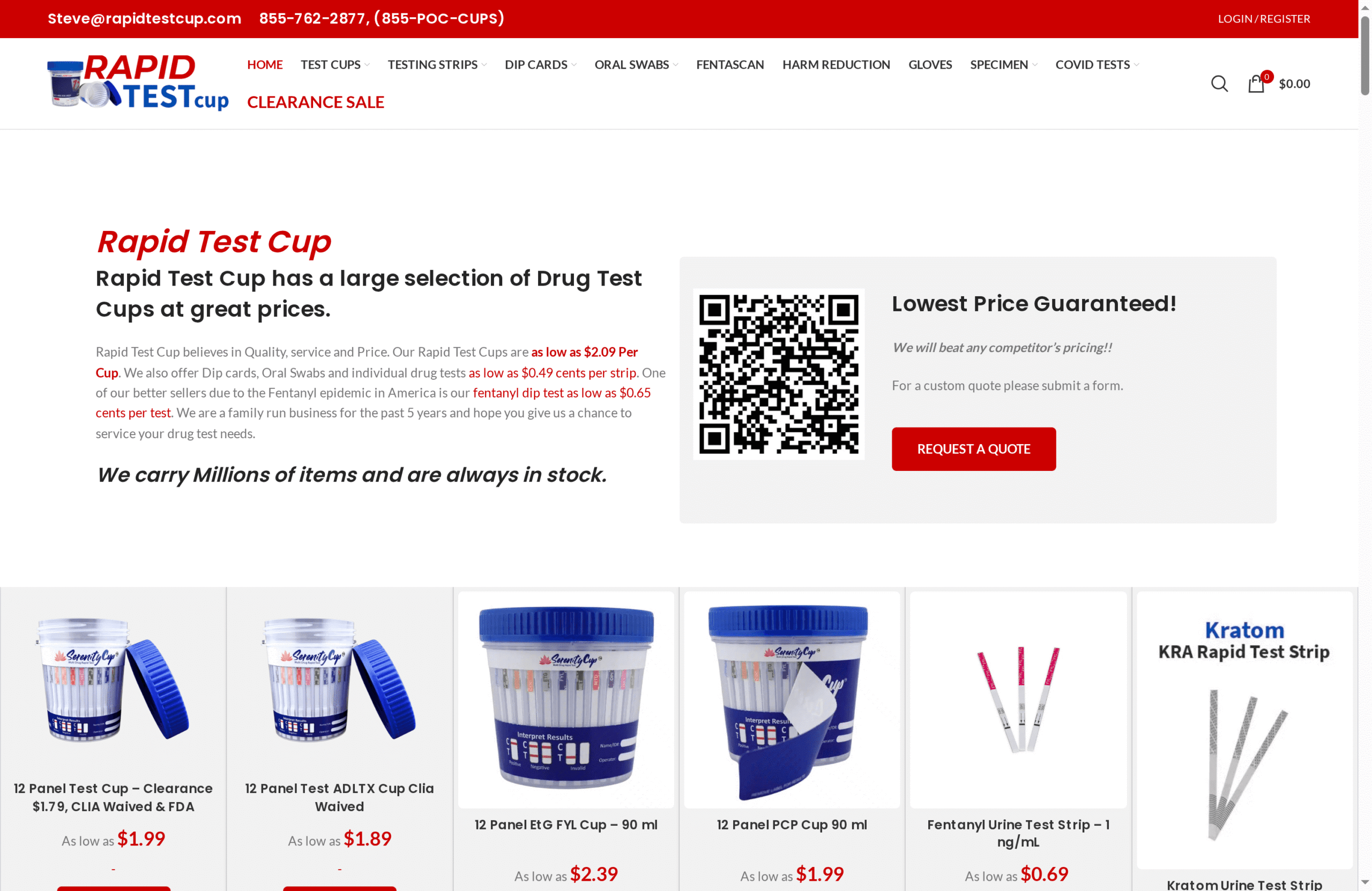
If you need the same device in volume for a clinic, treatment program or workplace, ask us for a custom quote and we will work from your testing schedule.
FAQ
What does a urine oxidants test detect?
It detects chemicals that can chemically alter or destroy drugs and their metabolites in a urine sample, such as nitrite, chromium(VI) compounds, halogens and glutaraldehyde, as listed in the NLCP’s 2025 overview. It is a general screen, so it shows that an oxidant may be present but not which one.
Is an oxidants test required for every urine drug test?
For federal agency urine testing, yes: the HHS guidelines effective February 1, 2024 require one or more oxidant validity tests on every specimen. Private employers set their own policies, and many adopt the same approach. Check any state or industry rules that apply to you.
Can vitamins or food cause a positive oxidant result?
The Siemens assay instructions say concentrated cranberry extract may cause a positive result. They also say ascorbic acid interferes with the assay. Because of this, a positive screen should be confirmed before anyone draws conclusions.
What is the difference between adulterated and invalid?
Adulterated means a specific, quantitative confirmatory test met the criteria for a particular adulterant. Invalid means the specimen could not be tested reliably, for example when a lab without confirmation methods repeats the general oxidant test and finds consistent abnormal results. Your policy should say how each outcome is handled.
Sources
- NLCP: Validating Specimen Validity Testing (2023)
- NLCP: An Introduction to Specimen Validity Testing in Workplace Drug Testing (2025)
- Federal Register: Mandatory Guidelines for Federal Workplace Drug Testing Programs
- SAMHSA: Medical Review Officer Guidance Manual for Federal Workplace Drug Testing Programs (2024)
- Siemens Healthineers: oxidant validity assay instructions (2020)
- Comparison of different methods used in drugs of abuse testing (2021)
- NRC: 10 CFR 26.137 Quality assurance and quality control