

Blog
Bulk Testing Implementation Steps for Lab Managers


TL;DR:
- Bulk testing involves structured, validated steps to ensure reliable and compliant analysis of large sample volumes. Proper preparation with test maps, validated methods, and accredited labs prevents delays and audit failures, while disciplined documentation maintains ongoing quality assurance. Addressing common challenges with barcode systems, standardized workflows, and early planning improves throughput and reduces errors in high-volume testing.
Bulk testing implementation steps are the structured, validated actions lab managers and healthcare professionals must follow to test large sample volumes reliably and in compliance with regulatory standards. In pharmaceutical and clinical settings, this process spans from sample receipt through Certificate of Analysis (COA) issuance, governed by frameworks including GMP, ISO 17025, and UKAS accreditation. Getting these steps right the first time prevents batch release delays, audit failures, and costly rework. This guide lays out the full procedure, from prerequisites to troubleshooting, so your lab can run high-volume drug testing with confidence.
What are the bulk testing implementation steps?
Bulk testing implementation, known in regulated industries as batch release testing or finished product testing, is a GMP-compliant end-to-end process that begins at sample receipt and ends with COA issuance. That scope matters because many lab managers treat testing as a final checkpoint rather than a structured workflow. The result is compliance gaps that surface during audits, not before them.
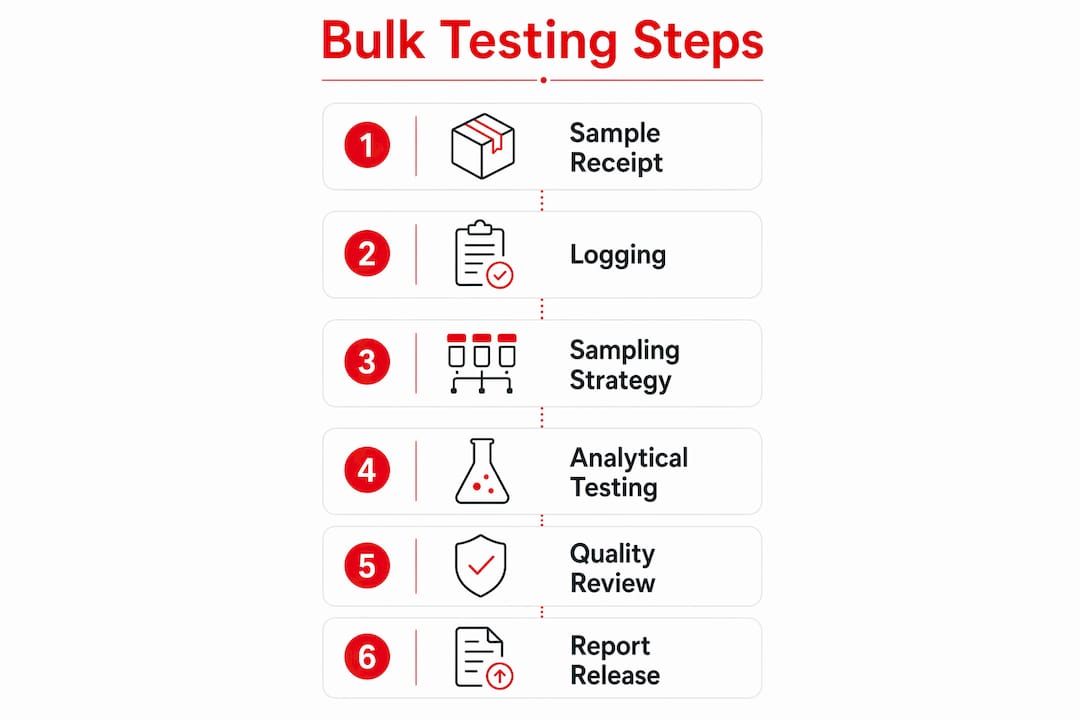
The core steps are: sample receipt and logging, sampling strategy execution, analytical testing across physical, chemical, and microbiological parameters, data recording, Out-of-Specification (OOS) investigation, and COA preparation. Each step requires documented SOPs, qualified personnel, and validated methods. Skipping or shortcutting any stage creates traceability failures that regulators flag immediately.

A well-designed bulk drug testing checklist maps every product specification to a test method, lab, frequency, and acceptance criteria before a single sample is collected. That document, called a test map, is the backbone of the entire program.
What prerequisites and tools are required before starting bulk testing?
A compliant bulk testing program requires eight foundational elements before any sample is processed. A new product launch testing program demands regulatory frameworks, test maps, qualified labs, validated methods, and initiated stability protocols as mandatory readiness items. Missing even one creates a compliance gap that can invalidate an entire batch.
Personnel and accreditation requirements
QA personnel must be formally assigned to sampling and testing roles, with documented authority to reject product. GMP mandates that any product failing specifications after OOS investigation requires formal rejection by a Manager-QC or Manager-QA. That authority must be defined in writing before testing begins, not improvised after a failure.
Lab accreditation is non-negotiable. ISO 17025 certification confirms that a laboratory’s methods are validated and its personnel are competent. Verifying accreditation before testing starts prevents the costly mistake of running hundreds of samples through an unqualified facility.
Documentation and infrastructure checklist
- Test map: Links each specification to a method, lab, frequency, and acceptance criteria
- SOPs: Written procedures for sampling, analysis, OOS handling, and COA issuance
- Batch record templates: Pre-formatted forms that capture all required data fields
- Equipment calibration logs: Current calibration certificates for all analytical instruments
- Stability protocols: Initiated before or concurrent with batch release testing
- Regulatory framework document: Identifies which standards (GMP, ISO 17025, UKAS) govern each test
| Prerequisite | Why It Matters |
|---|---|
| ISO 17025 accreditation | Confirms method validation and personnel competency |
| Test map | Prevents specification-to-method mismatches during audits |
| Validated SOPs | Ensures reproducible, defensible results |
| Batch record templates | Supports ALCOA data integrity principles |
| Stability protocols | Required for regulatory submission and shelf-life claims |
Pro Tip: Many lab managers confuse purchasing testing equipment with having a compliant testing program. True compliance requires test mapping, method validation, and verified lab accreditation. Buy the equipment last, not first.
Which step-by-step procedures ensure efficient execution of bulk testing?
GMP-compliant bulk testing follows a defined sequence from sample receipt to COA issuance. Deviating from that sequence, even with good intentions, creates documentation gaps that regulators treat as failures. The steps below reflect current GMP and ISO 17025 requirements for finished drug product testing.
-
Receive and log samples. Assign a unique batch ID to every incoming sample at the point of receipt. Record the date, time, sample condition, and receiving personnel in the batch record. Damaged or improperly labeled samples trigger immediate hold procedures.
-
Execute the sampling strategy. Composite sampling from appropriate production stages such as compression, filling, and coating ensures the sample represents the full batch. QC personnel perform sampling per validated SOPs, not ad hoc judgment.
-
Run analytical tests. Testing covers physical parameters (appearance, weight, hardness), chemical parameters (assay, dissolution, identification), and microbiological parameters (bioburden, sterility where required). Each parameter maps to a validated method documented in the test map.
-
Record data per ALCOA principles. ALCOA stands for Attributable, Legible, Contemporaneous, Original, and Accurate. Every data entry must be made at the time of testing, by the analyst performing the test, with no retroactive corrections without documented justification.
-
Evaluate results against specifications. Compare each result to the acceptance criteria in the test map. Results within specification move to COA preparation. Results outside specification trigger the OOS procedure immediately.
-
Investigate OOS results. A single failed unit triggers mandatory OOS investigation that can delay batch release by weeks. The investigation must identify root cause, assess batch impact, and determine whether retesting is scientifically justified. Formal rejection by Manager-QC or Manager-QA is required if the batch fails.
-
Issue the Certificate of Analysis. The COA summarizes all test results, compares them to specifications, and carries the signature of the authorized QA reviewer. It is the official release document for the batch.
Pro Tip: Build your drug testing reporting workflow so that COA templates auto-populate from batch records. Manual transcription of results is the single largest source of data integrity failures in high-volume labs.
How to maintain compliance and quality assurance throughout bulk testing procedures?
Quality assurance in bulk testing is not a final review. It is continuous oversight embedded at every step of the workflow. Labs that treat QA as a sign-off function at the end of the process consistently fail audits because deviations accumulate undetected throughout execution.
The following practices sustain compliance across the full testing cycle:
- Enforce SOPs without exception. Every deviation, even minor ones, must be documented and assessed. Undocumented deviations are the most common audit finding in GMP inspections.
- Use only validated methods. Running samples through unvalidated methods produces results that regulators will not accept, regardless of how accurate those results appear.
- Maintain full traceability. Every sample, result, instrument, and analyst must be traceable through the batch record. Record retention periods vary by regulation but typically span several years post-batch release.
- Implement CAPA for every deviation. Corrective and Preventive Action (CAPA) workflows close the loop on deviations by identifying root cause and preventing recurrence. Labs without active CAPA systems accumulate repeat failures.
- Run ongoing method verification. Validated methods require periodic revalidation when instruments, reagents, or personnel change. Verification studies confirm the method still performs within its validated parameters.
“Mapping every product specification to a test method, lab, frequency, and acceptance criteria prevents compliance gaps during audits and is often overlooked. Test map documentation serves as the backbone of the testing program, correlating each specification item to method, lab, frequency, and acceptance criteria.”
Stability protocols deserve special attention. Initiating stability studies concurrent with batch release testing provides the ongoing data regulators require for shelf-life claims. Labs that delay stability initiation create a compliance debt that compounds over time.
What are common challenges in bulk testing and how do you fix them?
High-volume testing amplifies every process weakness. A manual data entry error that goes unnoticed in a 10-sample run becomes a systemic data integrity problem across 500 samples. The challenges below are the most common, and each has a direct fix.
-
Slow turnaround times. UKAS-accredited labs typically require 5 working days from sample receipt to completed results. Build that timeline into batch release planning from day one. Labs that promise faster turnaround without validated capacity create bottlenecks that delay product release.
-
Manual data entry errors. Barcode-driven workflows and standardized intake reduce human error and increase throughput at scale. Replacing manual sample ID transcription with barcode scanning eliminates the most common source of sample mix-ups in high-volume operations.
-
OOS results stalling the main workflow. Separating exception lanes for failed samples keeps the primary testing line moving while OOS investigations proceed in parallel. Without a dedicated exception lane, a single failed sample can halt processing for an entire shift.
-
Inadequate OOS SOPs. Labs that write OOS procedures after a failure spend weeks in reactive mode. Robust OOS SOPs that trigger immediate investigation and CAPA workflows must exist before testing begins.
-
Scaling without losing quality. Standardizing sample intake, using consistent tracking systems, and training personnel on exception handling allows labs to process hundreds of units without proportional increases in error rates.
Pro Tip: Review your clinic drug test workflow against your current intake process quarterly. Workflows that worked at 50 samples per day often break at 200. Catch the failure point before it becomes a compliance event.
Key Takeaways
Successful bulk testing requires validated SOPs, a complete test map, and embedded QA oversight at every step, not just at final review.
| Point | Details |
|---|---|
| Build the test map first | Map every specification to a method, lab, frequency, and acceptance criteria before collecting any sample. |
| Verify lab accreditation | Confirm ISO 17025 or equivalent accreditation before running any analytical work. |
| Apply ALCOA data principles | Record every result at the time of testing, by the analyst performing it, with no retroactive edits without justification. |
| Separate exception lanes | Route failed samples to a dedicated OOS lane to keep the main workflow moving. |
| Plan for 5-day turnaround | Build UKAS-standard timelines into batch release schedules to avoid downstream delays. |
What I’ve learned from watching labs skip the test map
Most bulk testing failures I’ve seen trace back to one skipped step: the test map. Labs invest in equipment, hire qualified analysts, and write SOPs, then launch testing without a document that connects every specification to a validated method and a qualified lab. The result is a program that looks compliant on paper but falls apart the moment an auditor asks which lab ran which test and under which validated method.
The second pattern I see constantly is treating OOS investigations as bureaucratic delays rather than diagnostic tools. A failed sample is information. It tells you something about your process, your materials, or your method. Labs that rush through OOS investigations to hit release timelines miss that signal and repeat the same failure in the next batch.
The fix for both problems is the same: build the infrastructure before you need it. A complete test map and a working OOS SOP take time to develop. That time is always shorter than the time lost to a failed audit or a delayed batch release. The labs that run bulk testing well are not the ones with the most sophisticated equipment. They are the ones with the most disciplined documentation.
— Justin
Rapidtestcup products built for high-volume drug testing
Lab managers running bulk drug testing programs need supplies that hold up across hundreds of collections without variation in performance.
Rapidtestcup carries a full catalog of drug testing products for labs designed for high-volume workflows, including CLIA waived, FDA-cleared multi-panel test cups, dip cards, and urine test strips. The 12-panel ADLTX cup integrates directly into batch testing protocols with built-in adulterant detection, reducing the need for separate adulteration screens. Bulk pricing and fast shipping mean your lab stays stocked without interrupting testing schedules. Request a custom quote directly through the site for large-volume orders.
FAQ
What are the core bulk testing implementation steps?
The core steps are sample receipt and logging, composite sampling, analytical testing across physical, chemical, and microbiological parameters, ALCOA-compliant data recording, OOS investigation if needed, and COA issuance. Each step requires validated SOPs and qualified personnel.
How long does bulk testing typically take?
UKAS-accredited labs typically require 5 working days from sample receipt to completed results. Build that timeline into batch release planning to avoid scheduling conflicts downstream.
What is a test map and why does it matter?
A test map links every product specification to a validated test method, qualified lab, testing frequency, and acceptance criteria. It prevents compliance gaps during audits and is the foundational document for any bulk testing program.
What triggers an OOS investigation in bulk testing?
A single unit failing any specification triggers a mandatory Out-of-Specification investigation under GMP. The investigation must identify root cause, assess batch impact, and result in formal rejection or documented justification for retesting.
How do barcode systems improve bulk testing procedures?
Barcode-driven workflows replace manual sample ID transcription, eliminating the most common source of sample mix-ups and data entry errors in high-volume testing operations. They also support ALCOA traceability requirements by creating an auditable electronic record at each step.