Blog
What Is an FDA Approved Test? A 2026 Guide


TL;DR:
- An FDA-approved test is a diagnostic tool reviewed and authorized based on scientific evidence of safety and effectiveness.
- There are different regulatory pathways, like 510(k) clearance, De Novo, and Premarket Approval, each with specific evidence requirements.
An FDA-approved test is a diagnostic tool that the U.S. Food and Drug Administration has reviewed and authorized based on scientific evidence confirming its safety and effectiveness for a specific intended use. The term “FDA-approved test” is widely used, but the industry distinguishes between FDA approval (the highest standard) and FDA clearance or authorization, each carrying different evidentiary requirements. Understanding what is an FDA approved test matters whether you run a clinical lab, manage a substance abuse program, or purchase testing supplies for compliance. This guide explains the regulatory pathways, the real meaning behind the labels, and what the distinctions mean for your practice.
What are the different FDA regulatory pathways for test approval?
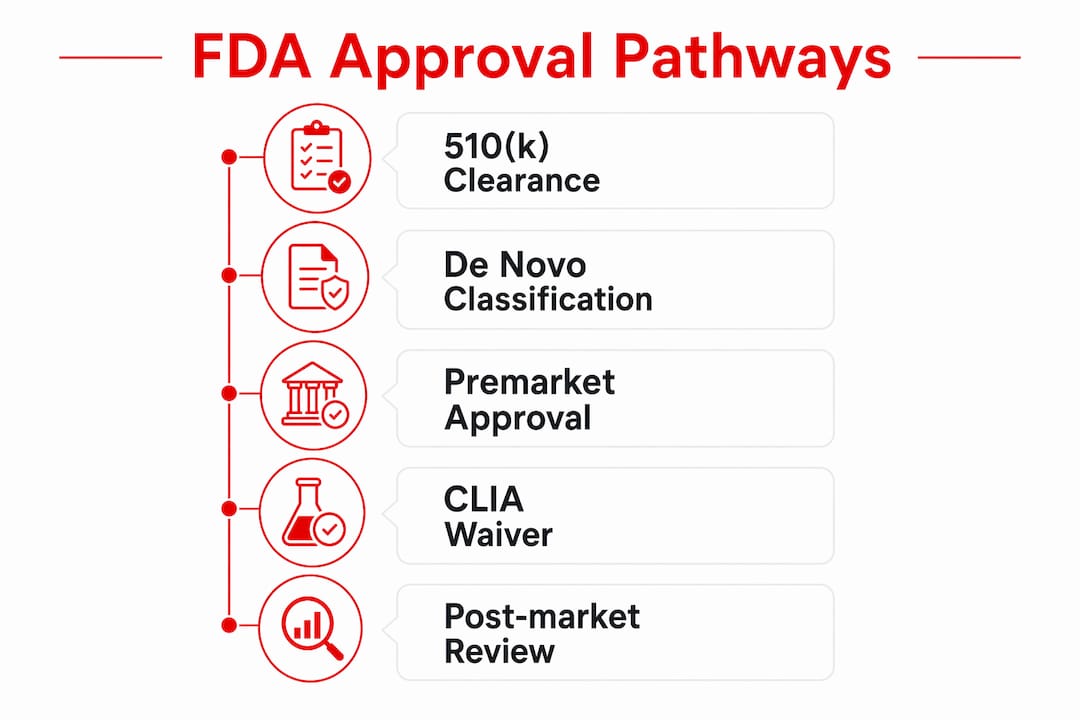
The FDA regulates diagnostic tests, formally called in vitro diagnostics (IVDs), through three main pathways based on risk level. Each pathway has different evidence requirements and review timelines. Knowing which pathway applies to a test tells you a great deal about how thoroughly it was evaluated before reaching the market.

510(k) clearance
The 510(k) pathway is the most common route for low to moderate risk diagnostic tests. A manufacturer submits evidence showing the new test is substantially equivalent to a legally marketed predicate device. The FDA targets a 90-day review for 510(k) submissions. That speed reflects the lower evidentiary bar: the test does not need to prove safety and effectiveness independently, only that it performs comparably to something already on the market.
De Novo classification
The De Novo pathway applies when a test is novel and has no predicate device, but still poses only low to moderate risk. The FDA targets a 150-day review for De Novo requests. This pathway creates a new regulatory category and can itself become a predicate for future 510(k) submissions. It is the right route when a test is genuinely new but not high risk.
Premarket Approval (PMA)
PMA is the most rigorous pathway and applies to high-risk diagnostic tests with no predicate. Manufacturers must independently demonstrate safety and effectiveness through clinical data. The FDA targets a 180-day review for PMA applications. This is the pathway most people mean when they say a test is “FDA approved” in the strictest sense.
CLIA Waiver by Application
Beyond the three main pathways, manufacturers can pursue a CLIA Waiver by Application after receiving 510(k) clearance or PMA approval. CLIA Waiver criteria require that a test be so simple and accurate that the likelihood of user error is negligible, or that no unreasonable harm occurs if performed incorrectly. Tests cleared for home use qualify automatically. A CLIA waiver allows the test to be used outside of certified labs, including at point-of-care settings and by individuals. This is a critical distinction for drug testing professionals who need CLIA waived kits for field or clinic use.
Summary of FDA pathways:
| Pathway | Risk level | Review target | Key requirement |
|---|---|---|---|
| 510(k) Clearance | Low to moderate | 90 days | Substantial equivalence to predicate |
| De Novo | Low to moderate (novel) | 150 days | No predicate; new category created |
| PMA Approval | High | 180 days | Independent safety and effectiveness data |
| CLIA Waiver | Post-authorization | Varies | Simplicity and low error risk |
What does FDA approval or clearance actually mean in practice?
FDA approval and FDA clearance are not the same thing, and the difference matters. 510(k) clearance confirms substantial equivalence to a predicate device, while PMA approval requires an independent demonstration of safety and effectiveness. A cleared test has not been proven safe and effective on its own terms. It has been shown to perform like something that was already on the market.
FDA authorization is specific to a particular intended use, specimen type, and testing technology. A test approved for urine drug screening is not automatically valid for oral fluid or blood. A test cleared for professional lab use is not automatically cleared for home use. This specificity is one of the most misunderstood aspects of FDA-regulated diagnostics.
Common misconceptions worth correcting:
- FDA approval does not mean the test is error-free. The FDA determined that benefits outweigh risks, not that the test is perfect.
- FDA clearance is not the same as FDA approval. Clearance (510(k)) relies on predicate comparison. Approval (PMA) requires independent evidence.
- FDA authorization does not transfer across uses. A test authorized for one specimen type cannot be used for another without separate authorization.
- Emergency Use Authorization (EUA) is a separate, temporary status. EUAs apply during public health emergencies and do not carry the same evidentiary weight as standard clearance or approval.
Pro Tip: When evaluating a test for your lab or program, always check the FDA’s 510(k) database or PMA database directly. The label on the box tells you the intended use. The database tells you the exact scope of authorization.
Understanding these distinctions protects your program from compliance gaps. If you use a test outside its labeled intended use, you are operating outside FDA authorization, regardless of how the product is marketed. For a deeper look at how this plays out in substance abuse settings, the FDA clearance distinctions article from Rapidtestcup covers the practical implications well.
How does FDA approval relate to lab certifications and practical testing settings?
FDA approval and CLIA certification are separate systems that serve different purposes. Many professionals assume that a CLIA-certified lab automatically uses FDA-authorized tests. That assumption is wrong.
CLIA certification governs laboratory quality standards, including personnel qualifications, quality control procedures, and proficiency testing. FDA authorization governs the specific diagnostic test device and its intended use. A lab can be fully CLIA-certified while running tests that lack FDA authorization for the specific use case. The two systems are complementary, not interchangeable.
Here is how the two systems interact in practice:
- FDA authorizes the test kit or device. The authorization covers the specific analyte, specimen type, and intended use listed in the labeling.
- CLIA certifies the laboratory. The certification covers the lab’s operations, personnel, and quality systems, not the individual tests it runs.
- CLIA complexity categories align with FDA pathways. Tests with a CLIA waiver can be run in any setting. High-complexity tests require a CLIA-certified lab with appropriate personnel.
- Both are required for compliant professional testing. A lab running FDA-authorized tests in a CLIA-certified facility meets the full compliance standard for professional diagnostic use.
For professionals managing lab compliance, the laboratory drug testing checklist from Rapidtestcup provides a practical framework for keeping both FDA and CLIA requirements in order.
What are practical steps and common pitfalls for test developers seeking FDA approval?
Navigating the FDA test approval process is where many developers lose time and money. The process is well-defined, but the execution demands precision at every step.
The single most valuable step a developer can take is scheduling an FDA Pre-Submission (Q-Sub) meeting before filing. Pre-Submission meetings provide formal written feedback on regulatory strategy and clinical study design, typically delivering 5–20 pages of actionable FDA guidance. That feedback shapes the entire submission. Developers who skip this step frequently receive Deficiency letters or Refuse to Accept notices during review, causing costly delays that could have been avoided.
Common pitfalls in the FDA submission process:
- Poor predicate selection for 510(k). Choosing a predicate that differs in intended use or technology invites rejection. The predicate must match closely on both dimensions.
- Electronic formatting errors. FDA submissions increasingly depend on strict adherence to electronic Common Technical Document (eCTD) formatting. Minor technical failures can cause outright rejection before any scientific review occurs.
- Skipping the 513(g) classification request. When device classification is unclear, a 513(g) request provides written FDA guidance. In FY2026, 513(g) fees are $7,820 for standard applicants and $3,910 for qualifying small businesses. That cost is far lower than the cost of a misclassified submission.
- Underestimating post-market obligations. PMA approval carries ongoing post-market surveillance requirements. Developers who treat approval as a finish line often struggle with compliance after launch.
Pro Tip: Submit your Pre-Submission questions in writing, as specifically as possible. Vague questions get vague answers. Ask the FDA to confirm your predicate selection, your study design, and your intended use statement before you build your clinical data package.
Early engagement with FDA through Pre-Submission meetings is strategically the most valuable step in the entire process. Developers who treat regulatory planning as a parallel workstream, not an afterthought, consistently reach market faster.
Key Takeaways
FDA-approved tests are authorized for specific intended uses, specimen types, and settings, and using them outside those parameters puts your program out of compliance regardless of the product’s general reputation.
| Point | Details |
|---|---|
| Approval vs. clearance | PMA approval requires independent safety data; 510(k) clearance requires only predicate equivalence. |
| Authorization is specific | FDA authorization covers one intended use, specimen type, and technology, not a broad category of tests. |
| CLIA and FDA are separate | A CLIA-certified lab is not automatically using FDA-authorized tests; both standards must be met independently. |
| Pre-Submission meetings save time | FDA Q-Sub meetings provide 5–20 pages of written feedback that reduce the risk of costly review delays. |
| CLIA waivers expand access | Tests meeting simplicity criteria can be used at point-of-care or home settings without a certified lab. |
What I’ve learned from watching developers and labs get this wrong
The most common mistake I see is not a regulatory mistake. It is a framing mistake. Professionals treat “FDA approved” as a binary quality stamp: either a test has it or it does not. The reality is far more specific, and that specificity is where compliance problems live.
A test authorized for urine drug screening in a clinical lab setting is not the same authorization as one cleared for point-of-care use. A lab running the former in a field setting is out of compliance, even if the test itself is excellent. I have seen programs get flagged not because they used bad tests, but because they used good tests in the wrong context.
The other pattern I keep seeing is developers who treat the FDA Pre-Submission process as optional paperwork. It is not. The written feedback from a Q-Sub meeting is the closest thing to a preview of your submission review that the system allows. Skipping it is like taking an exam without reading the syllabus. The questions are knowable in advance.
For labs and programs that purchase rather than develop tests, the practical lesson is simpler: read the labeling carefully, verify the intended use matches your setting, and confirm the CLIA complexity category before you deploy. The laboratory compliance guidelines resource from Rapidtestcup is a good starting point for building that verification into your standard operating procedures.
The shift toward electronic submissions has also changed what “compliance” means at the submission stage. The FDA now rejects submissions for formatting errors before a single scientist reviews the science. That is a structural change that many developers have not fully absorbed yet.
— Justin
FDA-cleared drug testing products for professional labs
Rapidtestcup carries a full catalog of FDA-cleared and CLIA waived drug testing products built for professional and forensic use. Every product in the catalog is labeled with its intended use, panel configuration, and compliance status so you can match the right test to your specific setting without guesswork.
Whether you need a multi-panel cup for a substance abuse program or a single-analyte strip for targeted screening, the top drug testing products for labs page organizes the full catalog by panel count, specimen type, and compliance tier. For programs that need the advantages of FDA-cleared testing explained in plain terms, the FDA-approved kit benefits guide covers what to look for before you buy.
FAQ
What is the difference between FDA approved and FDA cleared?
FDA approval (PMA) requires a manufacturer to independently prove a test is safe and effective. FDA clearance (510(k)) requires only that the test is substantially equivalent to a predicate device already on the market.
Do all diagnostic tests need FDA approval?
Most diagnostic tests marketed in the United States require FDA authorization through clearance, approval, or De Novo classification. Laboratory-developed tests (LDTs) have historically operated under different oversight, though FDA regulatory expectations for LDTs have been evolving.
What does a CLIA waiver mean for a drug test?
A CLIA waiver means the test is simple enough to be used outside a certified laboratory, including at point-of-care settings. Tests cleared for home use qualify automatically; others must apply for waiver status after receiving FDA authorization.
Can a lab use any FDA-cleared test for any purpose?
No. FDA authorization is specific to the intended use, specimen type, and testing conditions listed in the product labeling. Using a test outside those parameters puts the lab out of compliance with FDA authorization, regardless of CLIA certification status.
How long does the FDA test approval process take?
Review targets are 90 days for 510(k) clearance, 150 days for De Novo classification, and 180 days for PMA approval. Actual timelines extend when submissions have deficiencies or formatting errors, which is why Pre-Submission meetings and precise eCTD formatting are critical.