Blog
How to comply with CLIA regulations for drug testing accuracy


TL;DR:
- A single failed CLIA inspection can halt lab testing and lead to federal penalties.
- Compliance depends on proper certification, personnel qualifications, documentation, and ongoing quality controls.
- regulations will require digital records, unannounced inspections, and stricter personnel standards.
A single failed inspection can suspend your lab’s testing operations within days, leaving patients without critical diagnostic results and exposing your facility to federal penalties. CLIA applies to virtually all labs testing human specimens for health assessment or diagnosis, with narrow exceptions. Whether you manage a hospital lab, a substance abuse treatment clinic, or an occupational health center, this guide walks you through preparation, execution, and verification steps to stay compliant. You’ll also see the most common mistakes labs make and practical insights to keep your operations running without interruption.
Table of Contents
- Understanding CLIA and drug testing requirements
- Preparing your lab for CLIA compliance
- Executing compliant drug testing procedures
- Avoiding common CLIA compliance pitfalls
- Special scenarios and 2026 updates
- Our perspective: Compliance is more than a checklist, it’s operational resilience
- Streamline compliance with proven drug testing solutions
- Frequently asked questions
Key Takeaways
| Point | Details |
|---|---|
| CLIA applies to most labs | Unless you’re a SAMHSA lab for employment or covered by a state variance, your lab must comply with CLIA. |
| Complexity matters | Waived, moderate, and high complexity testing each have unique requirements for documentation and staffing. |
| Top pitfalls are preventable | Regular QC, PT enrollment, and up-to-date records help avoid the most common inspection citations. |
| 2026 brings new rules | Digital documentation and tougher personnel standards go into effect July 1, 2026 for all labs. |
Understanding CLIA and drug testing requirements
The Clinical Laboratory Improvement Amendments, known as CLIA, establish federal standards for all laboratory testing performed on human specimens. The Centers for Medicare and Medicaid Services (CMS) administers CLIA and holds authority to inspect, certify, and sanction labs. For drug testing specifically, understanding which certificate your lab needs is the first decision that shapes everything else.
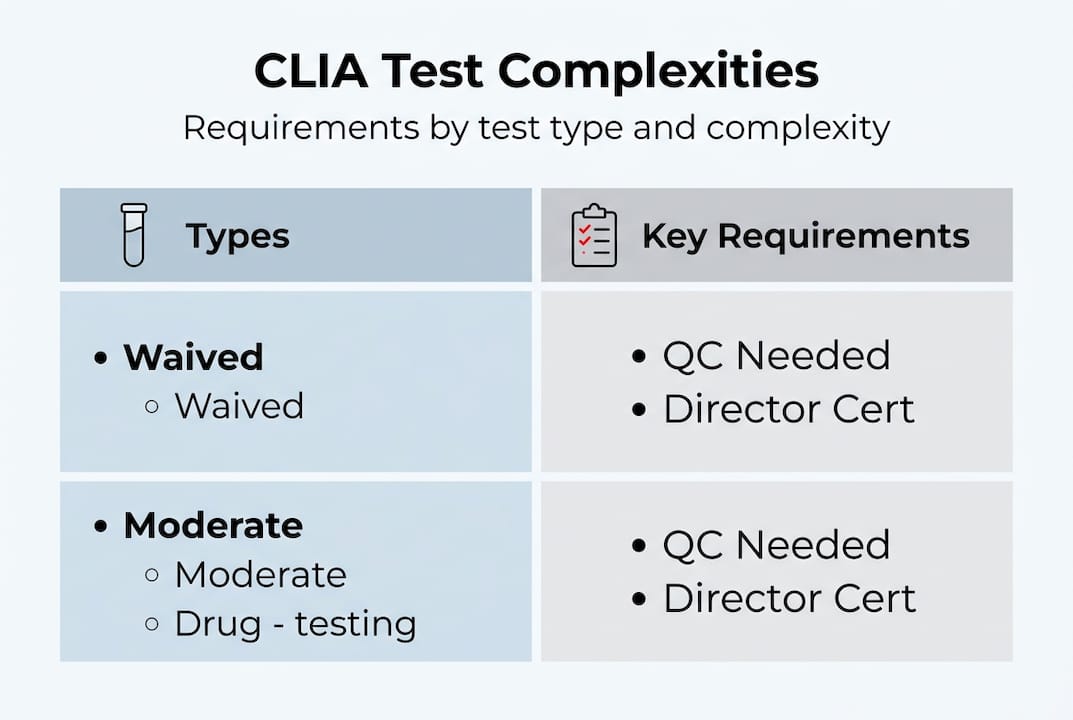
Labs must obtain a CLIA certificate matched to the complexity level of the tests they perform. CMS categorizes tests into three tiers:
| Complexity level | Example drug tests | Key requirements |
|---|---|---|
| Waived | Urine drug test cups, dip cards | Follow manufacturer instructions, minimal QC |
| Moderate complexity | Some immunoassay analyzers | QC, PT enrollment, competency assessments |
| High complexity | GC/MS confirmatory testing | Full personnel quals, QC, PT, competency |
For most clinical drug testing workflows, the split is straightforward. Waived cups handle presumptive screening, while confirmatory testing requires a moderate or high complexity lab. Knowing what CLIA waived means for your daily operations is essential before you order a single test kit.
Key exemptions that compliance officers often overlook:
- SAMHSA-certified labs conducting federally mandated workplace drug testing are exempt from CLIA for those specific tests.
- New York and Washington state operate under partial state exemptions with their own oversight frameworks.
- Research labs that do not report patient results are also excluded.
Why does complexity level matter so much? Because it determines your personnel requirements, your quality control (QC) obligations, and your proficiency testing (PT) enrollment. A lab running high-complexity tests with staff only qualified for waived testing is a citation waiting to happen. Understanding the benefits of waived tests can help you decide whether to limit your scope and reduce your compliance burden intentionally.
Preparing your lab for CLIA compliance
Once you know your CLIA requirements, the next step is preparing your lab’s foundation for compliance. This is where many labs stumble, not during inspections, but in the months before one ever happens.
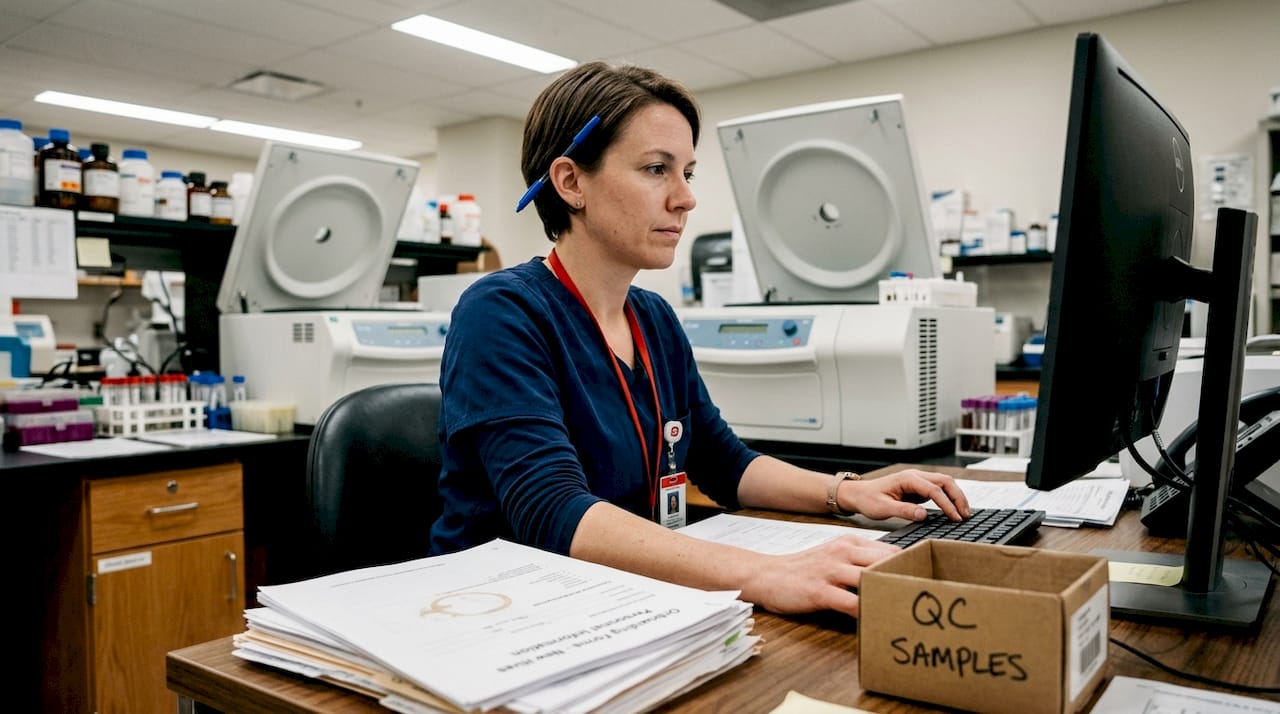
Start by selecting the right certificate type. If your lab only performs urine drug screening with FDA-cleared, waived test options, a Certificate of Waiver is your most efficient path. It carries the lowest regulatory burden while still producing defensible, actionable results.
Here is a step-by-step preparation checklist:
- Apply for the correct CLIA certificate through your state agency or CMS directly.
- Draft standard operating procedures (SOPs) for every test you perform, including specimen collection and rejection criteria.
- Enroll in a proficiency testing program approved by CMS before you begin non-waived testing.
- Compile personnel files with credentials, training records, and competency assessments.
- Set up a QC log with defined acceptable ranges for each analyte you test.
- Implement a digital recordkeeping system that meets the July 1, 2026 mandate for electronic documentation.
Personnel requirements scale by complexity. High-complexity labs need a laboratory director with doctoral or board certification and a technical supervisor with at least a master’s degree. Moderate-complexity labs require a technical consultant with a bachelor’s degree in a relevant science. Waived labs have no specific personnel credential requirements, which is one reason many clinics deliberately limit their scope.
| Role | Waived | Moderate complexity | High complexity |
|---|---|---|---|
| Lab director | No specific credential | Bachelor’s + experience | Doctoral/board certified |
| Technical supervisor | Not required | Bachelor’s degree | Master’s degree minimum |
| Testing personnel | No requirement | High school + training | Associate’s degree minimum |
Pro Tip: Build your personnel qualification matrix before you hire, not after. Retrofitting credentials to meet CLIA requirements mid-operation is expensive and time-consuming.
Executing compliant drug testing procedures
With your team and documentation ready, you can start executing CLIA-compliant testing procedures. The execution phase is where compliance becomes daily practice rather than paperwork.
For waived testing, the protocol is simpler but still requires discipline:
- Follow manufacturer instructions exactly. Any deviation, such as extending read times or altering specimen volume, can reclassify the test as high complexity.
- Document each test run with the lot number, expiration date, and operator ID.
- Perform QC as directed by the manufacturer, typically with positive and negative controls.
- Record and retain results for at least two years.
For non-waived testing, the requirements are more intensive. Key compliance mechanics include PT enrollment under Subpart H, QC under Subpart K, and competency assessments covering six specific procedures annually for every non-waived analyst. Procedure manuals must be current, signed, and accessible at the bench.
Quality control is not optional. Run controls at the beginning of each day of testing, when you open a new reagent lot, and after any instrument maintenance. Document everything in real time, not at the end of the shift.
Proficiency testing is the external check on your internal processes. Failing two consecutive PT challenges in the same analyte triggers a CMS investigation and can result in certificate suspension.
Competency assessment is another area where labs get cited. You must evaluate each analyst using six methods: direct observation, monitoring records, blind samples, problem-solving scenarios, instrument maintenance, and result reporting. Document each one individually.
It is worth noting that drug test cups used for presumptive screening have real advantages as waived kits, but they do have immunoassay limits that make confirmatory testing necessary for legal or disciplinary actions.
Pro Tip: Set a recurring calendar reminder 60 days before PT submission deadlines. Missing a submission window counts the same as a failing score.
Avoiding common CLIA compliance pitfalls
Even with processes in place, ongoing compliance challenges can emerge. Here are common pitfalls to watch for.
CMS publishes annual deficiency data, and the 2024 numbers are instructive. Top deficiencies include analytic systems issues at 5%, procedure manual gaps at 3.9%, expired reagents at 3.7%, competency documentation failures at 3.4%, and PT enrollment lapses. These are not obscure technical failures. They are operational habits that slip when labs treat compliance as a one-time setup task.
Here is how to prevent each major pitfall:
- Expired reagents: Assign one person to check expiration dates weekly. Build a reagent inventory log with color-coded alerts for items expiring within 30 days.
- Procedure manual gaps: Review and re-sign all SOPs annually. If a test changes even slightly, update the manual before the next run.
- Competency failures: Schedule competency assessments at hire, at six months, and annually. Do not wait for an inspection to discover a gap.
- PT enrollment lapses: Enroll before you start testing, not after. Keep enrollment confirmation letters in your compliance binder.
- Analytic system failures: Validate your QC ranges when you switch reagent lots. Do not assume the new lot performs identically.
The compliance best practices that separate high-performing labs from those that get cited are not complicated. They are consistent. A lab that runs controls every day, reviews its SOPs every year, and trains new staff before they touch a specimen will rarely see a deficiency notice.
Pro Tip: Conduct a mock inspection quarterly. Walk through your lab with a compliance checklist and cite yourself before CMS does. It is far less painful.
Special scenarios and 2026 updates
Beyond the routine, there are crucial exceptions and new requirements for 2026 every manager needs to track.
First, the exemptions. SAMHSA-certified labs are exempt from CLIA when performing employment-related drug testing under federal workplace programs. New York and Washington maintain partial state exemptions and operate under their own laboratory oversight systems. If your lab operates in those states, verify your obligations with the state health department directly, not just CMS.
Test modifications are a hidden compliance trap. If you alter a waived test in any way, including changing the cutoff interpretation, using it on a non-standard specimen type, or combining it with another method, CMS may reclassify it as high complexity. That reclassification triggers full non-waived requirements immediately.
Now for the 2026 updates every lab manager must act on now:
- Digital records are mandatory starting July 1, 2026. Paper-only systems will no longer satisfy CLIA documentation requirements. Your electronic system must support audit trails and access controls.
- Enhanced personnel qualification standards take effect, with stricter verification of education and training credentials for moderate and high-complexity roles.
- Unannounced inspections are now standard practice, replacing the previously scheduled inspection model for many lab types.
The 2026 regulatory updates represent the most significant shift in CLIA enforcement in over a decade. Labs that have relied on advance notice to prepare for inspections will need to maintain audit-ready status at all times. That means your documentation, your reagent logs, your competency files, and your QC records must be current every single day.
To prepare for unannounced audits, designate a compliance lead who can immediately pull any document an inspector requests. Run a readiness drill twice a year.
Our perspective: Compliance is more than a checklist, it’s operational resilience
Here is the uncomfortable truth most compliance guides skip: labs that treat CLIA as a checklist exercise are the ones that get suspended. We have seen it repeatedly. A lab passes its initial inspection, files the certificate, and then slowly lets the habits erode. QC logs get filled in retroactively. Competency assessments get skipped for long-tenured staff. Reagent checks become informal.
True compliance is a culture, not a calendar event. The labs that consistently pass inspections, including unannounced ones, are the ones where every analyst understands why the rules exist, not just what the rules are. They know that a false positive from an expired reagent affects a real person’s life. That understanding is what drives daily discipline.
Understanding what CLIA waived means in practice is a good starting point, but the highest-performing labs go further. They build redundancy into their compliance systems, cross-train staff, and conduct internal audits without waiting for external pressure. Compliance is not the ceiling. It is the floor.
Streamline compliance with proven drug testing solutions
Taking action is simpler with the right tools. Here’s where to find them and keep your lab audit-ready.
At rapidtestcup.com, we stock CLIA-waived, FDA-cleared drug testing products built for the compliance demands you face every day. Our 12 panel drug test cups and 18 panel drug test cups are designed for high-volume clinical environments where accuracy and speed matter equally.
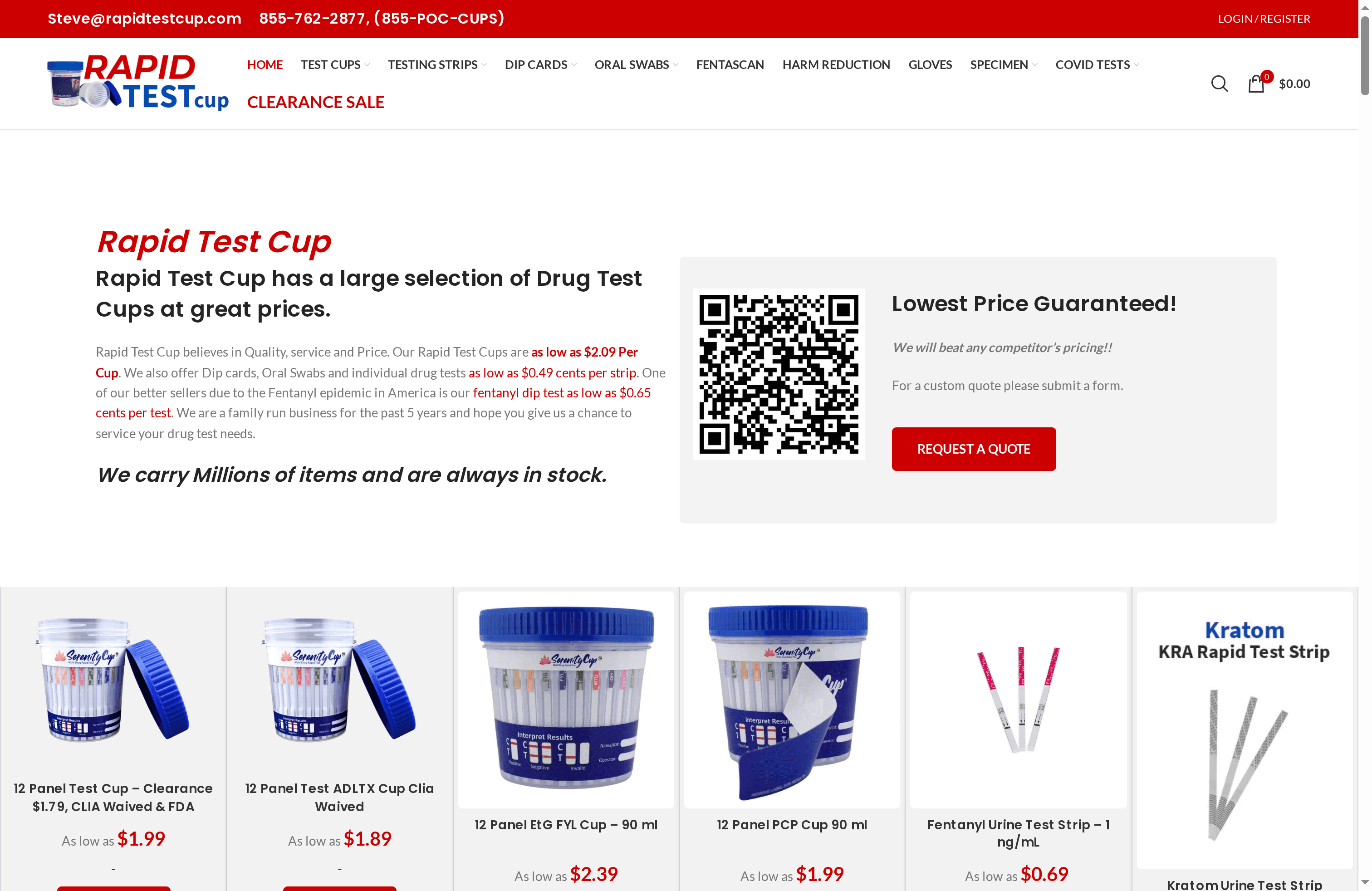
Every product in our CLIA-waived testing hub comes with clear manufacturer instructions, lot documentation, and bulk pricing that makes stocking your lab straightforward. Whether you need to expand your panel coverage or replace expired inventory before an inspection, we have the supplies and the support to keep your lab running clean.
Frequently asked questions
Who is exempt from CLIA regulations for drug testing?
SAMHSA-certified labs conducting employment-related drug testing are exempt from CLIA for those specific tests, and labs in states like New York and Washington may operate under partial state exemptions with their own oversight requirements.
What are the top reasons labs fail CLIA inspections?
The most cited deficiencies are analytic system failures, missing or outdated procedure manuals, expired reagents, insufficient competency documentation, and failure to enroll in proficiency testing before beginning non-waived testing.
What are the new CLIA requirements in 2026?
Starting July 1, 2026, digital recordkeeping becomes mandatory, personnel qualification standards are enhanced for moderate and high-complexity labs, and CMS has shifted to unannounced inspections as the standard enforcement model.
How does a waived drug test differ from moderate or high complexity in CLIA compliance?
Waived tests require strict adherence to manufacturer instructions with minimal QC documentation, while moderate and high-complexity tests demand formal QC programs, PT enrollment, and annual competency assessments for every analyst.