
Blog
EtG vs. Ethanol Test: Detection Windows Explained


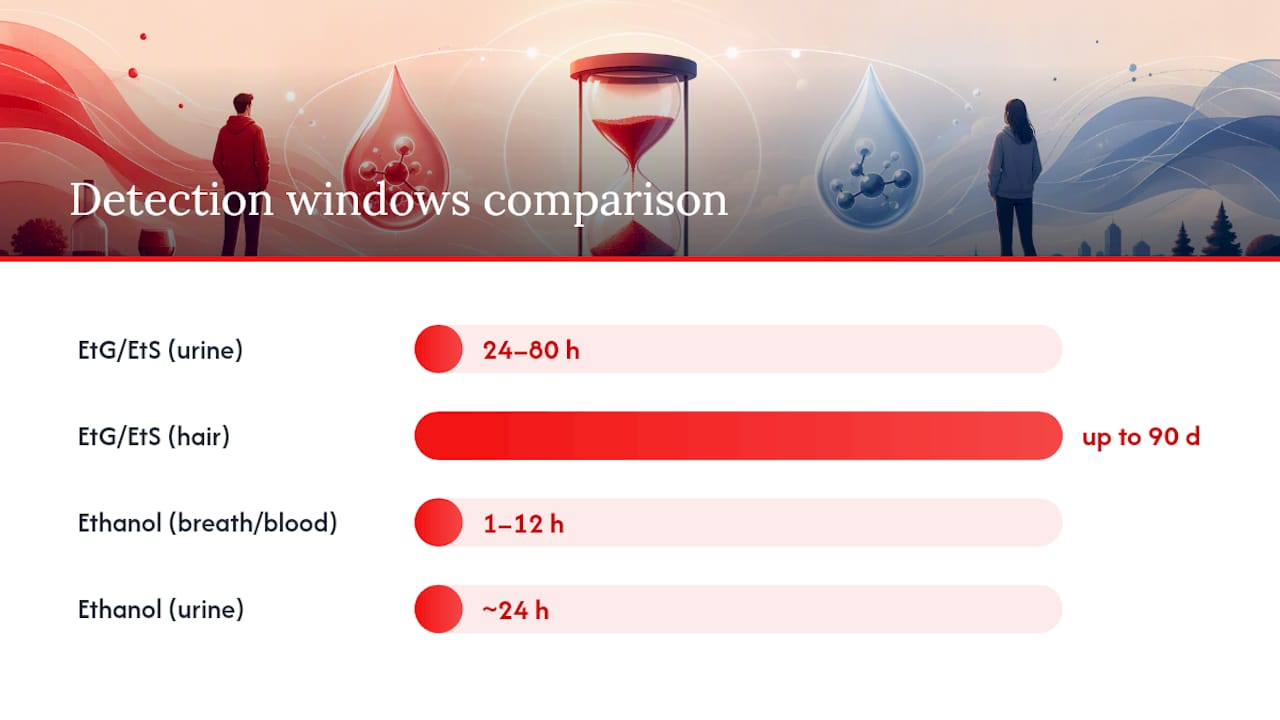
Direct ethanol tests measure alcohol itself and detect drinking only within a narrow window, typically 12–24 hours in urine, a few hours in breath or blood. EtG (ethyl glucuronide) and EtS (ethyl sulfate) tests detect metabolites the liver produces after alcohol is processed, extending the detection window to roughly 24–80 hours in urine depending on the cutoff and how much was consumed. The right choice depends entirely on what you need to know.
- Immediate impairment or intoxication? Use breath or blood ethanol. These are the standard for DUI enforcement, emergency medicine, and any situation where you need to know if someone is currently impaired.
- Recent abstinence monitoring or past-day drinking? Use EtG/EtS urine testing. These metabolites persist long after ethanol has cleared, making them the standard for clinical monitoring programs, transplant candidacy, and workplace abstinence requirements.
- High-stakes decisions? Never rely on a single screening result. Confirm positives with mass spectrometry, pair EtG with EtS, and factor in cutoff, specimen, and context before acting.
Key Takeaways
EtG/EtS tests detect alcohol metabolites for up to 80 hours in urine, while direct ethanol tests detect alcohol itself for only a few hours, making the choice between them entirely dependent on whether you need to detect current impairment or recent past drinking.
| Point | Details |
|---|---|
| Detection window gap | Ethanol clears in hours; EtG/EtS persist up to ~80 hours in urine depending on cutoff and dose. |
| Cutoff drives sensitivity | A 500 ng/mL cutoff misses light-to-moderate drinking beyond 24 hours; 100–250 ng/mL extends the window but raises false-positive risk. |
| Confirm before acting | Immunoassay agreement with MS reaches 96.6% at 250–500 ng/mL; confirm positives with LC-MS/MS for high-stakes decisions. |
| Pair EtG with EtS | EtS has no documented in-vitro production, so its presence alongside EtG confirms actual ingestion rather than specimen artifact. |
| Rapidtestcup screening options | CLIA waived ETG strips and multi-panel EtG cups provide rapid point-of-care screening for clinics and treatment programs. |
Table of Contents
- How does the EtG vs. ethanol test comparison break down?
- How each test works biologically
- What are the typical detection windows by specimen and drinking amount?
- How do cutoffs affect what your lab actually reports?
- What causes false positives, and how do you reduce them?
- Immunoassay vs. mass spectrometry: which method should you trust?
- Which test should you use for your specific situation?
- Limits of testing and cautions for high-stakes decisions
- What recent research and proficiency surveys actually show
- The case for treating EtG results as the start of a conversation, not the end
- Rapidtestcup has point-of-care EtG products ready to ship
- Sources
How does the EtG vs. ethanol test comparison break down?
The table below covers the key decision dimensions. After the table, two bullets call out the most consequential practical differences.
| Dimension | EtG/EtS Urine Test | Direct Ethanol Test (Breath/Blood/Urine) |
|---|---|---|
| What is measured | Phase II metabolites (ethyl glucuronide, ethyl sulfate) | Ethanol molecule itself |
| Common specimens | Urine (preferred); also hair, blood, oral fluid | Breath (BrAC), blood (BAC), urine |
| Typical detection window | 24–80 hours in urine; up to 90 days in hair | Breath/blood: 1–12 hours; urine ethanol: up to ~24 hours |
| Common cutoffs | EtG: 100, 250, or 500 ng/mL; EtS: 100 ng/mL | Blood: legal threshold; breath: equivalent BAC |
| False-positive risk | Moderate at low cutoffs (mouthwash, hand sanitizer, foods) | Very low; ethanol is ethanol |
| False-negative risk | Low within 24 hours; rises sharply beyond 48–72 hours | High if drinking occurred more than a few hours prior |
| Confirmatory method | LC-MS/MS (gold standard); EtS pairing improves specificity | GC-MS for blood/urine; evidential breathalyzer for breath |
| Time to result | Point-of-care immunoassay: minutes; lab MS: 24–72 hours | Breathalyzer: immediate; blood GC-MS: hours to days |
| Best use-case | Abstinence monitoring, clinical programs, forensic review | Impairment detection, DUI, emergency medicine |
The two most consequential differences:
- EtG/EtS testing catches drinking that happened yesterday or the day before, long after the person appears sober and ethanol has cleared. Direct ethanol testing cannot do this.
- EtG tests at low cutoffs (100 ng/mL) are sensitive enough to flag incidental exposures like mouthwash or hand sanitizer. Direct ethanol tests are not susceptible to this problem.
When to prefer direct ethanol testing: Any scenario requiring proof of current impairment, including roadside enforcement, emergency triage, or pre-shift workplace checks where the question is “is this person impaired right now?”
When to prefer EtG/EtS: Ongoing abstinence monitoring in treatment programs, transplant candidacy evaluation, probation compliance, or any setting where the question is “did this person drink in the last few days?”
How each test works biologically
Ethanol is a small, water-soluble molecule that distributes rapidly through body fluids. When you measure it directly in breath, blood, or urine, you are detecting the alcohol molecule itself. The liver metabolizes ethanol at a fairly fixed rate, roughly 0.015 g/dL per hour, which is why blood alcohol concentration drops predictably after drinking stops. Once the liver finishes the job, there is nothing left to detect.
EtG and EtS take a different path. Both are phase II metabolites produced when the liver conjugates ethanol with glucuronic acid (forming EtG) or sulfate (forming EtS). These conjugates are water-soluble, non-volatile, and excreted in urine over a much longer period than ethanol itself. Because they are not volatile, they do not evaporate from urine the way ethanol does, and because they are produced even from small amounts of alcohol, they are sensitive markers of any recent exposure.
A simple example makes the timeline concrete:
- Two standard beers consumed at 8 PM: Blood and breath ethanol would likely clear by midnight or 1 AM for an average adult. A breathalyzer at 7 AM the next morning would read zero.
- EtG in urine at 7 AM: Likely still detectable at a 100 ng/mL cutoff, possibly at 250 ng/mL depending on individual metabolism, hydration, and urine concentration.
- EtG at 48 hours: Detection becomes unreliable for light drinking, though heavier consumption may still produce detectable levels.
One important distinction: EtS has no published reports of in-vitro production in urine specimens, while EtG can, in rare cases, form in a contaminated specimen sitting at room temperature. This is why labs that pair EtG with EtS gain a meaningful specificity advantage.
What are the typical detection windows by specimen and drinking amount?
Detection windows are not fixed numbers. They shift based on how much was consumed, the specimen type, the cutoff used, individual metabolism, and hydration status. The ranges below reflect published evidence, not worst-case or best-case scenarios.
Ethanol detection windows
- Breath (BrAC): Roughly 1–6 hours after light-to-moderate drinking; up to 12 hours after heavy consumption.
- Blood (BAC): Similar to breath, typically 1–12 hours depending on dose.
- Urine ethanol: Slightly longer than blood, up to approximately 24 hours after heavy drinking, but subject to in-vitro production if the specimen is not handled promptly.
EtG/EtS detection windows
- Urine EtG (100 ng/mL cutoff): Light drinking (1–2 drinks): approximately 12–24 hours. Moderate drinking (3–5 drinks): 24–48 hours. Heavy drinking (6+ drinks): potentially up to 72–80 hours.
- Urine EtG (500 ng/mL cutoff): Windows compress significantly. A study of a commercial EtG assay found acceptable detection for past-day drinking but poor sensitivity for detecting drinking across a 3-day window at this cutoff. Light-to-moderate drinking beyond 12–24 hours may be missed entirely.
- Hair EtG: Can reflect alcohol use over weeks to months, making it useful for longer-term history rather than recent-event detection.
- Blood EtG: Shorter window than urine; less commonly used in clinical practice.
A review published in PMC reports EtG detection up to approximately 80 hours in some conditions, but stresses that analytical method and cutoff are the primary drivers of whether that upper bound is achievable in practice.
Key figure: EtG/EtS sensitivity approaches 100% for detecting drinking within the previous 24 hours in some studies, but falls substantially for 48–72-hour detection in moderate drinking scenarios.
The practical implication: if a program needs to catch drinking that occurred more than 48 hours ago, a 500 ng/mL cutoff is likely insufficient for light-to-moderate drinkers. A 100–250 ng/mL cutoff extends the window but increases the risk of flagging incidental exposures.
How do cutoffs affect what your lab actually reports?
The cutoff is the threshold below which a result is reported as negative. Choosing it is not a technical detail. It is a clinical and policy decision with real consequences.
Common EtG cutoffs and their trade-offs:
- 100 ng/mL: Highest sensitivity. Catches light drinking and extends the detection window. Also most likely to flag incidental exposures from mouthwash, certain foods, or heavy hand sanitizer use. Best for programs where any alcohol exposure is a violation and false positives can be resolved with confirmatory testing.
- 250 ng/mL: A middle ground used by many clinical programs. Reduces incidental-exposure false positives while maintaining reasonable sensitivity for moderate drinking within 24–48 hours. Immunoassay agreement with lab-based EtG mass spectrometry reaches 96.6% at this cutoff, the same rate as at 500 ng/mL.
- 500 ng/mL: Most specific, fewest false positives from incidental exposure. However, sensitivity for detecting light-to-moderate drinking beyond 24 hours drops significantly. Many labs, including Quest Diagnostics, treat EtG below 500 ng/mL as negative in their standard reporting scheme.
EtS thresholds and confirmatory pairing:
Many labs require EtS at or above 100 ng/mL alongside EtG at or above 500 ng/mL before calling a positive. Because EtS cannot be produced in vitro in a urine specimen, its presence alongside EtG is strong evidence of actual ingestion rather than specimen artifact. For more detail on how cutoffs interact with test sensitivity, the drug test cutoff levels guide at Rapidtestcup covers the underlying logic clearly.
The inter-laboratory variability problem:
A College of American Pathologists proficiency survey documented EtG cutoffs reported across participating labs ranging from 10 to 1,000 ng/mL, and EtS cutoffs from 10 to 1,500 ng/mL. A result of 300 ng/mL EtG is negative at one lab and positive at another. This is not a minor technical footnote; it means a program that switches labs without updating its cutoff policy may be making consequential decisions on incomparable data.
Pro Tip: Set a consistent lab and cutoff policy in writing before you start a monitoring program. Switching labs mid-program without reconciling cutoff differences can produce false apparent changes in compliance.
What causes false positives, and how do you reduce them?
EtG false positives are a real and documented problem, particularly at low cutoffs. The sources fall into two categories: incidental ethanol exposure and specimen artifact.
Common incidental exposure sources:
- Mouthwash and breath fresheners containing ethanol (some products contain 20–27% alcohol)
- Nonalcoholic beer and wine (residual ethanol content varies)
- Foods prepared or cooked with alcohol
- Over-the-counter medications containing ethanol (certain cough syrups, liquid formulations)
- Ethanol-based hand sanitizers used frequently throughout a workday
That last one is not theoretical. Authoritative lab references document cases where heavy occupational use of ethanol-based hand sanitizer pushed EtG above 500 ng/mL, which is the threshold many labs use to call a positive. A healthcare worker who sanitizes their hands dozens of times per shift is a realistic scenario.
Specimen artifact:
EtG can form in vitro in a urine specimen that contains glucose and certain bacteria, a process called in-vitro ethanol production followed by glucuronidation. This is rare but documented. EtS does not share this vulnerability, which is the core reason labs pair the two.
Practical mitigation steps:
- Use EtS confirmation alongside EtG for any positive result before taking action.
- Confirm with LC-MS/MS when the stakes are high (employment, legal, transplant).
- Use a higher cutoff (250–500 ng/mL) in settings where incidental exposure is plausible and the program can tolerate some missed light drinking.
- Ask patients or program participants to document and report potential incidental exposures before specimen collection.
- Collect paired specimens when possible, and document chain of custody.
For a broader look at how false positives affect lab accuracy across drug test types, the false positives guide at Rapidtestcup covers the topic in depth.
Pro Tip: When a patient disputes a positive EtG result, request the quantitative EtG and EtS values from the lab. A very low EtG (just above cutoff) with no detectable EtS is a stronger argument for incidental exposure than a high EtG with confirmed EtS.
Immunoassay vs. mass spectrometry: which method should you trust?
Point-of-care immunoassay tests and laboratory mass spectrometry are not interchangeable. They serve different roles in a testing workflow.
Immunoassay (point-of-care or clinic-based):
- Results in minutes; no lab send-out required.
- Reasonable agreement with mass spectrometry at standard cutoffs.
- Cross-reactivity with structurally similar compounds can produce false positives, particularly at low cutoffs.
- Appropriate for initial screening; not appropriate as the sole basis for high-stakes decisions.
Gas chromatography/mass spectrometry (GC-MS) and liquid chromatography-tandem mass spectrometry (LC-MS/MS):
- Greater specificity and quantitative accuracy.
- Can distinguish EtG from cross-reactive compounds that fool immunoassays.
- Longer turnaround (typically 24–72 hours from specimen receipt).
- Higher cost per test.
- Required for forensic, legal, and high-consequence clinical decisions.
What the agreement data actually shows:
A study comparing clinic-based EtG immunoassays with laboratory EtG mass spectrometry found agreement of 90.6% at a 100 ng/mL cutoff and 96.6% at both 250 and 500 ng/mL, with a Kendall’s tau correlation of 0.91 (p < 0.001). Most of the disagreement occurs at concentrations near the cutoff threshold, where small measurement differences flip a result from positive to negative.
Practical implication: At 250 ng/mL and above, immunoassay screening is a reliable first step. At 100 ng/mL, the higher disagreement rate means confirmatory MS is more important, not less.
The commercial EtG assay study also found that even with mass spectrometry confirmation, sensitivity for detecting drinking over a 3-day window at 500 ng/mL was poor. Method quality does not compensate for a cutoff that is too high for the detection window you need.
Which test should you use for your specific situation?
The right test depends on the question you are trying to answer. Here is a short decision framework.
If the goal is detecting current impairment:
- Use a breathalyzer (evidential grade for legal purposes) or blood ethanol.
- Urine ethanol is a secondary option but is less reliable for timing.
- EtG/EtS adds nothing here. A positive EtG does not mean the person is impaired now.
If the goal is monitoring abstinence in a treatment or compliance program:
- Use urine EtG/EtS with a cutoff matched to program goals (100–250 ng/mL for high sensitivity; 250–500 ng/mL for fewer false positives).
- Pair EtG with EtS for all positive results before taking action.
- Confirm with LC-MS/MS for any result that will trigger a significant consequence.
If the goal is forensic or legal documentation:
- Use LC-MS/MS confirmation for all positive screens.
- Maintain chain of custody from collection through reporting.
- Document the cutoff policy and lab used in the case record.
If the goal is transplant candidacy or high-stakes clinical evaluation:
- Use EtG/EtS urine with confirmatory MS.
- Consider hair EtG for longer-term history (weeks to months).
- Combine test results with clinical interview and collateral information. No single test result should determine candidacy alone.
Specimen and timing notes:
- Urine is the preferred matrix for EtG testing. It offers the longest detection window and is the most studied specimen type.
- Hair provides a longer retrospective window but cannot pinpoint when drinking occurred within that window.
- Collect urine specimens as close to the suspected drinking event as possible. A 72-hour delay after light drinking may produce a negative EtG even at a 100 ng/mL cutoff.
For programs evaluating urine drug test options for clinics, the choice of EtG configuration and cutoff is worth reviewing against program-specific goals before committing to a product.
Limits of testing and cautions for high-stakes decisions
No alcohol test, including EtG, is infallible. Several limits deserve explicit acknowledgment before results are used to make major decisions.
- No single test should be the sole basis for high-consequence actions. Transplant denial, employment termination, license revocation, or custody decisions based on a single EtG result without confirmatory testing and contextual review are ethically and clinically problematic. Combine test results with clinical interview, documented history, and expert interpretation.
- Cutoff choice is a policy decision, not a technical default. A lab’s default cutoff may not match your program’s goals. Programs should set their own cutoff policy in writing and apply it consistently.
- Consent and chain of custody matter. In clinical settings, informed consent for alcohol metabolite testing is standard practice. In forensic or legal settings, documented chain of custody from collection through reporting is required for results to hold up to scrutiny.
- Individual variability is real. Body weight, hydration, kidney function, and metabolic rate all affect how quickly EtG clears. Two people who drank the same amount on the same night may produce very different EtG concentrations 48 hours later.
- Confirmatory testing is not optional for high-stakes results. A positive immunoassay screen is a reason to order confirmatory LC-MS/MS, not a reason to act.
What recent research and proficiency surveys actually show
The evidence base for EtG testing is substantial but not uniformly reassuring, particularly for longer detection windows.
Detection sensitivity findings:
- EtG/EtS sensitivity is reported near 100% for detecting drinking within 24 hours in controlled studies. Beyond 48–72 hours, sensitivity drops substantially for moderate drinkers, depending on assay and cutoff.
- The commercial assay study specifically found that a 500 ng/mL cutoff produced poor sensitivity for 3-day detection windows. Programs relying on that cutoff to catch drinking that occurred 2–3 days prior will miss a meaningful proportion of events.
Inter-laboratory variability:
The CAP proficiency survey is the clearest evidence that EtG testing is not standardized across labs. Reported cutoffs ranged from 10 to 1,000 ng/mL for EtG and 10 to 1,500 ng/mL for EtS. The survey authors concluded that programs should establish consistent laboratory and cutoff policies to reduce interpretive variability.
Immunoassay vs. MS agreement:
The outpatient addiction clinic study showing 96.6% agreement at 250 and 500 ng/mL is encouraging for programs using point-of-care immunoassays as a first step.
A 250 ng/mL cutoff offers a practical balance: it maintains high immunoassay-to-MS agreement, reduces incidental-exposure false positives compared to 100 ng/mL, and still detects moderate drinking within 24–48 hours in most cases. Programs that need to detect light drinking or extend the window further should use 100 ng/mL with mandatory EtS confirmation and LC-MS/MS for all positives.
Hair EtG and longer windows:
Hair EtG testing extends the retrospective window to weeks or months, but standardization is even less mature than for urine. Interpretation requires specialist expertise and should not be attempted without a lab experienced in hair matrix analysis.
The case for treating EtG results as the start of a conversation, not the end
There is a tendency in monitoring programs to treat a positive EtG result as a verdict. The biology does not support that. EtG is a sensitive marker, which is exactly what makes it useful and exactly what makes it dangerous to misuse.
A result just above the cutoff at 100 ng/mL could represent a single drink 36 hours ago, mouthwash used that morning, or a contaminated specimen. A result at 800 ng/mL with confirmed EtS is a much stronger signal. The number alone does not tell you which scenario you are in. The cutoff, the EtS result, the quantitative value, the clinical context, and the patient’s reported exposures all matter.
Programs that use EtG well treat it as one data point in a broader picture. They pair it with EtS, confirm positives with LC-MS/MS before acting, document incidental exposure policies, and use the quantitative value rather than just the positive/negative call. Programs that use it poorly treat a single immunoassay screen as definitive and act on it without confirmation.
It is an argument for choosing your lab carefully, setting a written cutoff policy, and building confirmation into your workflow from the start.
Rapidtestcup has point-of-care EtG products ready to ship
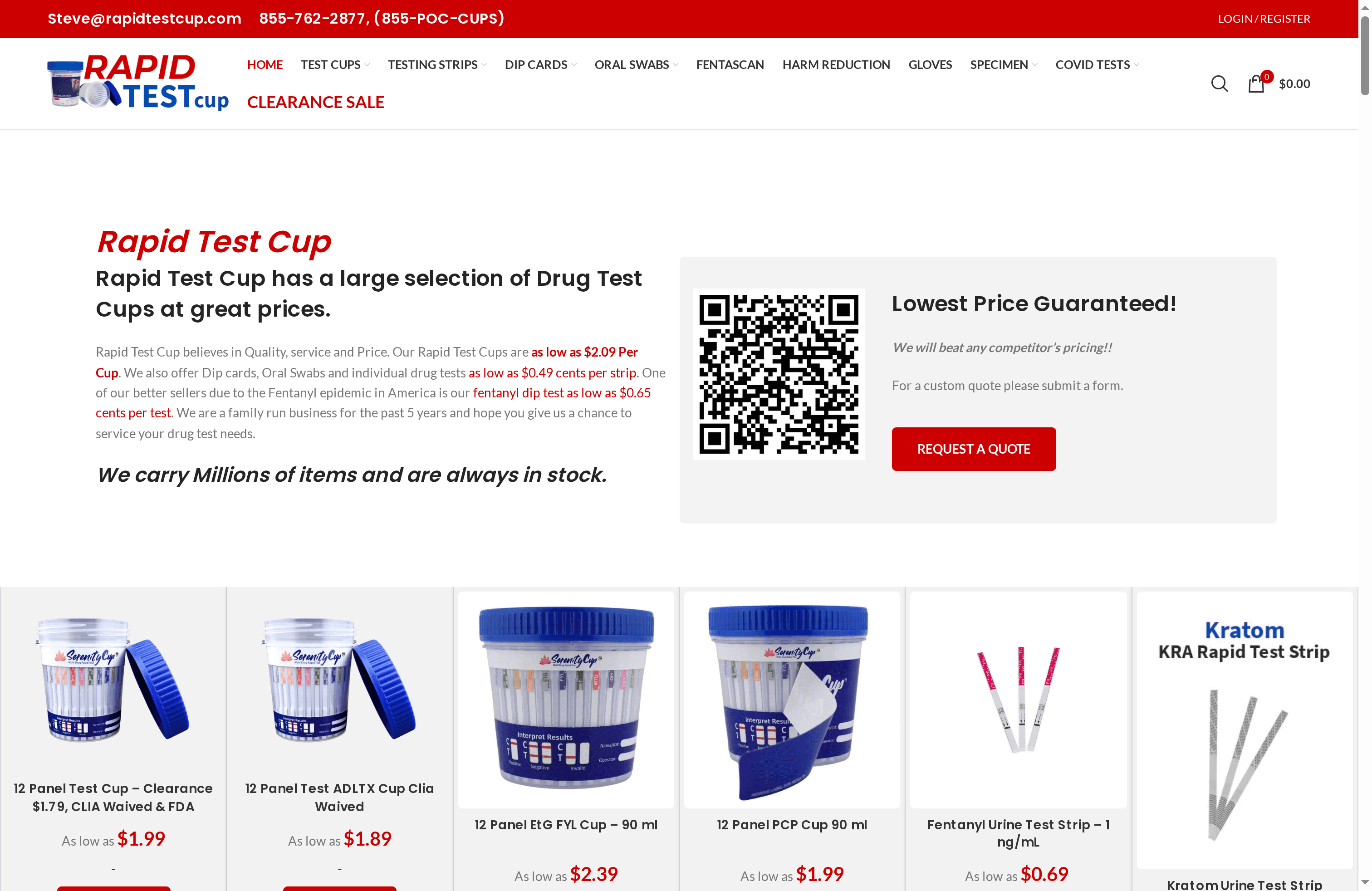
For programs that need to start EtG screening without a long procurement cycle, Rapidtestcup offers ETG urine test strips for rapid point-of-care screening, along with multi-panel cups that include EtG alongside other substance panels. The 14-panel EtG cup covers EtG and 13 other substances in a single collection, which suits clinics and treatment programs running comprehensive screens. For programs that need a specific 300 ng/mL EtG configuration, the ETG/300 cartridge option fits that intermediate cutoff directly.
All products are CLIA waived and FDA approved for point-of-care use. For forensic, transplant, or legal-consequence decisions, pair any positive screen with LC-MS/MS confirmation through a certified reference lab. Rapidtestcup’s lab-focused testing products page covers the full range of professional-grade options. Browse the catalog or request a bulk quote to set up your confirmation workflow alongside point-of-care screening.
Sources
The findings in this article draw on peer-reviewed studies, CAP proficiency data, and clinical lab guidance. The sources below are the primary references.
- Pmc
- Pubmed
- Pmc
- Drug Toxicology Monitoring Alcohol Metabolites, Quantitative, Urine | Test Detail | Quest Diagnostics
- Ncbi
This article is general information, not a substitute for advice from a qualified doctor. Consult a qualified healthcare professional about your own circumstances before acting on anything here.