

Blog
Drug Detection Windows: Timelines, Tests, and What They Mean


A detection window is the period after last use when a drug or its metabolites remain measurable above a test’s cutoff threshold in a specific biological specimen. The window is not a fixed clock. It shifts with the specimen type, the drug, the dose, how often someone uses, and individual biology.
Here is where the ranges land by specimen:
- Blood and breath: hours to 1–2 days for most drugs
- Oral fluid (saliva): hours to 1–2 days
- Urine: 1 day to several weeks depending on drug and frequency
- Hair and nails: weeks to months, sometimes up to 90 days
These are approximate ranges. A single low dose of cocaine clears urine in a few days. A chronic daily cannabis user may test positive in urine for 30 days or more. The NCBI Bookshelf appendix on urine testing puts the baseline for most substances at approximately 2–4 days in urine after a single dose, with higher dose and frequency pushing that number up.
Pro Tip: When someone asks “will I test positive,” the first question to ask back is: which specimen? The answer changes the window by days or weeks.
Key Takeaways
Detection windows are specimen-specific, dose-dependent ranges, not fixed timelines, and THC in chronic users is the most significant exception to standard published estimates.
| Point | Details |
|---|---|
| Detection window definition | The period after last use when a drug or metabolite stays measurable above a test cutoff in a specific specimen. |
| Specimen drives the window | Blood and saliva: hours to 1–2 days; urine: days to weeks; hair: up to ~90 days. |
| THC is the major exception | Chronic users can test positive in urine for 30 days or longer; intermittent users typically clear in 7–10 days. |
| Confirm before acting | A positive immunoassay screen requires GC-MS or LC-MS confirmation and MRO review before any consequential decision. |
| Cutoff selection changes everything | Lower cutoffs extend the effective detection window; always confirm the cutoff threshold in use before interpreting a result. |
Table of Contents
- How detection windows connect to pharmacokinetics
- Which specimen type gives you the window you actually need?
- Approximate detection windows for common drugs
- What actually changes your detection window?
- How screening and confirmatory testing actually work
- What the research says about edge cases and special analytes
- The limits of detection-window estimates and why they matter
- Sources
How detection windows connect to pharmacokinetics
Half-life and lipid solubility are the two biggest drivers of how long a drug or its metabolites stay detectable. Half-life is the time it takes the body to reduce the drug’s concentration by half. A drug with a short half-life clears blood quickly. That does not mean it clears urine quickly, because urine tests usually target metabolites, not the parent drug.
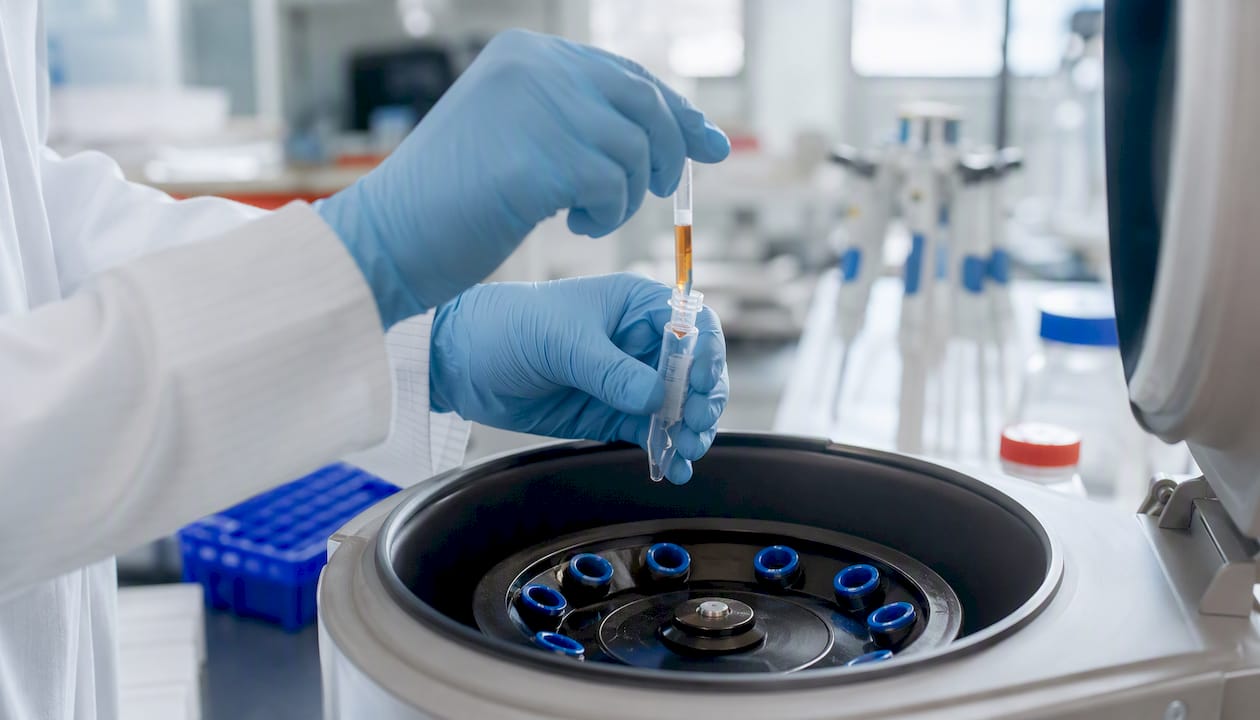
Here is the distinction that trips people up. After the body processes a drug through phase I and phase II metabolism in the liver, it excretes the resulting metabolites into urine. Those metabolites can linger long after the parent compound has dropped below detectable levels in blood. THC is the clearest example: the parent molecule leaves blood within hours, but THC-COOH, its primary urinary metabolite, accumulates in fat tissue and releases slowly, extending the urine detection window dramatically in regular users.
Lipid solubility matters for the same reason. Drugs that dissolve readily in fat (THC, PCP, some benzodiazepines) deposit in adipose tissue and release back into circulation gradually. That slow release keeps metabolite concentrations above the cutoff long after the last dose. For a deeper look at how metabolites extend detection, this guide on drug metabolite detection covers the mechanism in practical terms.
Key pharmacokinetic factors at a glance:
- Half-life: shorter half-life = faster blood clearance, but urine window depends on metabolite kinetics
- Lipid solubility: fat-soluble drugs accumulate in tissue and release slowly
- Metabolite stability: some metabolites are more stable than the parent drug and persist longer
- Elimination route: renal excretion (urine) vs. biliary excretion affects which specimen captures the drug
Pro Tip: When reading a lab report, check which analyte the test targets. A test for THC-COOH has a longer window than one targeting the parent THC. That single detail changes how you interpret the result.
Which specimen type gives you the window you actually need?
Each matrix answers a different question. Blood tells you what is in circulation right now. Urine tells you what the body has been processing over the past few days to weeks. Hair tells you what someone was using months ago. Choosing the wrong specimen for the question is one of the most common errors in testing programs.
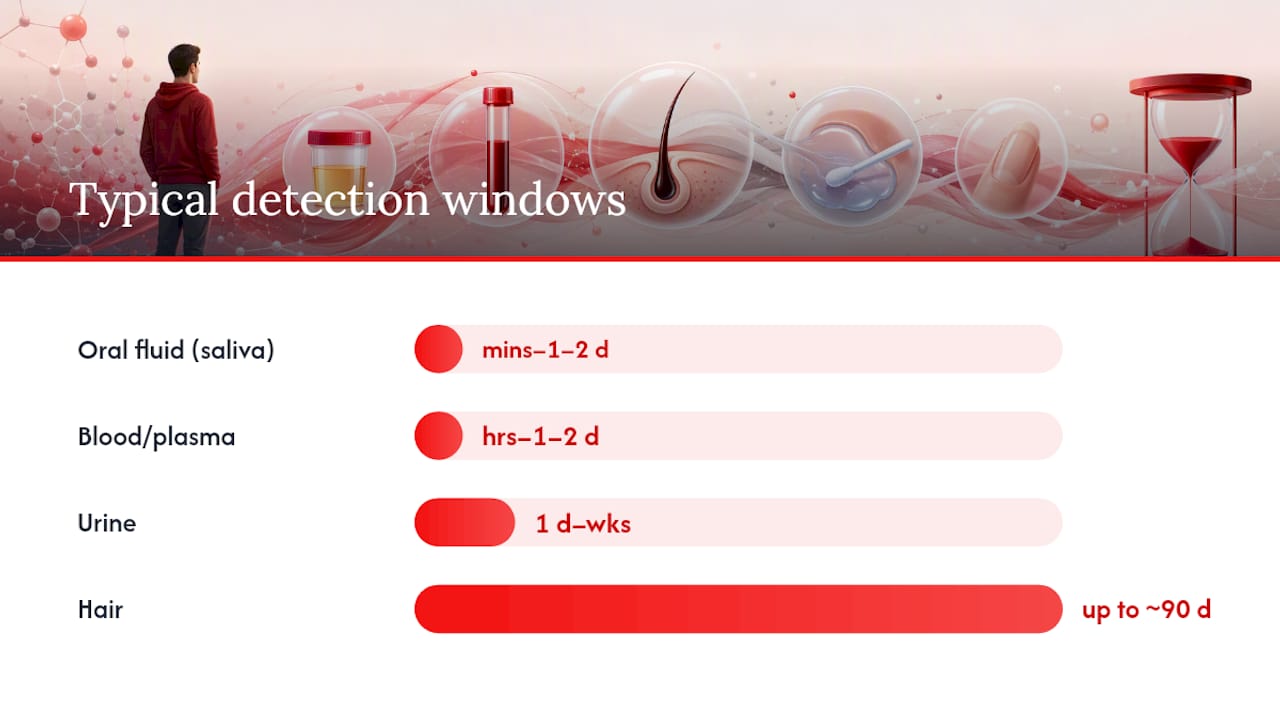
Peer-reviewed clinical references confirm that blood and oral fluid reflect recent exposure, urine captures excreted metabolites over a mid-range window, and hair provides a long-term historical record.
| Specimen | Earliest Detection | Typical Window | Main Advantage | Main Limitation |
|---|---|---|---|---|
| Urine | 2 hours | 1 day to several weeks | Mid-range window, non-invasive, low cost | Can be diluted or adulterated |
| Blood/plasma | Minutes | Hours to 1–2 days | Reflects current impairment | Short window, invasive |
| Oral fluid (saliva) | Minutes | Hours to 1–2 days | Observed collection, hard to adulterate | Short window, some drugs transfer poorly |
| Hair | ~7–10 days post-use | Up to ~90 days | Long retrospective window | Cannot detect very recent use |
| Sweat (patch) | Hours | Days to weeks (cumulative) | Continuous monitoring | Contamination risk |
| Nails | Weeks | Months | Very long retrospective window | Slow to standardize |
A few practical notes on interpretation:
- Urine is the dominant specimen in U.S. workplace and clinical screening because it balances cost, a useful mid-range window, and non-invasive collection. Workplace guidance consistently favors random urine screening for exactly these reasons.
- Blood is preferred when current impairment is the question, such as post-accident investigations.
- Oral fluid is gaining ground in roadside and workplace settings because collection is observed and adulteration is difficult.
- Hair cannot confirm use in the past week or two because it takes time for the drug to incorporate into the growing shaft. It is the right choice for historical pattern questions, not recent-use questions.
Pro Tip: For a clinical program that needs to verify recent abstinence, urine is usually the right call. For a forensic case asking whether someone used drugs three months ago, hair or nails are the only matrices that reach that far back.
For a full reference on collection options and devices, this specimen collection guide covers the practical differences across specimen types.
Approximate detection windows for common drugs
Most non-lipid-soluble drugs clear urine in a few days after a single dose. Lipid-soluble drugs, particularly THC, are the major exception. The table below reflects ranges from peer-reviewed detection-window literature and a PubMed review of blood, urine, and oral fluid detection times. Ranges assume standard cutoff thresholds; lower cutoffs extend detection, higher cutoffs shorten it.
THC stands out. For intermittent users, urine detection typically runs up to 7–10 days. For chronic heavy users, the detection window can reach 30 days or longer. No other commonly tested drug shows that degree of accumulation in urine.
A few points worth flagging:
- Benzodiazepines vary widely by agent. Short-acting agents like triazolam clear in 1–2 days. Long-acting agents like diazepam and its active metabolites can produce positive urine results for weeks in chronic users.
- Fentanyl requires a specific test panel. Standard opiate immunoassays do not reliably detect fentanyl. A dedicated fentanyl urine test strip or a panel that includes fentanyl is necessary.
- ETG and ETS extend alcohol detection well beyond what a breath test captures. They are used when short-term abstinence verification matters, such as in DUI monitoring programs.
- Cutoff thresholds shift the window. A test with a 15 ng/mL THC-COOH cutoff will stay positive longer than one set at 50 ng/mL.
What actually changes your detection window?
Dose and frequency are the two most powerful variables, but they are not the only ones. Workplace substance abuse guidance explicitly notes that single small doses sit near the lower boundary of published ranges, while chronic long-term use approaches the upper boundary.
Individual factors that lengthen or shorten detection:
- Body fat percentage: Fat-soluble drugs (THC, PCP, some benzodiazepines) deposit in adipose tissue. Higher body fat means a larger reservoir and a longer release period.
- Metabolic rate: Faster metabolism clears drugs more quickly. Age, genetics, and certain medications all affect how fast the liver processes drugs.
- Liver and kidney function: Impaired hepatic or renal function slows elimination. A person with liver disease may show positive results longer than published ranges suggest.
- Hydration and urine concentration: A heavily diluted urine sample may push a borderline result below the cutoff. Conversely, concentrated urine can keep a result above the cutoff longer.
- Urine pH: Acidic urine accelerates excretion of some drugs (amphetamines, PCP); alkaline urine slows it.
- Age: Older adults generally metabolize drugs more slowly, which can extend windows.
- Chronicity of use: Chronic use allows metabolites to accumulate in tissue. Even after stopping, the slow release from tissue keeps urine concentrations elevated.
Test-related factors that shift the window:
- Specimen type: As the table above shows, the matrix alone can change the window from hours to months.
- Analytic method: Immunoassay screening is fast but cross-reactive. GC-MS and LC-MS confirmation is specific and quantitative. A positive immunoassay for opiates may reflect poppy seed consumption; GC-MS resolves that.
- Cutoff threshold: Lower cutoffs increase sensitivity and extend the effective detection window. Higher cutoffs shorten it.
- Test panel: A standard 5-panel test misses fentanyl, synthetic cannabinoids, and kratom. Panel selection determines what is even measurable.
Pro Tip: Expect longer-than-typical positives when three factors combine: chronic heavy use, high body fat, and a low cutoff threshold. That combination can push a THC-positive urine result well past the 30-day mark.
How screening and confirmatory testing actually work
Screening immunoassays are designed for speed and throughput, not specificity. GC-MS and LC-MS confirmation tests identify the exact compound and quantify it. Cutoff thresholds determine whether a result is reported as positive or negative. SAMHSA’s federal workplace drug testing guidance sets the policy framework for cutoffs, confirmatory requirements, and chain-of-custody procedures in federally mandated programs.
The standard lab workflow after a positive screen:
- Initial screen: Immunoassay (urine, oral fluid, or other matrix) produces a preliminary positive.
- Confirmation: The same specimen goes to GC-MS or LC-MS, which confirms the specific drug and its concentration.
- Medical Review Officer (MRO) review: A licensed physician reviews the confirmed result, considers any legitimate medical explanation (prescription medications, medical conditions), and reports the final result to the employer or program.
- Result communication: The MRO reports positive, negative, or “canceled” (if the specimen was invalid or the collection had a procedural flaw).
Screening tests are designed to be sensitive, not specific. A positive screen is a preliminary finding, not a confirmed result. Decisions about employment, treatment, or legal action should never rest on a screen alone.
Common sources of false positives on immunoassay screens:
- Opiates: Poppy seeds, quinolone antibiotics, and rifampin can trigger false positives. GC-MS distinguishes morphine from codeine and rules out non-drug sources.
- Amphetamines: Several prescription medications (pseudoephedrine, bupropion, certain antihistamines) cross-react with amphetamine immunoassays.
- THC: Dronabinol (synthetic THC, prescribed for nausea) produces a legitimate positive. MRO review handles this.
- Benzodiazepines: Sertraline and oxaprozin have been reported to cause cross-reactivity in some assay formats.
For programs that need laboratory-grade compliance protocols, chain-of-custody documentation and confirmatory testing are non-negotiable steps. For direct-access lab testing without a provider referral, EIV Diagnostics outlines options for individuals who want to order their own confirmatory panels.
Pro Tip: If a result matters, confirm it. An immunoassay screen costs a few dollars. A GC-MS confirmation costs more but eliminates the ambiguity that can derail a career or a treatment plan.
What the research says about edge cases and special analytes
Multiple peer-reviewed sources and federal resources confirm that detection windows are matrix-specific and that chronic use materially extends windows for lipophilic drugs. The PMC review on objective drug testing provides the most widely cited tables for clinical reference, covering detection windows across blood, oral fluid, urine, and hair for a broad range of drug classes.
Hair testing captures a fundamentally different kind of information than urine. A 1.5-inch hair segment represents approximately 90 days of exposure history. Urine tells you about the past few days to weeks; hair tells you about the past few months.
THC accumulation in fat tissue is the most studied example of how chronic use distorts expected windows. The drug deposits in adipose tissue during regular use and releases slowly after cessation, keeping urine metabolite concentrations above the 50 ng/mL cutoff for weeks. Occasional users typically clear within 7–10 days. Daily users can remain positive for 30 days or longer, and in some documented cases, even longer with very high body fat and heavy prior use.
For alcohol, ETG (ethyl glucuronide) and ETS (ethyl sulfate) are the biomarkers that extend detection beyond what a breath test captures. Standard breath and blood alcohol tests reflect current intoxication and clear within hours. ETG in urine can remain detectable for up to approximately 80 hours after the last drink, making it useful for abstinence monitoring programs. PEth (phosphatidylethanol) in blood is a longer-term alcohol biomarker used when the question is chronic heavy drinking over weeks, not a single recent episode.
Pro Tip: When the clinical or legal question is about historical use patterns rather than recent use, hair or PEth are the right tools. Urine answers “did they use recently?” Hair and PEth answer “have they been using regularly?”
The limits of detection-window estimates and why they matter
Detection windows are probabilistic ranges, not exact timestamps. A published “3–7 day” window for PCP in urine means that most people in most studies cleared the drug within that range under the conditions tested. It does not mean a specific individual will clear it on day 4.
Key limitations to keep in mind:
- Interindividual variability: Genetics, body composition, age, health status, and concurrent medications all produce real differences between people tested under identical conditions.
- Test sensitivity and cutoff differences: A lab using a 15 ng/mL THC-COOH cutoff will report positives days longer than one using 50 ng/mL. Published ranges usually assume standard cutoffs; always confirm the cutoff in use.
- Hair-color and cosmetic treatment bias: Melanin binds some drugs more readily than others, and chemical treatments (bleaching, perming) can reduce drug concentrations in hair. Dark hair may show higher concentrations of certain drugs than lighter hair from the same exposure.
- Environmental contamination: Hair and sweat patches carry a small risk of external contamination from passive exposure. Confirmation testing and MRO review are the safeguards.
- Sample adulteration: Urine is the most commonly adulterated specimen. Adulterants, substitution, and dilution can all push a result below the cutoff. Adulterant-detection panels address this directly.
- Single-use vs. chronic-use ranges: Most published ranges are derived from controlled single-dose studies. Real-world chronic users often fall outside those ranges on the high end.
A detection window estimate tells you the probable range, not the certain outcome. Treat a single test result as one data point, not a complete picture. Confirmatory testing and clinical context are what turn a data point into a defensible conclusion.
Pro Tip: If a result surprises you given the expected window, check the cutoff, the specimen type, and whether the person is a chronic user before drawing conclusions. The biology is more variable than the published tables suggest.
This article provides general educational information about drug detection windows. It is not medical or legal advice. For guidance on a specific test result, consult a licensed clinician, toxicologist, or Medical Review Officer.
What I actually tell people when they ask about detection windows
Prioritize specimen type and test cutoff over exact day estimates. That is the rule that holds up in practice. Published timelines are useful starting points, but they were built from controlled studies, often on healthy adults with known single doses. Real-world testing involves chronic users, variable body compositions, and lab-to-lab cutoff differences that can shift the window by days.
The second thing I emphasize: if a result matters, confirm it. A positive immunoassay screen is a flag, not a verdict. GC-MS or LC-MS confirmation, followed by MRO review, is what converts a preliminary finding into something you can act on. Programs that skip confirmation because of cost end up paying more when a false positive triggers a wrongful termination dispute or a treatment decision based on a cross-reactive antibody.
For clinics and programs that need reliable, CLIA-waived testing tools that match the specimen types discussed here, Rapidtestcup supplies multi-panel cups, urine strips, and collection kits built for exactly these settings.
Sources
The sources below are the primary references for detection-window data, testing protocols, and federal guidance in the United States.
- OBJECTIVE TESTING – URINE AND OTHER DRUG TESTS – PMC
- Appendix B. Urine Collection and Testing Procedures and … – NCBI
- Drug Detection Windows (substance abuse workplace guidance)
- Detection times of drugs of abuse in blood, urine, and oral fluid – PubMed
- THE MARIJUANA DETECTION WINDOW
Always verify cutoff thresholds and confirmatory methods directly with the testing laboratory, since lab-specific policies can shift results relative to published ranges.
This article is general information, not a substitute for advice from a qualified doctor. Consult a qualified healthcare professional about your own circumstances before acting on anything here.