

Blog
Fentanyl False Positives: Some Assays Reach 38%; Verify First


A positive fentanyl screen is presumptive, not proof of use. Immunoassays and test strips can cross-react with other molecules, and published clinical evaluations have reported false-positive rates as high as 38% for some assays. Your immediate step is to request confirmatory testing by LC-MS/MS, the gold standard, and review every medication on the list.
TL;DR:
- Reported false positive rates varied by assay: adjusted cutoffs or different technology lowered two rates from 38% to 17%, and 11.2% to 3.2%.
- Loperamide interference depends on concentration, with reported thresholds from 5.72 to 23.7 mg/L; also disclose risperidone, trazodone, labetalol, and haloperidol.
- Follow strip dilution and reading instructions, use controls when available, and repeat borderline results with a fresh strip from the same lot.
- In regulated workplace testing, ask the Medical Review Officer for split specimen retesting and get the request deadline in writing, since program rules set timing.
Table of Contents
- 1. Why screening assays produce false positives
- 2. Medications and substances that can cause cross-reactivity
- 3. Fentanyl test strips: lot variability, sample prep, and dilution
- 4. Confirmatory testing: LC-MS/MS, lab-developed tests, and better immunoassays
- 5. What the lab and Medical Review Officer do after an unexpected positive
- 6. A step-by-step verification checklist
- 7. Why certain drugs look like fentanyl to an antibody
- 8. Reading faint or borderline lines on a fentanyl test strip
- 9. How urine, saliva, and sweat samples affect false-positive risk
- 10. Newer technology aimed at cutting false positives
- 11. Collecting and handling specimens to avoid contamination
- 12. A clinical-testing perspective: verify before you act
- 13. Where to get testing supplies quickly
- FAQ
- Sources
1. Why screening assays produce false positives
Immunoassays and strips work by antibody binding, and the antibody does not “see” a whole molecule. It recognizes a shape. Anything with a similar shape can trigger the same signal. Manufacturers tune these assays for sensitivity, because missing a true positive is considered the worse error in a screen. The price of that choice is specificity, which is why a screening result is a question, not an answer.
The scale of the problem depends on the assay and the cutoff. In clinical evaluations, reported false-positive rates reached 38% and 11.2% for specific assays, and adjusted cutoffs or different assay technologies brought those down to 17% and 3.2%.
Early evaluations reported false-positive rates of 38% and 11.2% for specific fentanyl assays, reduced to 17% and 3.2% with adjusted cutoffs or different technology. The same assay can look very different depending on how it is configured, so ask which assay and cutoff your lab used.
Confirmatory methods settle most of these cases. LC-MS/MS identifies the specific molecule by mass and fragmentation pattern, not by shape. Experts in toxicology describe immunoassays as presumptive tools that favor sensitivity over specificity, and they recommend confirming any positive with a more specific method and reading it alongside clinical history and medications. Our guide on reading fentanyl test cutoffs covers how cutoff choice shifts these numbers.
2. Medications and substances that can cause cross-reactivity
When a fentanyl result conflicts with the patient’s history, check the medication list first. Published reports and reviews have linked a recurring set of agents to false positives:
- Loperamide: an antidiarrheal linked to false positives at concentrations above 5.72 mg/L up to 23.7 mg/L, depending on the assay.
- Risperidone and 9-hydroxyrisperidone: a study of a fentanyl immunoassay found five of seven false positives were positive for risperidone-related analytes.
- Trazodone: a common antidepressant reported in cross-reactivity cases.
- Labetalol: a blood pressure medication with similar reports.
- Haloperidol: an antipsychotic on the same list.
- Diphenhydramine and lidocaine: over-the-counter and anesthetic agents that interfered with some test strip lots.
- Methamphetamine and MDMA: high concentrations, roughly above 1–2 mg/mL, can trigger false-positive strip results.
Concentration matters as much as the drug. Someone taking loperamide at the labeled dose is unlikely to reach interfering urine levels, while someone taking far more than the labeled amount may. A therapeutic dose and a super-therapeutic concentration behave very differently in an assay.
Pro Tip: Write down drug name, dose, and last dose time for every prescription, supplement, and over-the-counter product before you call the lab. The more specific your list, the faster the lab can judge whether cross-reactivity is plausible.
3. Fentanyl test strips: lot variability, sample prep, and dilution
Test strips are built for field use, and field use adds variables that a lab never has. In a laboratory evaluation of fentanyl test strips, sensitivity and specificity varied from lot to lot. Some lots were less sensitive for certain fentanyl analogs, and some were more prone to false positives from diphenhydramine, lidocaine, MDMA, and methamphetamine at certain concentrations.
One lab assessment of three drug-checking devices found a false-positive rate of about 9.6% and a false-negative rate of about 3.7% for fentanyl test strips. Device choice and use shape both numbers.
What to do about it:
- Follow the manufacturer’s dilution instructions exactly. Too little dilution lets stimulants and cutting agents interfere, and too much risks a false negative.
- Test a known control sample when you can, especially when opening a new lot.
- Use the same lot for repeat testing so you can compare like with like.
- Treat every strip positive as presumptive and every negative as incomplete, because analogs can slip past some strips. Our piece on fentanyl analogs and strip detection gaps explains why.
Our deeper look at test strip accuracy for labs goes through lot checks in more detail.
4. Confirmatory testing: LC-MS/MS, lab-developed tests, and better immunoassays
Confirmatory testing answers the question the screen cannot. LC-MS/MS and high-resolution mass spectrometry (LC-HRMS) separate compounds, then identify them by mass, so a look-alike molecule does not register as fentanyl. Labs commonly look for both fentanyl and its metabolite norfentanyl, and many methods also cover analogs.
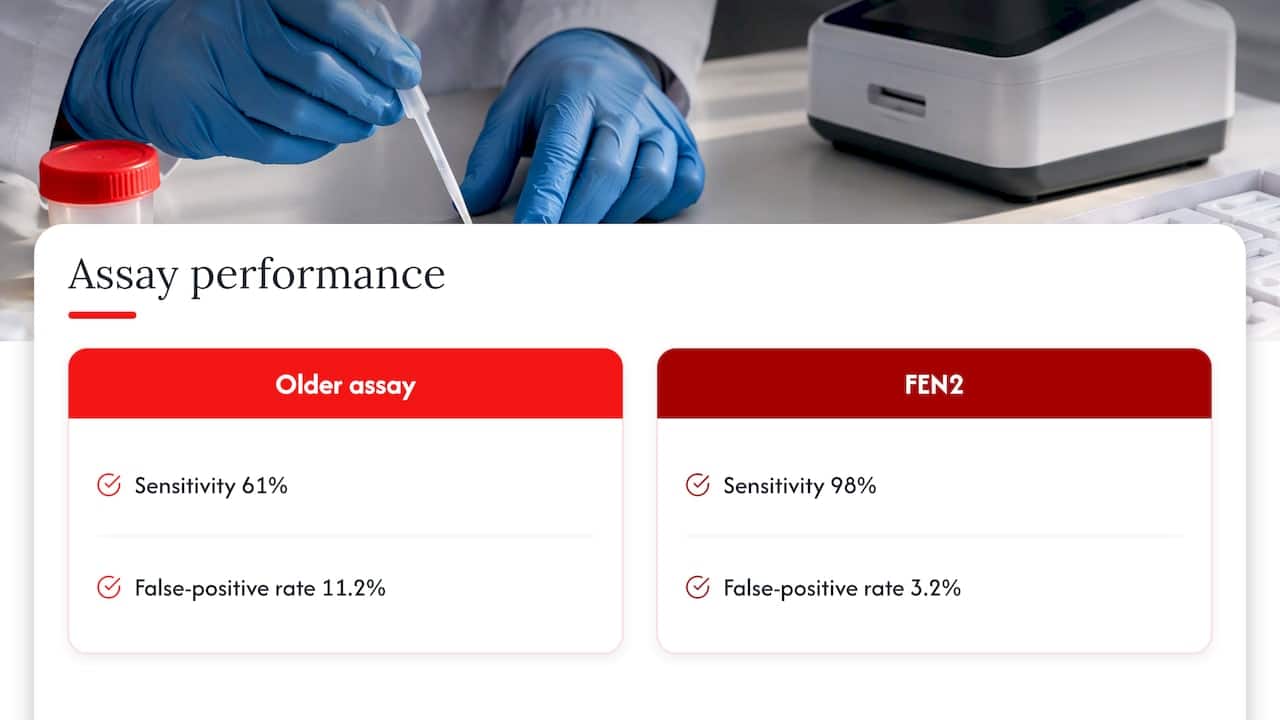
Newer screening assays narrow the gap too. A clinical validation of the Roche FEN2 immunoassay, using LC-MS/MS for confirmation, found:
- Clinical sensitivity of 98% for FEN2 versus 61% for an older DRI assay.
- A false-positive rate of 3.2% for FEN2 versus 11.2% for the older assay.
- Specificity of 99.5% for FEN2.
Two practical notes. First, the reporting threshold for confirmation affects how a result is classified: a sample with norfentanyl present but below the lab’s cutoff may be reported differently than one with parent fentanyl. Second, many labs run lab-developed mass spectrometry tests alongside the screen, so ask whether your confirmation used one and what it covers.
5. What the lab and Medical Review Officer do after an unexpected positive
In federally regulated workplace programs, the process has defined steps. The SAMHSA Medical Review Officer guidance manual describes how Medical Review Officers (MROs) review, document, and request retesting of urine specimens. You can expect:
- Custody form review: the MRO checks the chain of custody and testing paperwork for errors.
- Donor interview: the MRO asks about medications, procedures, and anything else that could explain the result.
- Prescription verification: the MRO confirms prescriptions with the prescriber or pharmacy.
- Confirmatory testing: presumptive positives go to an HHS-certified lab for confirmation, with documentation maintained.
- Split-specimen retesting: when indicated, the donor can request analysis of the second (split B) specimen at a different certified lab.
Turnaround and deadlines for requesting the split specimen are set by the program’s rules, so ask for the dates in writing the day you learn of the result.
6. A step-by-step verification checklist
You can act on a presumptive result immediately. Work through these in order:
- Gather your full medication list with doses, plus any prescription documentation.
- Contact the testing lab or MRO, request confirmatory LC-MS/MS, and ask which assay and cutoff produced the screen.
- Send prescription records and request split-specimen analysis if one is available.
- Keep clinical monitoring in place while confirmation is pending, and avoid irreversible decisions about treatment or employment until the result is back.
- If results remain discordant, ask for a toxicologist or MRO consultation.
Keep a dated log of every call, name, and document sent. That record protects patients and employers alike if the result is disputed later. Our guide on identifying false positives pairs well with this checklist.
Pro Tip: Ask the lab for the specimen’s collection date and time. Medication timing relative to collection often explains a surprising result.
7. Why certain drugs look like fentanyl to an antibody
An immunoassay antibody is raised against a fentanyl-like structure, and it binds a region of the molecule, not the whole thing. Fentanyl has a piperidine ring with a phenethyl group on the nitrogen and an anilide group, and the antibody recognizes some portion of that arrangement. A drug that shares part of that shape can fit the binding site well enough to produce a signal, even though it is chemically a different compound.
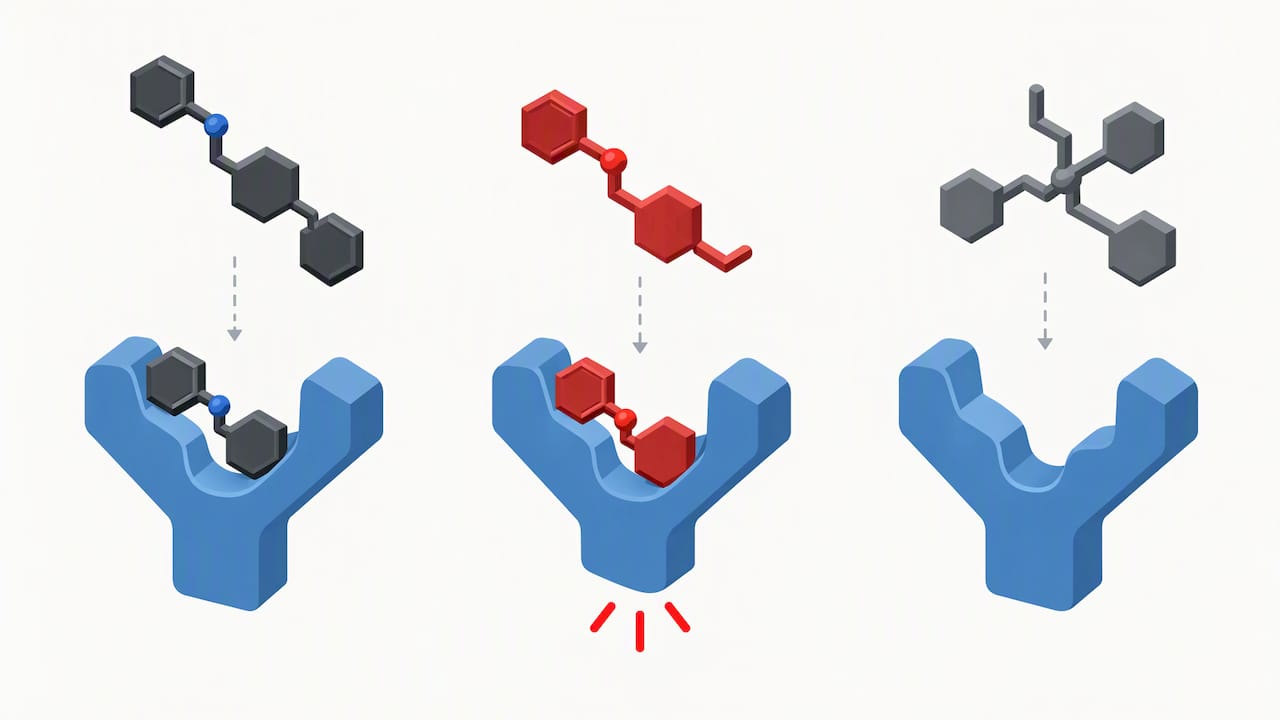
Risperidone is a good example. It contains a piperidine ring, and its metabolite 9-hydroxyrisperidone retains that feature, which is consistent with the cross-reactivity reported in the risperidone and acetylfentanyl study. Trazodone and haloperidol also carry piperazine or piperidine-type rings, though the published reports do not fully explain the binding mechanism for each agent.
Concentration is the second driver. Cross-reactivity is rarely all-or-nothing. A weakly binding molecule may only trigger a signal when its urine concentration is high, which is why the loperamide reports tie false positives to specific concentration thresholds.
Third, assay design matters. Different manufacturers use different antibodies and different cutoffs, so the same drug may cross-react with one product and not another. That is why the answer to “does drug X cause a false positive?” is often “it depends on the assay,” and why you should always ask which one was used.
8. Reading faint or borderline lines on a fentanyl test strip
On a lateral-flow strip, a line in the test region usually means the drug was below the detection threshold, and no line means the drug was at or above it. That makes faint lines confusing, because a very faint test line sits near the threshold and cannot be read as a clean negative or positive.
A few principles help:
- Read within the time window. Check the result at the time the manufacturer specifies. Lines can change after that window, and a late-developing line is not a valid reading.
- Use good light and a white background. Faint lines are easy to misjudge under dim or yellow light.
- Compare against the control line. If the control line fails to appear, the strip is invalid regardless of the test line.
- Retest instead of guessing. Repeat the test with a fresh strip from the same lot, and a second lot if available, using the same dilution.
- Treat borderline as unresolved. A borderline reading means the concentration is near the cutoff. It tells you something may be present, or that an interfering substance is, but it does not tell you which.
Because strip results are qualitative, a borderline line cannot be turned into a number. When the stakes are clinical or employment-related, send the specimen for confirmation instead of settling the question by eye.
9. How urine, saliva, and sweat samples affect false-positive risk
The sample type changes what the test can see and what can interfere. Urine is the most common matrix for screening, and it is where most of the cross-reactivity literature comes from. Urine concentrates drugs and metabolites, which helps detection but also means interfering medications can reach levels that trip an antibody.
Oral fluid reflects more recent exposure and mostly contains parent drug. Contamination of the mouth with a substance can matter more here than in urine, so collection timing and rinsing rules are important. We carry oral swab products for programs that prefer this matrix, such as our oral swab product.
Sweat patches and wipes sample surface or accumulated drug over time. Surface contamination from handling or the environment is the main concern with these, because the sample can pick up drug that was never ingested.
I am not aware of published head-to-head false-positive rates across all three matrices for fentanyl, so avoid assuming one is categorically safer. What holds across matrices is simple: a screen in any matrix is presumptive, and confirmatory mass spectrometry on a properly collected specimen is what resolves it.
10. Newer technology aimed at cutting false positives
The clearest progress so far is better antibodies and better assay configuration. The FEN2 immunoassay validation is a good illustration: against an older assay, it raised clinical sensitivity from 61% to 98% and lowered the false-positive rate from 11.2% to 3.2%. Gains like these come from antibodies that recognize fentanyl more selectively and from cutoffs set with confirmatory data in hand.
Reader-based systems add another layer. Instead of a person judging a faint line by eye, an analyzer reads the result objectively, which removes one source of borderline-line disagreement. Our FentaScan analyzer is a CLIA-waived and FDA-approved reader option for point-of-care screening.
On the confirmatory side, high-resolution mass spectrometry makes it easier to detect new analogs without building a method for each one in advance. That helps close the gap that strips and older immunoassays leave open.
Technology narrows the false-positive problem. It does not remove it. Even an improved immunoassay is a screen, and an unexpected positive still earns a confirmation request.
11. Collecting and handling specimens to avoid contamination
Many false positives that are not true cross-reactivity trace back to the collection step. Good handling is cheap and prevents disputes later.
- Clean workspace. Wipe the collection surface and keep unrelated substances away from the area, since fentanyl and other drugs can transfer by contact.
- Fresh gloves for every donor. Change gloves between specimens and avoid touching the inside of cups or caps.
- Sealed, single-use containers. Use collection supplies, such as our urine specimen cups, and never reuse a cup.
- Observed chain of custody. Label and seal the specimen in front of the donor, and complete the custody form without gaps.
- Temperature and integrity checks. Check specimen temperature and appearance at collection, and follow the program’s rules for storage and transport.
- Follow dilution and timing rules. For strips, use the manufacturer’s volumes and read times, and do not mix specimens or reuse devices.
If a donor reports a possible contamination event, document it at the time. A written note made at collection is far more persuasive than a recollection weeks later.
12. A clinical-testing perspective: verify before you act
An unexpected positive is frightening, and the first reaction is often to assume the worst or to argue with the lab. I would encourage a calmer path. A screen is a starting point, and the confirmatory result is what should drive decisions about treatment, employment, or trust.
Talk openly. Patients should tell clinicians everything they take, clinicians should tell labs what the patient is prescribed, and labs should be ready to explain which assay they used. Most discordant results resolve once those three conversations happen. When they do not, a toxicology consultation is worth requesting.
— Justin
13. Where to get testing supplies quickly
When you need screening or specimen collection supplies fast, we stock urine test cups, fentanyl test strips, oral swabs, and a CLIA-waived analyzer. Choose CLIA-waived or FDA-cleared options when your clinic or workplace needs a validated device. You can browse everything in our shop.
This article is general information, not a substitute for advice from a qualified doctor. Consult a qualified healthcare professional about your own circumstances before acting on anything here.
FAQ
Can sertraline cause a false positive on a drug test?
Sertraline is best known for triggering false positives on some benzodiazepine screens, not fentanyl screens. The sources we reviewed for this article do not list it as a fentanyl cross-reactant. If a fentanyl screen is positive while you take it, request confirmatory testing and give the lab your full medication list.
Can trazodone cause a positive fentanyl test result?
Yes, it can. Cross-reactivity with fentanyl screening assays has been linked to trazodone, along with risperidone, labetalol, and haloperidol. Whether it happens depends on the assay, so ask for LC-MS/MS confirmation.
Can labetalol cause false positive drug test results?
Labetalol has been reported as a cause of false-positive fentanyl immunoassay results. It sits in the same group of medications as trazodone and haloperidol in the published cross-reactivity literature. Confirmatory mass spectrometry will tell you whether fentanyl is actually present.
How accurate are fentanyl tests?
Accuracy depends on the test type and lot. Clinical evaluations have reported false-positive rates from 38% down to 3.2% across assay configurations, and newer assays perform better than older ones. Confirmatory LC-MS/MS is the standard for settling any presumptive positive.
Sources
- Pubmed
- An Opioid Hiding in Plain Sight: Loperamide-Induced False-Positive Fentanyl and Buprenorphine Immunoassay Results – PubMed