

Blog
2–8 Day Urine Window, False Positives, and Pro Kit Guidance for PCP Drug Tests


A PCP drug test screens biological samples for phencyclidine or the metabolites it leaves behind. Urine tests typically catch use for about 2 to 8 days, hair testing extends that window to several weeks to months, and blood or oral fluid samples cover only a day or two at most. Every initial screening result, no matter the sample type, is presumptive and requires confirmation by GC/MS or LC-MS/MS before anyone treats it as fact.
TL;DR:
- PCP detection in urine typically lasts 2 to 8 days, but heavy or chronic use can extend detection up to 14 days, especially in heavy users.
- False positives are common with immunoassays due to cross-reactivity with medications like dextromethorphan, tramadol, and some antidepressants, requiring confirmatory testing.
- Confirmatory analysis by GC/MS or LC-MS/MS is essential to verify initial positive results and provides specific concentration levels for legal or medical decisions.
- Chain-of-custody documentation is critical for legal or employment cases and must be established at the time of collection to ensure result defensibility.
- Proper sample collection, disclosure of current medications, and avoiding tampering or dilution maximize test accuracy and interpretability.
Table of Contents
- How Does PCP Drug Testing Work?
- How Long Does PCP Stay in Your System?
- What Causes a False Positive on a PCP Test?
- What Happens After a Positive PCP Screen?
- How Do You Read a PCP Test Result Correctly?
- What Should You Do After a Presumptive Positive Result?
- Why Do PCP Metabolites Matter for Detection?
- How Do Testing Protocols Differ by Setting?
- What Are the Legal and Privacy Considerations for PCP Testing?
- How Should You Prepare for a PCP Drug Test?
- RapidTestCup’s Take on Choosing a Professional PCP Test Kit
- Where to Buy Professional PCP Test Kits and Custody Supplies
- Sources
- FAQ
How Does PCP Drug Testing Work?
Most PCP screening starts with a urine immunoassay, the same rapid-cup or dip-card technology used across workplace and clinical drug panels. These tests work fast, cost little, and commonly use a 25 ng/mL cutoff to flag a sample as positive. They’re built for speed, not certainty.
That speed comes with a tradeoff. Immunoassays detect antibody reactions to compounds that resemble PCP structurally, which means they occasionally flag substances that aren’t PCP at all. Confirmatory testing by gas chromatography-mass spectrometry (GC/MS) or liquid chromatography-tandem mass spectrometry (LC-MS/MS) removes that ambiguity by identifying the exact molecule present.
Beyond urine, three other sample types serve specific purposes:
- Hair testing captures a long-term history of use but takes weeks to become detectable, since it depends on hair growth.
- Blood testing shows recent, active exposure but clears quickly, making it useful mainly in emergency or acute clinical settings.
- Oral fluid testing offers a short window similar to blood, favored for its noninvasive collection during roadside or immediate-need screening.
How Long Does PCP Stay in Your System?
PCP typically clears the body within days for occasional users, but chronic use can stretch detection windows considerably. The drug’s clearance half-life averages about 15 hours, meaning the body eliminates roughly half of what’s present in that time frame. That relatively short half-life is why most single-use cases clear urine within a week.
Detection windows by sample type break down like this:
- Urine: roughly 2 to 8 days after use, with some lab sources reporting up to 14 days in heavy or chronic users.
- Hair: approximately 90 days, reflecting drug incorporation into the hair shaft over time.
- Blood: typically under 24 to 48 hours, since PCP moves out of the bloodstream fast.
- Oral fluid: a similarly short window, usually one to two days.
Several factors push these ranges wider or narrower. Dose size and frequency of use matter most. Someone who used PCP once will clear it faster than a chronic user whose body has stored the drug in fat tissue over weeks. Metabolic rate, body fat percentage, and urine pH all shift the numbers too, since PCP is a basic compound that behaves differently depending on how acidic or alkaline the urine is. The test’s own cutoff threshold matters as well. A lab using a lower cutoff will flag trace amounts a higher cutoff would miss entirely.
What Causes a False Positive on a PCP Test?
Immunoassay screens work by detecting antibody binding, not the exact chemical structure of PCP. That design flaw is exactly why certain unrelated medications can trigger a positive result. If a drug’s molecular shape resembles phencyclidine closely enough, the antibodies in the test kit react to it the same way.
Documented cases back this up. One case report describes a false-positive PCP screen attributed to desvenlafaxine (Pristiq), an antidepressant with no pharmacological relationship to PCP. A broader analysis of urine immunoassay results found that several common medications produce false-positive PCP readings with more regularity than most people assume.
Medications and substances commonly implicated include:
- Dextromethorphan, found in many over-the-counter cough suppressants.
- Tramadol, a widely prescribed opioid pain reliever.
- Certain antidepressants, including desvenlafaxine.
- Some antihistamines and other structurally similar compounds.
A drug that has nothing to do with PCP pharmacologically can still trigger a positive PCP screen, simply because its molecular shape fools the antibody used in the immunoassay. That’s not a flaw unique to cheap test kits. It’s a limitation built into how every rapid immunoassay works.
Specimen problems compound the risk. Adulterated samples, unusual urine pH, and collection errors can all distort a result independent of what the person actually used. None of that changes the standard response: any presumptive positive needs confirmatory testing before it means anything.
What Happens After a Positive PCP Screen?
Reflex testing is the industry-standard response to a positive immunoassay. When a screen flags positive, the laboratory automatically runs a confirmatory GC/MS or LC-MS/MS test on that same sample without waiting for a separate request. This protocol exists because immunoassays generate false positives often enough that no accredited lab treats a screening result as final.
Chain-of-custody testing adds a second layer specifically for workplace or legal cases. Standard clinical screening doesn’t document who handled the sample at each step, but chain-of-custody collection does, using tamper-evident seals and signed transfer logs that hold up if a result gets challenged in a hearing or court proceeding. Anyone facing an employment or legal consequence should request this format specifically rather than a routine clinical cup.
Quantitative confirmation results add something a simple positive/negative screen can’t: an actual concentration, expressed in nanograms per milliliter. That number matters for a few reasons.
- It tells a reviewing physician or medical review officer whether the level is consistent with reported use, or trace exposure to a medication.
- It creates a documented, legally defensible record tied to a specific concentration rather than a vague “positive” flag.
- It allows comparison against the SAMHSA-referenced 25 ng/mL cutoff used by most labs, clarifying whether the result falls near the threshold or well above it.
Pro Tip: If you’re ordering test kits for anything beyond routine clinical screening, always specify chain-of-custody collection at purchase. Retrofitting documentation after a sample is already collected doesn’t hold up the same way.
How Do You Read a PCP Test Result Correctly?
A screening result only tells you positive or negative. It says nothing about how much PCP is present, which is where a lot of confusion starts. Confirmatory testing, by contrast, reports an actual quantitative value in ng/mL, giving you a number instead of a binary flag.
The 25 ng/mL cutoff commonly used in urine screening means the test is calibrated to ignore trace amounts below that threshold and flag anything above it. On rapid cassette-style tests, this shows up physically as a line’s presence or absence. A faint line near the cutoff threshold isn’t a malfunction. It usually means the concentration sits right around that 25 ng/mL boundary, which is exactly the kind of result that benefits most from lab confirmation rather than a visual read.
Timing and urine chemistry can also produce misleading negatives:
- Testing too early or too late in the detection window can miss a true positive entirely.
- Diluted urine, whether from overhydration or intentional tampering, can push a real positive below the cutoff.
- Because PCP is a basic compound, unusual urine pH can alter how much drug shows up in a given sample, sometimes enough to change a result.
What Should You Do After a Presumptive Positive Result?
The right next step depends on who you are and what’s at stake. None of these paths skip confirmation. They differ in documentation and follow-up.
- Individuals should request confirmatory testing immediately, preserve the original sample if possible, and disclose every current medication to whoever ordered the test. A prescription cough medicine or antidepressant could easily explain an unexpected result.
- Clinicians should order GC/MS or LC-MS/MS confirmation before making any treatment decision based on a screen alone, weigh the patient’s medication list and clinical presentation, and document every step of that reasoning in the chart.
- Employers and legal representatives should insist on chain-of-custody confirmation testing rather than accepting a rapid screen as final, follow whatever retesting provisions their policy allows, and keep documentation consistent with the standards labs like Mayo Clinic Laboratories use for legally defensible results.
Why Do PCP Metabolites Matter for Detection?
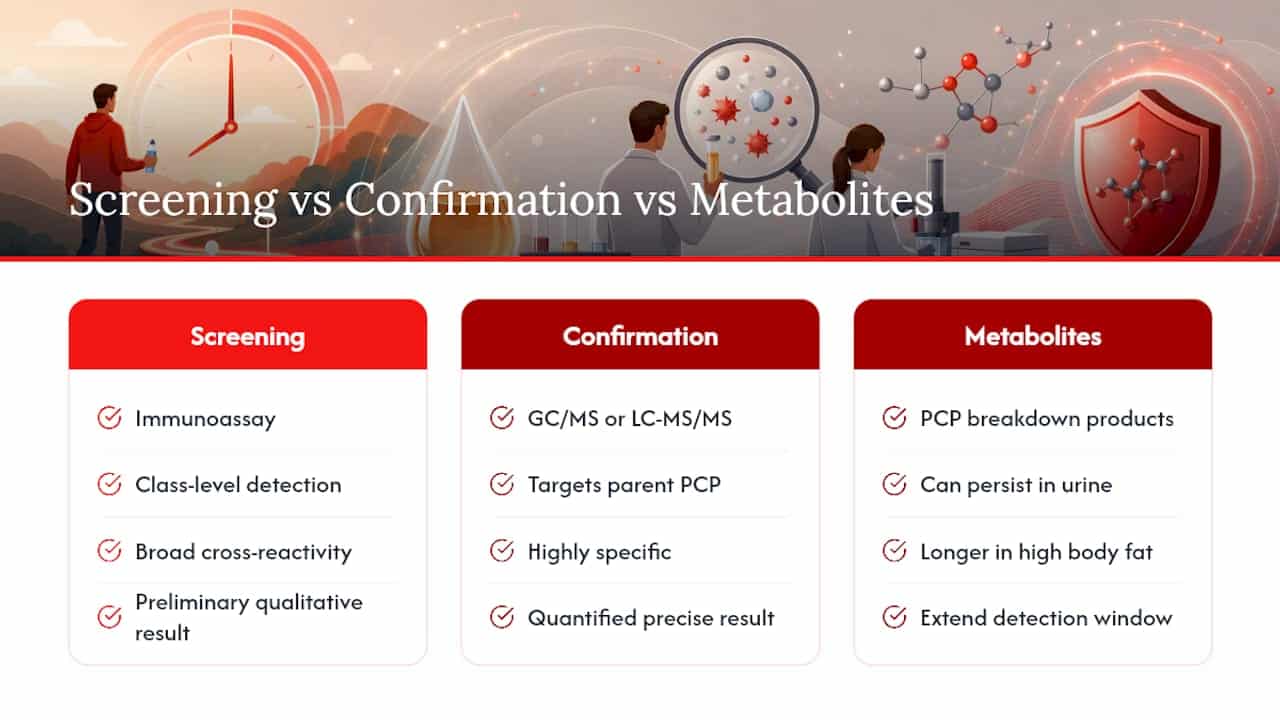
The body doesn’t excrete PCP unchanged. It metabolizes the drug into several breakdown products, and most testing methods are actually designed to detect either the parent compound, its metabolites, or both, depending on the sample type and testing method used.
This matters practically because metabolite behavior differs from the parent drug. PCP is a basic, lipophilic compound, meaning it distributes into fat tissue and takes longer to fully clear in people with higher body fat or in chronic users who’ve built up a larger internal reservoir. Metabolites can linger in urine even after the parent compound itself has dropped below detectable levels, which partly explains why detection windows stretch further for heavy users than the simple half-life math would suggest.
Confirmatory testing by GC/MS or LC-MS/MS typically targets the parent PCP molecule directly, giving toxicologists a precise, quantifiable answer rather than a broad antibody reaction to a family of related compounds. That precision is exactly why confirmation exists as a separate step from screening. An immunoassay reacts to a class of structurally similar molecules; a mass spectrometry-based confirmation identifies the specific compound and reports how much of it is actually present. Anyone reviewing a PCP drug test results report should understand that distinction, since a screening-only result and a confirmed, quantified result carry very different evidentiary weight, whether the context is medical, legal, or workplace-related. Understanding how drug metabolites affect testing accuracy helps explain why two people with similar use patterns can still produce different detection timelines.
How Do Testing Protocols Differ by Setting?
Workplace testing, legal testing, and medical testing all use the same underlying science, but the procedures around collection and documentation diverge sharply.
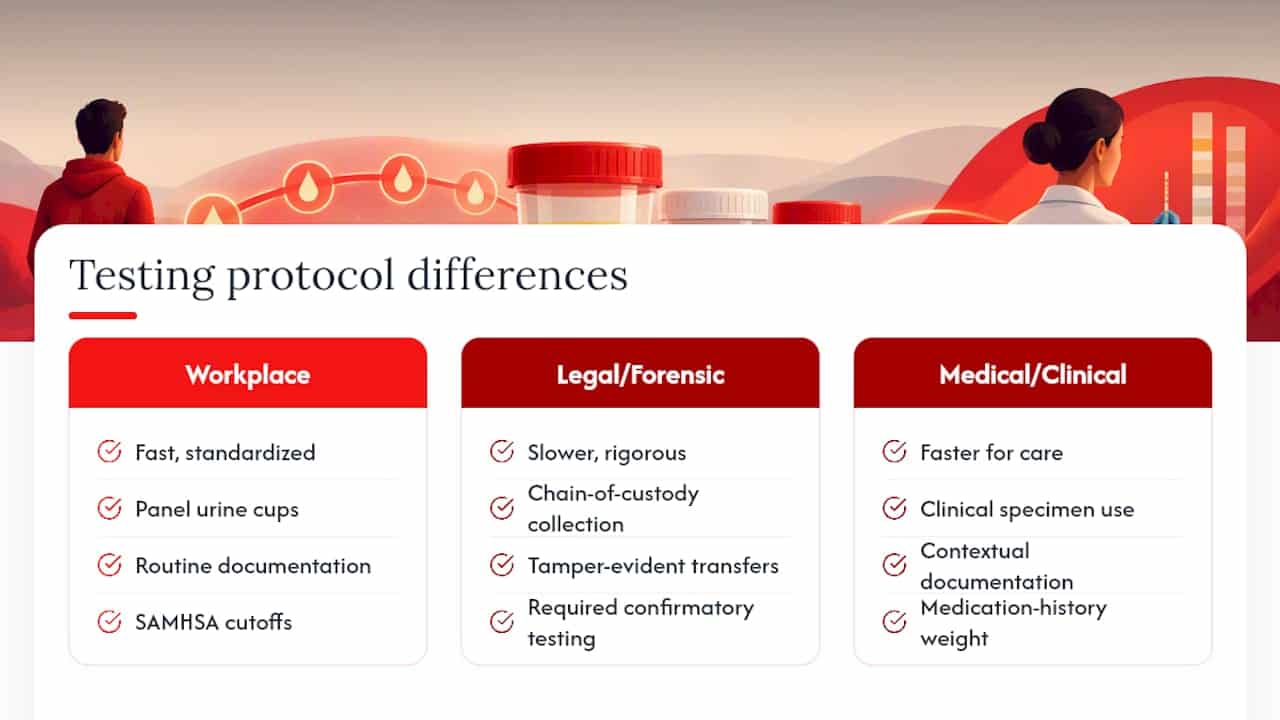
Workplace drug testing programs generally prioritize speed and standardization. Most employers use panel-based urine cups that screen for PCP alongside other common substances, often following SAMHSA-referenced guidelines and cutoffs for consistency across large employee populations. Documentation matters, but the process is usually less formal than a legal chain-of-custody collection unless company policy specifically requires it.
Legal and forensic testing operates under stricter rules. Every sample requires a documented chain of custody from collection through lab analysis, with tamper-evident packaging and signed transfer records at each handoff. This format exists specifically so results hold up under legal scrutiny, and any presumptive positive automatically proceeds to confirmatory testing before anyone treats the finding as evidence.
Medical and clinical testing tends to focus less on procedural rigor and more on clinical context. A physician ordering a PCP screen in an emergency department or substance treatment setting is usually trying to inform immediate patient care decisions, which means the medication history and clinical presentation carry as much weight as the test result itself. A positive screen in a patient on a cross-reactive antidepressant, for instance, means something very different than the same result in a patient with no such prescription.
What Are the Legal and Privacy Considerations for PCP Testing?
Drug test results carry real consequences, which is exactly why legal and privacy protections exist around how they’re collected, stored, and shared. Workplace testing programs are generally governed by a mix of federal guidelines and state law, and requirements vary depending on the employer type, industry, and whether federal contracts are involved.
Privacy protections typically limit who can access a specific result. Medical review officers, human resources staff, and legal representatives may have defined access under company policy or applicable law, but that access isn’t unlimited, and results generally shouldn’t circulate beyond the people with a legitimate need to know. Anyone unsure of their rights around a specific test, particularly in an employment dispute, should consult the specific policy governing that test or a qualified attorney rather than assume a blanket rule applies.
Chain-of-custody documentation exists partly as a privacy safeguard too. It creates an auditable record of exactly who touched a sample and when, which limits opportunities for mishandling or unauthorized access. That same documentation is what makes a legal or workplace result defensible if challenged.
Medical testing carries its own confidentiality expectations under standard patient privacy protections, meaning a clinical PCP screen ordered for diagnostic purposes is generally treated differently than one ordered for employment. The purpose behind the test, medical, legal, or workplace, shapes both the procedure and the privacy rules that apply to it.
How Should You Prepare for a PCP Drug Test?
Preparation looks different depending on whether someone is being tested for medical, legal, or workplace reasons, but a few practical points apply broadly.
Hydration matters, though not in the way some people assume. Reasonable water intake before a test is fine and often expected, but deliberately overhydrating to dilute a sample can itself trigger a dilute-specimen flag at most labs, which often requires a retest rather than helping anyone avoid detection. Labs specifically watch for this, and a dilute result rarely benefits the person being tested.
Avoiding adulterants is equally important, and for a different reason. Attempting to add substances to a sample, or substituting a sample entirely, is typically detectable through specimen validity testing that checks pH, creatinine levels, and temperature at collection. Getting caught tampering with a sample generally carries far more serious consequences than a positive result would on its own, particularly in workplace or legal contexts.
The most useful preparation step is disclosure. Anyone taking a PCP drug test, especially in a medical or legal context, should list every current medication and supplement beforehand. Given how many common drugs can cross-react on a PCP immunoassay, that disclosure gives whoever reviews the result the context needed to interpret a positive screen correctly rather than treating it as automatic proof of PCP use.
RapidTestCup’s Take on Choosing a Professional PCP Test Kit
Not every PCP test cup is built the same. Rapidtestcup stocks multi-panel cups, dip cards, and oral swabs with CLIA-waived and FDA-approved selections, which matters because labeling determines whether a kit is meant for professional use or personal screening. Before buying, check the package insert for the stated cutoff, review documented cross-reactants, and confirm the intended-use labeling matches your setting, whether that’s a clinic, a treatment program, or a workplace program.
— Justin
Where to Buy Professional PCP Test Kits and Custody Supplies
Screening needs and legal needs call for different products, and mixing them up creates problems down the line. For routine screening, a multi-panel drug test cup that includes PCP alongside other common panels covers most clinical and workplace situations efficiently. For anything tied to a legal proceeding or disciplinary action, chain-of-custody collection documentation is non-negotiable, and the collection format needs to reflect that from the start.
Bulk quantities of CLIA-waived and FDA-approved test cups, dip cards, and oral swabs are available with same-day shipping to support timely inventory replenishment for labs, clinics, and treatment programs. Whether you need a handful of cups for a small program or a bulk order for a facility running dozens of screens a week, the shop page lists current stock and pricing across every panel configuration, including options built specifically for PCP detection alongside other common substances. Browse the catalog and place an order today to keep your screening program stocked and ready.
Sources
- Phencyclidine (PCP) – Drug Testing
- Phencyclidine (PCP) screen — Medical News Today
- False-positive phencyclidine (PCP) on urine drug screen attributed to desvenlafaxine (Pristiq) use
FAQ
What Is PCP on a Drug Test?
PCP stands for phencyclidine, a dissociative drug that standard drug test panels screen for using urine immunoassay technology. A positive screen means the sample reacted with antibodies calibrated to detect PCP or a structurally similar compound, not necessarily confirmed PCP use.
What Is a PCP Test?
A PCP test is a screening or confirmatory procedure that checks biological samples, most often urine, for phencyclidine or its metabolites. Initial screening uses immunoassay technology with a common cutoff of 25 ng/mL, while confirmation relies on GC/MS or LC-MS/MS for a definitive answer.
How Long Can PCP Be Detected in Urine?
PCP typically shows up in urine for about 2 to 8 days after use, though heavy or chronic use can extend that window in some reported cases. The exact timeframe depends on dose, frequency of use, metabolism, and the test’s cutoff threshold.
What Causes PCP to Be Positive on a Screen?
Actual PCP use is the most direct cause, but certain medications can trigger a false positive due to cross-reactivity with the immunoassay antibodies. Documented cases include desvenlafaxine and other common drugs identified in broader medication cross-reactivity research, which is exactly why any positive screen requires confirmatory testing before it’s treated as conclusive.
Does Rapidtestcup Sell Chain-of-Custody Kits for Legal Cases?
Rapidtestcup offers multi-panel drug test cups and collection supplies suited to both routine screening and legal or workplace documentation needs. Product listings on the shop page specify intended use, so buyers can match the collection format to whether they need standard screening or documented chain-of-custody collection.