

Blog
Point of Care Testing: What Clinicians Need to Know


TL;DR:
- Point-of-care testing provides rapid diagnostics directly at or near the patient’s care site, improving treatment speed and outcomes. Its success depends on strict quality assurance, proper operator training, and thorough documentation to maintain result reliability.
Point-of-care testing is defined as clinical laboratory testing performed at or near the patient’s care site, delivering results fast enough to inform immediate treatment decisions. Unlike centralized lab testing, which routes specimens through a separate facility and introduces hours of delay, point-of-care testing puts diagnostic power directly in the hands of the clinician at the bedside, in the clinic, or in the field. The global POCT market is projected to reach $78.19 billion by 2029, growing at an 11.4% CAGR. That growth reflects how central rapid diagnostics have become to modern clinical workflows across every care setting.
What is point-of-care testing and how does it differ from lab testing?
Point-of-care testing, commonly abbreviated as POCT, is defined by location rather than complexity. The test happens at or near the patient’s bedside, not in a centralized laboratory. That distinction changes everything about how clinical decisions get made.
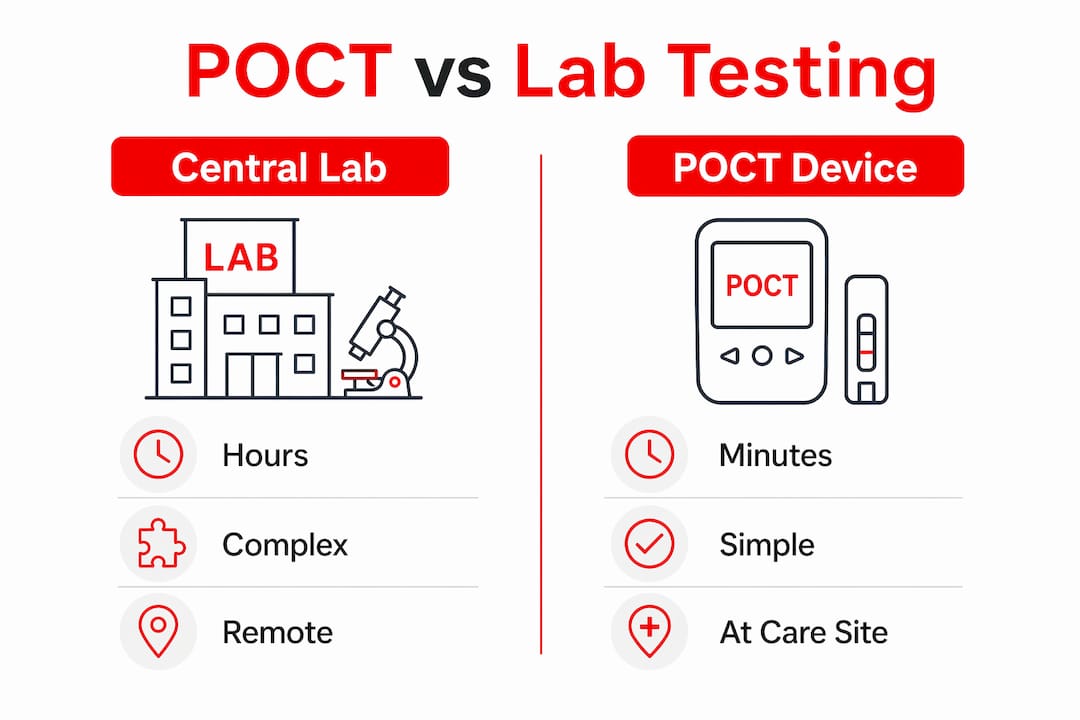
Traditional laboratory testing follows a fixed path: specimen collection, transport, processing, analysis, and result reporting. Each step adds time. POCT collapses that chain. A clinician collects the sample, runs the test on a portable device, and reads the result within minutes. No courier. No queue. No waiting for a lab report to arrive hours later.
The technology behind this shift is miniaturization. Devices that once required a full laboratory bench now fit in a coat pocket or on a countertop. Immunoassay strips, biosensors, and compact molecular platforms all make this possible. Common examples of point-of-care tests include blood glucose monitoring, HbA1c measurement, rapid influenza and COVID-19 antigen tests, urine drug screens, and pregnancy tests.
- Blood glucose meters: Used daily by patients with diabetes and by clinical staff in hospitals.
- HbA1c analyzers: Provide three-month glycemic averages during a single clinic visit.
- Rapid infectious disease tests: Detect influenza, strep, COVID-19, and HIV antigens within minutes.
- Urine drug screen cups: Used in clinics, substance abuse programs, and occupational health settings for drug testing in clinics.
- Cardiac biomarker panels: Measure troponin and BNP at the bedside in emergency care.
Pro Tip: When evaluating a POCT device for your clinic, confirm it is CLIA waived. CLIA waived tests meet federal standards for simplicity and low risk of error, which reduces the regulatory burden on your staff.
What are the benefits of point-of-care testing in clinical settings?
The primary benefit of POCT is speed, and speed translates directly into better patient outcomes. A clinician who has a result in five minutes can prescribe, adjust, or rule out a diagnosis before the patient leaves the room. That immediacy reduces the risk of patients being lost to follow-up or starting the wrong treatment while waiting for lab results.
HbA1c testing at the point of care reduces the need for multiple follow-up appointments by enabling immediate treatment adjustments during the same visit. That is a direct operational benefit for both the clinic and the patient. Fewer return visits mean lower costs and higher patient satisfaction.
The benefits extend well beyond speed:
- Faster diagnosis: Results in minutes rather than hours allow same-visit treatment decisions.
- Reduced hospital admissions: Early diagnosis in outpatient settings prevents conditions from escalating to inpatient care.
- Improved chronic disease management: Real-time feedback on glucose, HbA1c, or INR motivates patients and supports adherence.
- Better access in underserved areas: Portable POCT devices reach rural clinics, mobile health units, and community pharmacies where lab infrastructure does not exist.
- System-wide cost savings: Although per-test costs are higher, overall healthcare savings come from reduced hospital stays, fewer follow-ups, and faster treatment initiation.
POCT also improves patient engagement. Real-time test results increase patient motivation, medication adherence, and confidence in managing their own health. Seeing a number change in response to a lifestyle or medication adjustment is far more compelling than receiving a lab report in the mail three days later.
How does point-of-care testing work?
Every POCT device shares three functional components: a sample handling module, a detection system, and a readout interface. The sample handling module collects and prepares the specimen, whether blood, urine, saliva, or a nasal swab. The detection system identifies the target analyte using one of several technologies. The readout interface displays the result, often as a line on a strip, a number on a screen, or a digital signal sent to an electronic health record.

The three most common detection technologies in POCT are immunoassays, molecular diagnostics, and biosensors. Immunoassays use antibody-antigen reactions to detect specific proteins or drugs. Molecular platforms amplify and detect nucleic acids, offering high sensitivity for infectious disease testing. Biosensors convert a biological reaction into an electrical signal, which is how glucose meters work.
Modern POCT devices are benchmarked against the WHO REASSURED criteria. That acronym stands for: Real-time results, Equitable access, Affordable, Sensitive, Specific, User-friendly, Rapid, Equipment-free where possible, and Deliverable to those who need them. A device that meets REASSURED criteria is suitable for deployment outside a traditional lab setting.
| Feature | Central laboratory | Point-of-care device |
|---|---|---|
| Result turnaround | Hours | Minutes |
| Location | Centralized facility | Bedside, clinic, field |
| Operator | Lab technician | Nurse, EMT, pharmacist, patient |
| Equipment footprint | Large, fixed | Portable, compact |
| Regulatory category | High complexity | Often CLIA waived |
AI and digital health integration are now enhancing POCT accuracy and connectivity. Devices linked to electronic health records automatically log results, flag abnormal values, and trigger clinical alerts. That connectivity reduces transcription errors and keeps the full care team informed in real time.
Pro Tip: Always run the manufacturer-supplied quality control material before using a new lot of POCT reagents. A failed QC result on a new lot is far better than a failed result on a patient sample.
What are common challenges when implementing point-of-care testing?
POCT introduces operational complexity that many clinics underestimate. The device is simple to use. Managing it well is not.
Effective POCT programs require internal quality assurance programs that cover daily calibration, operator competency assessment, data management, and documentation for regulatory audits. Without these systems in place, even a high-quality device produces unreliable results. The device is only as good as the program around it.
Key challenges to address before and after deployment:
- Operator training: Staff who run POCT devices must demonstrate competency, not just complete a one-time orientation. Competency should be reassessed at regular intervals.
- Sample quality: Interfering substances such as hemolysis, lipemia, and icterus can produce falsely accurate results that lead to flawed clinical decisions if unrecognized. Clinicians must know when to send a sample to the central lab instead.
- Device calibration: Calibration must follow the manufacturer’s schedule. Skipping calibration is the fastest way to introduce systematic error.
- Documentation: Every test result, QC run, and calibration event needs a documented record. Regulatory bodies and accreditation bodies require this trail.
- Cost management: Per-test reagent costs are higher with POCT than with centralized lab testing. Cost-effectiveness is realized through system-wide efficiencies, not per-test savings.
Pro Tip: The most overlooked factor in POCT performance is temperature. Reagent strips and cartridges stored outside their specified temperature range degrade silently. Always check storage conditions when troubleshooting unexpected results.
What are the practical applications and emerging trends in point-of-care testing?
POCT now spans nearly every clinical specialty. Emergency departments use cardiac biomarker panels to rule out myocardial infarction at the bedside. Primary care clinics use rapid strep and influenza tests to prescribe antibiotics or antivirals on the spot. Substance abuse treatment programs use urine drug screen cups to monitor patient compliance during the same visit as the counseling session.
POCT is increasingly used by nurses, EMTs, pharmacists, and patients themselves for self-management. That expanding user base reflects how far the technology has moved beyond the laboratory. A pharmacist running a point-of-care INR test for a patient on warfarin, or a patient checking their own glucose at home, represents the same fundamental model: testing at the site of care.
Emerging trends are accelerating this shift:
- Miniaturized molecular platforms: Compact PCR and isothermal amplification devices now deliver lab-grade sensitivity for infectious disease testing outside the lab.
- AI-powered diagnostics: Machine learning algorithms interpret test results, flag patterns, and integrate findings into clinical decision support tools. AI in drug testing is already improving accuracy in occupational and forensic settings.
- EHR integration: Devices that automatically push results into electronic health records reduce manual entry errors and support population health tracking.
- Telemedicine support: Remote clinicians can order and interpret POCT results from patients in distant locations, extending diagnostic reach without requiring travel.
The drug testing trends shaping 2025 and 2026 include oral fluid testing and AI-assisted result interpretation, both of which fit squarely within the POCT model. Clinics that adopt these tools now will be better positioned as the technology matures.
Key Takeaways
Point-of-care testing delivers diagnostic results at the site of care, and its clinical value depends entirely on the quality assurance program that surrounds the device.
| Point | Details |
|---|---|
| POCT is defined by location | Testing happens at or near the patient’s care site, not in a centralized laboratory. |
| WHO REASSURED criteria set the standard | Devices must be sensitive, specific, affordable, user-friendly, and deliverable outside lab settings. |
| Speed improves outcomes | Same-visit results reduce follow-up visits, support chronic disease management, and enable faster treatment. |
| Quality assurance is non-negotiable | Calibration, operator competency, and documentation are required to maintain result reliability. |
| Cost-effectiveness is system-wide | Higher per-test costs are offset by reduced hospital stays, fewer follow-ups, and faster care. |
Why quality assurance is the real differentiator in POCT
After working closely with clinical teams that have adopted POCT across primary care, substance abuse programs, and occupational health settings, the pattern I see most often is this: the device works fine. The program around it does not.
Clinics invest in a CLIA waived test cup or a rapid antigen device, train staff once, and then assume the system runs itself. It does not. Reagent lots change. Staff turn over. Temperature logs go unchecked. Six months later, a QC failure surfaces, and nobody can explain why results have been drifting.
The clinics that get the most out of POCT treat it like any other clinical process: with written procedures, scheduled competency checks, and a designated coordinator who owns the program. That is not bureaucracy. That is how you protect patients from a result that looks right but is not.
The other thing I have seen underestimated is patient engagement. When a patient with diabetes sees their HbA1c result during the visit and discusses it with their provider on the spot, their adherence to the treatment plan improves. That is not a soft benefit. It is a measurable clinical outcome. POCT done well is not just faster. It is better.
— Justin
Rapidtestcup’s POCT-ready testing solutions
Clinics and administrators who need reliable point-of-care testing supplies do not have to search far.
Rapidtestcup carries a full catalog of CLIA waived, FDA-approved test cups, urine drug screen strips, and specimen collection supplies built for professional use. Whether your program needs a multi-panel drug test cup for a substance abuse clinic or urine test strips for occupational health screening, Rapidtestcup offers bulk pricing, fast shipping, and products that meet the quality standards your program requires. The guide to selecting drug test kits is a practical starting point for clinics evaluating their options.
FAQ
What is the point of care testing definition?
Point-of-care testing is clinical laboratory testing performed at or near the patient’s care site rather than in a centralized laboratory. The defining feature is location, not test complexity.
How does point-of-care testing work?
A POCT device collects a patient sample, runs a detection reaction using immunoassay, biosensor, or molecular technology, and displays a result within minutes. No specimen transport or lab processing is required.
What are examples of point-of-care tests?
Common examples include blood glucose meters, HbA1c analyzers, rapid influenza and COVID-19 antigen tests, urine drug screen cups, pregnancy tests, and cardiac biomarker panels.
Why is point-of-care testing important in healthcare?
POCT enables same-visit diagnosis and treatment decisions, reduces follow-up appointments, improves chronic disease management, and extends diagnostic access to underserved or remote care settings.
What are the main challenges of point-of-care testing?
The primary challenges are maintaining operator competency, managing sample interferences such as hemolysis or lipemia, ensuring daily calibration, and meeting documentation requirements for regulatory audits.