Blog
Specimen Retention Policy: What to Keep, How Long, and Why


A specimen retention policy is a written rule that says which specimens your lab or clinic keeps after testing, for how long, under what storage conditions, and how they are destroyed. There is no single national number. The period depends on the kind of specimen (pathology, forensic, workplace, research), the rules that govern your program, and any hold someone has requested. This guide gives you the timelines that are written into federal rules, the pieces every policy needs, and a practical way to draft one for a drug testing program.
TL;DR
- A retention policy covers four things: what you keep, for how long, how you store it, and how and when you destroy it.
- Federal workplace (DOT) testing requires the laboratory to keep reported positive, adulterated, substituted, or invalid specimens for at least one year in long-term frozen storage, and to extend that on written request.
- CLIA sets at least 2 years for most test records, 10 years for pathology reports, 5 years for cytology slides and 10 years for histopathology slides. State and accreditor rules can be longer.
- Chain of custody and an inventory log matter as much as the freezer: a specimen you cannot account for is a specimen you cannot defend.
- Instant-read cups and dip cards are usually read at the point of collection, so the policy must say plainly what happens to the device and the leftover urine afterward.
Table of Contents
- What a specimen retention policy actually covers
- Retention timelines you can point to
- Workplace drug testing: the one-year rule and how it extends
- Where instant tests fit
- Storage and chain of custody during the retention period
- When you can destroy a specimen, and what stops you
- Common mistakes in retention programs
- A starter policy structure you can adapt
- Perspective: what we see from the supply side
- Stock the supplies your policy depends on
- FAQ
- Sources
What a specimen retention policy actually covers
The National Cancer Institute’s vocabulary defines specimen retention as the continued possession, cataloging, and storage of collected biological specimens beyond their initial use. That definition has three verbs worth noticing: possess, catalog, store. A policy that only says “keep for one year” misses the cataloging and the storage conditions.
The Association of Public Health Laboratories (APHL) puts it in operational terms. Each laboratory should have a written plan for retaining original specimens, specimen products, and specimens with unusual results. The plan should state how long and under what conditions each is stored, and it should call for routine destruction of anything no longer needed. That last clause is easy to forget. Keeping everything forever is not a safe default: it costs freezer space, creates a liability trail, and makes it harder to find what you must keep.
A workable policy answers these questions for every specimen category you handle:
- What is retained? The original specimen, an aliquot, extracts, slides, blocks, or only the paperwork.
- Who decides? A named role (laboratory director, program manager, medical review officer liaison), not “staff.”
- How long? A number of days, months, or years, tied to the rule that sets it.
- Where and at what temperature? Room, refrigerated, or frozen, in a locked location with access limited by role.
- What can extend it? Legal holds, disputed results, audits, or a written request from an authorized party.
- How is it destroyed, and who signs off? Method, date, and a record of both.
Retention timelines you can point to
The numbers below come from federal rules. They are floors, not ceilings, and they apply to different types of laboratory work. Match each to your actual activity before you adopt it.
| Category | Minimum retention | Source |
|---|---|---|
| Test requisitions and authorizations, QC and patient test records, proficiency testing records, quality system assessment records | At least 2 years | 42 CFR 493.1105 |
| Test procedure copies | At least 2 years after discontinuance | 42 CFR 493.1105 |
| Pathology test reports | At least 10 years after the reporting date | 42 CFR 493.1105 |
| Cytology slides | At least 5 years | 42 CFR 493.1105 |
| Histopathology slides | At least 10 years | 42 CFR 493.1105 |
| DOT-regulated specimens reported positive, adulterated, substituted, or invalid | At least 1 year, in secure long-term frozen storage | 49 CFR 40.84 |
| Records supporting results in HHS-certified federal workplace testing | At least 2 years | 2024 MRO Guidance Manual |
| Documentation, raw data, and specimens for nonclinical lab studies | The shortest of: 2 years after FDA permit approval, or 5 years after results are submitted to FDA | 21 CFR 58.195 |
Two cautions when reading this table.
First, CLIA’s retention standard is mostly about records, with specific rules for slides and blocks. It does not hand you a general rule for how long a urine specimen sits in a freezer. For urine drug testing, the program that tests the specimen usually sets that period.
Second, the floor can be raised. The College of American Pathologists notes that state or federal mandates may require longer retention than CLIA ’88, so you must review every law that applies when setting policy. CAP also points out that labs should exceed the federal minimums when patient care, education, or quality improvement call for it. When two rules disagree, the longer one wins.
Workplace drug testing: the one-year rule and how it extends
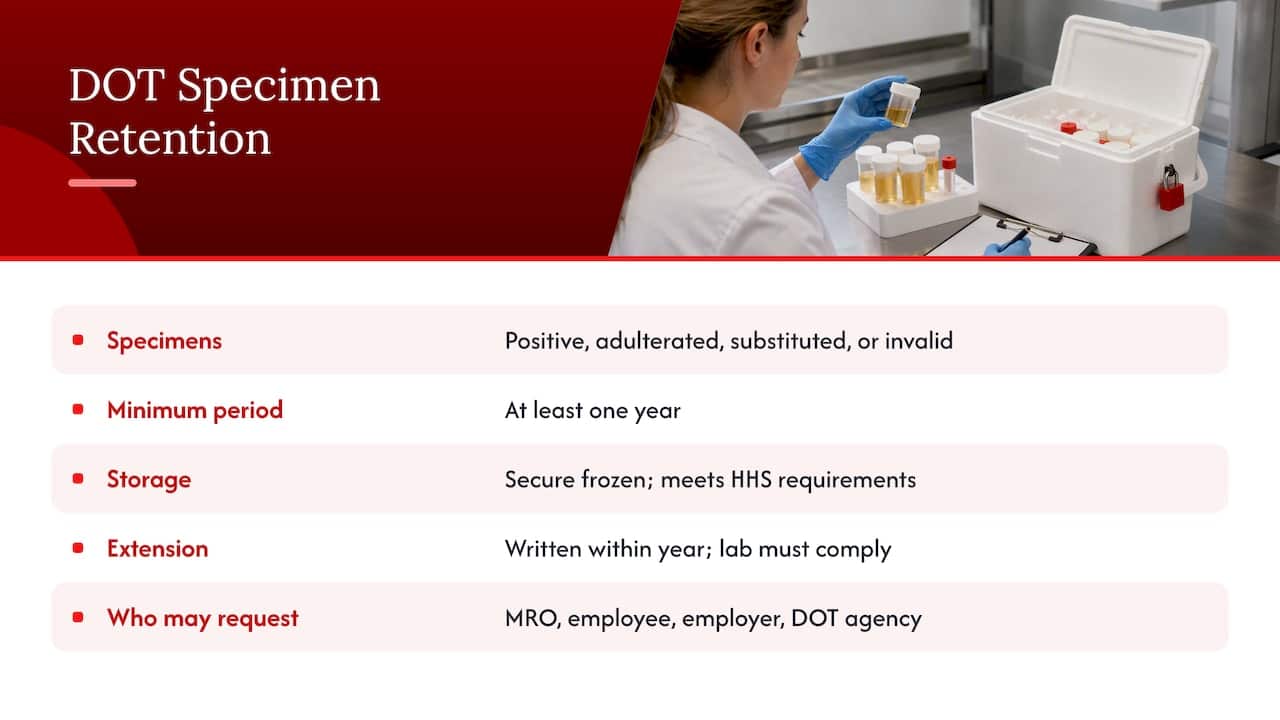
If your program falls under U.S. Department of Transportation testing, the rule is specific. Under 49 CFR 40.84, a laboratory testing the primary specimen must retain specimens reported positive, adulterated, substituted, or invalid for at least one year, in secure, long-term frozen storage that meets HHS requirements.
The same section provides for extensions. Within that year, the medical review officer (MRO), the employee, the employer, or a DOT agency can ask in writing that a specimen be kept longer, and the laboratory must comply. Your policy should therefore name who receives these requests, how they are logged, and who releases the hold. The common failure is not the freezer; it is a request that arrives by phone or lands in the wrong inbox.
For federally regulated testing, strict chain of custody applies as well. The 2024 SAMHSA MRO Guidance Manual describes laboratories and Instrumented Initial Testing Facilities (IITFs) as responsible for secure storage of all aliquots and specimens with documented transfers. If you are an employer or collection site rather than the laboratory, your obligation is different: you are the first link in that chain, and your paperwork has to match the lab’s.
Non-regulated employer programs have more latitude, but a defensible policy borrows the same structure: a fixed period, frozen or otherwise controlled storage for non-negative results, and a documented process for extending it when a donor disputes a result. For the broader workflow, see our guide to managing drug test results in the workplace.
Where instant tests fit
Most of the sources above assume a laboratory receiving a specimen. Many of our customers do something different: they run an instant test at the point of collection with a cup or dip card, read the result in minutes, and record it. That changes what “retention” means in practice.
With an instant cup, you have three things after reading: the result, the used device, and the leftover urine. A clear policy decides each one:
- The result and the paperwork are the records. Keep them for the period your program, your state, or your accreditor requires. Our guide on how to document test results lists what each entry should hold.
- The device is often discarded after the read window, but some programs photograph or retain it for a short, defined period when a result is non-negative. If you do, write that period down.
- The leftover urine is either discarded as regulated waste or, when a non-negative screen needs laboratory confirmation, sent on in a separate, properly sealed and documented specimen container.
That last case is why collection supplies matter. If a presumptive positive must go to a lab, the confirmation specimen needs its own sealed container and custody form, collected under the same procedure. Our article on why the specimen collection procedure matters covers that handoff, and the evidence handling workflow shows how the seals and signatures fit together.
Storage and chain of custody during the retention period
A retained specimen is only useful if you can show nobody tampered with it. That rests on two systems: physical storage and paperwork.
Physical storage
APHL’s guidance says the plan should state storage duration and conditions for each specimen type. For drug testing, that usually means:
- A locked freezer or refrigerator, with access limited to named people.
- A temperature log checked on a schedule, with a written response if the unit drifts out of range.
- Specimens sealed with tamper-evident tape or seals that carry the donor or accession identifier.
- Retained specimens separated from supplies, so no one confuses a retained container with a new one.
The inventory log
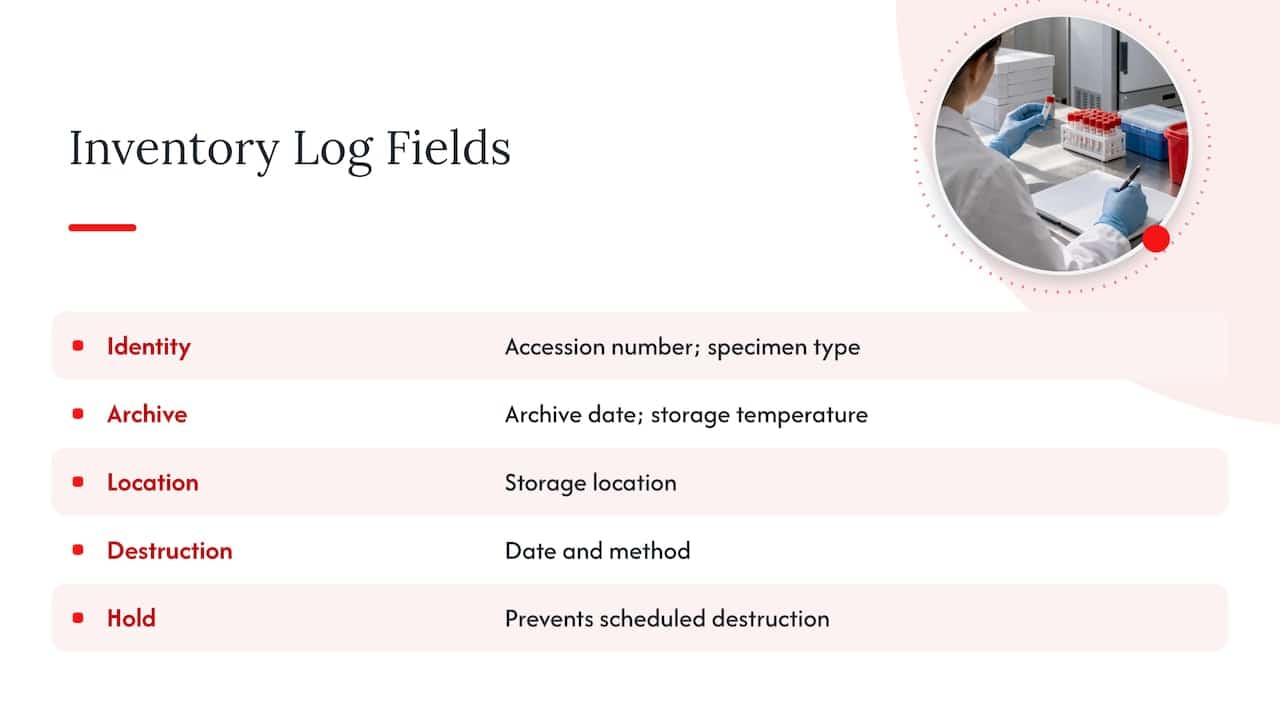
APHL recommends an inventory system for retained specimens that records at least the accession number, specimen type, date archived, storage temperature, storage location, destruction date, and destruction method. It is a short list, and it is enough to let you answer an auditor in a minute rather than an afternoon. Add one column of your own: the “hold” flag, so an extended retention never gets destroyed on schedule by accident.
Chain of custody
APHL’s guidance also says chain of custody must be maintained for forensic specimens. In practice that means every transfer, including pulling a specimen from the freezer to send to a second lab, is documented with date, time, the people involved, and the condition of the seal. Some states write this down explicitly in their own rules, which is another reason to check your state’s requirements. The forensic drug testing checklist and our forensic testing essentials guide walk through the custody steps in more detail.
One more point connects retention to integrity. A specimen that was adulterated or substituted at collection is a specimen you may need to keep, because it is the evidence. Our guide on ways to prevent test adulteration covers the collection-side controls that keep the retained specimen meaningful.
When you can destroy a specimen, and what stops you
Destruction is part of the policy, not an afterthought. A good rule is that a specimen may be destroyed when all of these are true:
- The minimum retention period has ended under every rule that applies to you.
- No written extension request or legal hold is open.
- No dispute, audit, or investigation involving the result is pending.
- The destruction is recorded in the inventory log, with date, method, and the name of the person who did it.
What stops destruction: a written request to extend (as the DOT rule allows), litigation or a pending grievance, a regulator or accreditor inquiry, and a longer state rule. If you are unsure whether one of these applies, treat it as a hold until the person responsible for compliance says otherwise.
The method is governed by waste rules. The CDC explains that regulated medical waste management is subject to federal, state, and local rules, and describes leak-resistant biohazard bags, puncture-resistant containers for sharps, and labeled, leak-proof, puncture-resistant containers for waste that must be stored. It recommends disposing of waste regularly rather than letting it accumulate, keeping it in ventilated areas pests cannot reach, and never bending or breaking sharps by hand. CDC guidance for testing sites likewise says they must follow state, local, and federal requirements for safe disposal of biohazardous waste. Our SOP-style article on how to dispose of used drug tests turns those rules into steps a clinic can post on the wall.
Common mistakes in retention programs
These are patterns we see when labs and clinics review their own practice, not a statistic. Each is easy to fix once you name it.
- One number for everything. A single “keep two years” rule ignores that pathology reports, slides, DOT specimens and test records each have their own period.
- Records and specimens treated as the same thing. Many rules govern the paperwork; the specimen itself may be governed by a program rule or a lab’s own policy. Write both down separately.
- No owner. If no named role approves destruction and handles extension requests, extensions get missed.
- Missing destruction records. You can prove you kept something for a year, but not that you destroyed it afterward. The log should close the loop.
- Never checking state law. Federal minimums are the start. Your state, your accreditor or your contract may require more.
- Storage drift. A freezer that failed over a weekend without a temperature log leaves you unable to vouch for the contents.
- Policy written once, never reviewed. Rules change. Put a review date on the policy and assign someone to it.
A starter policy structure you can adapt
Use this skeleton, and fill every blank with the figure from the rule that governs your program. Have your laboratory director, counsel or compliance lead review it before it becomes official.
- Purpose and scope. Which specimens and records it covers, and which programs (DOT, non-DOT workplace, clinical, forensic, research).
- Responsibilities. Who owns retention, who approves destruction, who receives extension requests.
- Retention schedule. A table by category: item, retention period, governing rule, storage condition.
- Storage and security. Location, access control, temperature monitoring, sealing.
- Chain of custody. Required forms, transfer documentation, handling of seal breaks.
- Holds and extensions. How a written request is received, logged, and released.
- Destruction. Method, waste stream, sign-off, log entry.
- Review. Annual review date and the person responsible.
For how this connects to day-to-day lab procedures, our laboratory drug testing protocols guide shows where retention steps sit in the overall workflow. If you also supply collection kits to other sites, compare the kit contents of drug test cups against what your retention steps require, such as tamper-evident seals and labeled containers.
Perspective: what we see from the supply side
We are a family business that ships drug test cups, dip cards, strips and collection supplies to labs, clinics, treatment centers, employers and individuals. We do not run a laboratory, and we are not your regulator. What we see is how retention problems begin: not in the freezer, but at collection.
A clean retention policy depends on a clean specimen. If the cup is not sealed, the label is wrong or the donor’s identity is not recorded, no storage plan can repair it. So our advice is to decide the end of the specimen’s life before you buy the first cup. Ask which result types need a confirmation specimen, which supplies you need to create one, and where the paperwork lives.
We also see sites over-collect. Keeping every leftover specimen “just in case” turns into a storage and disposal burden that nobody budgets for. A short, specific policy that says what you keep, what you discard and who decides is easier to follow and far easier to defend.
— Justin
Stock the supplies your policy depends on
A retention policy runs on supplies: sealed collection containers, instant-read cups and dip cards for the screen, and labels and forms for the handoff. Browse our full shop for multi-panel cups and dip cards, or go straight to our urine specimen cups for the containers you will seal, label and store. Need volume pricing or a custom quote for a program? Ask us on the site, and we will help you match the supplies to your workflow.
For a side-by-side look at formats before you order, read our cup versus dip card comparison.
FAQ
What is a specimen retention policy?
It is a written rule that says which specimens and records you keep after testing, how long you keep them, how you store them, and how you destroy them. The APHL recommends that each laboratory have one, covering original specimens, specimen products, and specimens with unusual results.
How long must a drug test specimen be kept?
It depends on the program. For DOT-regulated testing, the laboratory must keep specimens reported positive, adulterated, substituted, or invalid for at least one year in frozen storage, and longer on written request. Other programs, states and contracts may set different periods, so check the rules that govern yours.
Do general six-year record retention rules apply to specimens?
Not as a rule of thumb. CLIA’s retention standard mostly sets periods for records, such as at least 2 years for test records and 10 years for pathology reports, with separate periods for slides. Longer state or accreditor requirements can apply, so verify before assuming any single figure.
What is a common mistake in retention programs?
The most frequent one we see is a single retention period applied to everything, with no named owner for extension requests or destruction. A schedule by category, an inventory log and a documented sign-off fix most of it.
Sources
- EVS Explore: Biospecimen Retention (NCI)
- APHL: Best Practice Guidance for Specimen and Specimen-Product Storage
- eCFR: 42 CFR 493.1105, Retention requirements
- eCFR: 21 CFR 58.195, Retention of records
- 49 CFR 40.84, How long does the laboratory retain specimens
- SAMHSA: Medical Review Officer Guidance Manual for Federal Workplace Drug Testing, 2024
- College of American Pathologists: Retention of Laboratory Records and Materials
- CDC: Regulated Medical Waste
- CDC: Provider-Performed Microscopy Procedures