

Blog
Types of Specimen Collection: A Clinical Lab Reference


Specimen collection covers every method used to obtain biological material from a patient for laboratory analysis. Blood, urine, stool, respiratory secretions, body fluids, tissue, and swabs for microbial culture each require a distinct approach, container, and handling protocol. Getting any one of those details wrong matters more than most clinicians realize: preanalytical errors account for the majority of all laboratory testing mistakes, and the majority originate at the point of collection, not inside the analyzer.
The core specimen types used in clinical and microbiologic testing include:
- Whole blood, serum, and plasma collected by venipuncture, arterial puncture, or capillary fingerstick
- Urine obtained by random catch, midstream clean-catch, timed collection, catheterization, or suprapubic aspiration
- Stool for culture, occult blood, ova and parasite examination, or Clostridioides difficile toxin
- Respiratory specimens including sputum, nasal swabs, nasopharyngeal swabs, and throat swabs
- Wound, genital, and mucosal swabs for aerobic and anaerobic bacterial culture
- Body fluids such as cerebrospinal fluid, pleural fluid, synovial fluid, and peritoneal fluid
- Tissue and biopsy specimens for histopathology, culture, or molecular testing
Each category demands specific technique. A midstream urine collected without proper perineal cleansing produces a contaminated culture. A swab transported in a dry tube rather than appropriate transport media yields a false-negative result. The sections below break down each specimen type, container requirements, and the collection practices that protect sample integrity from patient to analyzer.
What container should you use for each specimen type?
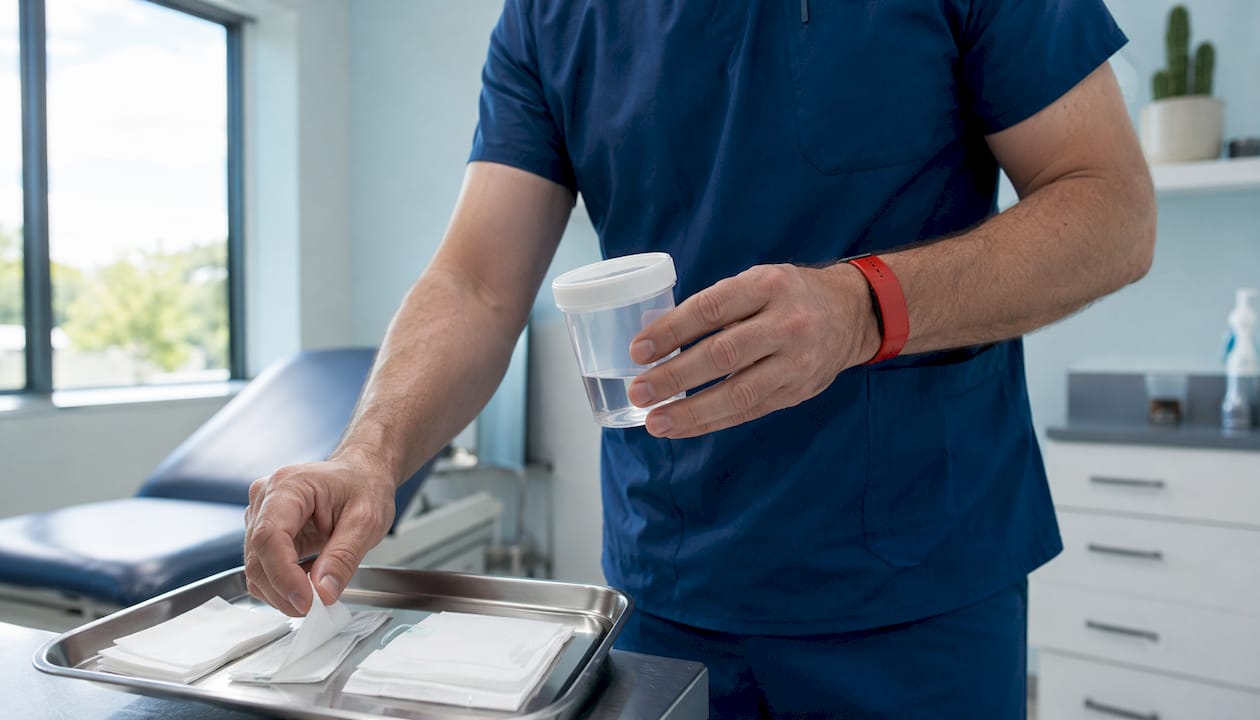
Choosing the right container is not a minor administrative step. The additive inside a blood collection tube directly determines which tests can run on that sample, and using the wrong tube invalidates results before the specimen ever reaches the bench.
| Tube color / container | Additive | Primary use |
|---|---|---|
| Lavender (purple) top | EDTA (anticoagulant) | — |
| Red top (glass) | None (clot activator) | Serum chemistry, serology |
| Gold / SST | Serum separator gel + clot activator | Comprehensive metabolic panel, lipid panel |
| Green top | Lithium or sodium heparin | Plasma chemistry, ammonia, chromosomal studies |
| Light blue top | Sodium citrate | Coagulation studies (PT, aPTT, fibrinogen) |
| Gray top | Sodium fluoride + potassium oxalate | Glucose, lactate (glycolysis inhibited) |
| Yellow top (SPS) | Sodium polyanethol sulfonate | Blood cultures, certain microbiology specimens |
| Sterile urine cup | None | Urinalysis, urine culture |
| Stool transport vial | Formalin or SAF fixative | Ova and parasite exam |
| Anaerobic transport vial | Reduced atmosphere media | Anaerobic bacterial culture |
| Viral transport media (VTM) | Buffered saline with stabilizers | Respiratory virus PCR, viral culture |
Blood draw order matters when multiple tubes are collected from a single venipuncture. The Clinical and Laboratory Standards Institute (CLSI) order of draw places blood culture bottles first, then citrate tubes, then serum tubes, then heparin, then EDTA, then glycolytic inhibitor tubes. Skipping this sequence allows additive carryover that distorts coagulation or chemistry results.
For urine, a sterile, leak-proof cup with a secure lid is standard for routine urinalysis and culture. Timed collections such as 24-hour urine require a large, pre-labeled container, often with a preservative such as boric acid or hydrochloric acid depending on the analyte. Stool specimens for culture go into a clean container without preservative; ova and parasite exams require a dual-vial kit with formalin and polyvinyl alcohol or SAF fixative.
Pro Tip: Label every tube at the bedside, not at the nurses’ station. Bedside labeling is the single most effective intervention for preventing mislabeling events, which can trigger catastrophic diagnostic errors and wrong-patient treatment.
How to collect specimens for microbiologic culture
Microbiology specimens fail more often from poor collection technique than from any laboratory processing error. The goal is to collect material from the actual site of infection, minimize contamination from surrounding flora, and deliver viable organisms to the lab before they die or overgrow.
Respiratory specimens
Sputum for culture and sensitivity should be collected before antibiotic therapy begins whenever possible, because antimicrobials suppress pathogen growth and skew sensitivity results. Ask the patient to rinse with water first, then produce a deep cough. Saliva is not sputum. A specimen with more than 10 squamous epithelial cells per low-power field gets rejected as oral contamination. For tuberculosis, collect at least three consecutive early-morning samples, since Mycobacterium tuberculosis shedding is intermittent.
Nasal and nasopharyngeal swabs for influenza, COVID-19, and RSV require a flocked or Dacron swab inserted along the floor of the nasal passage to the nasopharynx, held for 5–10 seconds, and placed immediately into viral transport media. Cotton swabs inhibit PCR amplification and should not be used for molecular testing. Throat swabs for group A streptococcus require firm contact with both tonsillar pillars while avoiding the tongue and uvula.
Wound and tissue cultures
Aspirate fluid from closed wounds whenever possible rather than swabbing the surface. Surface swabs pick up colonizing flora, not the causative pathogen. For open wounds, debride necrotic tissue first, then swab the advancing edge or aspirate from the wound base. Tissue biopsy placed directly into a sterile container without formalin is the gold standard for culture; formalin kills organisms and prevents growth.
Anaerobic cultures
Anaerobic organisms die rapidly on exposure to oxygen. Collect material by needle aspiration into a syringe, expel air bubbles, and cap the needle immediately before transferring to an anaerobic transport vial. Swabs are a poor choice for anaerobic culture because oxygen exposure during transport destroys fastidious anaerobes. Specimens from the eye, internal ear, or genital tract must never be refrigerated because cold temperatures kill many fastidious organisms.
Stepwise collection guidelines for microbiologic swab specimens:
- Confirm the correct swab type for the test (flocked for molecular, Dacron or rayon for culture, charcoal-coated for gonorrhea)
- Collect before antimicrobial therapy starts when clinically feasible
- Use the appropriate transport media and confirm it has not expired
- Label the swab with site of collection, not just “wound” or “culture”
- Deliver to the lab within 2 hours at room temperature, or per the specific organism’s protocol
Sample collection and submission for infectious disease testing
Infectious disease testing places the highest demands on collection timing and documentation. A blood culture drawn after three doses of broad-spectrum antibiotics may never grow the causative organism. A respiratory specimen sitting at room temperature for six hours before processing loses viral viability. Getting the logistics right is as important as the collection itself.
Appropriate sample types by test category:
- Bacteremia / sepsis: Two to three sets of blood cultures from separate venipuncture sites, collected within 30 minutes of each other at fever onset
- Sexually transmitted infections: Urethral, cervical, or rectal swabs in nucleic acid amplification test (NAAT) transport media; urine NAAT is acceptable for chlamydia and gonorrhea
- Gastrointestinal pathogens: Fresh stool in a clean container, submitted within 2 hours; C. difficile testing requires liquid or unformed stool only
- Respiratory viruses: Nasopharyngeal swab in VTM for PCR; bronchoalveolar lavage for immunocompromised patients
- Fungal infections: Blood in a dedicated fungal culture bottle; tissue biopsy in a sterile container without fixative
- Parasitology: Three stool specimens collected on separate days to account for intermittent shedding
Patient preparation and documentation requirements before submission:
- Confirm patient identity using two identifiers (name and date of birth, or name and medical record number)
- Record the exact time and date of collection on the requisition and the tube label
- Document current antimicrobial therapy, including drug name, dose, and start date
- Note the specimen source precisely (e.g., “right knee aspirate” rather than “joint fluid”)
- Include relevant clinical history such as recent travel, immunosuppression, or exposure history
Transport conditions vary by organism category. Most bacterial cultures tolerate room temperature for up to 2 hours. Viral specimens require cold chain transport at 2–8°C unless the VTM is validated for room temperature. Specimens classified as Category B infectious substances under UN 3373 require triple packaging: a primary leak-proof container, a secondary watertight container with absorbent material, and a rigid outer box with appropriate labeling. Laboratories and collection sites that ship specimens by air, road, or courier must comply with ICAO and IATA dangerous goods regulations.
For urine collection procedures covering midstream, catheterized, and timed methods in detail, Rapidtestcup provides step-by-step procedural guidance built for clinical staff.
Best practices and quality control in specimen collection
Preanalytical errors cause the majority of laboratory inaccuracies, and they are preventable. The problem is not a lack of technology inside the lab. Advanced analyzers cannot compensate for a hemolyzed tube, an insufficient volume, or a specimen collected in the wrong container. Quality starts before the sample ever arrives.
Laboratory standards from the WHO make clear that sample quality is a shared responsibility between the collector and the laboratory. Nurses, phlebotomists, and clinicians who collect at the bedside must receive the same standardized training as laboratory staff. A specimen collection process that relies on memory rather than written standard operating procedures will produce inconsistent results.
Critical quality measures every collection site should enforce:
- Patient identification: Two identifiers confirmed before any collection begins, every time
- Container selection: Match tube type and additive to the ordered test; never substitute
- Volume sufficiency: Fill tubes to the manufacturer’s indicated line; underfilled citrate tubes produce falsely prolonged coagulation times
- Timely transport: Deliver specimens within the validated stability window for each analyte
- Storage conditions: Keep temperature-sensitive specimens at the required temperature; do not refrigerate specimens that require room temperature
Insufficient specimen volume triggers a QNS (Quantity Not Sufficient) rejection, which delays diagnosis and requires a repeat collection from the patient. Proper storage and validated transport media, not improvised workarounds, are what protect sample integrity from collection site to analyzer. Expired containers, incorrect additives, and wrong volumes cause rejection regardless of how sophisticated the downstream instrumentation is.
Pro Tip: Build a site-specific collection failure log. Tracking rejection reasons by collector, shift, and specimen type reveals patterns that generic training misses. A single phlebotomist with a recurring hemolysis problem is a training opportunity, not a system failure.
For sample handling protocols covering storage, transport, and rejection prevention, Rapidtestcup offers practical guidance written for clinical lab professionals.
Key Takeaways
Proper specimen collection is the single most controllable variable in laboratory accuracy, with preanalytical errors accounting for the majority of all testing mistakes.
| Point | Details |
|---|---|
| Preanalytical errors dominate | 46–68% of lab testing mistakes occur before analysis, mostly during collection. |
| Container choice is non-negotiable | Each blood tube additive determines which tests are valid; substitution invalidates results. |
| Microbiology timing is critical | Collect before antimicrobial therapy starts; deliver specimens within validated stability windows. |
| Bedside labeling prevents misdiagnosis | Labeling at the point of collection is the most effective defense against wrong-patient errors. |
| SOPs and training reduce rejections | Standardized procedures and ongoing collector training cut specimen rejection and repeat draws. |