Blog
Interpreting Invalid Results: A Clinical Guide for Professionals


An invalid test result means the lab could not produce a definitive positive or negative outcome. Not inconclusive, not negative. Invalid. The distinction matters more than most people realize, and MedlinePlus confirms that this outcome indicates testing constraints rather than any conclusion about the patient’s actual condition.
What does an invalid test result actually mean?
An invalid result is not the same as a negative result, and treating it as one is a genuine patient safety risk. The FDA flags this directly for home-use tests: users who misread an invalid result as a negative can walk away with false reassurance and no follow-up.
Here is how the main result types break down:
- Invalid: The test could not run properly. No conclusion about presence or absence is possible.
- Inconclusive: The test ran, but the result fell in an ambiguous zone. Per MedlinePlus, this often stems from diet, medication, or collection errors.
- Negative/normal: The target substance or condition was not detected.
- Positive/abnormal: The target was found. May still require confirmatory testing.
- False positive: The test flagged a condition that is not actually present.
- False negative: The test missed a condition that is present.
Invalid results sit outside this positive/negative framework entirely. They signal a procedural or specimen failure, not a clinical finding.
Pro Tip: Never document an invalid result as “negative” in a patient record or workplace file. They are categorically different outcomes with different required responses.

What causes a drug or diagnostic test to come back invalid?

Most invalid results trace back to the specimen itself, not the test device. Urine specimen validity testing exists precisely to catch these failures before they produce misleading data.
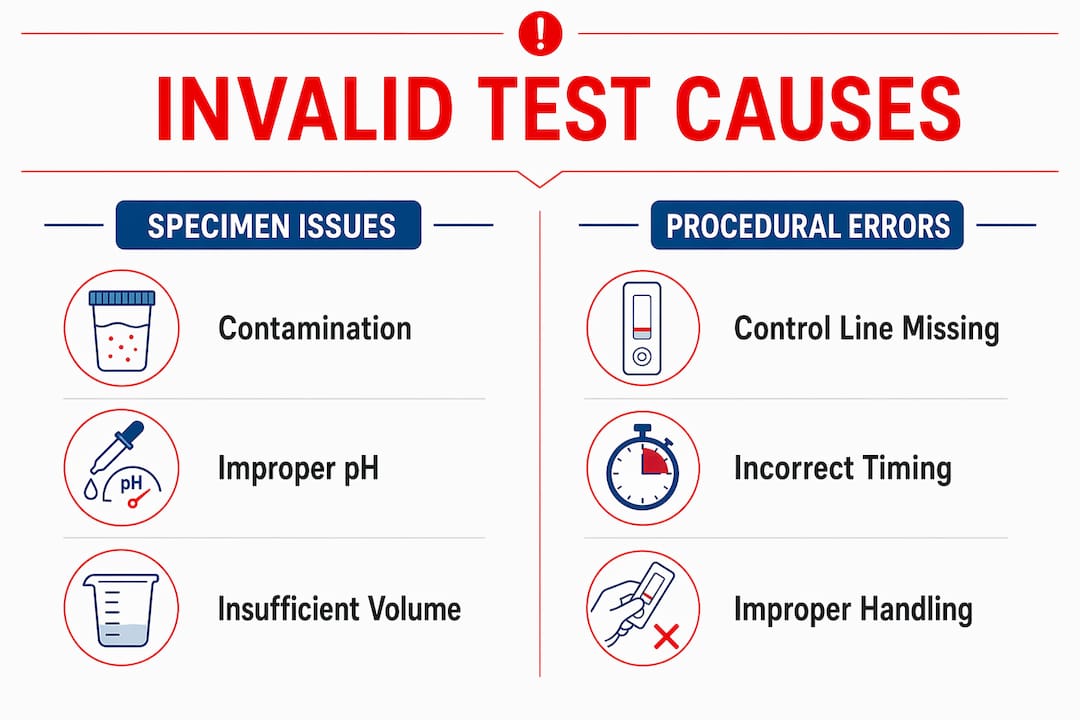
| Cause | What happens | Effect on result |
|---|---|---|
| Abnormal pH | Specimen chemistry disrupts reagent reaction | Invalid classification reported to MRO |
| pH outside the normal range | Indicates deliberate adulteration | Refusal to test |
| Sample dilution | Creatinine or specific gravity out of range | Dilute or invalid specimen |
| Oxidizing adulterants | Bleach, nitrites, or chromates destroy drug metabolites | Invalid or adulterated result |
| Improper collection temperature | Specimen outside 90–100°F at collection | Specimen rejected |
| Device malfunction | Reagent strip defect or expired kit | Invalid control line |
| Contamination | Foreign substances introduced pre or post collection | Unreliable chemistry |
Common causes at a glance:
- Specimen collected outside the required temperature window
- pH abnormalities from natural causes or deliberate tampering
- Use of adulterants such as bleach, nitrites, or commercial masking products
- Expired or defective test devices
- Improper storage or transport of the specimen before analysis
- Insufficient sample volume for the test to run
Pro Tip: Always check the control line first. If the control line is absent or unclear, the result is invalid regardless of what the test lines show.
How invalid results compare to positive, negative, and inconclusive findings
Interpreting invalid results requires a different mental model than reading a positive or negative. A positive or negative result sits on a spectrum of diagnostic accuracy defined by sensitivity and specificity. An invalid result exits that spectrum entirely.
- Positive result: Requires confirmation testing in most clinical and workplace contexts. Sensitivity and specificity apply.
- Negative result: Indicates the target was not detected at the cutoff threshold. Does not rule out sub-threshold presence.
- Inconclusive result: Falls in a gray zone. Retesting or additional clinical context usually resolves it.
- Invalid result: No diagnostic information was produced. Sensitivity and specificity are irrelevant because the test did not complete.
- False positive: A real outcome error. Addressed through confirmatory testing like GC-MS.
- False negative: Also a real outcome error. Addressed by adjusting sensitivity thresholds or retesting.
Positive predictive value (PPV) and negative predictive value (NPV) both depend on disease prevalence in the tested population. When a condition is highly prevalent, a positive result is more likely to be a true positive. An invalid result bypasses this calculation entirely since no result was generated to evaluate.
The clinical implication is straightforward. A clinician cannot apply pre-test probability reasoning to an invalid result. The test must be repeated with a new specimen before any decision-making can proceed.
What you should do after getting an invalid test result
The standard response to an invalid result is retesting with a fresh specimen. Not repeating the same test on the same sample. A new collection is required because the original specimen is the likely source of failure.
- Discard the original specimen entirely. Do not retest it.
- Collect a new specimen following proper urine collection procedures for temperature, volume, and chain of custody.
- Document the invalid result and the reason for recollection in the patient or employee file.
- Notify the Medical Review Officer (MRO) if the test is federally mandated, such as DOT-regulated workplace testing. Laboratories report specimen abnormalities to MROs for formal interpretation.
- Communicate clearly with the patient or donor. Explain that invalid does not mean negative and that a new test is required.
- In clinical settings, consult with the ordering provider before proceeding. An invalid result on a diagnostic test may require a different collection method or an alternative test entirely.
- For home-use tests, the FDA recommends discarding the kit and starting fresh rather than repeating with the same device.
Legal contexts add another layer. In workplace drug testing governed by 49 CFR Part 40, an invalid result does not automatically clear a donor. The MRO may request a direct-observed collection for the retest, particularly if adulteration is suspected. Failing to follow this protocol can expose employers and testing facilities to compliance risk.
Pro Tip: When documenting an invalid result in a regulated testing program, note the specific validity test finding (pH, creatinine, oxidant level) that triggered the invalid classification. Vague documentation creates compliance gaps.
Clinical insights that sharpen how you read invalid results
Diagnostic tests estimate probability. They do not deliver certainty. That framing, drawn from StatPearls at NCBI, is the foundation for understanding why invalid results require a specific response rather than a clinical guess.
- Invalid does not mean negative. Clinicians and testing staff must treat invalid results as a data gap, not a finding.
- Sensitivity and specificity become irrelevant. These metrics only apply when a test produces a result. An invalid outcome means no result was produced.
- Adulteration can coexist with a positive. Per DOT guidance, a specimen can be classified as invalid while simultaneously containing drug metabolites above the cutoff. In those cases, the positive finding stands. The invalid classification does not erase it.
- Retesting protocols exist for a reason. Testing pathway standards require repeat testing after procedural failure to reestablish diagnostic accuracy.
- MRO review is not optional in regulated programs. The MRO role exists specifically to interpret specimen validity results in context, including cases where invalid and positive findings overlap.
- Publication bias affects diagnostic research. Studies on test accuracy can overstate performance when negative or inconclusive findings go unpublished, which means evaluating diagnostic evidence critically matters when setting testing protocols.
- Clinical pathology services that handle complex or ambiguous results, such as those offered by EIV Diagnostics, apply structured decision frameworks to manage invalid outcomes without defaulting to clinical assumptions.
The bottom line for any professional handling these results: an invalid test is a procedural event, not a clinical conclusion. Treat it that way, retest properly, and document everything.
Key Takeaways
An invalid test result signals a specimen or procedural failure, never a clinical finding, and always requires retesting with a fresh sample before any decision is made.
| Point | Details |
|---|---|
| Invalid vs. inconclusive | Invalid means no result was produced; inconclusive means the result was ambiguous. |
| Top causes | Abnormal pH, adulteration, improper collection temperature, and device failure drive most invalid results. |
| Retesting is mandatory | Discard the original specimen and collect a new one; never retest the same sample. |
| Adulteration and positives can coexist | A specimen flagged as invalid can still carry a confirmed positive finding per DOT guidance. |
| MRO involvement | Federally regulated programs require MRO review of all invalid specimen validity findings before any final determination. |
When your testing program needs equipment that reduces invalid results at the source, Rapidtestcup carries CLIA waived, FDA-cleared drug test cups with built-in adulterant detection panels. The 12-panel ADLTX cup checks pH, creatinine, oxidants, and specific gravity alongside drug panels in a single collection, which cuts the most common causes of invalid results before they reach the lab. For labs and programs running high volumes, the full drug testing product catalog includes multi-panel cups, dip cards, and strips built for professional accuracy.