Blog
Why Rapid Test Kits for Clinics Matter in 2026


TL;DR:
- Rapid test kits are effective tools that provide rapid results, improving clinical decision-making and patient outcomes. Proper integration, validation, and staff training are essential to maximize their operational and clinical benefits. Without a structured workflow adjustment, however, their potential may remain underutilized or misapplied.
Rapid test kits are often dismissed as a compromise. The assumption is that speed costs accuracy, and that anything short of a certified lab result is a liability. That assumption is wrong, and it’s costing clinics real efficiency. Understanding why rapid test kits for clinics are not just acceptable but often preferable requires looking at what they actually do inside a functioning clinical workflow. This article breaks down the technology, the clinical benefits, the operational advantages, and the practical steps for adoption so you can make informed decisions for your practice.
Table of Contents
- Key takeaways
- Why rapid test kits for clinics are worth understanding
- Clinical benefits that directly affect patient care
- Operational and workflow advantages for clinics
- Challenges and best practices for implementation
- Selecting and integrating the right kits for your clinic
- My take on where clinics get this wrong
- High-quality rapid test kits for your clinic
- FAQ
Key takeaways
| Point | Details |
|---|---|
| Speed changes outcomes | Rapid tests compress turnaround time to minutes, enabling same-visit treatment decisions. |
| Training is non-negotiable | Rapid test benefits depend entirely on staff knowing how to interpret and act on results correctly. |
| Workflow integration matters | Connecting test results to EHR or LIS systems reduces errors and keeps records accurate. |
| Not all kits perform equally | Sensitivity and specificity vary by brand and clinical context, so local validation before adoption is required. |
| Operational savings are real | Decentralized testing reduces lab bottlenecks and shortens patient visit times, lowering overall clinic costs. |
Why rapid test kits for clinics are worth understanding
Rapid test kits are point-of-care diagnostic tools that deliver results at or near the patient, without sending specimens to a central laboratory. They cover a wide range of clinical needs. Antigen tests detect specific proteins from a pathogen. Molecular tests like loop-mediated isothermal amplification (LAMP) detect genetic material. Lateral flow assays, the most common format, use antibody-antigen reactions visible as colored lines on a strip. Immunoassay-based urine test cups are widely used for drug screening in clinical and forensic settings.
The critical difference from traditional lab testing is turnaround time. Lab-based results typically take hours to days. Rapid tests deliver results in 5 to 30 minutes. That window matters enormously in primary care, urgent care, and substance use treatment clinics where fast testing improves care by enabling decisions within the same patient encounter.
Common uses in clinic settings include:
- Infectious disease screening: Influenza A/B, strep A, RSV, COVID-19
- Reproductive health: Pregnancy testing, which dominates a market projected at USD 2.6 billion by 2036
- Substance use monitoring: Multi-panel urine drug screening
- Chronic disease management: Point-of-care HbA1c, lipid panels, and CRP tests
The comparison with traditional lab tests is not a question of one being categorically better. Labs offer higher throughput and broader test menus. Rapid tests offer speed and accessibility where time-sensitive decisions matter most.
Clinical benefits that directly affect patient care
The clearest case for rapid testing in clinics is what it does for patients who are sitting in the room with you. When a result takes three days to return, treatment is delayed, patients return for follow-up appointments, and the window for early intervention closes. Rapid testing eliminates that gap.

Faster decisions, better outcomes
The ability to make same-visit decisions reduces hospital admissions and slows the spread of infectious disease. For a patient presenting with flu-like symptoms, a positive rapid influenza test means antiviral therapy starts the same day, which is clinically meaningful since antivirals are most effective within 48 hours of symptom onset.
Patient confidence and chronic disease management
There is strong evidence that rapid tests improve medication adherence and lifestyle behavior in patients managing chronic conditions. When patients see their own results in real time, they connect cause and effect more concretely. That connection drives engagement in a way that a mailed lab report rarely does.
Infection control through early detection
Rapid identification of contagious patients allows clinics to implement isolation protocols immediately, protecting other patients and staff. This is especially relevant in pediatric clinics, urgent care, and any setting with high foot traffic during respiratory illness season.
“Decentralizing diagnostics to the point of care allows healthcare providers to initiate test-and-treat protocols in a single encounter, fundamentally improving patient experience and reducing unnecessary follow-up.” — Roche Diagnostics
The benefits of rapid drug tests in substance use treatment settings follow the same logic. Immediate results support real-time clinical conversations, accountability, and treatment adjustments without waiting for lab confirmation on every routine screen.
Operational and workflow advantages for clinics
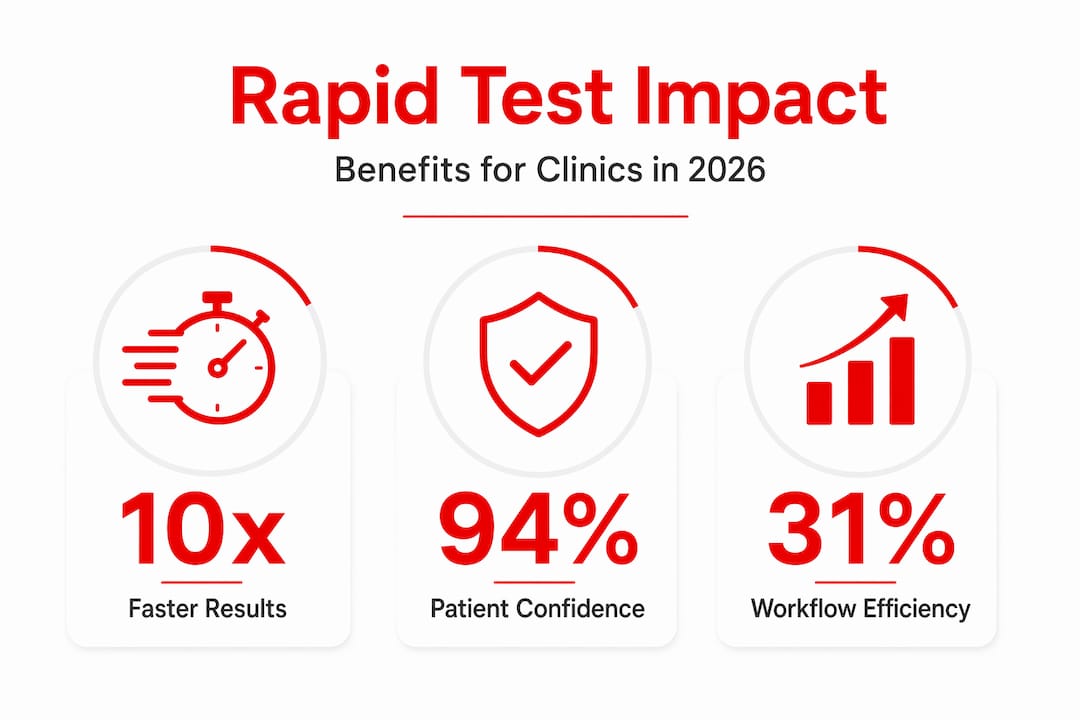
Patient care benefits and operational benefits are connected. A faster diagnostic loop means the entire patient visit moves faster. That has measurable effects on clinic operations.
Here is how rapid test kits for healthcare change the workflow in practical terms:
- Shorter visit times. When a result is available within 10 minutes, the provider can complete the encounter in a single session rather than scheduling a return visit. That improves patient satisfaction and frees appointment slots for other patients.
- Reduced lab bottlenecks. Decentralizing diagnostics relieves central lab capacity, which is particularly valuable for clinics in rural or underserved areas with limited lab access.
- Lower operational costs at the system level. Individual rapid tests cost more per unit than sending specimens to a reference lab in bulk. However, when you factor in reduced return visits, lower staff time per encounter, and avoided hospital admissions, system-level savings are well documented.
- EHR and LIS integration. Connecting test results to EHR systems through automated result entry reduces transcription errors, supports quality control, and triggers follow-up actions automatically. This is no longer optional for clinics operating at scale.
- Staff workload reduction. When a provider can act on a result during the visit, there are fewer callback tasks, fewer result-routing tasks, and fewer incomplete encounters clogging the schedule.
Pro Tip: Before purchasing rapid test kits, audit your current average visit length for encounters that require diagnostics. Quantifying the existing bottleneck gives you a baseline to measure ROI after implementation.
The advantages of clinic testing kits go beyond speed. They reorganize how work flows through your practice, and that reorganization pays dividends across staffing, scheduling, and patient retention.
Challenges and best practices for implementation
No honest discussion of rapid testing in clinics should skip the limitations. Clinics that go in without a realistic picture of the pitfalls tend to misuse these tools or abandon them prematurely.
The most important limitation is variability in accuracy. Diagnostic accuracy varies significantly across brands and clinical indications. A rapid strep test and a rapid flu test from the same manufacturer do not necessarily perform the same way relative to lab-confirmed results. Sensitivity can range widely depending on the stage of infection, specimen quality, and patient population.
There is also the behavioral dimension. A study found that rapid microbiological test results alone did not reduce antibiotic prescribing rates in primary care. The reason was simple: clinicians adjusted their behavior to offset the new information, often prescribing antibiotics anyway due to patient pressure or diagnostic uncertainty. The test result only changed outcomes when it was embedded in a clinical protocol with explicit decision rules.
Best practices that address these challenges include:
- Local validation before full deployment. Run parallel testing against your reference lab on a sample of specimens to confirm the kit performs as claimed in your specific patient population.
- Ongoing quality control programs. Use internal positive and negative controls on every batch. Document results to satisfy accreditation requirements.
- Staff training on interpretation. A faint line on a lateral flow assay means something specific. Staff reading results visually should be calibrated and tested periodically.
- Digital lateral flow readers where possible. Digital readers remove subjective interpretation and provide objective, documentable results. They also support regulatory compliance, which is increasingly required for accreditation.
- Protocol-embedded decision rules. A positive result should trigger a defined action. A negative result should have its own pathway. Without written protocols, rapid test results are underutilized.
Pro Tip: Build your rapid test result interpretation into your EHR as a structured template with required fields. This forces documentation and creates an audit trail for quality assurance.
Selecting and integrating the right kits for your clinic
Choosing the right rapid test kit is not simply a purchasing decision. It is a clinical and operational commitment. A kit that performs well in a hospital setting may be poorly suited for a high-volume primary care clinic with variable specimen collection practices.
Work through these steps before committing to a product:
- Define your use case clearly. Are you screening for infectious disease, monitoring substance use, managing chronic conditions, or some combination? Each use case has different accuracy requirements and workflow implications.
- Check regulatory status. For most clinic applications, you want a CLIA-waived, FDA-cleared kit. This simplifies your compliance obligations significantly. Use the guide to selecting test kits to compare options aligned with your patient population.
- Validate locally. Run 20 to 30 parallel specimens against your reference standard before rolling out clinic-wide. Document your findings.
- Design your storage and handling protocol. Most lateral flow assays have temperature sensitivity and expiration requirements that affect accuracy. Staff should know storage conditions and how to check lot expiration dates.
- Build the test-and-treat pathway. Create a written protocol for every result scenario. Who acts, what action they take, and in what timeframe should all be specified before the first kit is opened.
| Consideration | What to look for |
|---|---|
| Regulatory status | CLIA-waived and FDA-cleared for intended use |
| Sensitivity and specificity | Published data for your specific use case and population |
| EHR connectivity | Digital reader or interface for automated result entry |
| Storage requirements | Temperature range compatible with your clinic’s storage capacity |
| Training burden | Simple workflow with clear visual or digital interpretation |
For drug screening specifically, reviewing clinic drug testing workflows before selecting a kit can help you match panel configuration to your actual screening needs and avoid over- or under-detecting based on your patient population.
My take on where clinics get this wrong
I’ve watched clinics invest in rapid test kits, see initial enthusiasm from staff, and then watch utilization collapse within six months. The kits end up in a supply closet because the workflow was never really redesigned around them.
The mistake is treating a rapid test kit as a product purchase rather than a practice change. In my experience, the clinics that get lasting value from point-of-care testing are the ones that changed their protocols before the kits arrived. They defined what a positive result means operationally, not just clinically. They trained staff not just on how to run the test but on what to do in the next 10 minutes after the result appears.
The technology is genuinely useful. Digital lateral flow readers are eliminating the last real weakness of the format, which was subjective visual interpretation. AI-assisted result analysis is beginning to appear in clinical platforms. But none of that matters if the human workflow around the technology is broken.
My honest recommendation: before you order a single kit, spend two hours mapping your current diagnostic encounter from specimen collection to clinical action. Identify exactly where the delays are. Then design your rapid test integration to address those specific delays. That process will tell you more about what kit you need than any product specification sheet.
— Justin
High-quality rapid test kits for your clinic
Rapidtestcup carries a catalog of CLIA-waived, FDA-cleared rapid test kits built for clinical environments that need reliable results without the wait. For drug screening programs, the 12-panel ADLTX test cup covers a broad range of substances in a single-use, self-contained format designed for high-volume clinic use. For clinics running targeted single-analyte screens, the MET drug test strip delivers accurate results with minimal handling requirements. Bulk pricing is available for clinics managing ongoing monitoring programs, and all products ship quickly to minimize supply gaps. Browse the full catalog at Rapidtestcup to find the configuration that fits your clinic’s specific panel and compliance requirements.
FAQ
What makes rapid test kits better than lab tests for clinics?
Rapid test kits deliver results in minutes at the point of care, enabling treatment decisions within the same patient encounter. Lab tests offer broader menus but typically require hours to days for results, which delays clinical action.
How accurate are rapid test kits compared to lab results?
Accuracy varies by kit type, brand, and clinical context. CLIA-waived, FDA-cleared kits meet defined performance thresholds, but local validation against your reference lab is recommended before clinic-wide adoption.
Do rapid test kits actually reduce antibiotic prescribing?
Not automatically. Research shows that rapid microbiological results alone do not change prescribing behavior without structured clinical protocols and staff training embedded alongside the testing.
What is a CLIA-waived rapid test kit?
A CLIA-waived kit meets federal standards for simplified testing that can be performed outside a full clinical laboratory. These kits require minimal training and carry a lower regulatory burden, making them practical for most outpatient clinic settings.
How should clinics store rapid test kits?
Most lateral flow-based kits require storage at controlled room temperature, typically between 36°F and 86°F, away from direct sunlight and moisture. Always follow the manufacturer’s specific storage guidance and check lot expiration dates before use.