Blog
Privacy and Drug Testing Explained: Essential Workplace Facts


Balancing workplace safety with employee privacy is never simple for Human Resources professionals in American organizations, especially when drug testing enters the conversation. The rapid growth of technology and the use of sensitive biological sample collection have made privacy concerns more urgent. While drug testing in workplaces raises moral and privacy concerns and remains legally mandated in many industries, understanding how the law and ethics intersect empowers you to create testing programs that safeguard both your people and your business.
Table of Contents
- Defining Privacy and Drug Testing in Workplaces
- Drug Testing Methods and Detection Windows
- Legal Frameworks Governing Workplace Drug Testing
- Employee Rights and Privacy Protections
- Compliance Risks and Confidentiality Standards
Key Takeaways
| Point | Details |
|---|---|
| Balancing Privacy and Safety | Employers must navigate the tension between workplace safety and employees’ privacy rights when implementing drug testing programs. Legal protections for employee privacy are growing alongside the need for effective safety measures. |
| Effective Testing Methods | Utilize a combination of presumptive and confirmatory testing to accurately identify drug use while minimizing the risk of false positives. Match testing methods to the specific needs and risk profiles of the workplace. |
| Compliance with Legal Frameworks | Understanding the legal obligations surrounding drug testing is critical, as they vary by jurisdiction and may include federal, state, and industry-specific regulations. Regular policy reviews are necessary to ensure compliance. |
| Protecting Confidentiality | Implement strong confidentiality measures for test results, limiting access to authorized personnel only. A clear data retention policy is essential for managing sensitive employee information responsibly. |
Defining Privacy and Drug Testing in Workplaces
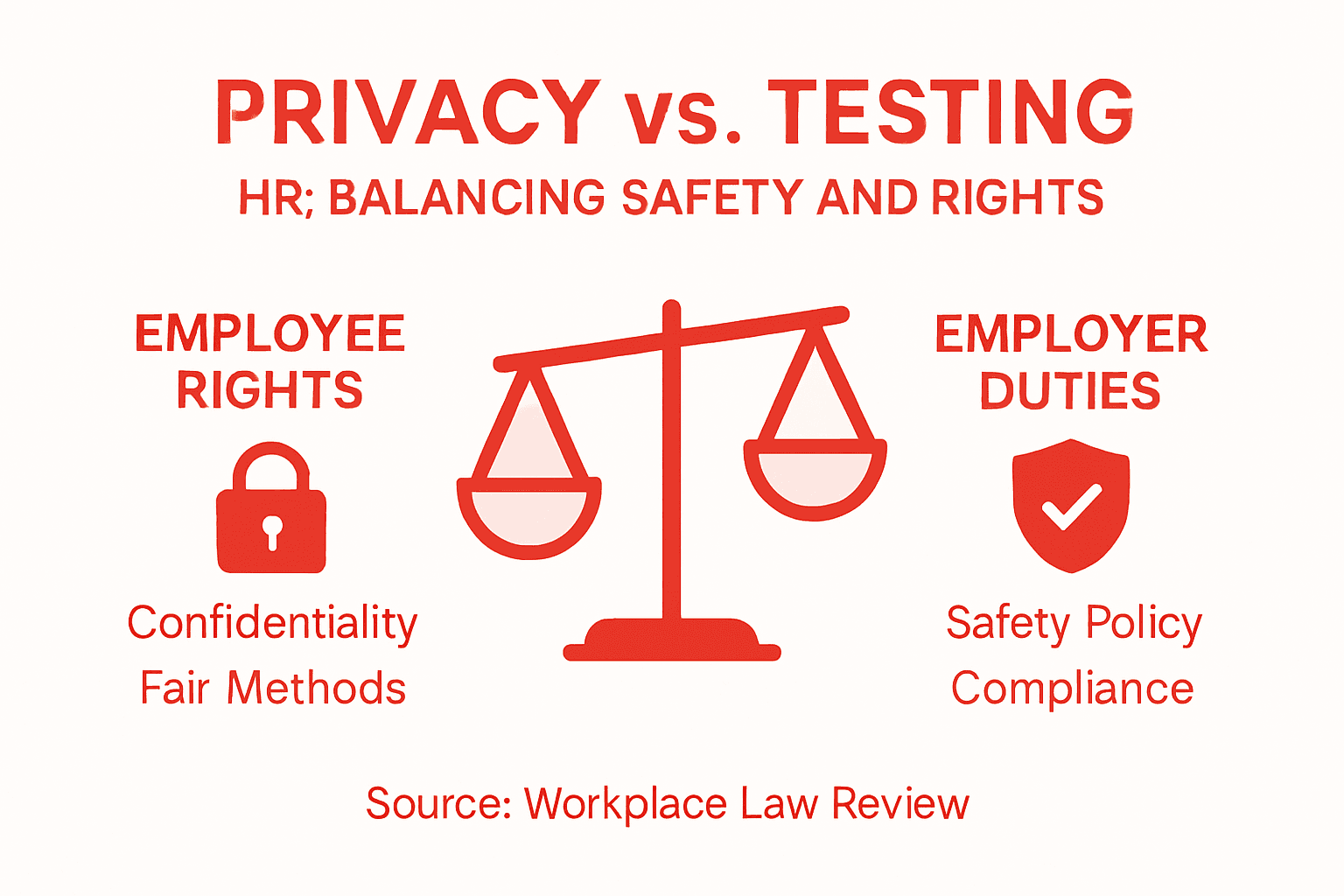
Privacy and drug testing represent two competing values that HR professionals navigate daily. On one side sits employer responsibility for workplace safety and productivity. On the other sits employee rights to personal autonomy and bodily integrity. Understanding how these concepts interact legally and ethically forms the foundation for compliant, defensible testing programs.
Workplace privacy has evolved dramatically. The rise of technology means employers now collect email communications, internet activity logs, and employee movement data alongside traditional personnel records. When drug testing enters this ecosystem, intrusive collection of biological samples compounds privacy concerns exponentially. Your organization may legally access significant amounts of employee data, but the question becomes whether you should, and under what safeguards.
Drug testing itself serves specific organizational goals. Programs aim to identify employees using controlled substances before impaired judgment creates safety hazards, reduces productivity, or exposes your company to liability. Drug testing in workplaces raises moral and privacy concerns precisely because it attempts to address legitimate safety issues through methods that feel intrusive to employees. The debate centers on balance: How far should employers reach into employee biology to protect workplace safety?
The legal tension is real. Most US jurisdictions recognize employer rights to test for drugs as a condition of employment, particularly in safety-sensitive positions. Yet states increasingly protect employee privacy through specific statutes governing when, where, and how testing occurs. Federal regulations like the Department of Transportation rules apply differently across industries.
For HR professionals, this means your drug testing program must accomplish two things simultaneously. First, it needs to protect your organization through effective screening using validated testing methods. Second, it must respect legal boundaries protecting employee privacy so you can defend your practices if challenged.
Pro tip: Document your drug testing policy’s legitimate business purpose explicitly, whether it’s safety compliance, regulatory requirement, or loss prevention, as this documentation proves your testing program addresses genuine organizational needs rather than mere invasiveness.
Drug Testing Methods and Detection Windows
Drug testing relies on two distinct phases that work together to catch substance use accurately. The first phase, presumptive testing, uses chemical reagents that change color when specific drug classes are present. This initial screen happens fast and costs less, making it practical for high-volume workplace screening. However, presumptive tests are not specific enough to confirm drug use on their own because multiple substances can produce similar reactions.
Confirmatory testing solves this problem through advanced laboratory analysis. Gas chromatography-mass spectrometry (GC-MS) provides highly specific and accurate identification of exactly which drugs are in a sample. When you need results that hold up legally or when an employee contests a positive result, confirmatory testing becomes essential. This two-step approach protects your organization by catching false positives before they damage employee relationships or create legal liability.
Detection windows vary dramatically depending on which substance your testing targets and how often the employee uses it. Urine tests typically detect drug use within days to weeks after consumption, making them the most common choice for workplace programs. Saliva tests show shorter windows, usually hours to a couple of days. Hair follicle tests detect drug use over months, though they cost more and raise greater privacy concerns. Detection windows depend on the biological matrix tested and how quickly each drug metabolizes through the body.
For HR professionals selecting testing methods, this matters intensely. A urine test misses drugs used only in the past few hours but catches regular users reliably. The timing of your test relative to suspected use becomes critical for effectiveness. If you test employees randomly, you need broader detection windows to catch users outside immediate use windows.
Modern testing panels offer flexibility in detecting multiple drug classes simultaneously. These comprehensive testing approaches screen for common substances like marijuana, cocaine, amphetamines, opioids, and phencyclidine in one collection. Knowing what detection window matches your workplace risk profile prevents both under-testing and unnecessary expense.
Here’s a comparison of common workplace drug testing methods highlighting detection windows, invasiveness, and typical applications:
| Test Method | Detection Window | Level of Invasiveness | Typical Workplace Use |
|---|---|---|---|
| Urine Testing | 2-30 days after use | Moderately intrusive | Random and routine screening |
| Saliva Testing | Up to 48 hours | Minimally intrusive | Post-incident, recent use checks |
| Hair Testing | Up to 90 days | Highly intrusive | Executive, long-term behavior |
| Blood Testing | Up to 24 hours | Most intrusive | Post-accident, impairment checks |
Pro tip: Match your test type and timing to your actual risk profile: safety-sensitive positions benefit from urine tests with broader detection windows, while post-incident testing should happen within hours using rapid methods to catch recent impairment.
Legal Frameworks Governing Workplace Drug Testing
Workplace drug testing operates within a complex legal landscape that varies significantly by jurisdiction, industry, and employment type. At the federal level, the Drug-Free Workplace Act of 1988 establishes mandatory requirements for federal contractors and grantees. This foundational law requires employers to maintain written policies prohibiting drug use, notify employees of consequences, and implement testing and awareness programs. If your organization holds federal contracts or grants, compliance is non-negotiable.

The Act’s reach extends broadly. Federal contractors include not just large defense companies but also construction firms, technology vendors, and service providers working with government agencies. If you win federal work, you must document your drug-free workplace policy and communicate it clearly to all employees. Failure to comply can result in contract termination and financial penalties.
Beyond federal requirements, state and local laws create additional constraints. Some states restrict when employers can test, requiring specific circumstances like reasonable suspicion, post-incident investigations, or random testing in safety-sensitive roles only. Other states offer broader employer authority. California, for instance, generally prohibits pre-employment marijuana testing, while many states allow it freely. Your legal obligations depend entirely on where your employees work.
Private employers not subject to federal requirements still face obligations. Most states recognize employer rights to implement reasonable suspicion drug testing when evidence suggests impairment or policy violation. However, states increasingly require advance notice, written policies, and sometimes confirmation testing before taking action. What you can legally do in one state may expose you to liability in another.
Industry-specific regulations add another layer. Transportation, healthcare, and nuclear industries have strict federal testing requirements. The Department of Transportation mandates testing for safety-sensitive roles in trucking, aviation, and rail transport. These programs require specific testing panels, medical review officers, and certified laboratories.
The legal framework consistently balances employer safety interests against employee privacy rights. You have authority to test, but that authority is bounded by statute, regulation, and common law. Your policy must clearly define when testing occurs, how samples are collected, who accesses results, and what happens after positive findings.
Pro tip: Consult an employment attorney licensed in your state to review your drug testing policy against current local laws, as statutes change frequently and federal contractor status may impose obligations your competitors avoid.
Employee Rights and Privacy Protections
Employees possess fundamental rights that constrain how and when you can test them for drugs. Bodily and informational privacy rights form the foundation of employee protections against invasive testing. Courts recognize that collecting biological samples, analyzing them, and storing results infringes on personal privacy unless justified by legitimate employer interests. Random testing without suspicion of impairment increasingly faces legal challenges across American jurisdictions.
Reasonable suspicion represents the most defensible basis for testing. This means observable signs of impairment, behavioral changes, or policy violations that actually suggest drug use. Testing someone simply because they work in a certain department or belong to a particular group opens you to discrimination claims. Documenting the specific reasons triggering your decision to test protects you legally.
Unionized workplaces add another layer of protection. Drug testing is a mandatory subject of collective bargaining in many contexts, meaning unions have contractual rights to negotiate testing policies. You cannot unilaterally implement testing in unionized environments without bargaining with union representatives. Failing to do so violates labor law regardless of your good intentions.
Employees also have rights to accurate results and fair procedures. This includes confirmation testing when initial results are positive, the right to know what substances are being tested for, and protection against disclosure of results to unauthorized people. Test results should be treated as confidential medical information, shared only with those who need to know for legitimate business purposes.
Minimally intrusive testing methods respect employee privacy better than invasive alternatives. Urine collection under observation feels humiliating and raises Fourth Amendment concerns in government workplaces. Saliva testing achieves similar drug detection with less intrusion. Consider whether your chosen method is proportionate to the risk you actually face.
The balance between your safety interests and their privacy rights is not automatically tilted in your favor. Courts ask whether testing is reasonable, necessary, and narrowly tailored. Blanket random testing of all employees triggers more scrutiny than focused testing of safety sensitive positions with documented hazards.
Pro tip: Limit test result access to medical professionals and supervisors with direct business need, use confidential storage, and establish a clear retention schedule that deletes records after a reasonable period, demonstrating respect for employee privacy even after testing is complete.
Compliance Risks and Confidentiality Standards
Drug testing programs create significant compliance obligations that go far beyond administering tests. Data integrity requirements demand that your testing results be complete, consistent, and accurate from collection through storage and reporting. Any manipulation, incomplete documentation, or improper access to records exposes your organization to regulatory penalties and legal liability. The stakes are real when test results influence employment decisions.
Confidentiality represents your first line of defense against compliance failures. Test results contain sensitive medical information that demands protection from unauthorized access or disclosure. Your obligation extends beyond simply securing physical records to controlling who can view results, when they can view them, and for how long results remain in your system. Confidentiality protects personal information from unauthorized disclosure and applies to every stage of your testing program.
Many HR professionals underestimate how many people gain access to test results unnecessarily. Your medical review officer needs results. Your testing facility provides them. Your employees see notification letters. Your legal counsel reviews disputes. Each access point is a breach risk. Limit access strictly to individuals with legitimate business reasons. A supervisor does not need to know whether an employee tested positive for marijuana unless that information affects job placement decisions.
Record retention creates another compliance minefield. How long should you keep test results? Federal regulations typically require three years for federal contractors, but state laws vary. Keeping records too long increases breach risk. Deleting them too quickly violates compliance requirements. Establish a documented retention policy and follow it consistently, destroying records when retention periods expire.
Data security failures lead to breach notifications, regulatory investigations, and reputational damage. Implement password protection for electronic records, limit physical file access to locked cabinets, and audit who accesses results regularly. These steps demonstrate your commitment to compliance if regulators investigate or employees challenge your practices.
Non-compliance can result in civil liability, regulatory fines, and loss of federal contracts if applicable. Worse, confidentiality breaches destroy employee trust and can trigger litigation from affected workers. Your testing program’s credibility depends entirely on demonstrating that you handle sensitive information responsibly.
Key legal and compliance risks in workplace drug testing programs can be summarized as follows:
| Risk Area | Business Impact | Sample Mitigation Strategy |
|---|---|---|
| Data Breaches | Regulatory fines, lawsuits | Restricted access, secure storage |
| Inadequate Policies | Legal challenges, reversals | Regular legal reviews, clear policies |
| Poor Documentation | Lost disputes, compliance gaps | Consistent records, audit trails |
| Excessive Retention | Privacy violations, liability | Scheduled record deletion |
Pro tip: Create a written data security and retention policy that specifies who can access results, how records are stored, and when they are destroyed, then train all personnel handling test information on these requirements and audit compliance quarterly.
Protect Privacy While Ensuring Workplace Safety With Trusted Drug Testing Solutions
Balancing employee privacy and effective drug testing is a challenge your HR team faces every day. The complex landscape of legal requirements and employee rights calls for testing methods that provide accuracy, compliance, and respect for bodily autonomy. If your organization needs reliable, FDA-approved drug testing products designed to support validated screening and confirmatory testing protocols, look no further.
Explore our extensive catalog at RapidTestCup featuring CLIA waived drug test cups, urine test strips, and specimen collection supplies that fit the varied detection windows and invasiveness levels outlined in your workplace policies. Whether your goal is random screenings or post-incident testing, our affordable, high-quality testing kits empower you to uphold legal standards while honoring employee confidentiality. Take the next step to safeguard your workplace. Visit RapidTestCup now to find the right solutions that align with your privacy and compliance needs.
Frequently Asked Questions
What are the primary objectives of workplace drug testing?
Workplace drug testing aims to identify employees using controlled substances to maintain safety, enhance productivity, and reduce the risk of liability related to impaired judgment.
How do I ensure compliance with drug testing laws in my workplace?
To ensure compliance, review federal, state, and local drug testing laws applicable to your organization. Consult with an employment attorney and document your drug testing policy, explicitly stating the legitimate business purposes behind testing.
What are the different methods of drug testing, and how do they vary in effectiveness?
Common drug testing methods include urine, saliva, hair, and blood tests. Urine tests offer broader detection windows and are commonly used, while saliva tests are less invasive but detect more recent substance use. Hair tests can detect drug use over longer periods, though they raise more privacy concerns.
What rights do employees have regarding drug testing and privacy protections?
Employees have the right to privacy regarding their bodily and medical information. They should be informed about the testing process, have the right to confirmation testing if results are positive, and maintain confidentiality of their test results. Minimally intrusive testing methods are recommended to respect employee privacy.