

Blog
Why Calibrate Test Equipment: A Lab Manager’s Guide


TL;DR:
- Calibrating test equipment ensures accurate and legally defensible drug-test results linked to national standards. Skipping calibration increases measurement errors and legal risks, leading to costly disputes and compliance failures. Proper calibration programs and documentation are essential for maintaining test integrity and meeting regulatory requirements.
Calibrating test equipment is non-negotiable for drug-testing operations: it produces accurate, traceable, and legally defensible results tied to NIST standards and required by U.S. compliance frameworks including CLIA, FDA, and SAMHSA. Without it, every reading your instrument produces carries an undefined margin of error. This guide walks through what calibration means in practice, which U.S. rules reference it, what happens when you skip it, and how to build a low-friction program your procurement and compliance teams can actually maintain.
Table of Contents
- Why calibrate test equipment in a drug-testing context?
- How U.S. regulations tie calibration to your program
- What happens when you skip calibration?
- Which instruments in your workflow actually need calibration?
- How often should you calibrate?
- Who should perform calibration?
- How to set up a calibration program for your operation
- Procurement checklist: buying with calibration in mind
- Key Takeaways
- Calibration matters more than most programs admit
- Rapidtestcup products are built for programs that take documentation seriously
- Authoritative sources for your calibration program
Why calibrate test equipment in a drug-testing context?
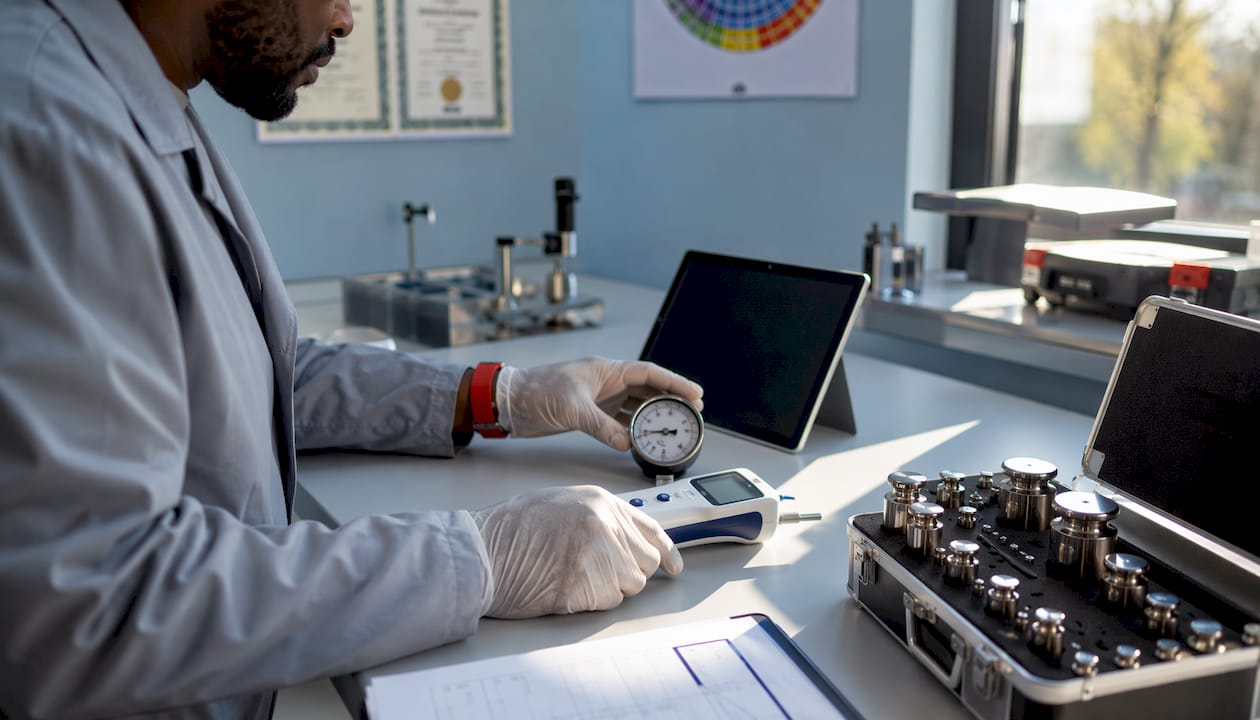
Calibration compares an instrument to a reference standard of known accuracy, documents any deviation, and adjusts the instrument back into specification. The output is a report showing before and after readings along with measurement uncertainties. That report is what auditors, attorneys, and accrediting bodies ask for when a result is challenged.
What calibration is — and what it is not:
- Calibration: Comparison to a traceable reference standard, with documented before/after readings, uncertainty values, and corrective adjustment. Produces a certificate.
- Field verification: A quick comparison between two instruments in the field. Useful for spotting obvious problems, but it cannot establish traceability or confirm which instrument is correct when both have drifted.
- Spot check: A single-point sanity check. Fine for daily assurance; not a substitute for a full calibration cycle.
Traceability is the chain that runs from your instrument up through a reference standard, through an accredited calibration lab, to NIST, and ultimately to the International System of Units (SI). Every link in that chain must be documented. A NIST-traceable result means your measurement correlates with every other properly calibrated instrument in the world — which matters the moment a positive drug-test result is disputed in court or a CLIA surveyor walks through the door.
How U.S. regulations tie calibration to your program
Several federal frameworks reference calibration or its documentation directly, and each carries different audit implications for drug-testing operations.
- CLIA (Clinical Laboratory Improvement Amendments): Requires labs to follow manufacturer instructions for test systems, including calibration and quality control procedures. Even CLIA-waived tests carry manufacturer-specified verification steps that must be documented.
- FDA: Regulates test devices as medical devices; labeling and package inserts specify calibration and QC requirements that are legally binding for the cleared indication.
- SAMHSA Mandatory Guidelines: Federal workplace drug-testing programs under SAMHSA require certified laboratories to maintain documented calibration and quality assurance records for all instrumentation used in confirmation testing.
- ISO 9001 / ISO/IEC 17025: Calibration and record-keeping are core requirements in quality management systems; ISO/IEC 17025 specifically governs calibration laboratories providing traceable, auditable results.
- State rules: Many states layer additional requirements on top of federal ones, particularly for substance abuse treatment programs and forensic testing.
Calibration records are your first line of defense in a dispute. When a test result is challenged, auditors and attorneys look for documented proof that the instrument was performing within specification on the date the sample was collected. A gap in your calibration log can invalidate an otherwise clean chain of custody.
This article is general information, not legal or regulatory advice. Confirm current requirements with your accrediting body or institutional counsel for your specific program.
What happens when you skip calibration?
Skipping calibration does not just introduce measurement error. It shifts your operation from a predictable, manageable cost to an unpredictable liability.
Jeff Gust, Chief Corporate Metrologist at Fluke, puts it plainly: without calibration, organizations cannot guarantee that their measurements correlate with global standards or meet performance requirements — and when measurements drive high-stakes decisions, that gap is unacceptable.
In drug testing, the stakes are concrete. A false negative sends someone with an active substance problem back into a safety-sensitive role. A false positive triggers a wrongful-action claim. Either outcome means repeat testing, legal exposure, and program credibility damage that is far harder to repair than a missed calibration appointment.
The financial logic is straightforward. A formal calibration program carries predictable operating costs; the alternative is unpredictable and can be catastrophically expensive. Industry analysis documents legal and lost-revenue costs that can exceed $100 million per incident in catastrophic failures tied to uncalibrated equipment. Drug-testing programs rarely face that scale, but the proportional logic holds: a disputed result that triggers litigation will cost far more than every calibration service you ever scheduled.
Which instruments in your workflow actually need calibration?
Not every item on your bench requires a full accredited calibration cycle, but several do require at minimum a documented verification schedule.
- Thermometers and temperature monitors (storage units, incubators, specimen transport): full calibration recommended; these directly affect test stability and cutoff reliability.
- Timers: verification against a traceable time standard; critical for timed-read immunoassay steps.
- Pipettes and liquid dispensers: full calibration; volume accuracy affects reagent concentrations and cutoff thresholds.
- Analytical balances and scales: full calibration with NIST-traceable weights; used for reagent preparation.
- Centrifuges: RPM and timer verification; affects specimen separation integrity.
- Confirmatory analyzers (GC-MS, LC-MS/MS): full calibration per manufacturer and SAMHSA requirements; non-negotiable for federally mandated programs.
- Temperature strips on collection cups: verification against a calibrated thermometer; these are single-use indicators, not instruments, but the reference thermometer must be calibrated.
- Environmental monitors (humidity, temperature): periodic calibration; affects storage compliance.
Pro Tip: Prioritize calibration for any instrument whose output directly determines a pass/fail cutoff or affects specimen integrity during collection and storage. For proper test kit storage, the thermometer monitoring your storage unit is the single most overlooked calibration item in small clinic settings.
How often should you calibrate?
Frequency should be risk-based, not arbitrary. The right answer depends on four factors: measurement criticality, usage volume, environmental exposure, and prior drift history.
Calibration frequency options range from event-driven to monthly, quarterly, annually, or biannually depending on criticality and exposure. Use this table as a starting framework, then adjust based on your manufacturer’s insert and your own drift history.
| Instrument | Recommended Cadence | Trigger for Immediate Recalibration |
|---|---|---|
| Temperature monitors (storage) | Daily verification; annual full calibration | Reading outside ±1°C of expected range |
| Pipettes and dispensers | Quarterly verification; annual full calibration | Visible damage, erratic volumes |
| Analytical balances | Quarterly verification; annual full calibration | Drop or impact event |
| Confirmatory analyzers (GC-MS) | Per manufacturer; typically annual or semi-annual | Failing QC standards, system maintenance |
| Centrifuges | Semi-annual RPM verification | Unusual noise, vibration, or maintenance |
| Environmental monitors | Annual full calibration | Alarm event or suspected sensor failure |
Event-driven recalibration applies any time an instrument is dropped, repaired, moved to a new environment, or produces a result that conflicts with a control sample. Do not wait for the scheduled date.
Who should perform calibration?
Use an ISO/IEC 17025-accredited laboratory for any calibration that needs to be traceable and auditable. In-house verification is acceptable for routine checks when properly documented and fit for purpose, but it cannot substitute for a lab using standards with an order-of-magnitude better accuracy than the instrument under test.
What to check on a calibration certificate:
| Certificate Field | Why It Matters |
|---|---|
| Calibration date and due date | Confirms currency; auditors check this first |
| Standard used (NIST-traceable) | Establishes the traceability chain |
| Measurement points tested | Shows coverage across the instrument’s range |
| Before and after readings | Documents the as-found condition and correction |
| Measurement uncertainty | Required for ISO/IEC 17025 compliance |
| Lab accreditation ID | Verifies the lab’s standing with its accrediting body |
| Corrective actions taken | Documents any adjustment made during calibration |
In-house verification is appropriate for daily temperature checks using a certified reference thermometer, or for control-sample comparisons on immunoassay readers. The limit: if the result will be used in a legal proceeding or regulatory audit, get the full accredited certificate.
How to set up a calibration program for your operation
A documented calibration program does not need to be complex. It needs to be complete.
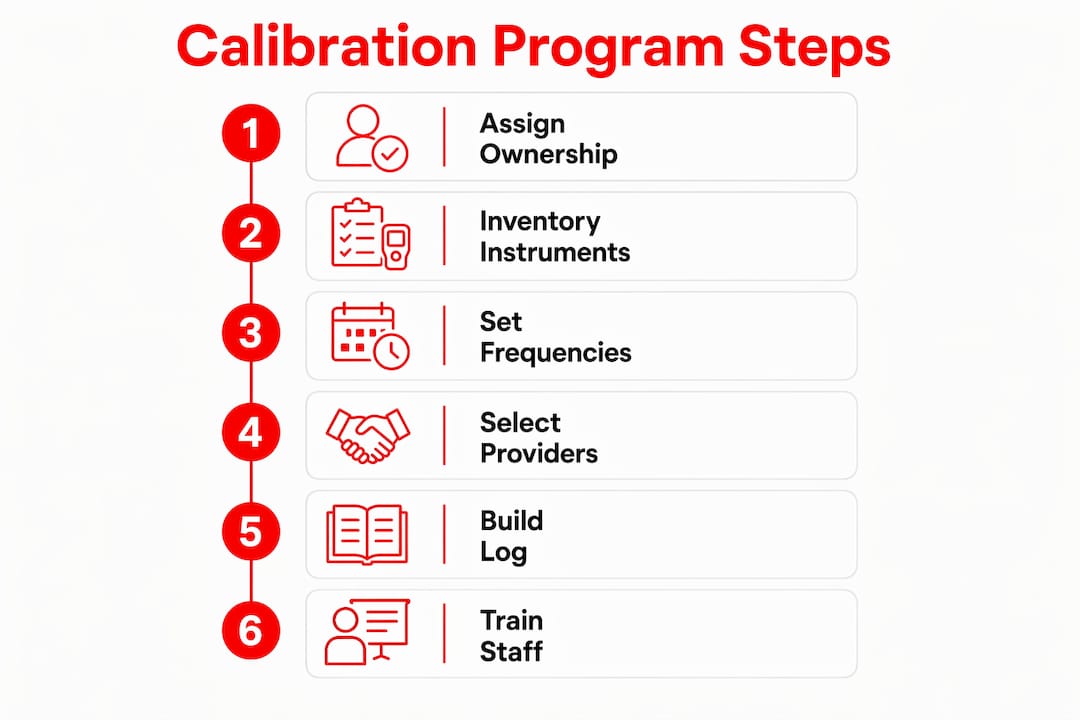
Step 1: Assign ownership. One person, typically the lab manager or quality officer, owns the calibration schedule and records. Without a named owner, schedules slip.
Step 2: Inventory all instruments. List every device that produces a measurement affecting a test result. Assign each an instrument ID and record the serial number, manufacturer, model, and current calibration status.
Step 3: Set frequencies. Use the table above as a baseline. Cross-reference manufacturer inserts and any applicable CLIA or SAMHSA requirements.
Step 4: Select service providers. For accredited calibrations, verify ISO/IEC 17025 status through the provider’s accrediting body (NVLAP, A2LA, or equivalent). For in-house verifications, document the procedure in your SOP.
Step 5: Build your calibration log. Every calibration event, in-house or external, gets a log entry.
| Log Field | What to Record |
|---|---|
| Instrument ID and serial number | Unique identifier for the device |
| Calibration date | Date the calibration was performed |
| Standard used | Reference standard ID and NIST traceability |
| As-found and as-left readings | Pre- and post-adjustment values |
| Measurement uncertainty | From the calibration certificate |
| Technician name | Person who performed or received the calibration |
| Next due date | Calculated from frequency policy |
Step 6: Train staff. Anyone who performs in-house verification needs a written procedure and documented training. Undocumented training does not satisfy an auditor.
Pro Tip: Set calendar reminders 30 days before each calibration due date. Missed calibrations discovered during an audit are treated the same as no calibration. Pair this with your lab testing checklist to keep all QA tasks on the same schedule.
Procurement checklist: buying with calibration in mind
The cheapest instrument at purchase is rarely the cheapest instrument over its service life. Before you order, run through these questions.
- Does the manufacturer provide a factory calibration certificate with the unit?
- Is the instrument supported by an ISO/IEC 17025 accredited service provider in the U.S.?
- Are replacement reference standards and spare parts available domestically?
- Does the package insert specify calibration intervals and acceptable QC materials?
- What is the turnaround time for external calibration, and does the vendor offer loaners?
- Is the calibration cost included in a service-level agreement, or billed separately?
- Does the instrument’s drift history (from published specs) support your required frequency?
Plan a calibration line item in your annual budget. Treating calibration as an unexpected expense is how programs end up with gaps in their records.
Key Takeaways
Calibration is the foundation of defensible drug-testing results: without NIST-traceable documentation, a disputed result has no evidentiary floor.
| Point | Details |
|---|---|
| Calibration is legally required | CLIA, FDA labeling, and SAMHSA guidelines all reference documented calibration for drug-testing instruments. |
| Documentation is half the job | Calibration records are your legal defense; gaps in logs can invalidate chain-of-custody even when the instrument was functioning correctly. |
| Risk-based frequency beats fixed schedules | Set cadence by criticality, usage, and drift history — and recalibrate immediately after any impact, repair, or suspicious reading. |
| Rapidtestcup supports compliant procurement | Rapidtestcup’s CLIA-waived, FDA-labeled test cups and specimen supplies come with product documentation that fits directly into a calibration-friendly procurement program. |
Calibration matters more than most programs admit
The gap between what calibration promises and what most drug-testing operations actually do is wider than it should be. Programs invest in high-quality test cups and multi-panel screens, then leave the thermometer monitoring their storage unit uncalibrated for years. That thermometer is the silent variable that can invalidate every result stored at the wrong temperature.
The other underappreciated point: documentation quality often matters more than calibration frequency. A program that calibrates annually with complete, auditable records is in a far stronger position than one that calibrates quarterly but keeps sloppy logs. When a result is challenged, the attorney does not ask how often you calibrated. They ask to see the certificate from the date in question.
Procurement decisions compound this. Buying instruments without checking calibration support availability is a common mistake. A device with no domestic accredited service provider forces you into workarounds that auditors will question. Build the calibration path into your purchasing criteria the same way you build in panel count and cutoff levels.
Rapidtestcup products are built for programs that take documentation seriously
Labs and clinics that run tight calibration programs need test cups and supplies that come with clear product documentation, defined storage parameters, and consistent manufacturing quality. Rapidtestcup’s CLIA-waived, FDA-labeled multi-panel test cups, dip cards, and specimen collection supplies are designed for exactly that kind of operation. Every product ships with documentation you can file directly into your QA records, and bulk ordering means you can standardize on a single SKU across your program rather than managing multiple product lines.
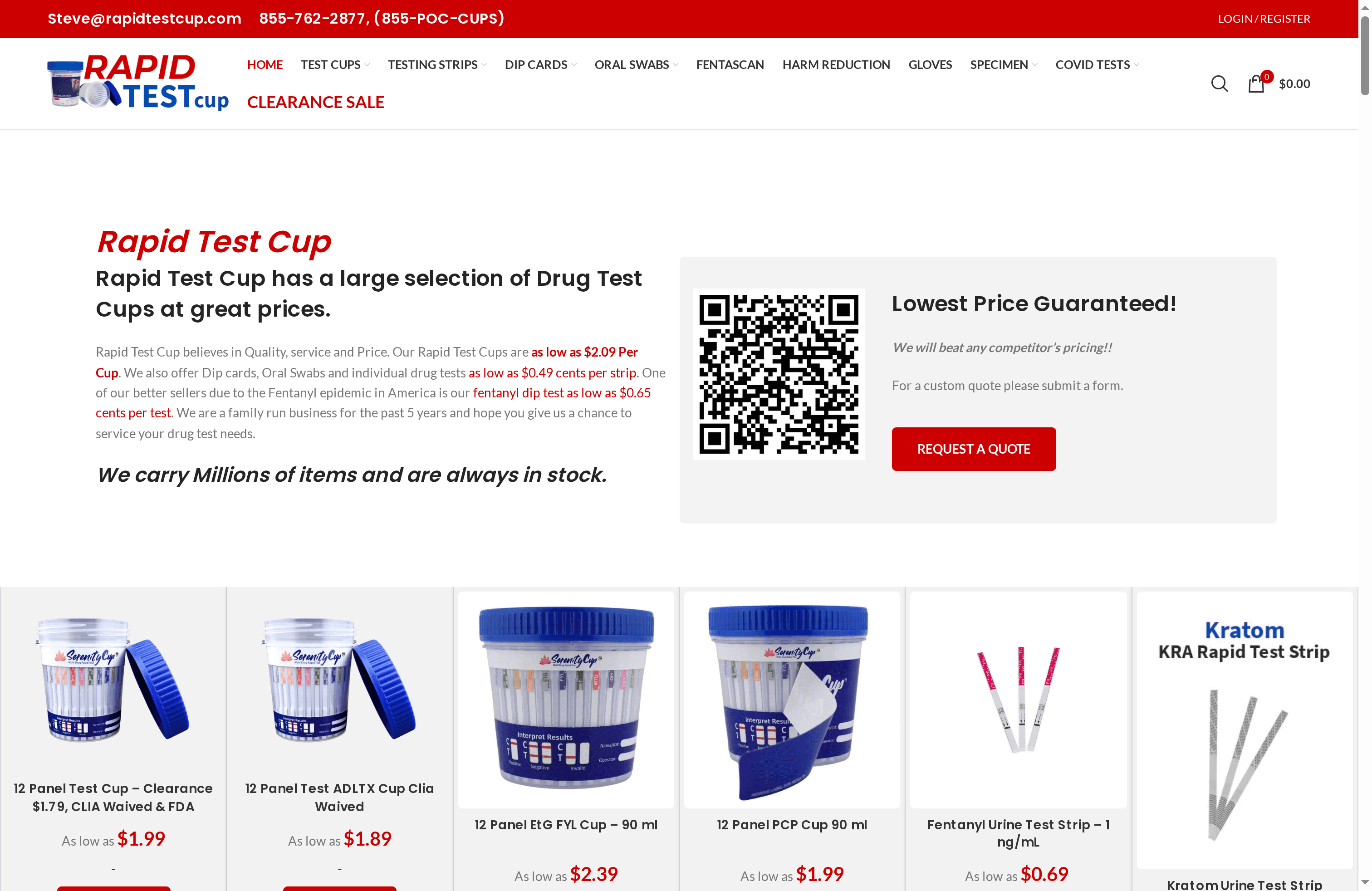
Whether you are stocking a high-volume workplace testing program or a clinical collection site, Rapidtestcup offers lab-focused drug testing products with the documentation support your calibration program requires. Contact Rapidtestcup directly for CLIA-waived options, storage guidance, and bulk pricing that fits your procurement budget.
Authoritative sources for your calibration program
Use these references when writing SOPs, justifying budget requests, or preparing for audits.
- Fluke: Why calibrate test equipment — Best for technical calibration procedures, frequency decision frameworks, and the traceability chain explanation. Cite in SOPs to justify frequency choices.
- Fluke: Calibration and documentation for process manufacturing — Best for cost/risk arguments and certificate field requirements. Use when justifying calibration budget to administration.
- Fluke: Why is calibration important (Jeff Gust) — Authoritative expert framing for high-stakes measurement decisions. Useful in training materials and policy preambles.
- NIST (nist.gov) — Primary source for traceability standards and the U.S. national measurement system. Reference in SOPs when specifying that standards must be NIST-traceable.
- ISO/IEC 17025 — The governing standard for calibration laboratory competence. Use when vetting service providers and when explaining to auditors why you chose an accredited lab.
- NASA Technical Standard for Metrology and Calibration — Detailed technical requirements for calibration systems; useful for programs that need to demonstrate rigorous measurement control beyond basic CLIA requirements.
- SAMHSA Mandatory Guidelines for Federal Workplace Drug Testing Programs — Primary regulatory source for federally mandated programs. Required reading for any lab performing DOT or federal agency testing.