Blog
Drug Test Kits for Treatment Centers: Clinical Guide


TL;DR:
- Treatment centers should use CLIA-waived, FDA-cleared multi-panel urine cups with adulterant checks, supplemented by ETG strips and fentanyl tests when necessary, to ensure accurate and compliant screening. Confirm all presumptive positives with laboratory GC-MS or LC-MS testing before clinical or legal action and document every specimen’s chain of custody thoroughly. Prioritizing these standards builds a defensible, reliable drug testing program aligned with regulatory requirements.
Treatment centers should use CLIA-waived, FDA-cleared multi-panel urine cups with integrated adulterant checks as their point-of-care standard, supplemented by ETG strips for alcohol monitoring and high-sensitivity fentanyl strips where opioid use is a clinical concern. Every presumptive positive from a point-of-care screen should go to an accredited lab for GC-MS/LC-MS confirmation before any clinical or legal action is taken. Rapidtestcup, operating under FDA guidance and CLIA/CMS testing-location designations, supplies the full range of kits, documentation, and bulk pricing that treatment programs need to run defensible, audit-ready screening programs.
The short version: require CLIA-waived, FDA-cleared multi-panel cups with adulterant checks, add ETG and fentanyl strips where your patient population warrants it, document every collection with a chain-of-custody form, and send positives for GC-MS/LC-MS confirmation with MRO review.
- Use CLIA-waived point-of-care urine cups for routine monitoring, selecting panel options appropriate for your program’s needs.
- Add ETG urine strips for alcohol monitoring in programs where alcohol use is a concern.
- Add high-sensitivity fentanyl strips for opioid treatment programs when clinically indicated.
- Require integrated adulterant checks (creatinine, specific gravity, pH, oxidants) on every cup to help verify specimen integrity.
- Confirm all presumptive positives by GC-MS/LC-MS at an accredited lab; route through a Medical Review Officer (MRO) before clinical action.
- Maintain thorough chain-of-custody documentation on every specimen, including lot numbers, timestamps, and collector signatures.
Table of Contents
- Which specimen types and test formats do treatment centers actually use?
- Regulatory essentials: CLIA status, FDA clearance, and confirmatory testing
- Collection protocols and chain-of-custody best practices for clinical settings
- How to choose the right drug test kit for your treatment center
- What to do when a screen comes back positive
- Budgeting and procurement: calculating the true per-screen cost
- Key Takeaways
- A supplier’s perspective on what treatment centers actually need
- Rapidtestcup makes compliant procurement straightforward for treatment centers
- Useful sources and further reading
Which specimen types and test formats do treatment centers actually use?
Urine is the most commonly used specimen for drug testing in substance abuse treatment programs, and for good reason: it covers a broad panel of substances, the collection process is well understood, and point-of-care results are available in minutes. Multi-panel urine cups are the workhorse format, available in various panel configurations to suit different monitoring needs, and the multi-panel advantages for patient monitoring are real: one collection event, one result read, one documented record.
Oral fluid (saliva) testing has a shorter detection window than urine, generally covering recent use within a couple of days, which is actually useful when you need to know about very recent use. Observed collection is straightforward, and there is no privacy-room requirement. The tradeoff is that saliva misses use from earlier in the week, so it is not the right tool for routine weekly monitoring.
Hair testing sits at the other end of the detection spectrum. Hair testing reflects a longer detection window, making it well suited for intake baseline assessments or historical pattern documentation. It is not appropriate for detecting recent use or for monitoring MAT adherence, where you need to know what happened in the last few days.
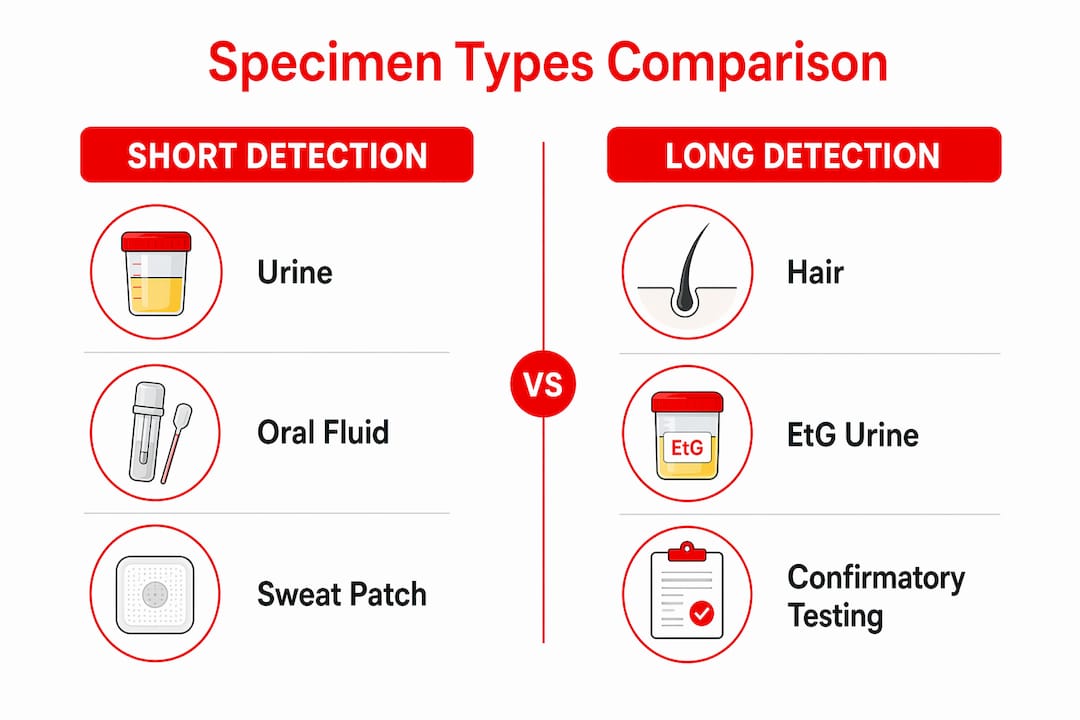
EtG (ethyl glucuronide) urine testing detects alcohol metabolites for a longer period after consumption than breath tests. For programs monitoring alcohol use disorder or co-occurring alcohol and drug use, ETG urine strips are the standard add-on. Breath alcohol testing is faster but has a detection window measured in hours, making it better for real-time sobriety checks than for program monitoring.
Sweat patches offer continuous monitoring over days to weeks and are used in some court-ordered or probation-linked programs. They are harder to administer at scale and require specialized collection and lab processing.
| Specimen Type | Detection Window | Best Clinical Use Case |
|---|---|---|
| Urine (multi-panel cup) | 1–4 days (most substances) | Routine monitoring, broad coverage, random testing |
| Oral fluid (saliva) | — | Recent-use detection, observed collection, intake screening |
| Hair | Up to 90 days | Intake baseline, historical pattern, court documentation |
| Urine EtG strip | — | Alcohol monitoring in SUD and co-occurring programs |
| Breath alcohol | 1–6 hours | Real-time sobriety check, pre-session screening |
| Sweat patch | 7 days | Continuous court/probation monitoring |
Pro Tip: For programs running both alcohol and drug monitoring, an 18-panel cup that includes an ETG panel and adulterant checks consolidates two separate tests into one collection event, cutting staff time and reducing documentation errors.
Regulatory essentials: CLIA status, FDA clearance, and confirmatory testing
CLIA-waived status is the non-negotiable starting point for any point-of-care test used in a treatment center. The Clinical Laboratory Improvement Amendments (CLIA), administered by CMS, classify tests by complexity. Waived tests are simple enough to be performed outside a licensed laboratory, which is exactly the category your point-of-care urine cups need to fall into. Using a non-waived test without the appropriate lab certification exposes your program to compliance risk and can invalidate results in legal or court contexts.
FDA clearance is a separate but equally important credential. The FDA’s drugs of abuse test guidance covers in vitro diagnostic devices, and a cleared test has passed a defined analytical validation process. When you request documentation from a vendor, the FDA clearance number (510(k) number or equivalent) should appear on the product labeling or accompanying documentation. If a vendor cannot produce it, that is a red flag.
Point-of-care screens are preliminary; laboratory confirmation by GC-MS or LC-MS/MS is the standard when results will inform clinical decisions or have legal consequences. This is not a technicality. Immunoassay-based point-of-care tests can cross-react with certain medications, producing a presumptive positive that a confirmatory test would resolve as negative. Sending every positive for confirmation protects your patients and your program.
Regulatory baseline for treatment center procurement: Every kit you purchase should carry a CLIA-waived designation, an FDA clearance number on its labeling, and lot-specific QA documentation. Point-of-care positives are presumptive results. Before any clinical or legal action, confirm by GC-MS/LC-MS at an accredited laboratory and route through a Medical Review Officer.
Vendor documentation checklist before purchase:
- FDA clearance number (510(k) or equivalent) on product label or data sheet
- CLIA-waived designation confirmed in writing
- Lot-specific QA documentation and Certificate of Analysis (COA)
- Shelf life and storage temperature specifications
- Sensitivity/detection limits (ng/mL) per analyte
- Adulterant check specifications (which parameters are included)
OSHA’s interpretation of 1904.35 is also worth reviewing for programs that coordinate with employers or handle work-related injury cases, since it clarifies when post-incident drug testing is permissible without running afoul of anti-retaliation provisions.
Collection protocols and chain-of-custody best practices for clinical settings
A clean collection process is what makes a drug test defensible. Specimen integrity problems, whether from tampering, mislabeling, or broken chain-of-custody, can unravel a result that was analytically correct. Well-established urine collection and testing procedures for addiction treatment programs include validity checks and documented collection steps at every stage.
Step-by-step collection workflow:
- Verify patient identity using a photo ID or program-issued identifier before collection begins. Document the ID type and number on the chain-of-custody form.
- Instruct the patient on the collection process. For observed collections (required when tampering is suspected or per program policy), a same-gender staff member must maintain direct observation.
- Check temperature immediately after collection. Urine should read 90–100°F within four minutes of collection. A temperature outside that range is grounds for a second collection under direct observation.
- Inspect tamper indicators on the cup. Most CLIA-waived cups include a tamper-evident seal; document its condition before and after collection.
- Read adulterant check results on the integrated validity strips (creatinine, specific gravity, pH, oxidants). Flag any out-of-range result and document it before proceeding.
- Seal and label the specimen with a tamper-evident label that includes the patient identifier, date, time, and collector initials. Apply the label in the patient’s presence.
- Complete the chain-of-custody form with: patient ID, collector name and signature, witness signature if applicable, kit lot number, collection date and time, and the condition of the specimen at handoff.
- Transfer or store the specimen per the kit’s storage specifications. If sending for confirmatory testing, package with the chain-of-custody form and document the handoff to the courier or lab.
A chain-of-custody form should capture every transfer of the specimen, from collection through lab receipt. Some residential programs now pair documented chain-of-custody workflows with one-time DNA cheek swabs to create an identity-verified audit trail, particularly for high-stakes legal or court-ordered cases.
Pro Tip: If an adulterant check flags a specimen, do not discard it. Document the specific parameter that failed, collect a second specimen under direct observation, and send the original to the lab for specimen validity testing. That paper trail protects your program if the result is disputed.
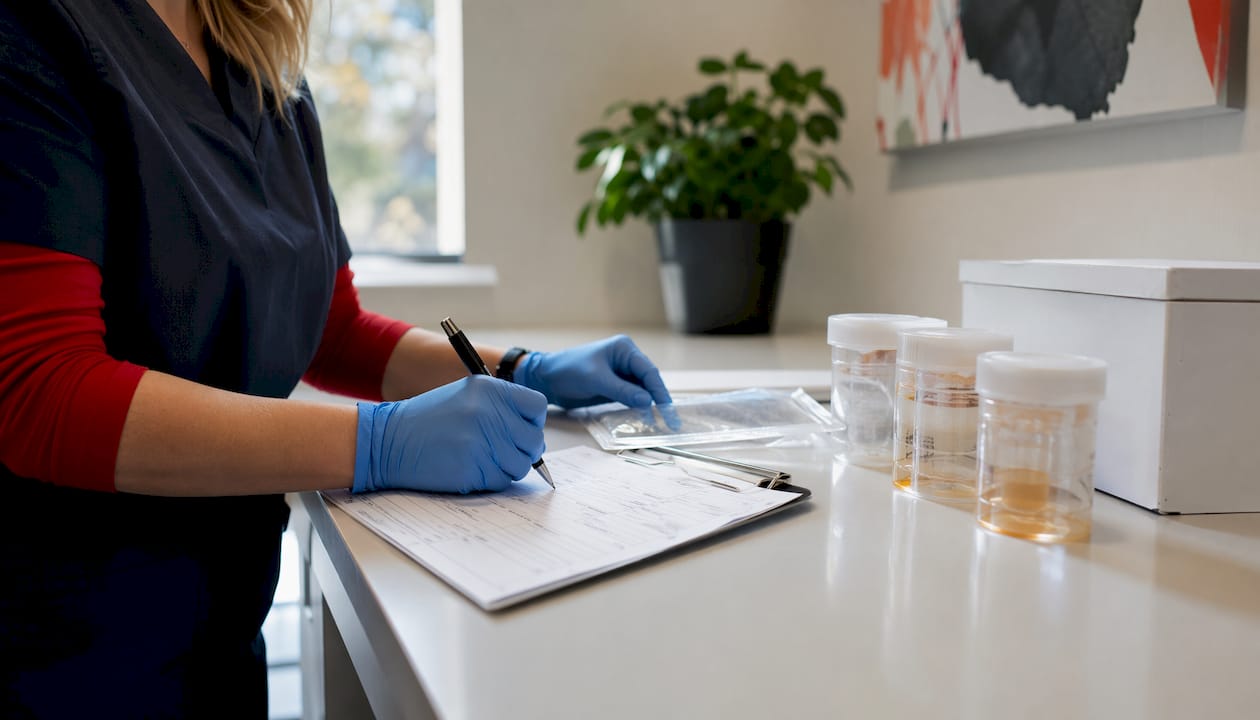
Adulterant detection built into the cup should cover at minimum: creatinine (dilution), specific gravity (dilution), pH (acid/base adulteration), and oxidants (bleach, nitrites). For a deeper look at how each validity parameter works, adulterant detection methods are worth reviewing before finalizing your SOP.
How to choose the right drug test kit for your treatment center
The best drug test kits for treatment centers are not necessarily the cheapest ones per unit. They are the ones that hold up under audit, produce reliable results, and come with the documentation your program needs to defend every decision. Here is how to evaluate them.
Must-have feature checklist:
- CLIA-waived designation (confirmed in writing, not just claimed)
- FDA clearance number on product labeling
- Panel coverage matched to your patient population (minimum 10-panel; add ETG and fentanyl where indicated)
- Integrated adulterant checks (creatinine, specific gravity, pH, oxidants)
- Temperature strip or tamper-evident indicator on the cup
- Lot-specific QA documentation and COA available on request
- Shelf life of at least 12 months from order date
- Storage requirements compatible with your facility (most cups: 36–86°F)
- Traceable lot/batch numbers on every unit
Questions to ask vendors before purchasing:
- Can you provide the FDA clearance number and CLIA-waived certificate for this specific product?
- What is your lot QA process, and can I receive a COA with each order?
- What are your bulk pricing tiers, and what is the minimum order for each tier?
- What is your standard lead time, and do you offer guaranteed delivery windows?
- Do you have a returns or replacement policy for kits that fail QC on arrival?
- Can you provide sample chain-of-custody forms and SOP templates?
- Do you have a confirmatory lab partnership or referral workflow for positive screens?
Red flags that should stop a purchase:
- No QA documentation available or “available on request” with no follow-through
- No adulterant checks included, or adulterant parameters not specified
- Vague CLIA/FDA claims with no clearance number
- Inconsistent lot numbers across a single shipment
- Vendor cannot answer questions about detection limits (ng/mL) per analyte
The table below shows common kit configurations and their typical clinical use cases. Use it as a starting framework, not a final answer, since your specific patient population and program requirements will drive the final panel selection.
| Kit Configuration | Specimen | Setting | Panel Coverage | Adulterant Detection | CLIA Status | Confirmatory Needed |
|---|---|---|---|---|---|---|
| 5-panel cup | Urine | Point-of-care | THC, COC, OPI, AMP, MET | Optional | Waived | Yes, for positives |
| 10-panel cup | Urine | Point-of-care | Adds BZO, MTD, OXY, BAR, PCP | Optional | Waived | Yes, for positives |
| 12-panel cup | Urine | Point-of-care | Adds TCA, BUP or similar | Recommended | Waived | Yes, for positives |
| — | Urine | Point-of-care | Adds ETG, FEN, K2/Spice | Integrated | Waived | Yes, for positives |
| 18-panel cup with ETG/FEN | Urine | Point-of-care | Broadest coverage including ETG/FEN | Integrated | Waived | Yes, for positives |
| ETG strip (standalone) | Urine | Point-of-care | Alcohol metabolite only | N/A | Waived | Yes, for positives |
| Fentanyl strip 1 ng/mL | Urine | Point-of-care | Fentanyl only, high sensitivity | N/A | Waived | Yes, for positives |
| Oral fluid swab | Saliva | Point-of-care | 5–10 panel | N/A | Waived | Yes, for positives |
For a detailed guide to selecting drug test kits that covers CLIA/FDA considerations and panel matching, that resource walks through the decision framework step by step.
Procurement negotiation levers: Ask for guaranteed delivery windows in writing, lot traceability SLAs, training credits for staff onboarding, and bundled confirmatory lab pricing if the vendor has a lab partnership. These are standard asks for volume buyers and most reputable suppliers will accommodate them.
What to do when a screen comes back positive
Treat every point-of-care positive as presumptive until a confirmatory lab test says otherwise. That is not a bureaucratic formality. Immunoassay cross-reactivity with common medications, including some antibiotics, antidepressants, and over-the-counter cold medicines, can produce a false positive on a urine screen. Acting on an unconfirmed result can harm a patient and expose your program to liability.
Confirmation pathway:
- Collect the specimen in a properly sealed, labeled container with a complete chain-of-custody form.
- Send to a SAMHSA-certified or CAP-accredited laboratory for GC-MS or LC-MS/MS confirmation.
- Request specimen validity testing (creatinine, specific gravity, pH, oxidant levels) alongside the drug panel confirmation.
- Retain all chain-of-custody documentation through the lab’s reporting process.
- Route the confirmed result to a Medical Review Officer (MRO) before any clinical or administrative action.
The MRO’s job is to review the confirmed result against the patient’s medication history and medical record. A confirmed positive for opioids in a patient on a legitimate buprenorphine prescription is not a program violation. The MRO adjudicates that distinction and documents the finding. Without MRO review, your program is making clinical decisions without the full picture.
Triggers for confirmatory testing beyond a standard positive:
- Clinical signs inconsistent with the screen result (patient appears impaired, screen is negative)
- Legal, court-ordered, or probation-linked cases where the result will be used in proceedings
- Suspected adulteration (temperature out of range, adulterant check flags, unusual specimen appearance)
- Medication interference is plausible given the patient’s current prescriptions
- Patient disputes the result
The workflow is straightforward: screen → validity check → send for GC-MS/LC-MS confirmation → MRO review → clinical action (treatment modification, stepped care, referral, or no action). Cleveland Clinic’s drug testing guidance reinforces that point-of-care screens are preliminary and that lab confirmation is the standard for results with clinical or legal weight.
Budgeting and procurement: calculating the true per-screen cost
Procurement experts recommend evaluating ‘total value’ — including adulterant detection, QA documentation, and vendor support — instead of choosing the lowest unit price. The true per-screen cost calculation should include the unit cost of the cup or strip, confirmatory lab fees, MRO review fees, shipping and handling, staff time for repeat collections, inventory carrying cost, and training expenses.
Most American clinics spend over 30% of their operational budgets on drug screening supplies annually, which makes total-value purchasing decisions important. A kit that costs slightly more per unit but eliminates one confirmatory test per 20 screens can easily pay for itself.
Common procurement models for treatment centers:
- Bulk purchase with tiered discounts: Best for programs with predictable monthly volume. Locks in a lower unit price; requires storage capacity and inventory management.
- Subscription replenishment: Automates reordering based on usage rate. Reduces stockouts and administrative overhead, though it requires accurate volume forecasting.
- White-label/OEM options: Some suppliers offer private-label cups with your program’s branding. Useful for large networks or multi-site programs.
- Drop-ship models: Supplier ships directly to your facility on demand. Higher per-unit cost but lower inventory risk.
Pro Tip: When negotiating a bulk contract, ask for a lot traceability SLA in writing. If a lot fails QC after delivery, you want a documented process for replacement, not a conversation. Also ask whether the supplier can bundle a confirmatory lab referral rate into the agreement.
For programs evaluating bulk drug test kit options, the math on tiered pricing often makes a meaningful difference at volumes above a few hundred tests per month.
Key Takeaways
Treatment centers that standardize on CLIA-waived, FDA-cleared multi-panel urine cups with integrated adulterant checks, ETG strips, and high-sensitivity fentanyl strips, and that route every confirmed positive through GC-MS/LC-MS and MRO review, build the most defensible and clinically reliable drug screening programs.
| Point | Details |
|---|---|
| CLIA and FDA status are non-negotiable | Every point-of-care kit must carry a CLIA-waived designation and an FDA clearance number on its labeling. |
| Adulterant checks belong in every cup | Integrated creatinine, specific gravity, pH, and oxidant checks protect specimen integrity and reduce invalid results. |
| Confirmatory testing is required for positives | Send presumptive positives to a GC-MS/LC-MS accredited lab and route through an MRO before any clinical action. |
| Total cost beats unit price | Factor in confirmatory fees, repeat collections, and staff time; cheaper kits often cost more per valid result. |
| Rapidtestcup supplies the full compliance stack | CLIA-waived cups, ETG strips, high-sensitivity fentanyl strips, and bulk pricing with QA documentation available. |
Immediate actions for this week:
- Update your SOP to require CLIA-waived status verification on every kit purchase order.
- Add ETG strips to your panel if alcohol is a primary or co-occurring concern in your program.
- Add high-sensitivity fentanyl strips if your program serves opioid use disorder patients.
- Order adulterant-checked cups for your next random monitoring cycle.
- Collect COAs, lot QA docs, and shelf-life specs from your current vendor; if they cannot provide them, start evaluating alternatives.
- Confirm your confirmatory lab partnership and MRO workflow are documented in your SOP.
A supplier’s perspective on what treatment centers actually need
Treatment centers do not need the cheapest test. They need a test that holds up when a patient disputes a result, when a court asks for documentation, or when an accreditation auditor reviews the file. That is the lens Rapidtestcup applies to its product line.
The kits Rapidtestcup supplies to treatment programs are CLIA-waived and FDA-cleared, with lot-specific QA documentation and COAs available for every order. The product range covers multi-panel urine cups from 5-panel through 18-panel configurations, standalone ETG strips, high-sensitivity fentanyl strips at both 1 ng/mL and 20 ng/mL cutoffs, and integrated adulterant-check cups. For programs that need broad coverage in a single collection event, the 18-panel cup with ETG and fentanyl panels is the most complete option in the catalog.
Bulk pricing is structured to reflect actual program volumes, with tiered discounts that make compliance affordable at scale. QA documentation, including FDA/CLIA labeling, lot traceability records, and storage/shelf-life data, ships with orders or is available on request. For programs building or updating their SOPs, sample chain-of-custody form templates and collection procedure guidance are part of the onboarding support.
A compliance program framework that integrates drug testing SOPs with broader clinical quality requirements is worth reviewing alongside your procurement decisions, particularly if your program is working toward or maintaining accreditation.
Rapidtestcup makes compliant procurement straightforward for treatment centers
Compliant drug screening for treatment centers requires more than a box of cups. It requires kits with the right panels, documented adulterant checks, CLIA-waived status, and a supplier who can back every lot with QA paperwork. That is exactly what Rapidtestcup delivers.
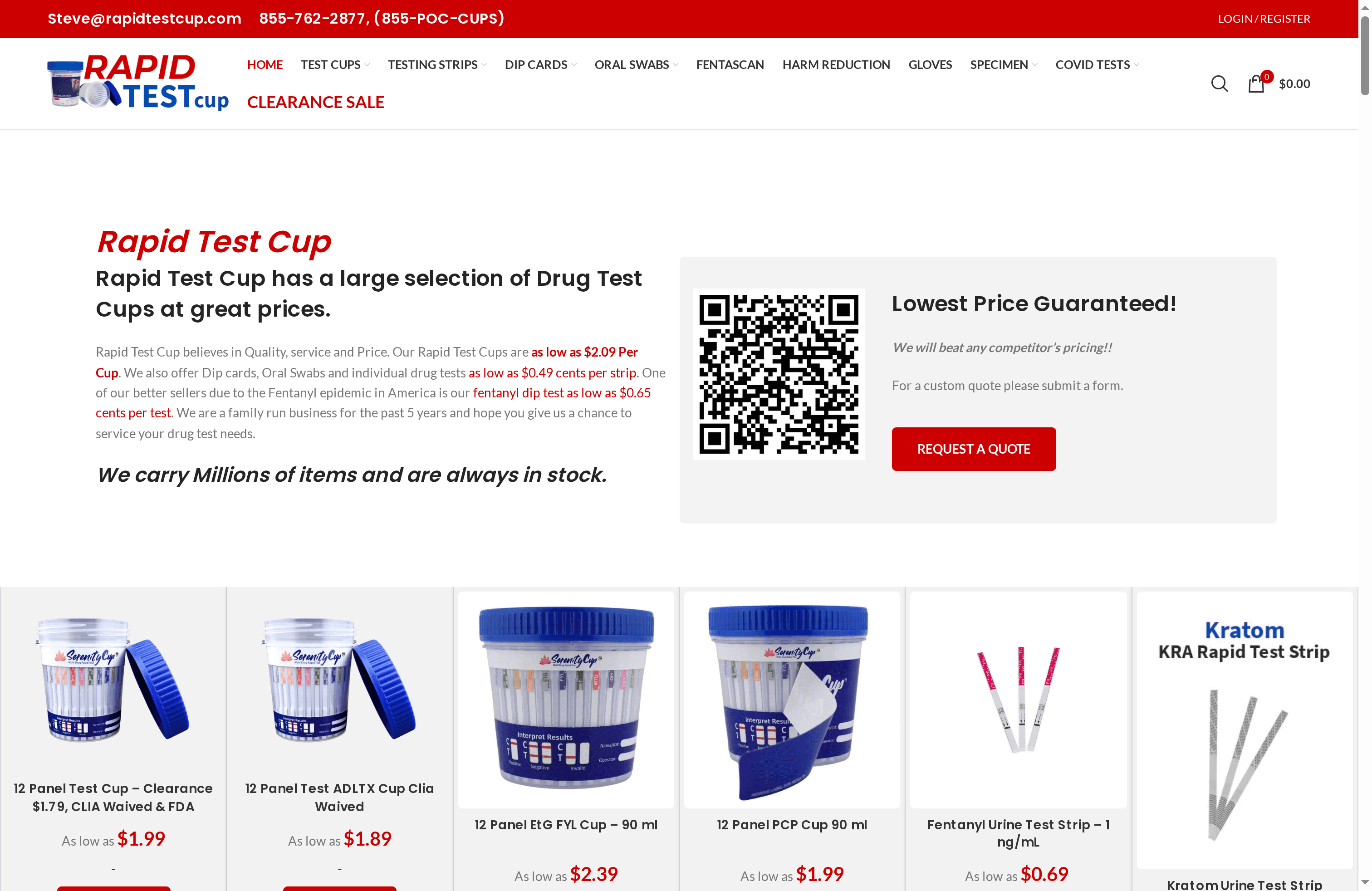
The product line built for treatment programs includes CLIA-waived multi-panel urine cups in 5-panel through 18-panel configurations, high-sensitivity fentanyl strips at 1 ng/mL for opioid programs, ETG urine strips for alcohol monitoring, and 18-panel cups with ETG, fentanyl, and adulterant checks for programs that need maximum coverage in one collection. Every order comes with FDA/CLIA labeling, lot QA documentation, and COAs. Bulk pricing tiers are available for programs ordering at volume, and purchase order terms are supported for institutional buyers.
Request a bulk quote or browse the full catalog at Rapidtestcup.com to find the configuration that fits your program’s panel requirements and budget.
Useful sources and further reading
The following authoritative sources informed this guide. Verify state-level rules and payer-specific requirements before changing your program’s testing policy, since state regulations on drug testing in treatment settings vary and can be more restrictive than federal minimums. Request vendor QA documentation during every procurement cycle, not just at initial onboarding.
- FDA: Drugs of Abuse Tests — FDA guidance on in vitro diagnostic devices for drugs of abuse, including clearance requirements.
- NCBI Bookshelf: Appendix B, Urine Collection and Testing Procedures — Clinical resource on urine collection and monitoring protocols for substance abuse treatment programs.
- MedlinePlus: Drug Testing — Plain-language overview of specimen types, test formats, and the role of confirmatory testing.
- Cleveland Clinic: Drug Test Overview — Clinical explanation of point-of-care screening, confirmatory testing, and MRO review.
- SAMHSA — Federal guidance on substance abuse treatment standards, including drug testing requirements for federally funded programs.
- HIPAA compliance considerations for handling patient test data — Relevant for programs managing chain-of-custody records and patient result documentation under HIPAA.
- OSHA Interpretation of 1904.35 — Clarifies permissible post-incident drug testing for programs coordinating with employers or handling work-related cases.