
Blog
Clinicians: Order the Right Hydrocodone Test, 300 ng/mL or 25 ng/mL


Hydrocodone is usually detectable in urine for about 2 to 3 days after the last dose, with a range of roughly 1 to 4 days depending on dose and metabolism, according to Mayo Clinic Laboratories. The catch: many routine opiate immunoassays are calibrated for morphine and codeine, so they can miss hydrocodone entirely unless the panel is hydrocodone-specific or confirmed by LC-MS/MS.
TL;DR:
- Hydrocodone can typically be detected in urine for 2 to 3 days after use, but detection depends on cutoff levels, metabolism, and specimen quality.
- Most routine immunoassays calibrated for morphine and codeine often fail to reliably detect hydrocodone unless they are specifically designed for it or confirmed by LC-MS/MS.
- Confirmatory tests measuring hydrocodone, norhydrocodone, and hydromorphone provide the most accurate detection, with lower cutoffs extending the detection window.
- Point-of-care tests built for hydrocodone at 300 ng/mL are available and improve detection accuracy over generic opiate panels.
- Variability in individual metabolism, specimen collection timing, and potential cross-reactivity with other substances can complicate interpretation of results.
Table of Contents
- Hydrocodone detection times in urine: what the kinetic data shows
- Why standard opiate immunoassays often miss hydrocodone
- Confirmatory testing, metabolites, and cutoff concentrations
- Interpreting results: common pitfalls and how to work through them
- Practical lab and point-of-care options for screening hydrocodone
- Potential interference from other medications or substances
- How detection windows differ across urine, saliva, and hair
- How individual metabolism changes what a test shows
- What test results mean for patients: legal, employment, and care decisions
- Building hydrocodone testing into a monitoring plan
- Where to find hydrocodone-capable testing supplies
- FAQ
- Sources
Hydrocodone detection times in urine: what the kinetic data shows
Controlled-dosing research from SAMHSA, RTI, and Johns Hopkins found that hydrocodone and its metabolite norhydrocodone show up in urine within about 2 hours of dosing, with concentrations rising over the following hours. How long the drug stays detectable afterward depends heavily on where the lab sets its cutoff.
At a cutoff of 2,000 nanograms per milliliter, detection can drop below 5 hours for some individuals, according to the SAMHSA controlled-administration data, while a lower cutoff of 50 ng/mL extends the window to roughly 28 hours. LC-MS/MS confirmatory testing at 25 ng/mL, the cutoff Mayo Clinic Laboratories uses, picks up hydrocodone and its metabolites even longer, which is part of why the 2 to 3 day window holds up clinically.
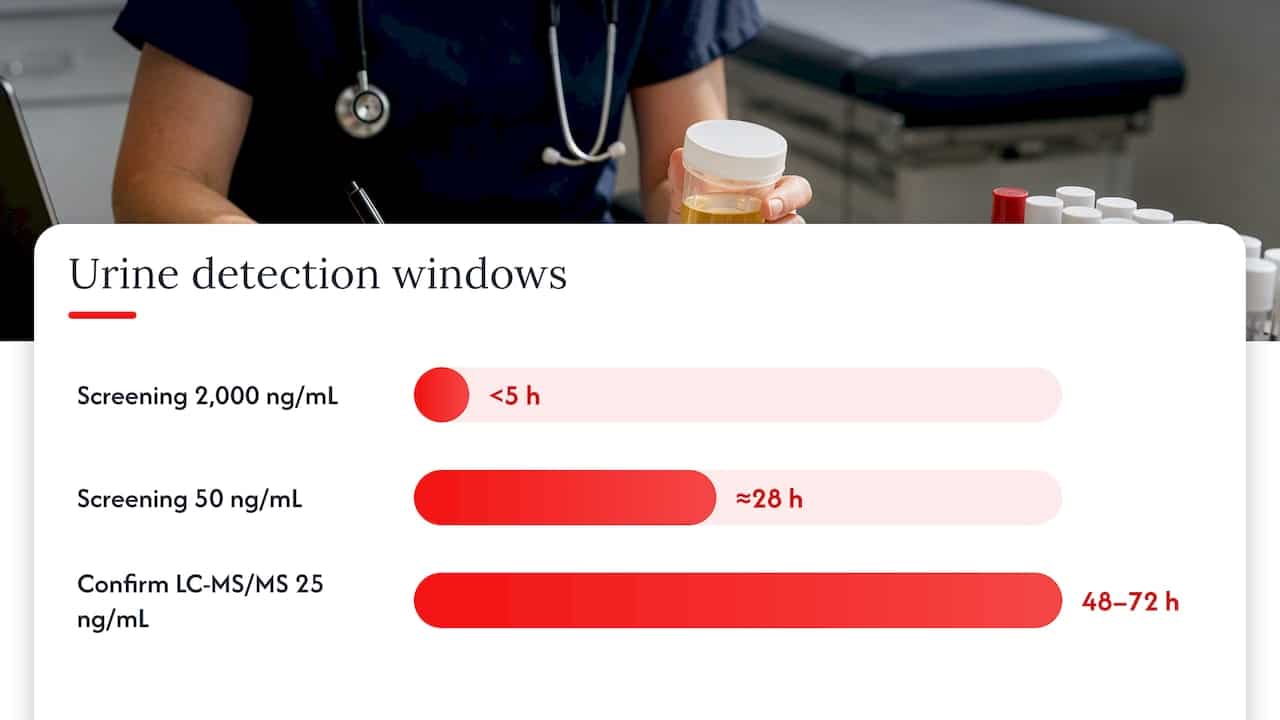
Several factors influence detection windows, including dosing frequency and amount, analytical cutoff sensitivity, and specimen quality such as urine concentration or timing of collection.
For clinicians, the lesson is straightforward: a negative result taken at face value, without knowing the cutoff or the assay’s target analyte, tells you less than it seems to. Readers who want a specimen-by-specimen breakdown can check this reference on substance detection windows.
Why standard opiate immunoassays often miss hydrocodone
Urine drug testing happens in layers. Point-of-care immunoassays, the dip cards and cups used at bedside or in an office, give a fast yes-or-no screen. Laboratory immunoassays do the same chemistry with more precision. Confirmatory methods, GC-MS or LC-MS/MS, identify and quantify the exact molecule present.
The problem sits in the first layer. Many opiate immunoassays are built and calibrated against morphine and codeine, the natural opiates, according to pharmacy guidance from the University of Illinois at Chicago. Hydrocodone is semisynthetic, and its molecular structure cross-reacts poorly with antibodies tuned for morphine. A patient taking a therapeutic dose of hydrocodone can test negative on a generic opiate screen while still having the drug in their system.
Cutoffs compound the issue:
- Generic opiate immunoassays have historically used cutoffs around 2,000 ng/mL, a level set for morphine-class detection.
- Hydrocodone-specific immunoassays, when used, often run at 300 ng/mL, the qualitative cutoff documented in FDA 510(k) review materials for commercial hydrocodone assays.
- Even a hydrocodone-specific screen is preliminary: a positive still needs mass spectrometry confirmation before it drives a clinical decision.
Pro Tip: If you are monitoring a patient prescribed hydrocodone, order a hydrocodone-specific immunoassay or confirmatory testing up front rather than relying on a generic opiate panel. For background on why the same issue plays out with a related opioid, see this clinician’s two-tier plan for oxycodone screening.
Confirmatory testing, metabolites, and cutoff concentrations
When a screen is positive, or when a negative screen does not match the clinical picture, confirmatory testing settles the question. Labs typically measure three analytes: hydrocodone itself, norhydrocodone (its primary metabolite), and hydromorphone (a secondary metabolite that is also a separate prescription opioid in its own right).
Norhydrocodone matters more than its name suggests. The SAMHSA controlled-dosing study found it is often the most abundant analyte in urine after a hydrocodone dose, sometimes outlasting the parent drug. A panel that only checks for hydrocodone and skips norhydrocodone can underreport exposure or shorten the apparent detection window.
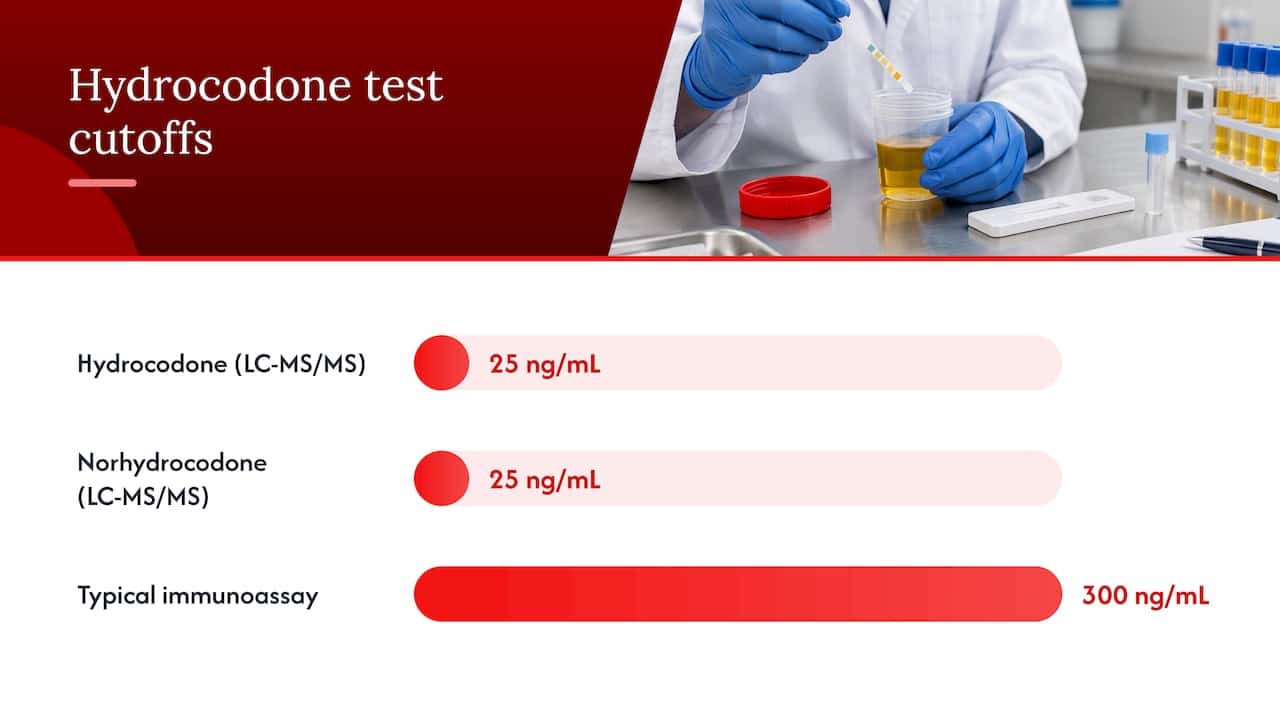
Mayo Clinic Laboratories reports a common LC-MS/MS cutoff of 25 ng/mL for hydrocodone, norhydrocodone, and hydromorphone, though procedures vary by lab and clinical need. That is far more sensitive than the 300 ng/mL used in many qualitative immunoassays.
A few details that change interpretation:
- Hydrolyzed urine testing breaks down conjugated metabolites before measurement, which can raise reported concentrations for certain analytes.
- Non-hydrolyzed testing measures only free drug and can underestimate total exposure.
- Trace hydrocodone can appear as a pharmaceutical impurity in some oxycodone or hydromorphone products, so a low-level positive deserves a look at the patient’s actual prescriptions before assuming misuse.
For monitoring accuracy, a confirmatory panel that includes hydrocodone, norhydrocodone, and hydromorphone by LC-MS/MS gives the clearest picture. More on how cutoff choice changes what a test can and cannot tell you is covered in this explainer on drug test cutoff levels.
Interpreting results: common pitfalls and how to work through them
An unexpected result, positive or negative, is rarely a dead end. It is a prompt to check a short list of explanations before treating the result as final.
- Rule out assay mismatch first. A negative on a generic opiate panel does not clear hydrocodone; confirm the panel targeted the right analyte and cutoff.
- Check specimen validity. Low creatinine or abnormal specific gravity can signal dilution, which pushes true concentrations below the cutoff.
- Cross-check the timing. A specimen collected more than 3 to 4 days after the last dose may legitimately read negative even with no tampering involved.
- Compare against prescription records. A positive that does not match what is prescribed warrants a conversation before any punitive or clinical action.
- Escalate to LC-MS/MS when it matters. Any result that will shape a treatment plan, a legal outcome, or an employment decision should be confirmed, not acted on from a screen alone.
Cross-reactivity and trace impurities account for most unexplained positives, while high cutoffs, dilution, and mistimed collection account for most unexplained negatives. Neither pattern is rare enough to ignore.
Practical lab and point-of-care options for screening hydrocodone
Point-of-care dip cards and test cups serve a real purpose: fast, low-cost screening at the point of care. But a screening device is only as good as the panel it was built for. A generic opiate strip can miss hydrocodone the same way a generic lab immunoassay does, unless the product is specifically formulated and labeled for it.
A hydrocodone-capable dip stick built around the 300 ng/mL cutoff documented in FDA 510(k) filings for commercial hydrocodone assays is available, aligning with assays designed for this specific drug rather than the broader opiate class. Multi-panel cups that include a dedicated hydrocodone line serve the same purpose for clinics screening multiple substances at once.
- Use a hydrocodone-specific dip stick or panel when the clinical question is specifically about hydrocodone, not just “any opiate.”
- Treat any POC positive or unexpected negative as preliminary and send it for LC-MS/MS confirmation.
- Stock multi-panel cups for general monitoring, but keep hydrocodone-specific strips on hand when managing patients on that exact prescription.
Pro Tip: Match the screening product to the drug you are actually monitoring. A panel built for morphine will not reliably flag hydrocodone.
Potential interference from other medications or substances
A handful of substances can distort a hydrocodone result in either direction. Some prescription and over-the-counter opioid combination products contain trace hydrocodone as a manufacturing impurity, which UIC Pharmacy’s FAQ on urine drug screen interference notes can muddy a low-level positive if the patient is actually taking a different opioid.
Cross-reactivity is the other main source of interference. Certain antihistamines, antidepressants, and other opioid medications have been documented to trigger false positives on opiate immunoassays depending on the specific antibody chemistry the assay uses. Because formulations and antibody specificity vary by manufacturer, the only reliable way to settle an ambiguous result is confirmatory testing that identifies the exact molecule present rather than a class-level reaction.
On the false-negative side, no substance is known to chemically block hydrocodone detection the way some adulterants interfere with cannabinoid or amphetamine assays. The more common failure mode is procedural: the wrong assay, a cutoff set too high, or a specimen collected outside the detection window. That distinction matters when a patient insists a positive is wrong. The question usually is not “did something interfere,” but “was the right test used.”
Any case where interference is suspected, whether from a prescribed medication or an over-the-counter product, should prompt a review of the patient’s full medication list alongside the lab’s documentation of that assay’s known cross-reactants.
How detection windows differ across urine, saliva, and hair
Specimen type changes both the detection window and what the result can tell you. Urine, the most common specimen for monitoring, captures the 2 to 3 day window described earlier and reflects use over the past several days rather than the last few hours.
Oral fluid testing generally reflects more recent use, since drugs appear in saliva soon after dosing and clear faster than in urine. It is useful when the clinical question is about very recent use rather than use over the past few days, though its shorter window makes it a poor fit for routine monitoring of a patient on a standing prescription.
Hair testing extends the detection window out to weeks or months, since drugs incorporate into the hair shaft as it grows. That makes it suited to questions about longer-term patterns rather than a single recent dose, but it cannot pinpoint when during that window the exposure happened, and environmental contamination is a recognized limitation.
None of these specimen types test interchangeably for a clinical question like “did this patient take their prescribed dose this week.” Urine remains the standard for opioid monitoring programs precisely because its window lines up with typical dosing intervals, while saliva and hair answer different questions about recency or duration.
How individual metabolism changes what a test shows
Two patients taking the same dose of hydrocodone on the same schedule can produce different test results, because the enzyme pathway that processes hydrocodone (primarily CYP2D6, with CYP3A4 also involved) varies by individual. Some people metabolize hydrocodone quickly and clear it sooner; others process it more slowly and may show detectable metabolites longer than the typical window suggests.
This variation also affects the ratio between hydrocodone and its metabolites. A fast metabolizer may show relatively low parent-drug concentrations alongside higher norhydrocodone, while a slow metabolizer may show the reverse. That is part of why confirmatory testing that captures all three analytes, hydrocodone, norhydrocodone, and hydromorphone, gives a more reliable picture than looking at any single one.
Hydration status, kidney function, body composition, and the specific hydrocodone formulation (immediate release versus extended release) all play into how quickly the drug and its metabolites clear. None of these factors change the underlying chemistry a lab test is measuring, but they do mean the 2 to 3 day window is a typical range, not a fixed rule for every patient. A clinician interpreting a borderline result should weigh the patient’s known metabolic factors before drawing a firm conclusion from timing alone.
What test results mean for patients: legal, employment, and care decisions
A hydrocodone result rarely stays a purely clinical matter. In a pain management or substance use treatment setting, an unexpected positive can affect whether a prescription continues, whether a treatment plan changes, or whether a referral gets made. An unexpected negative in a patient prescribed hydrocodone can raise questions about diversion, nonadherence, or simply a testing gap, so the workup described earlier matters before any of those conclusions get documented.
Outside the clinic, employment drug testing and legal proceedings carry their own stakes, and the standard there is typically a confirmed result, not a screening-level positive. A preliminary immunoassay result that has not been confirmed by mass spectrometry generally should not be treated as a final answer in a legal or employment context, partly because of exactly the cross-reactivity and cutoff issues covered above.
For patients, the practical guidance is simple: ask what specific drugs and cutoffs a test panel covers before assuming a negative clears you or a positive condemns you, and request confirmatory testing any time a result will materially affect your treatment, your job, or a legal case. For clinicians, documenting the assay type, cutoff, and any confirmatory steps taken protects both the patient’s care plan and the integrity of the record if that result is ever questioned later.
Building hydrocodone testing into a monitoring plan
Routine opioid monitoring works best when it is predictable rather than punitive. Baseline testing before starting hydrocodone, then periodic testing at a cadence matched to the patient’s risk level, reflects the CDC’s guideline recommendations for opioid prescribing. Patients who know what is being tested, how often, and why tend to engage with the process rather than resist it.
Documenting the plan in the chart, including which assay and cutoff were used, protects everyone if a result is ever questioned later.
— Justin
Where to find hydrocodone-capable testing supplies
Clinics and labs that need to move past generic opiate screens can find hydrocodone-specific options built around the 300 ng/mL cutoff documented in FDA review filings, alongside CLIA-waived, FDA-cleared multi-panel cups for broader screening needs.
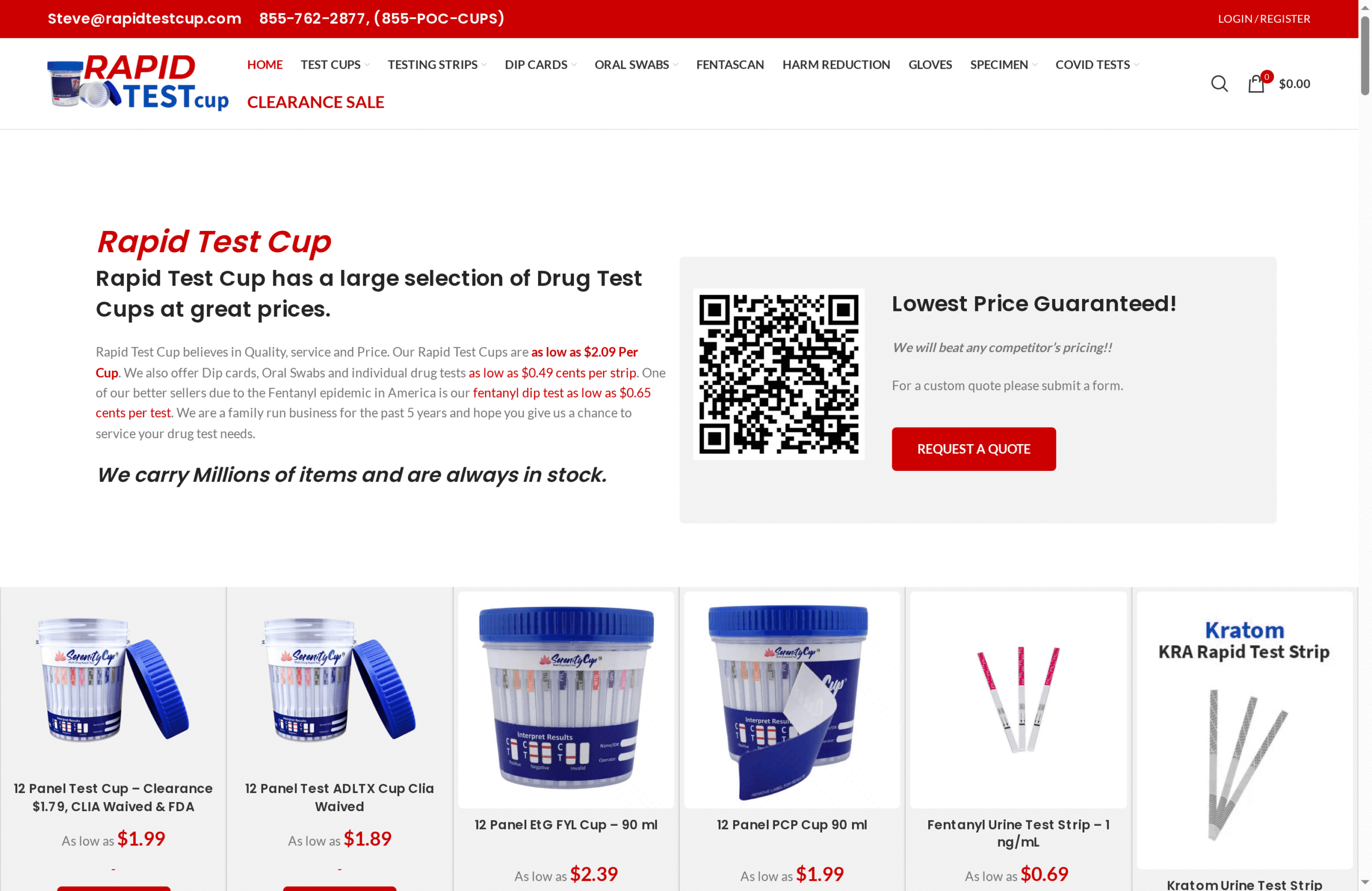
- The hydrocodone drug test dip stick is built specifically for this analyte rather than a generic opiate class.
- Multi-panel cups covering a wider drug menu are available for clinics that need broader coverage in a single device.
- The full shop carries dip cards, oral swabs, and specimen cups for both screening and collection needs.
Clinics managing patients on hydrocodone prescriptions can browse the full catalog at RapidTestCup’s shop to match the right panel and cutoff to their monitoring protocol before the next scheduled test is due.
This article is general information, not a substitute for advice from a qualified doctor. Consult a qualified healthcare professional about your own circumstances before acting on anything here.
FAQ
What will hydrocodone test positive for?
Hydrocodone itself, and its metabolites norhydrocodone and hydromorphone, are the analytes a confirmatory test looks for. A generic opiate immunoassay may not flag any of them if it is calibrated for morphine and codeine instead, which is why a hydrocodone-specific assay or LC-MS/MS confirmation gives a more reliable answer.
Can a urine test show the difference between oxycodone and hydrocodone?
A basic opiate immunoassay generally cannot distinguish them, since both are semisynthetic opioids that many generic panels were not built to separately identify. Confirmatory testing by LC-MS/MS or GC-MS can identify each drug and its specific metabolites individually, which is the only reliable way to tell them apart.
Why would hydrocodone not show up in a urine test?
The most common reasons are a generic opiate panel with a cutoff set too high, a specimen collected after the typical 2 to 3 day detection window, or a diluted sample, according to detection window data from Mayo Clinic Laboratories. A hydrocodone-specific assay or lower-cutoff confirmatory test reduces the chance of a missed result.
How long can opioids be detected in a urine test?
Detection windows vary by specific opioid, dose, and the test’s cutoff, but hydrocodone typically shows up for about 2 to 3 days after the last dose, with a range of roughly 1 to 4 days. Lower analytical cutoffs, such as the 25 ng/mL used in some LC-MS/MS confirmatory tests, can extend that window compared with higher-cutoff immunoassays.
Does RapidTestCup sell a test specifically for hydrocodone?
Yes, RapidTestCup carries a hydrocodone-specific urine dip stick built around a 300 ng/mL cutoff, along with multi-panel cups that include hydrocodone detection for broader screening needs.
Sources
- Mayo Clinic Laboratories: Hydrocodone with Metabolite Confirmation, Urine (Test Catalog)
- University of Illinois at Chicago Pharmacy: What drugs are likely to interfere with urine drug screens? (May 2021 FAQs)
- CDC Guideline for Prescribing Opioids for Chronic Pain — Supplementary data
- Oxycodone and Hydrocodone: Detection in Urine, Oral Fluid, and Blood (SAMHSA, 2014)