Blog
False Negatives from Expired Drug Test Cups: Collection-Site Checklist


An expired urine drug test cup is not reliable for any formal or legal decision, because the antibodies and control reagents inside degrade over time and can produce false negatives or invalid control lines. If you are holding an expired cup, the safe move is to stop, recollect with an in-date kit, or send the specimen to a lab for confirmatory testing instead of trusting the result.
TL;DR:
- Expired urine drug test cups can produce false negatives because the antibodies and reagents degrade over time, reducing sensitivity.
- Sensitivity loss is particularly problematic near the cutoff levels, leading to undetected drug presence in some cases.
- Proper inventory management, such as first-expired-first-out rotation and storage within the recommended temperature range, prevents most expiration-related issues.
- Negative results from expired cups are unreliable and should never be used as the sole basis for employment, legal, or clinical decisions.
- Confirmatory testing with GC-MS or LC-MS/MS is essential for any positive or disputed result, regardless of the test’s expiration status.
Table of Contents
- Why test kits have expiration dates in the first place
- How expiration undermines accuracy and control lines
- Specimen age versus kit expiry: two separate problems
- When an expired cup can still inform you, and when it never should
- What to do if you already used an expired cup
- Inventory and collection-site habits that prevent this problem
- The real lesson collection sites keep missing
- Where to buy in-date, lab-traceable test cups
- FAQ
- Sources
Why test kits have expiration dates in the first place
A urine drug test cup works through a lateral-flow immunoassay: antibodies bind to drug metabolites, a conjugate carries that reaction up a membrane, and a control line confirms the device itself functioned correctly. Every one of those components is chemically active and degrades on a timeline, which is why manufacturers assign an expiration date rather than treating the cup as a permanent object.
Desiccants inside the packaging keep humidity out, but once that seal is compromised or the shelf life passes, antibody binding weakens. Manufacturer 510(k) submissions to the FDA document this directly: stability testing for one Wondfo multi-drug urine cup supported a 24-month stability claim at 4 to 30 degrees Celsius, a range typical of the category.
- Antibodies and conjugates lose binding strength as chemical reagents degrade.
- Membranes and desiccants can fail once packaging seals are broken or stored outside the labeled range.
- Accelerated stability studies, not real-time guesswork, are what back the printed expiration date.
Related reading: our breakdown of drug test shelf life and storage conditions covers how temperature swings during shipping or storage can shorten that window further.
How expiration undermines accuracy and control lines
Once antibodies weaken, the test’s cutoff sensitivity drops. A specimen that would have flagged positive at the kit’s labeled threshold can instead read negative, because the degraded antibodies no longer bind reliably at low drug concentrations. This is the core failure mode of an expired cup: not a dramatic malfunction, but a quiet loss of sensitivity near the cutoff.
One widely cited industry overview notes that immunoassay kits commonly carry 18 to 24 month shelf lives because reagents and antibodies lose potency on that timeline, which is exactly the window where sensitivity problems start to show up in expired stock.
- A false negative near the cutoff concentration is the most common and hardest to detect failure.
- A missing or faint control line signals an invalid test and should be logged immediately, with the cup discarded and the test repeated.
- An expired kit’s result carries limited weight for an employer or a court, since neither can assume the device performed as labeled.
That last point matters operationally: a negative from an expired cup does not prove absence of a substance, it may simply mean the test failed to detect it.
Specimen age versus kit expiry: two separate problems
A kit’s expiration date and a specimen’s age are not the same issue, and conflating them leads to bad decisions. A cup can be freshly manufactured and still receive a specimen that has sat too long, or a fresh specimen can be tested in an expired cup. Both failure modes need separate checks.
Urine itself changes after collection: bacteria multiply, pH drifts, and some metabolites break down, which is why most labs set a short acceptance window for untested specimens rather than letting them sit for days.
- Check temperature within 4 minutes of collection, since an out-of-range reading is one of the first flags collectors use under SAMHSA collection-site guidance.
- Confirm creatinine, pH, and specific gravity fall within normal ranges, the core specimen-validity parameters labs use to flag dilution or substitution.
- Screen for adulterants, since masking agents or additives can interfere with the immunoassay even when the specimen itself is fresh.
- Expect rejection or a recollection request whenever temperature, pH, or creatinine fall outside accepted ranges, regardless of how new the test cup is.
Our guide to specimen validity and integrity checks walks through each of these markers in more depth.
When an expired cup can still inform you, and when it never should
Context changes how much an expired result is worth. A personal, non-decision screening, checking your own urine out of curiosity, carries little risk if you understand the result might be unreliable. Using the same expired cup to make an employment call, a custody decision, or a regulatory determination is a different matter entirely.
- Personal curiosity: an expired cup’s result is informal at best and should never be treated as conclusive.
- Employer or legal use: an expired kit’s result should not factor into any adverse action.
- Regulated testing: federal, DOT-type, or court-ordered collections require in-date devices and documented chain of custody, full stop.
Any preliminary result headed for a real decision needs confirmation. Immunoassay screening is a preliminary step, and GC-MS or LC-MS/MS confirmatory testing is the accepted standard before anyone acts on a result in a clinical, workplace, or legal setting.
Pro Tip: Replace test cups 60 to 90 days before their printed expiration date so an overlooked box never ends up in a collection kit.
What to do if you already used an expired cup
If you realize after the fact that the cup was expired, a few steps protect you from acting on bad information.
- Write down the lot number and expiration date printed on the cup, and photograph both along with the result window.
- If the specimen is still available, keep it refrigerated rather than discarded, since a lab may still be able to run it.
- Contact the receiving lab or the medical review officer right away and describe exactly what happened, including the expiration date.
- Follow their instructions, which will typically mean either confirmatory testing on the retained specimen or a fresh, observed recollection.
- Do not act on the expired-kit result for any employment, legal, or clinical decision while confirmation is pending.
Our step-by-step urine test guide covers the collection and documentation habits that make this kind of recovery easier when something goes wrong.
Inventory and collection-site habits that prevent this problem
Most expired-cup incidents trace back to inventory management, not bad luck. A first-expired-first-out rotation system, where older stock ships or gets used before newer stock, catches most problems before a cup ever reaches a collector’s hands. Storage also matters: cups held outside their labeled temperature range can degrade faster than the printed date suggests.
- Rotate stock using a first-expired-first-out system, and label storage shelves by expiration month.
- Store cups within the manufacturer’s stated temperature range, not just at room temperature by assumption.
- Train collectors to check the expiration date before opening a cup, record the lot number in the collection log, and verify specimen temperature within the first few minutes, steps consistent with SAMHSA’s collection-site manual.
These habits cost almost nothing and eliminate the single most common cause of invalid or disputed results.
The real lesson collection sites keep missing
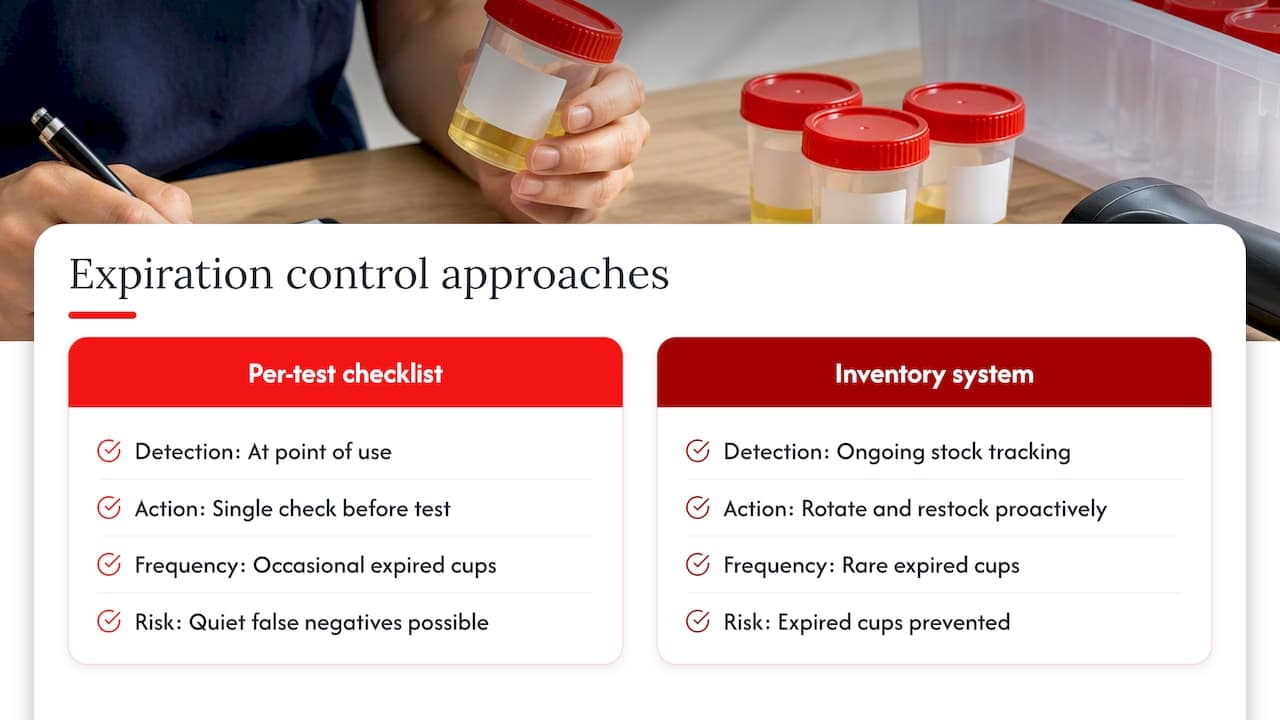
Most advice on this topic treats expiration dates as a formality, a date to glance at and move past. That misses the point. An expired cup rarely fails loudly with an obvious error message. It fails quietly, producing a negative that looks completely normal while hiding a positive near the cutoff. That is the scenario that should worry anyone running a collection program, far more than a cup that refuses to work at all.
The conventional fix, just check the box before you use it, is necessary but not sufficient. The bigger gap is inventory discipline: sites that rotate stock properly rarely encounter an expired cup in the first place, while sites that order in bulk and store boxes in a back closet eventually will. If there is one priority worth acting on from everything here, it is this: treat expiration tracking as an inventory system, not a per-test checklist item. The checklist only catches what the system already let slip through.
— Justin
Where to buy in-date, lab-traceable test cups
Getting this right starts with sourcing cups that are in-date, lot-traceable, and backed by CLIA-waived or FDA-cleared documentation, since none of the checks above matter if the box itself is already unreliable. A wide catalog of multi-panel cups, dip cards, and oral swabs is available with current lot numbers and clear expiration labeling on every listing.
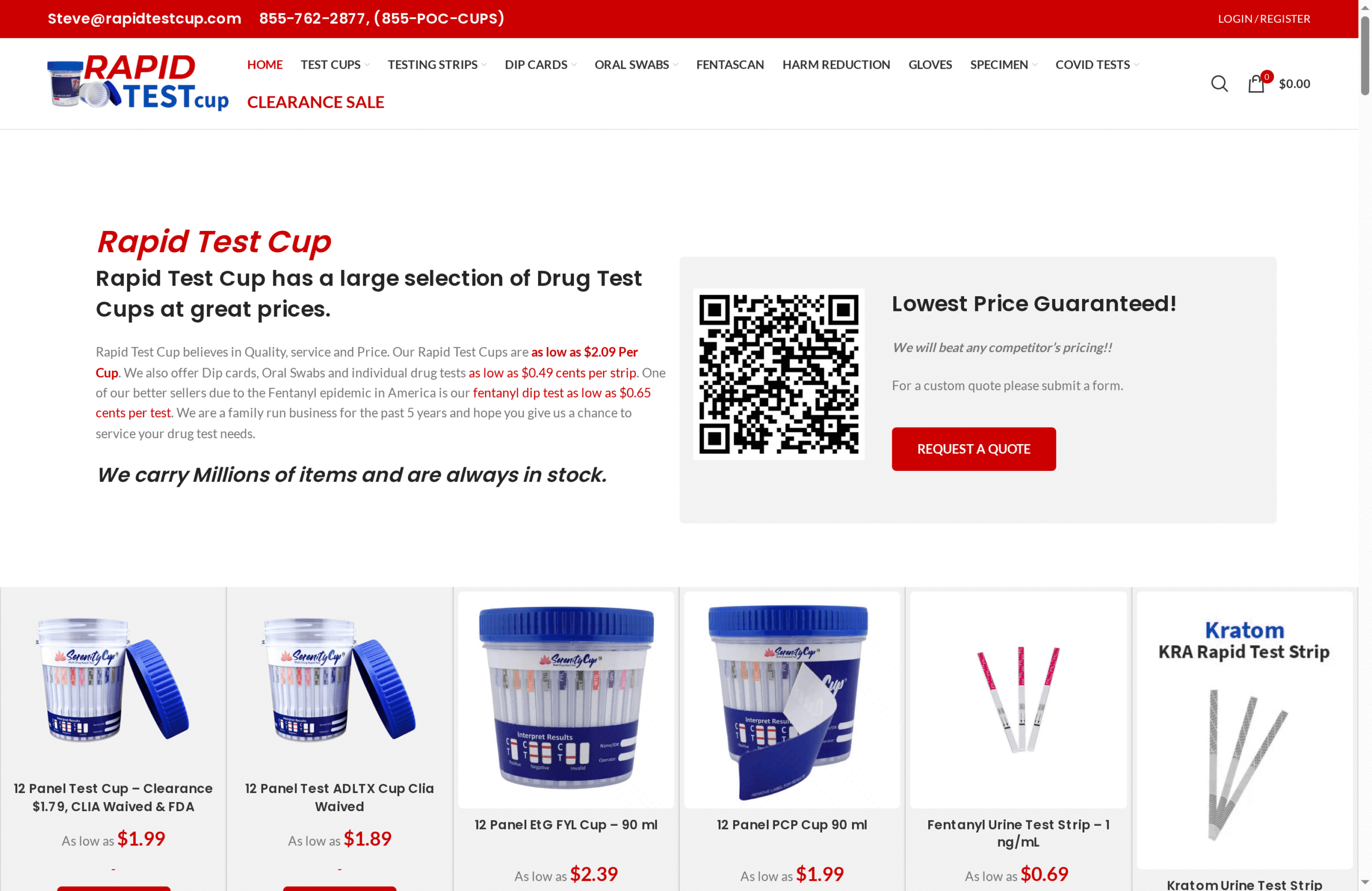
Before ordering, confirm a few details on any product page: the stated expiration window, storage instructions, whether specimen validity or adulterant detection features are built in, and that the lot number is disclosed. Our shop page lists current panels, including clearance options like the 12-panel cup and full-feature options such as the 18-panel cup with adulterant detection, so you can verify freshness before you check out.
FAQ
Will a drug test still work if it’s expired?
An expired cup may still produce a result, but the antibodies inside have likely weakened, which raises the risk of a false negative, especially near the cutoff concentration. Treat any result from an expired device as unreliable and recollect with a current kit when the outcome matters.
Can a drug test tell if it’s old urine?
Yes, labs check specimen-validity markers like temperature, creatinine, pH, and specific gravity that shift as urine ages or is tampered with. A specimen that falls outside normal ranges on these markers is typically flagged for recollection rather than accepted as-is.
How accurate are cup drug tests?
Cup tests are screening tools, not final answers, and immunoassay screening always requires confirmatory testing with GC-MS or LC-MS/MS before any clinical, legal, or employment decision. Our in-date, CLIA-waived cups are built to perform within their labeled accuracy range, but a positive or disputed result should still go to confirmatory testing.
Can I use 3-day-old urine for a drug test?
Urine left at room temperature for several days is likely to show bacterial growth and pH shifts that most labs will flag as invalid. Collection guidance generally expects a fresh specimen tested or shipped promptly, not one held for multiple days before testing.
Sources
- K182701 — Wondfo T-Cup® Multi-Drug Urine Test Cup — FDA 510(k) review
- Urine collection site manual — SAMHSA (2024)
- Do drug tests expire? Kits, specimens, and results — LegalClarity
- Urine drug testing: immunoassay screening and confirmatory methods — Mayo Clinic Proceedings
- Peer-reviewed overview of specimen validity and adulteration detection — PMC article