Blog
Impairment or Abstinence? Alcohol Testing for Employers and Employees


No, standard 5, 7, and 10 panel drug tests do not test for alcohol. An “alcohol panel” means a separate test such as breath, blood, or a urine EtG/EtS marker, run alongside or instead of a standard drug screen. Federal programs under DOT rules require their own breath testing workflow. The right choice depends on whether you need to catch active impairment, recent drinking, or a longer pattern of use.
TL;DR:
- Blood and breath tests are best suited for detecting current impairment, with detection windows of only a few hours.
- Urine EtG/EtS testing can identify alcohol consumption within the past one to two days but is susceptible to false positives from incidental exposure.
- Hair and PEth testing reveal longer-term drinking patterns over weeks or months, not recent use or impairment.
- Confirmatory testing with GC/MS or LC/MS/MS is essential before taking disciplinary or legal action based on positive screens.
- Adding a specific alcohol test to existing drug panels requires selecting the appropriate method based on the monitoring goal, whether impairment or abstinence.
Table of Contents
- Which tests detect alcohol and what each one measures
- EtG and EtS: cutoffs, false positives, and confirmatory testing
- Matching detection windows to the right alcohol test
- Choosing and operationalizing an alcohol testing approach
- Reading results correctly before taking action
- Where RapidTestCup fits into alcohol testing programs
- What the research actually supports
- Building an alcohol testing program that fits your goals
- Sources
- FAQ
Which tests detect alcohol and what each one measures
Standard workplace panels screen for drug classes like THC, opiates, and amphetamines, not alcohol, which is why SAMHSA’s drug testing panel guidance lists it as a separate category entirely. Each alcohol test method answers a different question, and picking the wrong one is the most common mistake employers make.
- Breath testing measures ethanol in real time and correlates closely with current blood alcohol concentration, making it the standard for impairment checks.
- Blood testing gives a direct ethanol reading for acute impairment, while a related marker called phosphatidylethanol (PEth) can flag heavier, longer-term drinking.
- Urine ethanol only stays detectable for a few hours, so most abstinence programs rely instead on EtG and EtS, metabolites that persist longer after drinking stops.
- Oral fluid devices can detect recent alcohol use and are increasingly built into combined point-of-collection drug panels, such as this 12-panel oral fluid swab with alcohol.
- Hair testing reflects a longer pattern of use over weeks or months rather than a single drinking episode.
Matching the method to the goal, not just the biomarker, is what separates a useful alcohol testing program from one that generates confusion.
EtG and EtS: cutoffs, false positives, and confirmatory testing
Ethyl glucuronide (EtG) and ethyl sulfate (EtS) are direct metabolites of alcohol, and urine EtG testing can detect drinking for roughly one to two days after intake, according to a SAMHSA advisory on alcohol biomarkers. That sensitivity is useful for abstinence monitoring, but it comes with a catch: the same advisory notes that EtG is vulnerable to incidental exposure from products like mouthwash or hand sanitizer, so a positive result is not proof of drinking on its own.
- Lower cutoffs catch lighter drinking but raise the odds of flagging incidental exposure rather than intentional use.
- Immunoassay screens can produce false positives and should be confirmed with GC/MS or LC/MS/MS before any serious action is taken.
- Labs should correct EtG results for creatinine or specific gravity, since dilute urine can distort the reading.
Reviewing EtG cutoff accuracy at common thresholds helps explain why two labs using different cutoffs can reach different conclusions from the same sample.
Pro Tip: Never treat a single EtG immunoassay result as final. Confirm it, and ask about the cutoff before you act on it.
Matching detection windows to the right alcohol test
Detection windows vary by test type, and confusing “recent use” with “current impairment” is where most testing programs go wrong. Breath and blood catch someone who is actively impaired within hours, while EtG/EtS catches someone who drank days ago even if they are sober by the time they are tested, a distinction LabTestsOnline’s review of ethanol testing lays out clearly.
| Test type | Specimen | Typical detection window | What it indicates | Common confirmatory method |
|---|---|---|---|---|
| Breath (EBT) | Breath | Hours | Current impairment | Second confirmatory breath test |
| Blood ethanol | Blood | Hours | Current impairment | GC-FID or GC-MS |
| Urine ethanol | Urine | Hours | Very recent use | GC/MS |
| Urine EtG/EtS | Urine | 1 to 2 days | Recent consumption | GC/MS or LC/MS/MS |
| PEth (blood) | Blood | Weeks | Long-term heavy pattern | LC/MS/MS |
| Hair | Hair | Weeks to months | Long-term pattern | GC/MS or LC/MS/MS |
For pre-employment or post-accident checks where impairment is the question, breath is the tool; if you face a DUI arrest in Alabama, specialist services like M&J Bail Bonds can assist with bail and related legal help. For abstinence programs tied to treatment or probation, EtG or combination EtG/EtS testing fits better. For safety-sensitive roles covered by DOT rules, breath and approved EBT devices are required by regulation, not by preference, so there is no substitute method available for those tests.
Choosing and operationalizing an alcohol testing approach
Start with the goal, not the technology. If you need to know whether someone is impaired right now, breath testing wins on speed and legal standing. If the goal is monitoring abstinence over time, EtG or PEth fits better. If you need a picture of a drinking pattern over weeks, hair or PEth is the right tool.
- Confirm whether the role is DOT-regulated, since 49 CFR Part 40 mandates breath/EBT testing and specific occasions for safety-sensitive positions.
- Decide whether the program needs an observed collection, and build chain-of-custody steps into every handoff.
- Run specimen validity testing alongside the alcohol test to catch dilution or substitution attempts.
- Route any positive screening result through confirmatory testing and a medical review officer before taking action.
- Weigh point-of-collection devices against lab-based confirmation, since faster turnaround usually means less certainty until confirmation comes back.
Pro Tip: Build the confirmatory step into your policy before you need it. Deciding mid-case how to handle a disputed EtG result is how good programs lose credibility.
Reading results correctly before taking action
A screening positive is a starting point, not a verdict. The SAMHSA biomarker advisory recommends confirming any immunoassay EtG or EtS result with GC/MS or LC/MS/MS before relying on it for a consequential decision, and blood ethanol results used in legal or disciplinary contexts need the same rigor, as outlined in a review of blood alcohol preanalytical methods.
- Hold any adverse action until the confirmatory result is back, not just the initial screen.
- Ask about incidental exposure (mouthwash, hand sanitizer, certain foods) when a result is unexpected, and document the subject’s response.
- Check whether the urine sample was corrected for creatinine or specific gravity, since dilution changes what a borderline number actually means.
- Loop in a medical review officer before communicating a final result to the person tested.
A short, consistent protocol here (hold, confirm, review, document) protects both the program’s integrity and the person being tested from a decision based on an unconfirmed screen.
Where RapidTestCup fits into alcohol testing programs
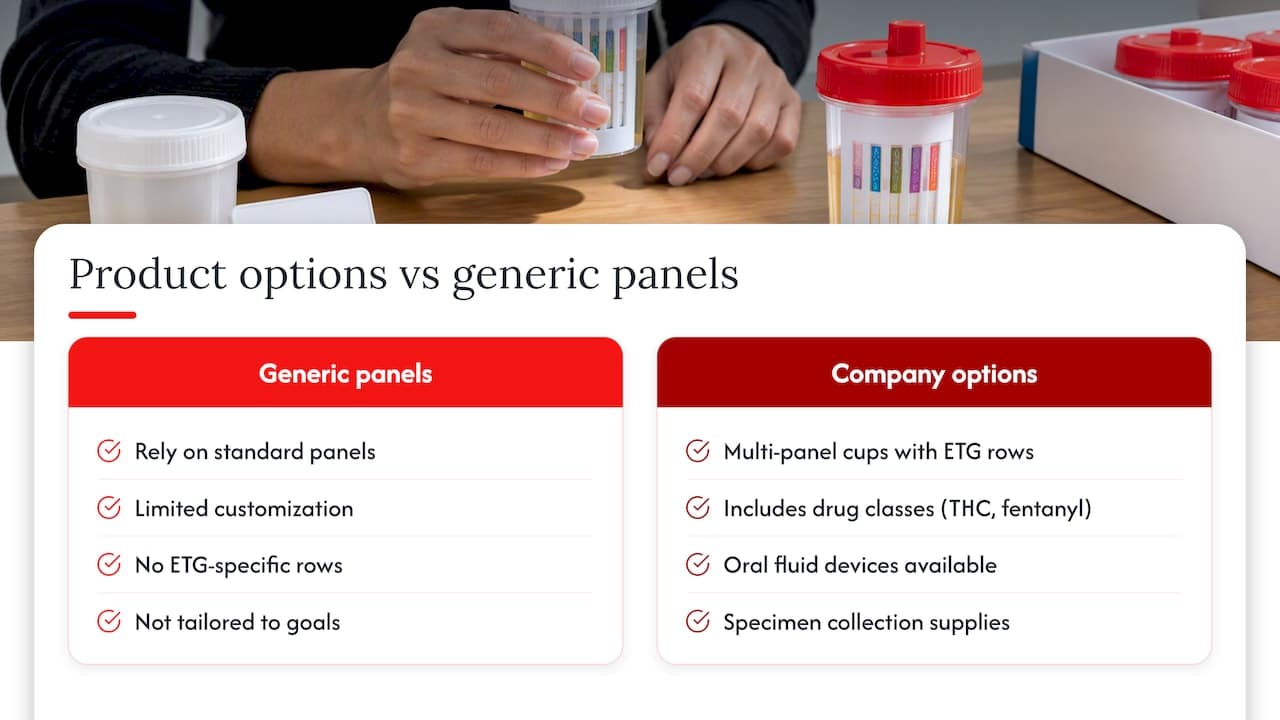
The company sells drug testing supplies including multi-panel cups with ETG rows alongside drug classes like THC and fentanyl, oral fluid devices, and specimen collection supplies, providing options to match a product to various monitoring goals rather than relying on generic panels.
What the research actually supports
The biggest misconception in alcohol testing is treating a positive EtG result like a breathalyzer reading. It is not a measure of impairment, and it was never meant to be one. It is a window into the last day or two of someone’s life, filtered through a sensitivity threshold that also catches mouthwash and sanitizer.
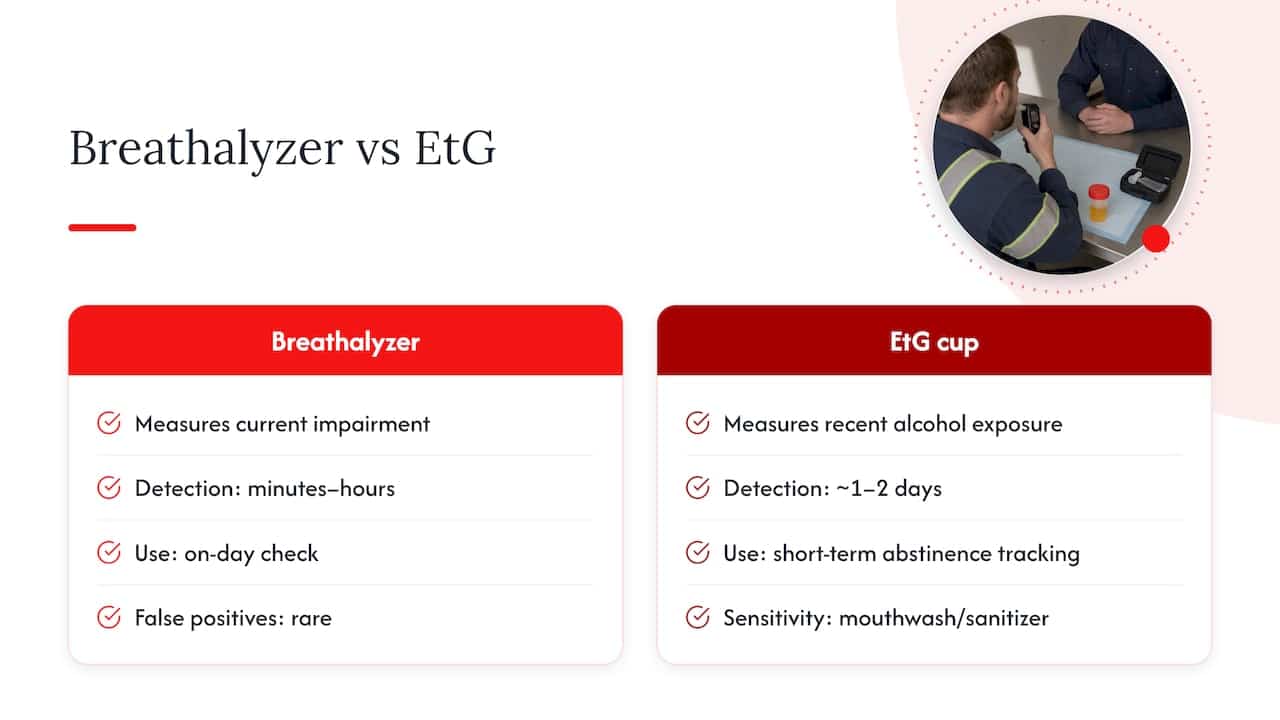
The conventional advice, “add an alcohol panel to the drug screen,” glosses over the fact that there is no single alcohol panel. There are five distinct tools with five distinct jobs, and bolting the wrong one onto a workplace program creates disputes that a clearer policy would have avoided.
If you take one thing from this, prioritize defining the question before picking the test. Are you checking for impairment on a given day, or tracking abstinence over weeks? That answer determines whether you need a breathalyzer, an EtG cup, or a PEth blood draw, and skipping that step is where most alcohol testing programs run into trouble.
— Justin
Building an alcohol testing program that fits your goals
If your drug screening program needs an alcohol component, the fix is not complicated: add the right product to the panel you already use. For abstinence monitoring, a cup with a built-in ETG row, like the 18 panel cup with ETG/300, covers both drug classes and recent alcohol use in a single collection. For point-of-collection screening that pairs alcohol with other substances, an oral fluid swab with alcohol detection works faster than a lab send-out.
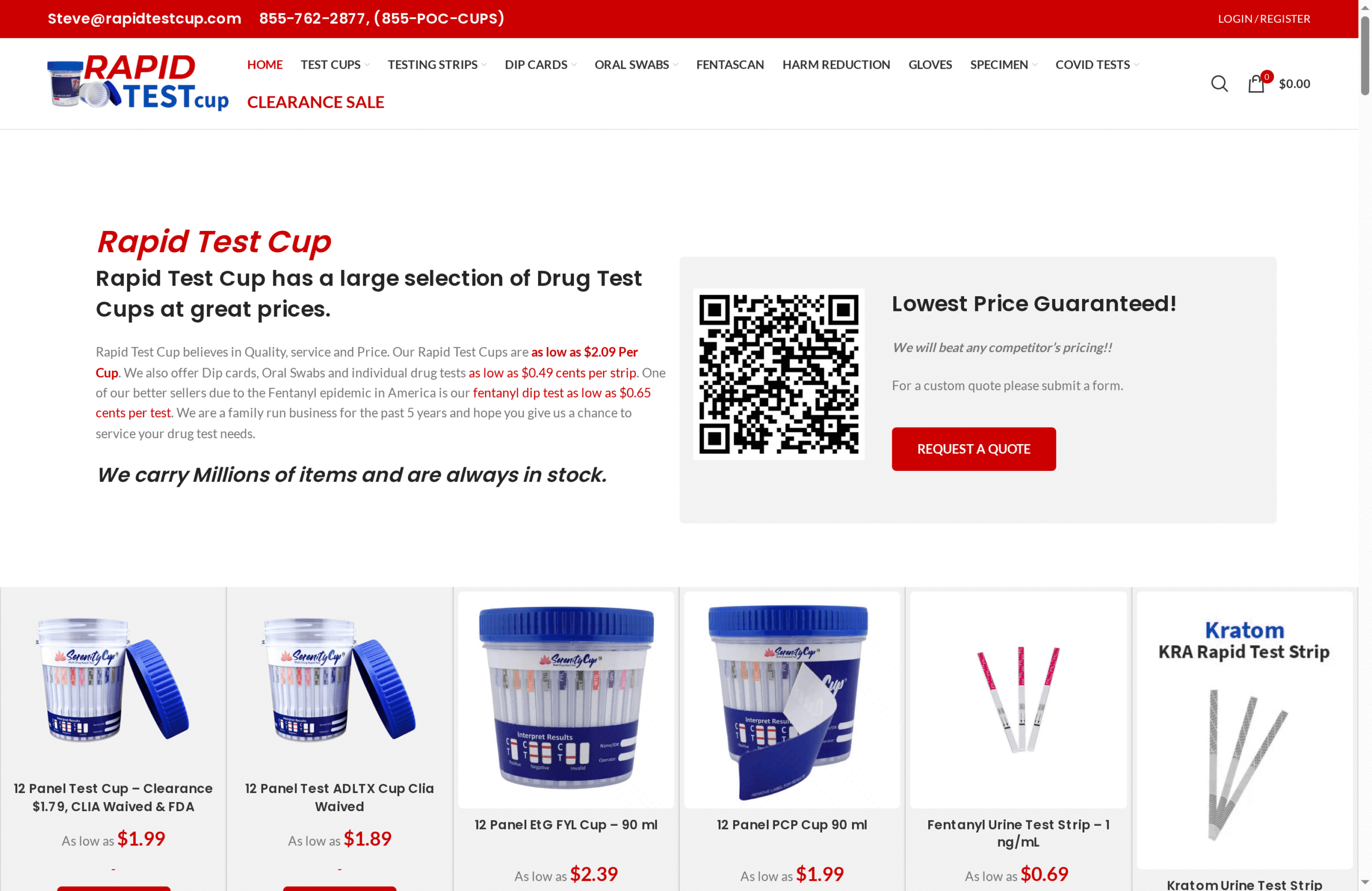
Whichever format you choose, pick a cutoff appropriate to your program’s tolerance, add an adulterant or specimen-validity check, and send any positive EtG result for GC/MS confirmation when the outcome matters. Browse the full range of alcohol-capable test cups and supplies to find the right fit for your volume and budget.
Sources
- U.S. Department of Transportation — Employer FAQs on alcohol testing
- Blood alcohol concentration in the clinical laboratory: a narrative review of the preanalytical phase
FAQ
Is alcohol part of a 5 panel drug test?
No, a standard 5 panel drug test does not include alcohol, since SAMHSA’s panel guidance treats alcohol as a separate testing category. Employers who want alcohol coverage need to add a breath test, blood test, or a urine EtG/EtS marker alongside the drug panel.
Why do I test positive for alcohol and I haven’t drank?
Incidental exposure from products like mouthwash or hand sanitizer can trigger a positive EtG screen, since the SAMHSA biomarker advisory notes this test is highly sensitive and not specific to drinking. Any unexpected EtG positive should be confirmed with GC/MS or LC/MS/MS before it is treated as evidence of alcohol use.
How many days will alcohol show up on a drug test?
It depends on the test: breath and blood ethanol only show recent use measured in hours, while urine EtG can detect drinking for roughly one to two days, according to SAMHSA’s advisory on alcohol biomarkers. Hair and PEth testing extend that window to weeks or months for tracking longer-term patterns.
What is alcohol listed as on a drug test?
On a urine panel, alcohol use is usually reported as EtG (ethyl glucuronide) or EtS (ethyl sulfate), the metabolites labs screen for rather than alcohol itself. On breath or blood tests, it is reported directly as ethanol or blood alcohol concentration.