Blog
Drug Testing Solutions for Clinics: 2026 Buying Guide


TL;DR:
- Most U.S. clinics use CLIA-waived urine multi-panel tests combined with laboratory confirmation and Medical Review Officer review for high-stakes results. Rapidtestcup supplies compliant testing kits, adulterant detection, and specimen collection tools suited for clinic workflows. Proper protocols, documentation, and confirmatory testing are essential for legal, employment, and clinical accuracy.
For most U.S. clinics, the practical default is a CLIA-waived urine multi-panel point-of-care system paired with a defined confirmatory lab workflow and Medical Review Officer (MRO) review for any presumptive positive that carries clinical or legal weight. That combination covers the majority of screening use cases without requiring a full laboratory license. Rapidtestcup supplies clinic-ready, CLIA-waived multi-panel cups, fentanyl and ETG strips, adulterant detection kits, and specimen collection supplies, offering bulk pricing and custom quotes.
Your immediate next steps:
- Order a starter kit: a multi-panel urine cup (10-panel minimum) plus adulterant strips
- Establish a confirmatory lab contract with a SAMHSA-certified or accredited laboratory
- Identify and contract an MRO before your first positive result, not after
Table of Contents
- What drug testing solutions for clinics actually cover
- Point-of-care testing vs. sending specimens to a lab
- CLIA, FDA, and HIPAA requirements your clinic must track
- Specimen collection best practices and adulteration controls
- Why confirmatory testing and MRO review are non-negotiable
- How to budget and procure drug testing supplies
- Pre-purchase checklist before you buy test kits or sign a contract
- Key Takeaways
- Drug testing as a clinical tool, not a compliance checkbox
- Rapidtestcup makes clinic procurement straightforward
- Useful sources for clinical drug testing programs
What drug testing solutions for clinics actually cover
Drug testing in a clinical setting spans four specimen matrices, each with different detection windows and operational trade-offs.
Specimen matrices at a glance:
- Urine: Most common for point-of-care (POC) screening. Noninvasive, sensitive, and cost-effective. Detection window is roughly hours to several days depending on the substance and frequency of use.
- Oral fluid: Short detection window (generally up to 48 hours), useful for recent-use scenarios and when observed collection is difficult.
- Hair: Reflects exposure up to approximately 90 days, making it useful for pattern-of-use assessments rather than acute screening.
- Blood: Most accurate for quantitative and emergency cases; expensive and requires venipuncture.
For most clinics, urine immunoassay remains the workhorse. Oral fluid and hair testing fill specific gaps when urine is unsuitable or a longer window is needed. A practical overview of urine test alternatives can help when urine collection is not feasible.
Standard and expanded panels:
The NIDA-5 panel screens for amphetamines, cannabinoids, cocaine, opiates, and PCP. Expanded 10-panel tests commonly add oxycodone, methadone, buprenorphine, and fentanyl. Clinics serving patients in opioid treatment programs or high-fentanyl-prevalence areas should add targeted assays for fentanyl and ETG (ethyl glucuronide, an alcohol metabolite) as a baseline, not an upgrade.
Standard panels miss substances like LSD, GHB, and certain synthetic opioids entirely, so pair any panel with a clinical intake assessment.
Pro Tip: When local overdose data or your patient population suggests high fentanyl or alcohol co-use, add fentanyl and ETG assays to your standard cup order from the start. Retrofitting a protocol after a missed positive is far more disruptive than building it in.
Point-of-care testing vs. sending specimens to a lab
Use CLIA-waived POC testing for screening and immediate care decisions. Send specimens to a laboratory for GC-MS or LC-MS/MS confirmation whenever a result will affect employment, legal status, treatment decisions, or discharge planning.
| Dimension | Point-of-Care (Immunoassay) | Laboratory (GC-MS / LC-MS/MS) |
|---|---|---|
| Turnaround time | Minutes (same visit) | 24 hours typically |
| Analytical specificity | Presumptive; cross-reactivity possible | High; identifies specific compounds |
| Operator training | Minimal; CLIA-waived | Requires certified lab personnel |
| Cost per test | Lower | Higher |
| Documentation burden | Moderate (lot QC, chain-of-custody) | High (full chain-of-custody, lab report) |
| Best use case | Screening, monitoring, immediate decisions | Confirmation, legal/employment, high-stakes |
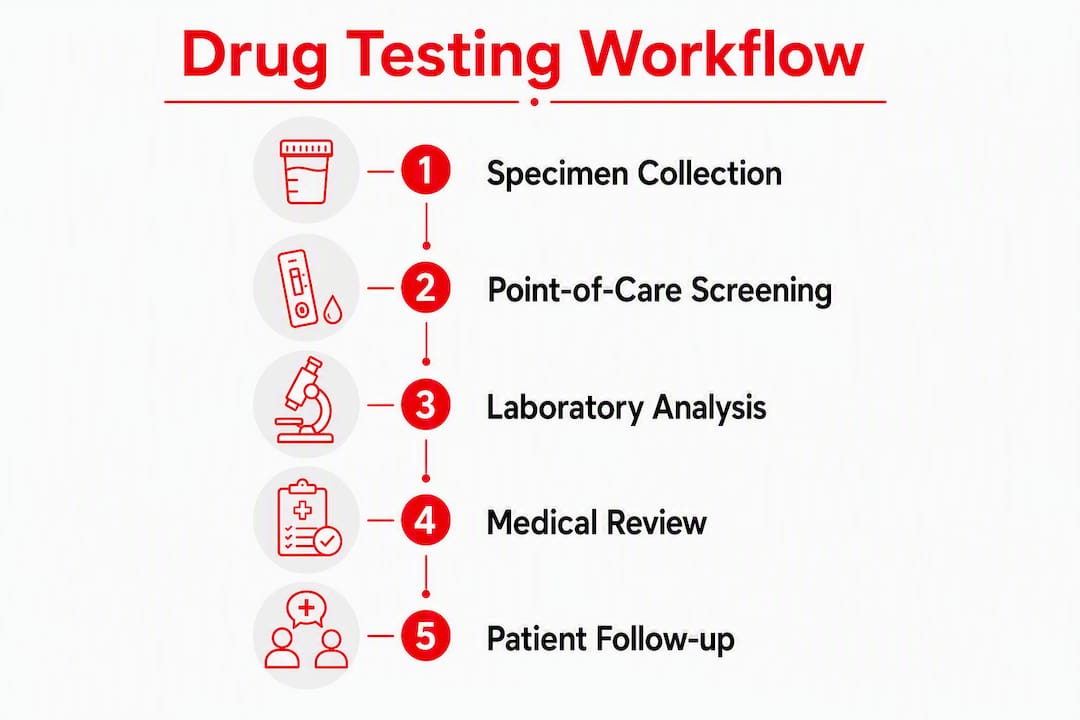
A practical POC-to-lab workflow:
- Administer CLIA-waived multi-panel cup at point of care.
- Screen positive result triggers chain-of-custody hold on the specimen.
- Ship specimen to a confirmatory laboratory under documented chain-of-custody.
- Lab runs GC-MS or LC-MS/MS; report goes to the MRO.
- MRO reviews for medical explanations, verifies result, and communicates the final determination.
- Clinic documents outcome in the EHR and notifies authorized parties per policy.
EHR integration is worth planning early. Many clinic information systems can accept discrete lab results via HL7 or direct interface; confirm this with your EHR vendor before finalizing your lab contract.
CLIA, FDA, and HIPAA requirements your clinic must track
The core compliance principle: CLIA-waived products allow in-clinic screening, but confirmatory testing and any use case with legal or employment consequences still require a laboratory pathway and documented chain-of-custody. Choosing a product labeled “CLIA-waived” and “FDA-cleared” is not optional for in-clinic POC testing — it is the regulatory floor.
Required compliance items:
- CLIA certificate of waiver (if performing only waived tests) or appropriate CLIA certificate level for the complexity of tests performed
- FDA-cleared or waived product status confirmed for every kit purchased
- HIPAA safeguards: role-based access to results, minimum-necessary disclosure, and secure storage
- Lot-level quality control records for every test kit lot used
- External proficiency testing (e.g., CAP) where applicable to your certificate level
- Written policies signed by a designated responsible official
- MRO contract in place before any result with employment or legal consequence is reported
- Sample retention policy specifying hold times and storage conditions
Documents to keep on file:
- CLIA certificate (current, posted at the testing site)
- Manufacturer Instructions for Use (IFU) for each product lot
- Lot-level QC logs with pass/fail records
- MRO contact information and signed contract
- Vendor certificates confirming FDA-cleared or waived status
- Chain-of-custody forms for every specimen sent for confirmation
- Staff training records and competency assessments
Best practices for random testing schedules from the DOT also apply to clinical programs that include random monitoring: unpredictable scheduling across all days of the week preserves deterrence value. Clustering tests in predictable weekly blocks undermines detection.
Specimen collection best practices and adulteration controls
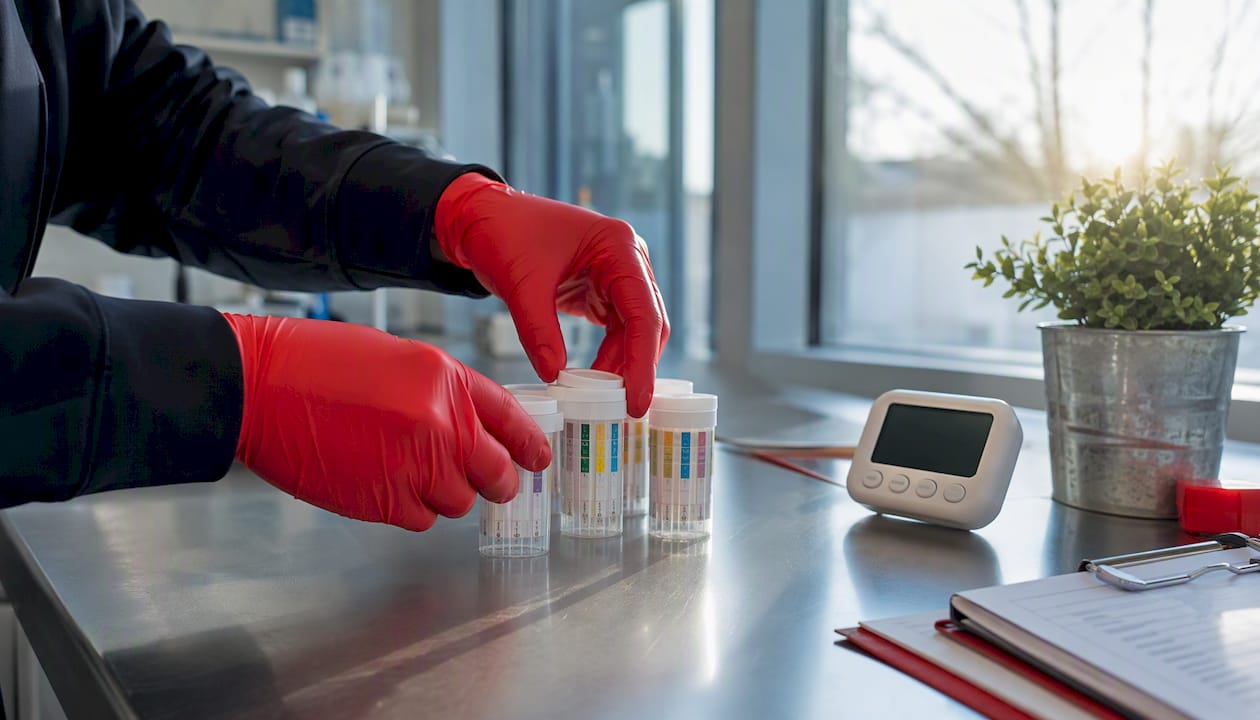
Observed collection, a temperature check, and adulterant testing together materially reduce tampering risk. Balance that with trauma-informed care, particularly in treatment and behavioral health settings.
Step-by-step collection protocol:
- Verify patient identity with photo ID and document in the chain-of-custody form.
- Instruct the patient to remove outer garments and empty pockets before entering the collection area.
- Apply direct observation per your policy (required for certain federal programs; use clinical judgment for others).
- Check specimen temperature immediately after collection: acceptable range is 90–100°F (32–38°C).
- Inspect the specimen visually for unusual color or clarity.
- Run adulterant strips to check specific gravity, creatinine, pH, oxidants, and nitrites.
- Reject specimens outside acceptable ranges and document the reason; a dilute specimen may warrant a recollect.
- Seal the specimen cup with a tamper-evident seal, have the patient initial the seal, and complete the chain-of-custody form.
- Store in a secure, temperature-controlled location until testing or shipment.
Equipment checklist:
- Multi-panel urine cups with integrated adulterant detection
- Standalone adulterant detection strips for secondary verification
- Temperature strips (built-in or adhesive)
- Tamper-evident seals
- Chain-of-custody forms
- Gloves and biohazard disposal bags
- Secure, locked specimen storage
Pro Tip: Dilution is the most common evasion tactic. A specific gravity below 1.003 or creatinine below 2 mg/dL is grounds to reject and recollect. Built-in adulterant detection on a multi-panel cup catches this at the point of collection, before the specimen ever leaves the room.
Why confirmatory testing and MRO review are non-negotiable
Always confirm presumptive positives that carry clinical, employment, or legal consequence using laboratory GC-MS or LC-MS/MS, and route results through an MRO before any adverse action.
The MRO role is physician-level: they contact the donor directly, evaluate legitimate medical explanations, and can overturn a laboratory positive when a valid prescription explains the result. No clinic should report a positive to an employer, court, or treatment program without MRO sign-off on any specimen that went through a confirmatory pathway.
Cutoff concentrations also matter more than most procurement teams realize. The same substance at the same dose can read positive or negative depending on the assay cutoff selected. Work with your MRO and lab to set cutoffs appropriate to your clinical context and regulatory requirements.
How to budget and procure drug testing supplies
Budget across three cost lines: screening kits (per-test cost), confirmatory lab fees (per confirmation), and compliance overhead (MRO fees, chain-of-custody forms, storage, training).
Supply list for a clinic starter order:
- Multi-panel urine cups (10-panel or expanded, with adulterant detection built in)
- Standalone adulterant strips for secondary checks
- Urine specimen cups for split-specimen or send-out collections
- Fentanyl test strips (CLIA-waived)
- ETG alcohol strips for monitoring programs
- Shipping materials and biohazard bags for lab send-outs
- Chain-of-custody forms (printed or electronic)
- PPE (gloves, face shields per OSHA requirements)
- Lot-level QC materials per manufacturer IFU
Pricing and ordering factors:
- Panel depth drives per-test cost: a 5-panel cup costs less than an 18-panel cup with adulterants.
- CLIA-waived and FDA-cleared status adds compliance value that justifies a modest price premium over uncleared products.
- Bulk discounts become significant at higher monthly volumes; request a custom quote for orders above your standard monthly need.
- Check shelf life on every lot before ordering large quantities; most urine immunoassay cups carry 12–24 month shelf lives.
- Confirm lead times with your vendor, especially for expanded-panel or specialty strips (fentanyl, ETG, buprenorphine).
Pro Tip: Order a sample kit before committing to a bulk purchase. Verify the IFU, check the lot QC documentation, and run the kit against your collection workflow before placing a large order. A five-minute pilot prevents a compliance headache.
Pre-purchase checklist before you buy test kits or sign a contract
Run through these yes/no checks before finalizing any kit purchase or lab/MRO contract:
- Is the product CLIA-waived and FDA-cleared for in-clinic use?
- Does the panel cover your required substances (fentanyl, ETG, buprenorphine, oxycodone)?
- Is lot-level QC documentation and the manufacturer IFU available on request?
- Does the cup or strip include adulterant detection (specific gravity, creatinine, pH, oxidants, nitrites)?
- Does the vendor support chain-of-custody documentation and provide collection accessories?
- Do you have a confirmatory lab relationship for GC-MS/LC-MS/MS send-outs?
- Is an MRO contracted and ready to receive confirmed positives?
- Does the vendor offer staff training support or IFU walkthroughs?
- Have you confirmed EHR integration options with your clinic’s system?
- Have you verified lead times, minimum order quantities, and the vendor’s return or replacement policy?
Prioritize CLIA-waived and FDA-cleared products for any in-clinic screening. For any result with employment, legal, or treatment consequence, confirm that your lab and MRO relationships are in place before the first specimen is collected.
Key Takeaways
Clinics that pair CLIA-waived point-of-care urine screening with a documented confirmatory lab workflow and MRO review cover the full compliance and clinical-care spectrum from a single, manageable procurement framework.
| Point | Details |
|---|---|
| Default workflow | CLIA-waived multi-panel POC urine cup for screening; GC-MS/LC-MS/MS confirmation for any high-stakes positive. |
| MRO is mandatory | Contract an MRO before your first positive — they verify results and prevent false-positive adverse actions. |
| Adulteration controls | Temperature check, adulterant strips, and tamper-evident sealing at collection reduce specimen integrity failures. |
| Procurement discipline | Verify CLIA/FDA status, lot QC documentation, and panel coverage (fentanyl, ETG, buprenorphine) before every bulk order. |
| Rapidtestcup | Supplies CLIA-waived multi-panel cups, fentanyl/ETG strips, adulterant kits, and specimen collection supplies with bulk pricing and custom quotes. |
Drug testing as a clinical tool, not a compliance checkbox
The clinics that run the most effective drug testing programs treat testing as one input into a care pathway, not as the endpoint. That framing changes everything about how collection is conducted, how results are communicated, and what happens after a positive.
Recovery-supportive programs consistently produce better outcomes than punitive-only approaches. A positive result should trigger a clinical conversation, not just a form. That means training collectors in trauma-informed practices, briefing clinical staff on what a screen can and cannot tell them (exposure, not impairment), and having a care pathway ready before the test is administered.
The phased approach that makes sense for most clinics: start with POC urine screening using CLIA-waived cups, train staff on collection and documentation, then layer in a confirmatory lab contract and MRO relationship as volume justifies it. Trying to build the full infrastructure on day one usually means something gets skipped. Build the foundation first, then add substance abuse program integration as the program matures.
Rapidtestcup makes clinic procurement straightforward
Clinic procurement teams spend too much time chasing CLIA documentation and IFUs from vendors who treat compliance paperwork as an afterthought. Rapidtestcup stocks professional-grade, CLIA-waived multi-panel test cups, high-sensitivity fentanyl test strips, ETG alcohol strips, adulterant detection kits, and a full range of specimen collection supplies, all with transparent bulk pricing and the documentation your compliance file actually needs.
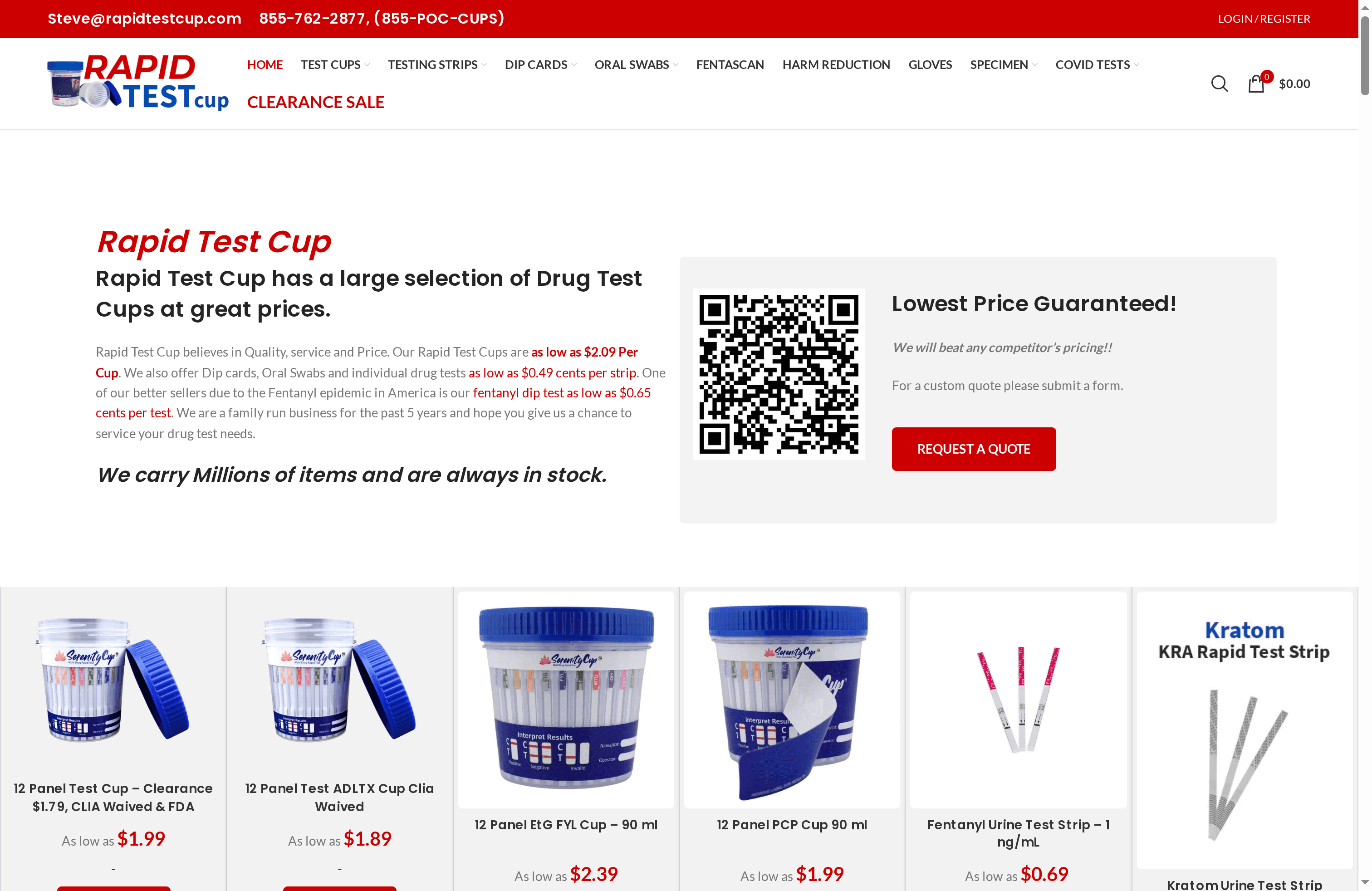
Whether you are setting up a new clinic testing program or restocking an existing one, Rapidtestcup offers sample kits for evaluation, custom bulk quotes for higher-volume programs, and product guidance on CLIA/FDA documentation. Browse the urine drug test kit comparison to match panel depth and adulterant coverage to your clinical use case, or request a quote directly for your monthly volume.
Useful sources for clinical drug testing programs
- Drug Testing — StatPearls, NCBI Bookshelf: Peer-reviewed clinical reference covering panel types, specimen matrices, MRO roles, and detection windows. The primary academic source for clinical drug testing protocols.
- Drug Testing — Merck Manual Professional Edition: Covers immunoassay limitations, false-positive risk from OTC medications, and the role of GC-MS/LC-MS/MS confirmatory testing.
- Drug Testing — MedlinePlus Medical Test: Patient-facing resource useful for patient education materials; addresses at-home testing and the need for laboratory confirmation after a positive screen.
- Best Practices for DOT Random Drug and Alcohol Testing — U.S. DOT: Federal best-practice guidance on random testing schedules, unpredictable timing, and program integrity; applicable to clinical random monitoring programs.
- Workplace Drug Testing Quick Guide — NSC: Frames testing within a recovery-supportive safety system; useful for policy development and supervisor training.
- Best Practice Standard VII — NTCRC: Detailed guidance on cutoff concentrations, assay selection, and cross-reactivity management for clinical and workplace programs.