Blog
Fentanyl Test Strips Accuracy: What U.S. Labs Need to Know


Fentanyl urine test strips are accurate enough for frontline clinical, workplace, and forensic screening, but not accurate enough to stand alone as a final answer. Studies put sensitivity and specificity for FDA-cleared devices anywhere from the mid-80s to near 100%, depending on the assay and the 1 ng/mL cutoff used. That range matters. Treat every screen as presumptive: a positive gets a reflex confirmation on LC-MS/MS before it drives a clinical, employment, or legal decision, and a negative in a suspected overdose still warrants clinical judgment.
- Positive screen → hold action, send for LC-MS/MS confirmation
- Negative screen in a high-suspicion overdose case → don’t rule out fentanyl on the strip alone
- Document the cutoff and lot number used for every run
A 2024 evaluation found sensitivity and specificity in the mid-80s range for one FDA-cleared rapid urine fentanyl device compared against mass spectrometry, a gap wide enough to justify mandatory confirmatory testing in any formal decision.
Key Takeaways
Fentanyl test strip accuracy depends on assay design and cutoff selection working together, and no screening result should drive a final decision without LC-MS/MS confirmation.
| Point | Details |
|---|---|
| Sensitivity and specificity vary by assay | Reported ranges span 84.3% to 100% sensitivity depending on the device and study population. |
| Cutoff choice changes outcomes sharply | Raising the threshold from 1.0 to 1.3 ng/mL cut false positives from 38% to 7.5% in one evaluation. |
| Confirm every positive | Route all presumptive positives to LC-MS/MS before clinical, forensic, or employment action. |
| Watch for known interferents | Trazodone, labetalol, and haloperidol have been linked to false-positive results. |
| Match the product to the use case | Rapidtestcup offers CLIA-waived strips at 1, 10, and 20 ng/mL cutoffs to fit ED, workplace, and routine screening needs. |
Table of Contents
- How Fentanyl Test Strip Accuracy Is Actually Measured
- What Recent Studies Show About Fentanyl Detection Test Accuracy
- Assay Types and Where Each One Fits
- Choosing the Right Cutoff for Your Population
- Building a Screening-to-Confirmation Workflow That Holds Up
- Verification and CLIA Requirements Before Clinical Use
- Why I Trust the Data Over the Marketing on This One
- CLIA-Waived Fentanyl Strips and Analyzers From Rapidtestcup
- Frequently Asked Questions
- Sources
How Fentanyl Test Strip Accuracy Is Actually Measured
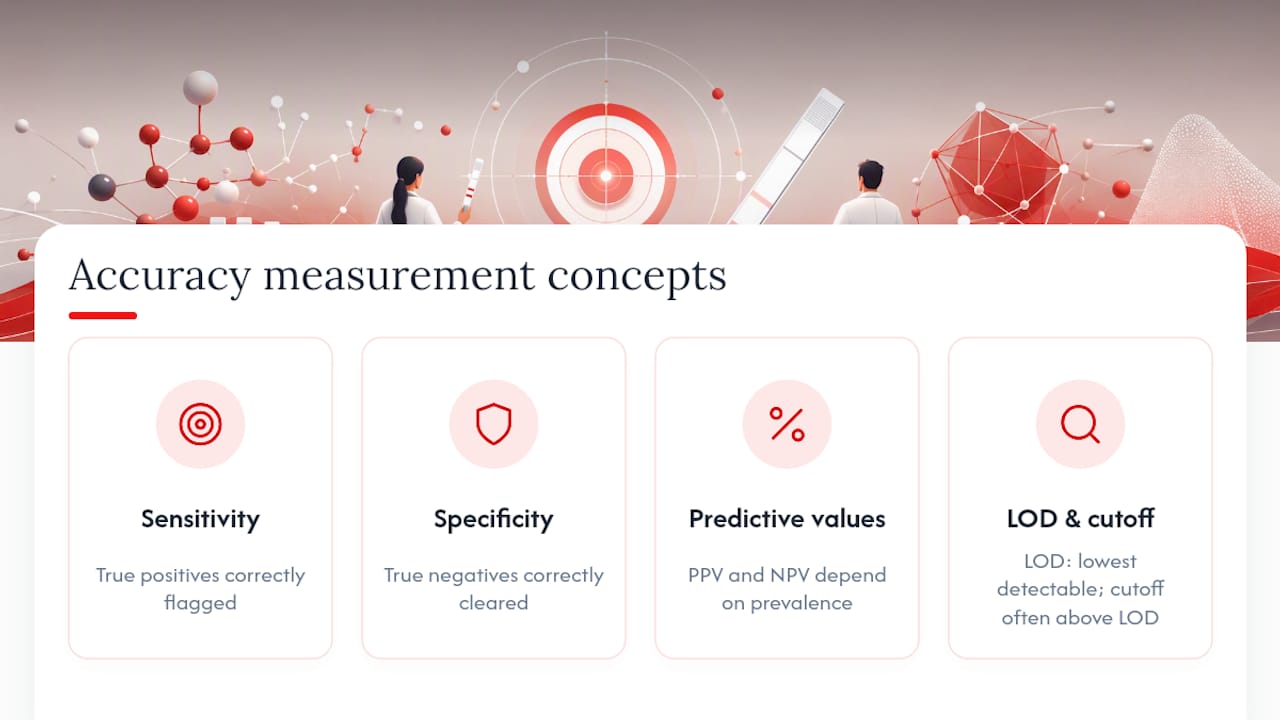
Sensitivity tells you how often a strip correctly flags a true positive; specificity tells you how often it correctly clears a true negative. Positive predictive value (PPV) is the percentage of positive results that are actually true, and negative predictive value (NPV) is the reverse. Limit of detection (LOD) is the lowest drug concentration an assay can reliably see; the cutoff is the concentration a lab picks as its clinical decision line, which is often set above the LOD on purpose.
Prevalence changes everything about PPV. In a population where 2% of specimens are truly fentanyl-positive, even a strip with 95% specificity generates a large share of false positives relative to true ones, because the pool of true negatives is so much bigger than the pool of true positives. A workplace program screening low-risk employees needs a different PPV expectation than an emergency department screening suspected overdose patients.
Pro Tip: Never take a vendor’s sensitivity claim at face value without checking the prevalence rate in the validation study. A strip validated in an ED population with high fentanyl prevalence will look better than it performs in a low-prevalence workplace population.
What Recent Studies Show About Fentanyl Detection Test Accuracy
The accuracy picture from 2024 through 2026 is consistent on one point: performance varies a lot by assay and by cutoff. The rapid urine device evaluated against mass spectrometry posted 84.3% sensitivity and 87.5% specificity, while a lateral flow assay built for emergency department use reported 100% sensitivity (95% CI 75.8 to 100%) and 99.5% specificity (95% CI 97.3 to 99.9%) across 218 ED samples targeting fentanyl at 1 ng/mL and norfentanyl at 10 ng/mL.
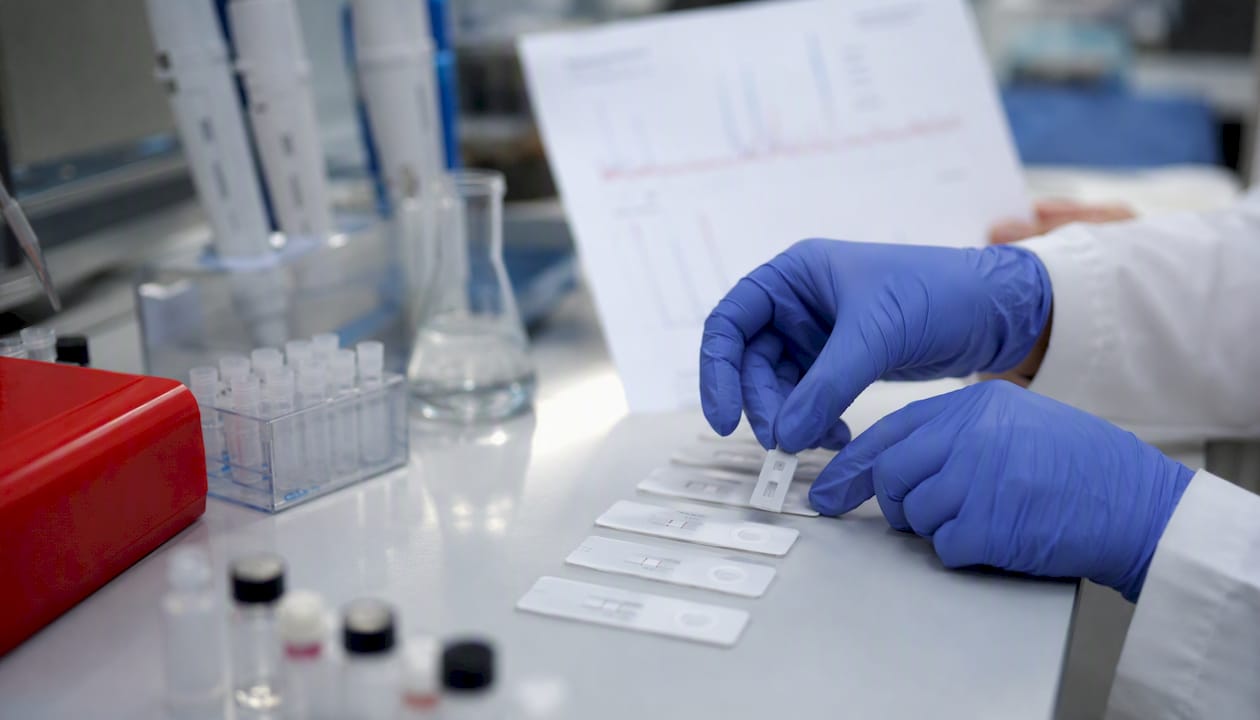
Cutoff choice moved the numbers just as much as assay design. One clinical evaluation of the SEFRIA fentanyl immunoassay found that raising the cutoff from 1.0 ng/mL to 1.3 ng/mL cut the false-positive rate from 38% to 7.5%. That is a massive swing from a small threshold change, and it tells you cutoff selection matters as much as assay chemistry. The tradeoff: a higher cutoff also risks missing lower-level exposures, so the studies behind these numbers matter, including sample sizes, population type, and whether confirmatory LC-MS/MS backed every reported result.
Assay Types and Where Each One Fits
Lateral flow strips are the fastest, cheapest option, with common cutoffs at 1 ng/mL, 10 ng/mL, and 20 ng/mL depending on the intended use. They’re built for point-of-care speed, not definitive confirmation.
- Lateral flow strips: rapid, low-cost, ideal for ED triage or bedside screening; results in minutes but presumptive only
- Automated immunoassays and chemiluminescence platforms: typical LODs around 1 to 2 ng/mL, integrate with lab analyzers, and improve turnaround time over manual strip reading for higher-volume labs
- Research-grade chemiluminescence assays: some newer designs report sub-picogram LODs in research settings, catching low-level positives that routine immunoassays miss
- LC-MS/MS: the gold standard, quantifying fentanyl to roughly 1 ng/mL or lower with definitive specificity, but slower and resource-intensive
Match the tool to the job: strips for ED triage and bedside decisions, automated immunoassays for clinic and workplace screening volume, and LC-MS/MS for any confirmatory or forensic chain-of-custody requirement.
Choosing the Right Cutoff for Your Population
The standard 1.0 ng/mL cutoff exists to catch as many true fentanyl exposures as possible, which is exactly what you want in an overdose or ED setting where missing a case has serious consequences. That sensitivity comes at a cost: in routine screening populations with lower fentanyl prevalence, 1.0 ng/mL generates a heavier false-positive burden.
The data backs raising the threshold for non-emergency use. Moving from 1.0 ng/mL to 1.3 ng/mL dropped false positives from 38% to 7.5% in one clinical evaluation, and a separate multicenter VA analysis found facilities using higher cutoffs reported far fewer false-positive confirmations than those still running 1.0 ng/mL.
- Keep 1.0 ng/mL for ED, overdose triage, and any setting where missing a true positive is the bigger risk
- Raise to 1.3 ng/mL or higher for routine workplace or program screening where false positives create unnecessary disruption.
- Never adjust a cutoff without documenting the rationale and validating it against your own population
Building a Screening-to-Confirmation Workflow That Holds Up
A defensible workflow follows the same shape whether you’re running a clinic, a treatment program, or a forensic lab.
- Receive and log the specimen with chain-of-custody documentation if forensic use is possible.
- Screen with a CLIA-waived or FDA-cleared strip or analyzer at your validated cutoff.
- Take any immediate clinical action required (monitoring, referral) based on the presumptive result.
- Apply reflex criteria: any positive screen, and any negative screen in a high-suspicion overdose case, moves to LC-MS/MS confirmation.
- Report the confirmed result and archive both the screening and confirmation data.
Quality steps that belong in every version of this workflow:
- Verify each new reagent lot before it goes into clinical use
- Run positive and negative controls on a set schedule, not just when something looks off
- Retain records long enough to satisfy CLIA inspection and, where relevant, forensic admissibility standards
For reporting language, FDA 510(k) documentation for cleared devices explicitly states these tests provide preliminary results only, and package inserts direct users to confirm positives with GC-MS or LC-MS/MS. Your report template should mirror that: “Preliminary positive, pending confirmatory testing” rather than a flat “positive” until LC-MS/MS results are in hand.
Verification and CLIA Requirements Before Clinical Use
No fentanyl strip belongs in clinical or forensic reporting until it clears internal verification. That means confirming precision, accuracy against LC-MS/MS, cutoff performance, and interference behavior with your own patient population, not just trusting the manufacturer’s package insert.
| Verification step | What it confirms |
|---|---|
| Precision testing | Consistent results across repeated runs of the same specimen |
| Method comparison vs. LC-MS/MS | Real-world accuracy against the confirmatory standard |
| Cutoff verification | The stated cutoff performs as expected in your population |
| Interference/specificity check | Known cross-reactants don’t distort results in practice |
| Lot-to-lot testing | Each new reagent lot performs consistently before use |
- Document control lot numbers, verification dates, and reviewer sign-off for every batch
- Confirm whether your test falls under CLIA-waived or moderate-complexity rules, since that changes personnel and QC requirements
- Keep the manufacturer’s intended use statement on file. It defines whether the device is cleared for screening only or supports broader clinical claims
Why I Trust the Data Over the Marketing on This One
Every fentanyl strip on the market gets sold on its sensitivity number, and almost none of the marketing mentions prevalence or cutoff tradeoffs. In practice, I treat every screening positive as a lead, not a verdict, and I’ve seen more programs get burned by skipping confirmation than by any assay’s raw performance gap. Train staff to read a strip result as “start here,” not “done here,” and escalate anything ambiguous to LC-MS/MS before it touches a clinical or personnel decision.
CLIA-Waived Fentanyl Strips and Analyzers From Rapidtestcup
Rapidtestcup carries the cutoff range this article just walked through, so you can match the product to the use case instead of settling for whatever cutoff a generic catalog happens to stock. For clinical and ED screening where sensitivity matters most, the 1 ng/mL CLIA-waived fentanyl strip fits the standard threshold discussed above.
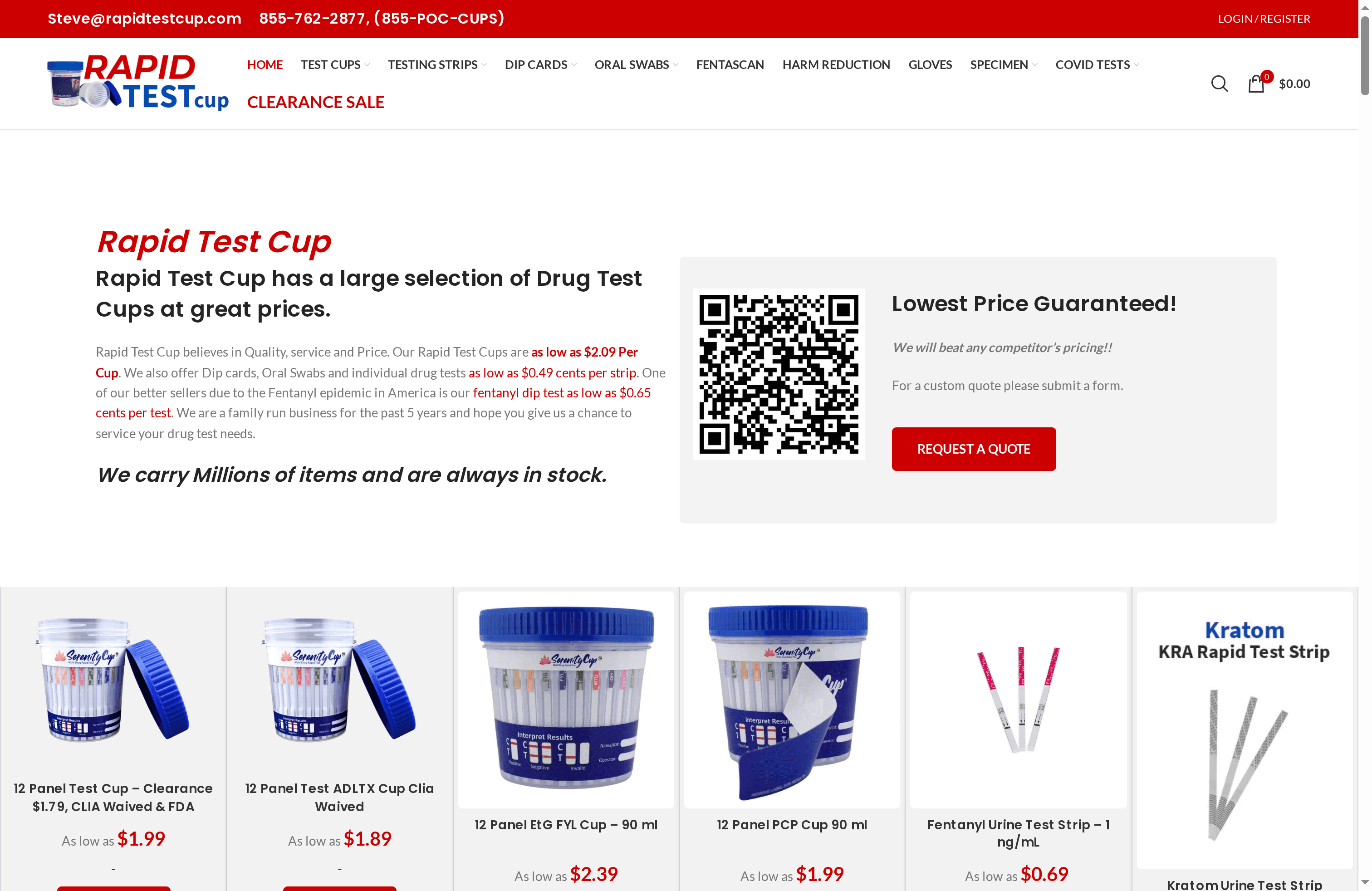
Programs managing a heavier false-positive burden at the standard cutoff can look at higher-threshold options, including the 10 ng/mL harm-reduction strip or the 20 ng/mL strip for routine workplace screening. Employers running multi-panel programs can also fold fentanyl detection into a broader panel with the 18-panel drug test cup, which covers fentanyl alongside other common panels and adulterant checks in one collection device.
Request datasheets, CLIA documentation, or a bulk quote before deployment, and always verify lot certificates and labeling against your own verification checklist. Start by reviewing the current lineup of urine drug test kits to find the cutoff and format that matches your screening population.
Frequently Asked Questions
Are fentanyl test strips accurate enough for clinical decisions on their own?
No. Even the best-performing strips in published studies require LC-MS/MS confirmation before any clinical, forensic, or employment decision.
How accurate are fentanyl strips compared to lab testing?
Sensitivity and specificity for FDA-cleared strips have ranged from the mid-80s to near 100% across recent evaluations, while LC-MS/MS remains the definitive confirmatory standard.
Do fentanyl test strips work for both fentanyl and its metabolite norfentanyl?
Reactivity varies by assay. Some lateral flow assays detect fentanyl at 1 ng/mL and norfentanyl at 10 ng/mL, but not every commercial strip covers both analytes equally.
What causes false positives on fentanyl detection tests?
Cross-reactivity with medications like trazodone, labetalol, and haloperidol accounts for a meaningful share of false positives, along with cutoff selection and population prevalence.
Should xylazine test strips accuracy be evaluated the same way as fentanyl strips?
Xylazine strips use the same core accuracy principles, sensitivity, specificity, and confirmatory testing, though they target a different drug class and require separate validation data.
This article is general information, not a substitute for advice from a qualified doctor. Consult a qualified healthcare professional about your own circumstances before acting on anything here.
Sources
False positives on fentanyl strips aren’t random noise. Clinical evaluations have repeatedly linked them to specific medications, including trazodone, labetalol, and haloperidol, which showed up in a meaningful share of false-positive results in real-world cohorts.
Norfentanyl, the primary fentanyl metabolite, adds another wrinkle. Assay reactivity to norfentanyl varies significantly, and a strip tuned mainly to parent fentanyl can miss cases where norfentanyl is the dominant analyte present in urine.
Mitigation steps worth building into your protocol:
- Evaluation of a Rapid Drug Test Device for Urine Fentanyl Compared to Mass Spectrometry and 2 Urine Fentanyl Assays
- Understand the FDA-cleared fentanyl testing: A clinical evaluation of the SEFRIA fentanyl immunoassay
- Novel high-sensitivity chemiluminescence immunoassay for fentanyl and analogs (published 2024)