

Blog
Collectors: Observed vs. Unobserved Collection, CCF Remarks & 90–100°F Rule


Unobserved collection is the default for almost every urine drug test, and observed collection is required only when a specific federal trigger applies, such as an MRO-reported invalid or adulterated result, an out-of-range specimen temperature, or a return-to-duty or follow-up test under DOT rules. Everything else follows from that one distinction, and getting it right starts with documenting the reason on the Federal Custody and Control Form every time.
TL;DR:
- Observed collection is only required when previous results are invalid, specimen temperature is out of range, or during return-to-duty and follow-up tests under federal rules.
- The process must follow strict steps: explaining observation, matching observer gender, maintaining visual contact, and thorough documentation to prevent invalidation or legal challenges.
- Secure restroom setup and specimen temperature checks within four minutes are crucial to avoid unnecessary escalation to observed collection.
- Refusing an ordered observed collection is treated as a test refusal, with potential legal and employment consequences.
- Only trained, gender-matched observers are permitted during direct observed collection, with all procedures documented carefully on the federal form.
Table of Contents
- What observed, monitored, and unobserved collection mean in practice
- When does federal guidance require a direct observed collection?
- Step-by-step observed collection procedure and documentation requirements
- Facilities, timing, and refusals: the operational side of observed collection
- Preventing unnecessary escalation to observed collection
- Balancing integrity, privacy, and operational reality
- Compliant supplies that make observed and routine collections easier to run
- FAQ
- Sources
What observed, monitored, and unobserved collection mean in practice
Most workplace and clinical drug tests use routine, unobserved collection: the donor enters a private stall alone, provides the specimen, and hands it to the collector. There is no one in the room, and the process typically takes only a few minutes once the donor is called.
Monitored collection sits in between. A monitor waits outside the stall, listening for signs of tampering, but does not watch the donor urinate. This method applies when a facility cannot guarantee that water sources are secured, such as a public restroom with multiple stalls.
Direct observed collection is the strictest option. The observer watches the urine leave the donor’s body and enter the container, and keeps the collection container in sight until it is handed to the collector. Mirrors and recording devices are never permitted during this process.
- Unobserved: donor alone, private stall, no monitoring
- Monitored: monitor outside the stall, listens for tampering, no visual contact
- Observed: trained observer maintains direct visual contact with urination
Oral fluid tests follow different privacy rules than urine tests, since saliva collection is inherently visible to the collector regardless of method.
When does federal guidance require a direct observed collection?
Observed collection is not a judgment call made on the spot. Federal rules spell out the exact conditions that trigger it, and collectors and employers are expected to apply them consistently rather than invent their own criteria.
The Urine Specimen Collection Handbook and 49 CFR Part 40 §40.67 identify the specific scenarios that require direct observation:
- An MRO or laboratory reports an invalid, substituted, or adulterated result on a previous specimen
- The donor’s first specimen falls outside the acceptable temperature range and a second, observed specimen is required
- The test is a return-to-duty or follow-up test under a DOT-regulated testing program
- A split-specimen issue requires a recollection under direct observation
Specimen temperature must read within the acceptable temperature range specified by federal guidelines within a few minutes of collection, according to HHS and DOT guidance on monitored and observed collection; a reading outside that window is one of the most common reasons a routine collection escalates to an observed one. The decision to direct an observed collection typically rests with the employer’s designated representative or the collector following established policy, and the donor must be told the reason before the process begins.
Step-by-step observed collection procedure and documentation requirements
A legally defensible observed collection follows a fixed sequence, and skipping a step is one of the fastest ways to invalidate a result or trigger a challenge later.
- Explain the reason for observation to the donor before starting, in plain language, per SAMHSA guidance.
- Have the donor wash and dry their hands, then empty their pockets and show they are empty.
- Secure or disable water sources in the stall where possible, consistent with site setup for direct observation.
- Select an observer whose gender matches the donor’s gender identity, with no exceptions.
- Have the observer accompany the donor into the collection area and maintain direct visual contact as urine passes from the donor’s body into the container.
- Keep the observer’s hands off the container unless that person is also serving as the collector.
- Maintain visual contact with the specimen until it is handed to the collector.
- Mark the collection as “Observed” on the Federal CCF, and record the observer’s name, gender, and the specific reason for observation on the Remarks line.
- Prepare a Memorandum for Record when the handbook calls for one, and route a second specimen to an HHS-certified lab if a recollection was required.
Pro Tip: Keep a laminated copy of the CCF Remarks-line wording requirements at the collection site so observers never have to guess what counts as a complete entry.
A detailed step-by-step collection workflow can help new collectors internalize this sequence before they handle a live observed collection.
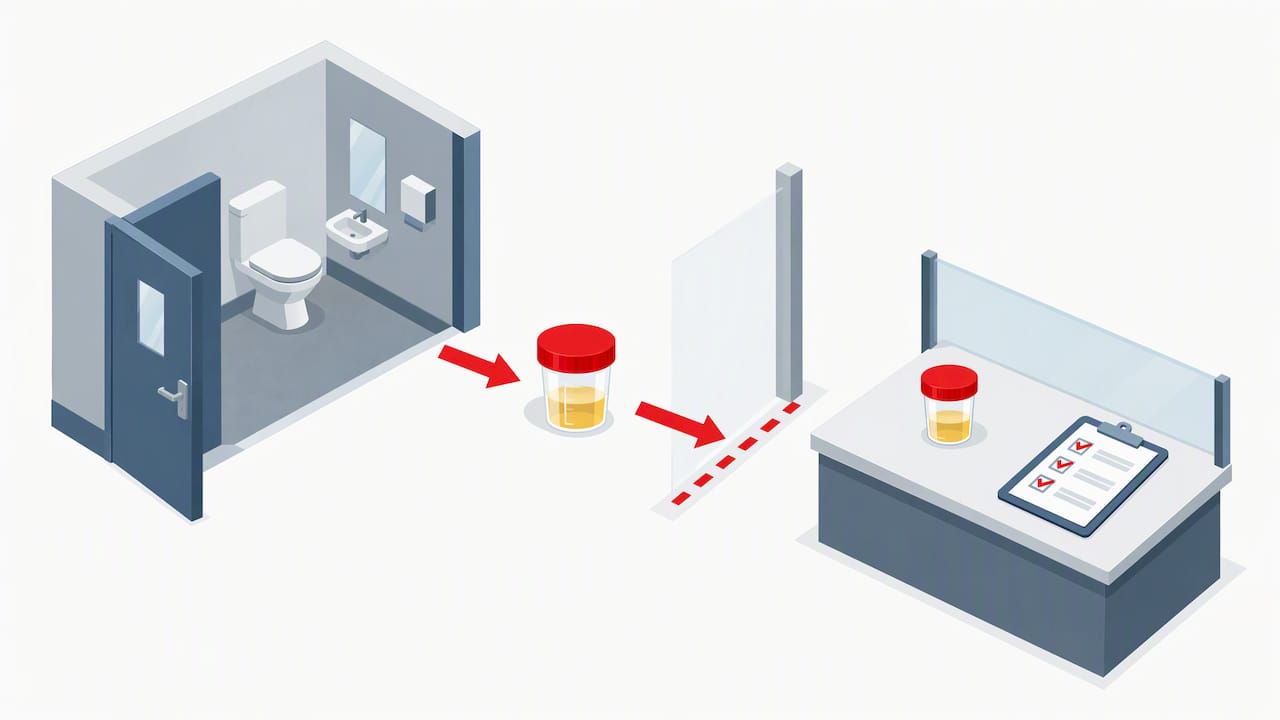
Facilities, timing, and refusals: the operational side of observed collection
Observed collections change what a site needs from its physical space and its staff, not just its paperwork.
- A single-stall, lockable restroom with secured water sources is the baseline for observed collection; a compliant bathroom setup avoids last-minute scrambling when a trigger occurs.
- Routine collections usually take a few minutes; observed collections run longer once donor explanation, observer coordination, and extra CCF documentation are factored in.
- A short, clear script explaining why observation is required reduces accidental refusals, since donors who understand the trigger are less likely to resist.
- Refusing to permit an observed collection when one is properly required is treated as a refusal to test, which carries the same consequences as a positive result and typically triggers MRO review and possible HR or legal action.
Preventing unnecessary escalation to observed collection
Most sites never need an observed collection if the routine process is run carefully from the start.
- Set up the restroom and secure water sources before the donor arrives, and use specimen cups with built-in temperature strips to catch problems immediately.
- Check specimen temperature within four minutes of collection and inspect color and clarity for anything unusual before sealing the container.
- Confirm specimen volume meets the minimum threshold, generally 45 milliliters, and follow split-specimen procedures exactly.
- Train collectors regularly on CCF documentation, since incomplete Remarks entries are a common cause of forced recollection.
Pro Tip: A quick visual and temperature check at the moment of handoff catches most problems before they ever require an observed recollection.
Sites that want a deeper breakdown of tampering indicators can review signs of drug test tampering and response protocols, and the adulteration prevention checklist covers site prep in more detail. When a result still looks questionable despite a clean collection, the MRO can evaluate medical explanations before anyone orders a recollection.
Balancing integrity, privacy, and operational reality
Observed collection exists to protect the integrity of a result, not to make the process harder than it needs to be. Sites that handle it best treat it as a procedure, not a punishment: they explain the reason clearly, document it completely, and move on.
What gets missed most often is not the rule itself but the paperwork around it. A perfectly justified observed collection can still get challenged if the Remarks line is incomplete or the observer’s gender match was never confirmed. Clear checklists and well-documented supplies solve more of this than extra training ever does.
— Justin
Compliant supplies that make observed and routine collections easier to run
We stock specimen cups, dip cards, and collection accessories that sites use to run both routine and observed collections without guesswork. Urine specimen cups come with built-in temperature strips to confirm the 90 to 100 degree range within the required window, and multi-panel cups provide a single, reliable first screen before anything escalates.
- Temperature-strip specimen cups and sterile, individually wrapped cups for routine and observed use
- Multi-panel cup options, including 12, 15, 16, and 18-panel configurations with adulterant checks
- Dip cards and test strips for sites that prefer point-of-care screening alongside cup-based collection
Browse our full specimen collection supplies to find the cups and accessories that match your site’s collection policy.
This article is general information, not a substitute for advice from a qualified doctor. Consult a qualified healthcare professional about your own circumstances before acting on anything here.
FAQ
What is the difference between observed and monitored collection?
Monitored collection has someone waiting outside the stall listening for tampering, with no visual contact during urination. Observed collection requires an observer to directly watch urine pass from the donor’s body into the container, as defined in SAMHSA’s guidance on federal testing procedures.
Is observed collection legal for workplace drug testing?
Direct observation is permitted and required under specific conditions in federally regulated testing programs, as set out in 49 CFR Part 40 §40.67. It is not a default procedure and must be tied to a documented trigger, such as a prior invalid result or a return-to-duty test.
Does the observer have to be the same gender as the donor?
Yes. SAMHSA guidance requires the observer’s gender to match the donor’s self-identified gender, with no exceptions, for any direct observed collection.
What happens if a specimen’s temperature is out of range?
An out-of-range temperature on a routine specimen generally requires a second specimen collected under direct observation, per HHS and DOT guidance. Both the original and the observed specimen are typically sent to an HHS-certified lab.
Can a donor refuse an observed collection?
Refusing a properly ordered observed collection is treated the same as refusing the test altogether. This typically leads to MRO review and can carry the same consequences as a confirmed positive result.