

Blog
Immunoassay Cross Reactivity: A Lab Workflow for Real Results


Immunoassay cross-reactivity happens when an antibody binds a compound that isn’t its intended target and generates a measurable signal anyway. The fix isn’t complicated: treat any unexpected positive as presumptive and send it for confirmatory testing by GC-MS or LC-MS/MS before it drives a clinical, employment, or legal decision.
Before you escalate, run three quick checks. Pull the patient’s medication list and look for known interferents. Check the assay’s package insert for a cross-reactivity table listing the compound or its metabolites. If a second immunoassay platform is available, repeat the test on it. Discordant results often resolve fast once you compare notes across formats.
Pro Tip: If the result doesn’t match the clinical picture, assume interference until mass spectrometry proves otherwise. Don’t chart a positive as a positive just because the screen lit up.
Key Takeaways
Cross-reactivity is a structural binding limitation of antibody-based detection, not a lab error, and every immunoassay positive requires confirmation by GC-MS or LC-MS/MS before acting on it clinically.
| Point | Details |
|---|---|
| Treat positives as presumptive | Confirm unexpected results with GC-MS or LC-MS/MS before any clinical or employment action. |
| Know your assay format | Competitive assays risk cross-reaction with metabolites; sandwich assays risk heterophile interference and hook effect. |
| Read the package insert critically | Check units, tested concentrations, and cutoffs, since online availability and drug coverage vary widely. |
| Watch for suppression too | Cross-reactants can push results down as easily as up, masking true positives. |
| Document every triage step | Record medication history, repeat testing, and confirmatory results for medicolegal clarity. |
Table of Contents
- Why Antibodies Bind Molecules They Shouldn’t
- Competitive Vs Sandwich Assays: Different Risk Profiles
- Common Cross-Reactants Labs Actually See
- Reading a Manufacturer’s Cross-Reactivity Table
- What Happens When Cross-Reactivity Goes Unchecked
- Detecting and Reducing Cross-Reactivity in the Lab
- A Stepwise Workflow When You Suspect Interference
- Why Package-Insert Literacy Matters More Than Chasing New Assays
- Sources
Why Antibodies Bind Molecules They Shouldn’t
Antibodies recognize three-dimensional shape, not molecular identity. An epitope that resembles the target closely enough in charge, size, and geometry can dock into the same binding pocket and trigger a signal, even when the parent structure is chemically distinct.
Three variables drive how much this matters in practice:
- Structural similarity between the cross-reactant and the target analyte, often driven by shared functional groups or a common metabolic backbone.
- Concentration of the interfering compound, since even weak affinity can produce a signal if enough of it is present.
- Binding kinetics, since a result read before the antibody-antigen reaction reaches equilibrium can amplify positive bias from cross-reactants, while other interactions suppress signal and cause false negatives instead.
That last point surprises people who assume cross-reactivity only inflates results. It doesn’t. A competing molecule can occupy binding sites without triggering the same downstream signal, pulling a true positive down below the cutoff.
Competitive Vs Sandwich Assays: Different Risk Profiles
Format determines vulnerability. Competitive immunoassays, the standard for small molecules like drugs of abuse, work by having the analyte compete with a labeled reagent for limited antibody sites. Anything structurally close to the target, including precursor drugs and shared metabolites, competes too, which is why competitive formats dominate the false-positive literature for urine drug screening.

Sandwich (two-site) immunoassays trade that risk for a different one. Higher specificity comes from requiring two antibodies to bind simultaneously, but that structure opens the door to heterophile antibodies and the hook effect, where extremely high analyte concentrations paradoxically produce a falsely low reading.
The same antibody pair can also behave differently depending on reagent concentration ratios or whether the assay runs in kinetic or equilibrium mode, shifting measured cross-reactivity by several-fold without changing the antibodies themselves.
Pro Tip: Estradiol immunoassays are a textbook case. Fulvestrant and exemestane, both used in breast cancer treatment, can distort estradiol readings depending on assay design. Pegvisomant causes a comparable problem in growth hormone assays. If a patient is on either drug class, flag the chart before the result even comes back.
Common Cross-Reactants Labs Actually See
Certain interferences show up often enough that experienced techs recognize the pattern on sight. Bupropion and its metabolites are notorious for triggering false-positive amphetamine screens. Labetalol metabolites can mimic amphetamines too. Certain quinolone antibiotics have long been reported to cross-react with opiate immunoassays.
On the endogenous side:
- Heterophile antibodies in the patient’s own serum can bridge assay antibodies and generate a false signal unrelated to the drug being tested.
- Anti-streptavidin antibodies and biotin supplementation interfere with assay chemistries that rely on biotin-streptavidin binding.
- Novel psychoactive substances and designer analogs are the biggest blind spot. Package inserts are validated against known compounds at the time of manufacture, so a new synthetic cannabinoid or opioid analog simply won’t appear on the list.
If a result doesn’t track with the patient’s known medications or history, suspect a specimen-dependent interference rather than a listed cross-reactant. Those cases are exactly why confirmatory chemistry exists.
Reading a Manufacturer’s Cross-Reactivity Table
Package inserts report cross-reactivity two ways: as an equivalent concentration (the concentration of the interfering compound, in ng/mL or µg/mL, that produces a signal equal to the assay cutoff) or as a percent cross-reactivity relative to the calibrator compound.
That’s a rough estimate, not a substitute for the manufacturer’s specific data.
Interpretation gets harder because of real gaps in this data. Package inserts test a limited set of compounds at a single concentration, they rarely include newer designer drugs, and approximately half are directly accessible online without contacting the manufacturer directly.
Before trusting a result, find the specific insert for the lot or platform in use, confirm the reporting units and cutoff, estimate whether the patient’s likely drug concentration falls in the interference range, and flag the case if the compound in question isn’t listed at all.
What Happens When Cross-Reactivity Goes Unchecked
A false positive isn’t an abstract lab problem. It can cost someone a job, disqualify a patient from a treatment program, or trigger unnecessary clinical intervention. A false negative is arguably worse in a clinical setting, since it can mean a missed diagnosis or a patient continuing undetected drug use during treatment.
The accepted standard across the field is straightforward: every immunoassay positive is presumptive until confirmed by GC-MS or LC-MS/MS. Confirmatory testing can take several days, particularly if the sample has to be sent to a reference lab, which means labs need a plan for interim decisions rather than treating the screen as final.
Cross-reactivity doesn’t only push results up. Suppression from a competing cross-reactant can mask a true positive, so a negative screen in a patient with strong clinical suspicion deserves the same scrutiny as an unexpected positive.
When a result conflicts with the clinical picture, the lab should call the ordering clinician directly rather than letting the report speak for itself. A short conversation about medication history often resolves the question faster than waiting on confirmatory turnaround.
Detecting and Reducing Cross-Reactivity in the Lab
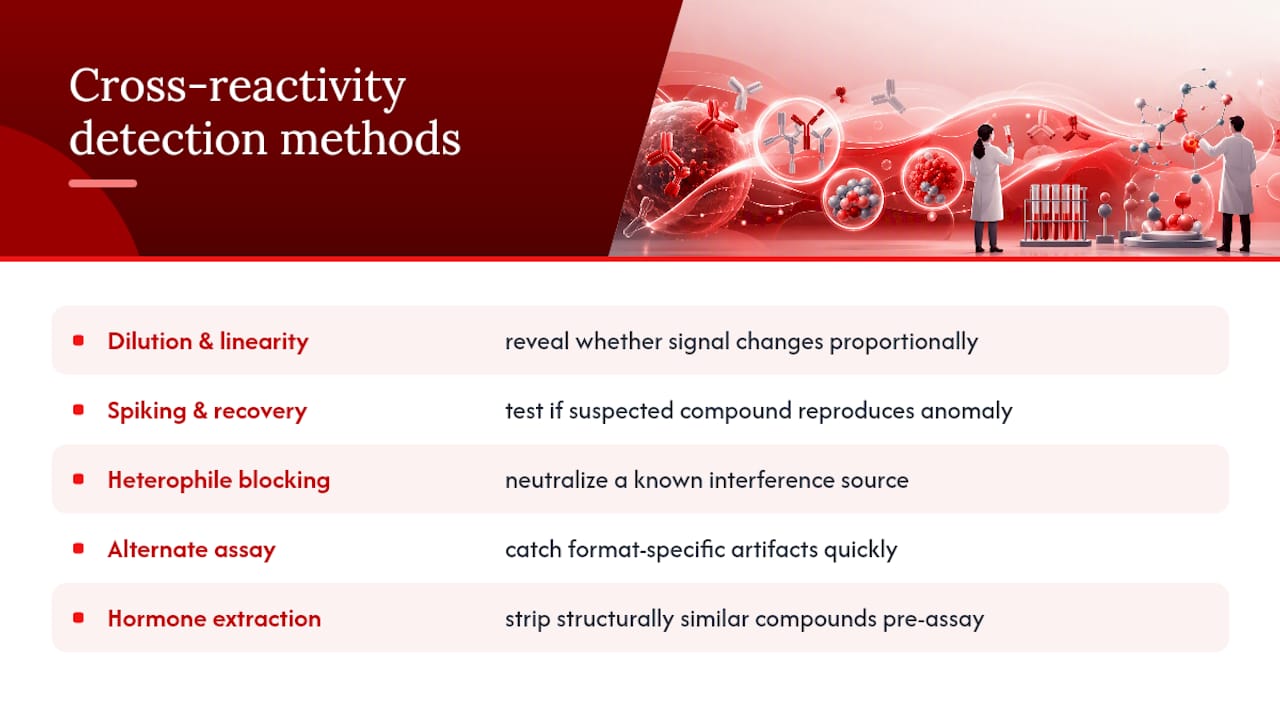
A handful of bench techniques catch interference before it reaches a chart. Dilution and linearity checks reveal whether a signal changes proportionally, which a true analyte concentration should but an interferent sometimes won’t. Spiking and recovery experiments test whether a suspected compound reproduces the anomaly in a controlled sample. Heterophile-blocking tubes neutralize a specific and well-documented interference source. Running the specimen on an alternate assay or platform, when available, is often the fastest way to catch a format-specific artifact.
For steroid and hormone assays specifically, an extraction step ahead of the immunoassay run can strip out structurally similar compounds before they ever reach the antibody.
Pro Tip: Reagent concentration ratios are a lever manufacturers and labs both use during method development. Shifting an assay from kinetic to equilibrium read timing can reduce cross-reactivity meaningfully without changing the antibody pair at all. It’s worth knowing this exists even if your lab doesn’t control assay chemistry directly.
Build these checks into your SOPs as a documented interference panel, not an ad hoc response, and loop in a reference lab when in-house tools can’t settle the question.
A Stepwise Workflow When You Suspect Interference
- Review the patient’s clinical history and current medication list for known interferents.
- Pull the assay’s package insert and check the cross-reactivity table, units, and cutoff.
- Repeat the test on a different immunoassay format or platform if one is available.
- Run a dilution/linearity check or a heterophile-blocking step to test for artifact.
- Send the specimen for confirmatory GC-MS or LC-MS/MS testing.
- Document every step and communicate results using presumptive language (“presumptive positive, pending confirmation”) until MS data return.
Record the medication list, specimen ID, and each action taken in the case file. That documentation matters as much for medicolegal defensibility as for clinical decision-making.
Reliable specimen collection is part of that chain of custody. Rapidtestcup’s multi-panel test cups are built for exactly this kind of documented, repeatable screening workflow, with CLIA waived and FDA-cleared options for labs that need to standardize collection before a specimen ever reaches the bench. For programs running high volumes of initial screens, the 12-panel ADLTX cup covers a broad drug panel while keeping the presumptive-to-confirmatory workflow intact.
Why Package-Insert Literacy Matters More Than Chasing New Assays
Most guidance on cross-reactivity focuses on which drugs cause which false positives, and that’s useful, but it treats the symptom rather than the skill. The real gap in most labs isn’t awareness that bupropion mimics amphetamines. It’s that nobody on staff regularly reads a package insert closely enough to know what units it uses or which concentrations it tested.
That skill degrades fast when labs assume a newer assay platform solves the problem. It doesn’t. Reagent ratios and assay mode can shift cross-reactivity for the same antibody pair by several-fold, meaning the platform your lab switched to last year might behave nothing like the validation data suggests today.
If there’s one thing worth prioritizing, it’s building the habit of pulling the insert before trusting the table you remember from training. Designer drugs and novel psychoactive substances will keep outpacing manufacturer validation data, and no assay format is immune to that lag. The labs that catch interference early aren’t the ones with the newest instruments. They’re the ones that treat the package insert as a living document and confirm anything that doesn’t add up.
Sources
Start with peer-reviewed sources like the PMC review on immunoassay interference and the analytical interference review. For assay-specific data, manufacturer package inserts remain the frontline resource. Siemens Healthineers, for example, publishes technical notes and package inserts with documented cross-reactant lists for its immunoassay platforms. Archive the exact insert version used for each assay, since these documents get revised.
- Discovering Cross-Reactivity in Urine Drug Screening Immunoassays through Large-Scale Analysis of Electronic Health Records – PMC
- A Difficult Challenge for the Clinical Laboratory: Accessing and Interpreting Manufacturer Cross-Reactivity Data for Immunoassays Used in Urine Drug Testing
- Changing Cross-Reactivity for Different Immunoassays Using the Same Antibodies: Theoretical Description and Experimental Confirmation
- False positives in urine drug immunoassays: review and examples (eScholarship)