Blog
Urine Drug Test Cost: What You’ll Actually Pay in 2026


Urine drug tests in the U.S. typically run $5 to $40 for instant kits, $50 to $150 for clinic or urgent care screens, and lab-based panels often land between $50 and $200 before confirmatory testing gets added. Confirmatory lab work, billed per drug class, can push a total bill well past the initial quote.
If you’re an individual who just needs a quick answer for a job application or personal peace of mind, an instant kit or a single clinic visit usually covers it. If you’re an employer building a testing program, the math changes fast: volume pricing and a mix of onsite screening with selective lab confirmation almost always beats paying full clinic rates per employee.
Two numbers anchor this whole conversation. Medicare’s Clinical Laboratory Fee Schedule sets a national baseline rate for the presumptive urine screen (CPT 80307) that shapes what labs charge everyone else, and SAMHSA’s workplace testing resources lay out the program standards most employers build their policies around.
- Instant kits (retail): $5 to $40 per test
- Clinic or urgent care screen: $50 to $150 per visit
- Lab-based panel (5 to 15+ panel): $50 to $200+, before confirmation
- Confirmatory testing (GC-MS/LC-MS): often $20 to $100+ per drug class, added on top
Key Takeaways
Urine drug test costs range from a few dollars for an instant kit to well over $150 once clinic fees and confirmatory testing enter the picture, and knowing which billing components apply to your situation is the difference between an accurate budget and a surprise invoice.
| Point | Details |
|---|---|
| Instant kits are cheapest | Retail cups and dip cards run $5 to $40 and suit personal or preliminary screening needs. |
| Confirmatory testing drives cost spikes | GC-MS/LC-MS confirmation is billed per drug class and can multiply the original screen price. |
| Employers save through volume | Contracted programs and mixed onsite/lab strategies lower per-test costs versus one-off clinic visits. |
| Medicare covers medically necessary screens | CPT 80307 is covered under CLFS when ordered for treatment, not for pre-employment testing. |
| Rapidtestcup offers itemized, bulk-ready options | CLIA-waived, FDA-approved panels with bulk pricing help buyers avoid clinic markup on comparable tests. |
Table of Contents
- How Much Does a Urine Drug Test Cost by Test Type?
- What Hidden Fees Can Inflate a Drug Test Quote?
- How Much Do Employers Pay for Drug Testing Programs?
- Does Insurance or Medicare Cover Urine Drug Testing?
- What Should You Check Before Buying a Drug Test?
- Why the Real Cost Story Isn’t the Kit Price
- Get Testing Supplies Without the Clinic Markup
- Sources
How Much Does a Urine Drug Test Cost by Test Type?
The price you pay depends almost entirely on which of four testing paths you choose, and each one solves a different problem.
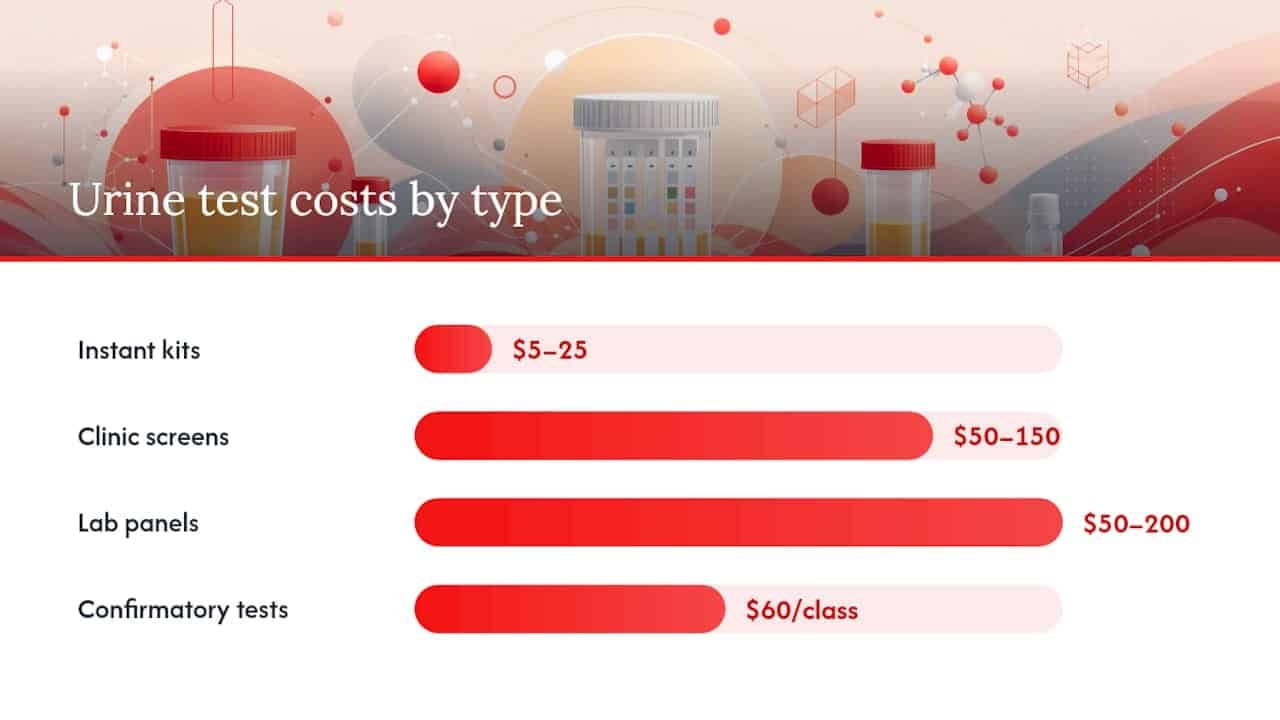
Instant cups and dip cards are the cheapest and fastest option. A single-use multi-panel cup runs anywhere from $5 to $25 retail, and dip cards tend to sit at the low end of that range. These are immunoassay screens, meaning they detect the likely presence of a drug class within minutes, not a legally defensible confirmed result. For personal use, parental monitoring, or a quick pre-interview check, this is usually all you need.
Clinic and urgent care screens cost more because you’re paying for a visit, not just a cup. Expect $50 to $150 for a presumptive urine screen performed on-site, sometimes with a same-day result and sometimes sent to a partner lab. This price reflects staff time, collection oversight, and the clinic’s overhead layered on top of the actual test.
Lab-based panels scale with how many drugs they screen for. A basic 5-panel test (opiates, cocaine, PCP, amphetamines, THC) sits toward the low end of the $50 to $200 lab range. Move up to a 10, 12, or 15-panel test that adds benzodiazepines, methadone, fentanyl, or synthetic opioids, and the price climbs, both because the lab reagents cost more and because broader panels are more likely to trigger a follow-up confirmation. Rapidtestcup’s comparison of urine drug test panels breaks down exactly which drug classes each panel size covers, which is worth checking before you assume a bigger panel is automatically better value.
Confirmatory testing is where costs get unpredictable. When an immunoassay screen returns a positive (or an unexpected result), labs often run gas chromatography-mass spectrometry (GC-MS) or liquid chromatography-mass spectrometry (LC-MS) to confirm it. CareRoute’s breakdown of CPT 80307 billing shows that confirmatory codes (80320 through 80377) are billed per drug class detected, not as one flat fee. A screen that flags three substances can mean three separate confirmatory charges.
Here’s how that plays out in practice: someone buys a $15 instant 12-panel cup at home, gets a presumptive positive for opiates, and decides to get it verified through a clinic. The clinic screen itself runs $75. The lab then confirms the result with GC-MS at $60 per drug class. Total cost: roughly $150, ten times the price of the original kit. That gap is the single biggest source of sticker shock in urine drug testing.
Pro Tip: If you only need a preliminary answer for personal reasons, an instant kit alone is usually sufficient. Save the clinic and lab route for situations where a legally defensible or employment-related result is required.
What Hidden Fees Can Inflate a Drug Test Quote?
A quoted price of $75 rarely stays $75. Several add-on charges show up after the fact, and knowing them ahead of time keeps you from getting blindsided.
- Observed or chain-of-custody collection. When a test requires documented proof of who collected the sample and when, that oversight costs extra. Chain-of-custody procedures exist specifically to keep a sample legally defensible from collection to lab result, which matters for legal, forensic, or DOT-regulated testing.
- Confirmatory testing per drug class. As covered above, this isn’t a flat add-on. Cleveland Clinic’s overview of screening versus confirmatory testing explains why confirmation is medically indicated after certain positives, and each confirmed class adds its own line item.
- Turnaround and shipping fees. Rush results, courier pickup, or mail-in lab kits often carry separate charges that don’t appear in the headline price.
- Administrative and documentation fees. Medical review officer (MRO) sign-off, paperwork for employer records, or legal documentation for court-related testing can each add a separate charge.
Billing codes are the quiet culprit behind a lot of price confusion. A presumptive screen billed under CPT 80307 has a set Medicare rate, but a provider’s cash-pay price for that same code can run several times higher depending on the clinic’s overhead and whether it’s billed through insurance or paid directly. That’s also why immunoassay screens sometimes flag false positives from common medications, prompting a confirmatory test you didn’t budget for. The UIC Pharmacy clinical guide on interfering substances lists several over-the-counter drugs that can trigger this.
How Much Do Employers Pay for Drug Testing Programs?
Employers rarely pay clinic retail rates once they set up a real program. A single walk-in clinic screen might cost $75 to $150 per employee, but employers who contract with a testing vendor or lab network typically negotiate per-test rates well below that, especially at volume.
Here’s a simple model. Say a small business tests 10 employees a month using onsite instant cups for initial screening at roughly $8 each, then sends the rare positive out for lab confirmation at $60 to $100 per drug class. If two tests come back positive in a given month, the total monthly cost lands around $200 to $280, a fraction of what 10 full clinic visits would run.
- One-off clinic screen (no contract): $50 to $150 per test
- Contracted employer program: often significantly lower per test at volume, especially with onsite screening
- DOT-regulated 5-panel testing: follows DOT Part 40 requirements, which mandate confirmatory testing on any non-negative result, so budget for that add-on as a certainty, not an exception
The strongest negotiation lever employers have is bundling. Ask any vendor for a capped confirmatory rate instead of open-ended per-class billing, and request a flat program fee that covers documentation and MRO review rather than paying for each separately. Employers who invest in structured testing programs also tend to see downstream savings; NORC’s analysis of employer testing programs found meaningful savings tied to reduced turnover and incident costs, which is worth factoring into the budget conversation beyond just the per-test price.
Does Insurance or Medicare Cover Urine Drug Testing?
Coverage depends almost entirely on why the test is being ordered. Medicare covers presumptive urine drug screens (CPT 80307) when a physician orders them for a documented medical reason, such as monitoring a patient on chronic opioid therapy. In that scenario, the Medicare CLFS national rate applies and beneficiaries typically owe little to nothing out of pocket for the covered test.
That coverage doesn’t extend to most of the reasons people actually search for pricing information, though.
- Pre-employment and employer-ordered tests are almost never billed to personal health insurance. Employers pay directly, or the applicant pays out of pocket.
- Court-ordered or legal testing is typically a private-pay or third-party-billed cost, not an insurance claim.
- Medicaid and private insurance sometimes cover medically necessary testing, but rules vary by state and plan.
Before assuming any test is covered, ask the provider directly whether it will be billed to insurance or charged as cash-pay. That one question prevents most billing surprises.
What Should You Check Before Buying a Drug Test?
Comparing a $12 online kit to a $90 clinic quote only makes sense if you’re comparing apples to apples. Before you commit to either, run through this checklist:
- What drug classes does the panel actually cover, and does it match what you need (see Rapidtestcup’s panel selection guide)?
- Is confirmatory testing included, optional, or billed separately per drug class?
- Does the price include chain-of-custody documentation, or is that an add-on?
- Are there itemized fees for shipping, rush turnaround, or administrative review?
- Does the vendor offer bulk or wholesale pricing if you need more than one test?
Rapidtestcup sells CLIA-waived and FDA-approved multi-panel test cups, dip cards, and urine strips built for exactly these comparisons, along with adulterant detection kits and specimen collection supplies for buyers who need forensic-grade documentation. Bulk pricing and custom quotes are available for labs, clinics, and employers ordering at volume, which is often the deciding factor once you’ve run the math on a program instead of a single test. For a side-by-side on when instant testing is appropriate versus when lab confirmation is worth the extra cost, Rapidtestcup’s guide comparing instant and lab drug tests walks through the tradeoffs in more depth.
Pro Tip: Get every quote itemized in writing before you agree to it. A vendor that hesitates to break down confirmatory and administrative fees separately is usually the one whose final bill won’t match the number they quoted you.
Why the Real Cost Story Isn’t the Kit Price
Most advice on this topic treats the sticker price as the whole answer, and that’s where it falls short. The kit or screen price is rarely what determines your final bill. Confirmatory testing, billed per drug class rather than as a flat add-on, is the actual variable that turns a $15 test into a $150 one. Employers who budget only for the upfront screening cost and skip planning for confirmation rates almost always end up surprised by their first quarter of invoices.

The conventional wisdom to “just compare prices” misses the structural issue: two vendors quoting the same $75 screen can produce wildly different final bills depending on how they bill confirmatory work and documentation. That’s not a pricing quirk, it’s a billing-code reality tied to how CPT 80307 and its confirmatory counterparts actually work.
If there’s one thing worth prioritizing, it’s asking for the confirmatory rate structure before asking for the screening price. A vendor who can’t answer that clearly hasn’t earned your business yet, regardless of how competitive their base quote looks.
— Justin
Get Testing Supplies Without the Clinic Markup
Rapidtestcup gives individuals and employers a direct way to control drug testing costs instead of absorbing clinic markups and unpredictable confirmatory fees. The catalog covers CLIA-waived, FDA-approved multi-panel cups, dip cards, and specialty strips, including fentanyl and adulterant detection, so you’re buying exactly the panel you need rather than paying for a bundled clinic visit.
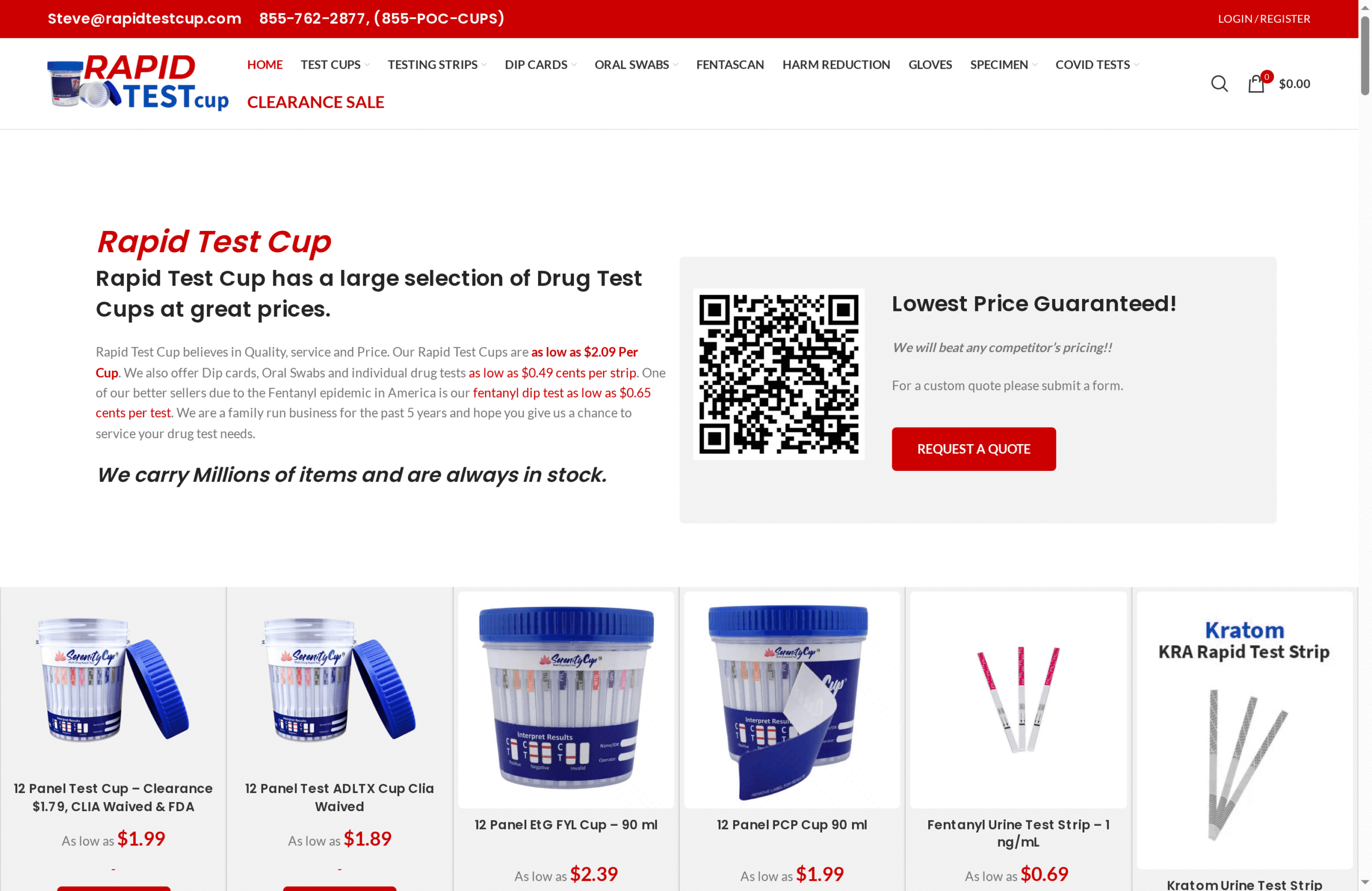
If you need broader coverage, the 18 panel drug test cup with adulterant detection is built for employers and clinics that want fentanyl, ketamine, and alcohol screening in a single cup. Individuals or smaller offices can start with the 12 panel drug test cup clearance pricing for a lower per-test cost without sacrificing panel coverage. Employers ordering in volume can request a custom bulk quote directly through Rapidtestcup to lock in per-test pricing before committing to a full program.
Sources
- SAMHSA workplace drug-testing resources
- DOT Part 40 — Procedures for transportation workplace drug and alcohol testing programs
- Cleveland Clinic — Drug testing