
Blog
5 ng/mL Tests Detect Cocaine in Urine 17–22 Days After Use


Most urine tests detect benzoylecgonine, cocaine’s primary metabolite, for about 2 to 3 days after occasional use, and up to 2 weeks in heavy or chronic users. The exact cocaine urine detection time window depends heavily on the lab’s cutoff level and confirmation method. High-sensitivity assays measuring down to 5 ng/mL can push that window past two weeks, up to around three weeks, because they catch trace amounts standard tests miss entirely.
TL;DR:
- Tests using high-sensitivity methods can detect benzoylecgonine for up to three weeks in heavy cocaine users, especially when cutoffs are set around 5 ng/mL.
- The typical detection window for occasional users ranges from 2 to 4 days, but it may extend beyond a week in frequent users, depending on the assay cutoff levels.
- Confirmatory testing with GC-MS or LC-MS/MS is essential for accurate interpretation, especially when results are borderline or don’t match the expected use timeline.
- Variability in detection times between individuals depends on dosage, route of administration, metabolic health, hydration, and the assay’s sensitivity.
- A positive test weeks after last use may reflect a low-level tail end of elimination rather than new use, emphasizing the importance of understanding assay cutoff thresholds.
Table of Contents
- How Long Cocaine Stays Detectable in Urine
- What Urine Tests Actually Measure, and Why Cutoffs Matter
- What Changes Detection Time From Person to Person?
- Why Rapid Screens Need Lab Confirmation
- Occasional, Recreational, and Chronic Use: Three Real-World Pictures
- A Practical Read on Fluctuating and Late-Positive Results
- Choosing the Right Screening Tools for Your Situation
- Sources
- FAQ
How Long Cocaine Stays Detectable in Urine
Cocaine itself disappears from urine fast, often within a matter of hours, because the liver breaks it down quickly. Benzoylecgonine is what sticks around, and it’s the metabolite nearly every urine drug test cup or dip card is actually designed to catch. That distinction matters because someone asking “how long cocaine stays in urine” is really asking about this one compound’s clearance curve, not the drug itself.
The ranges break down roughly like this:
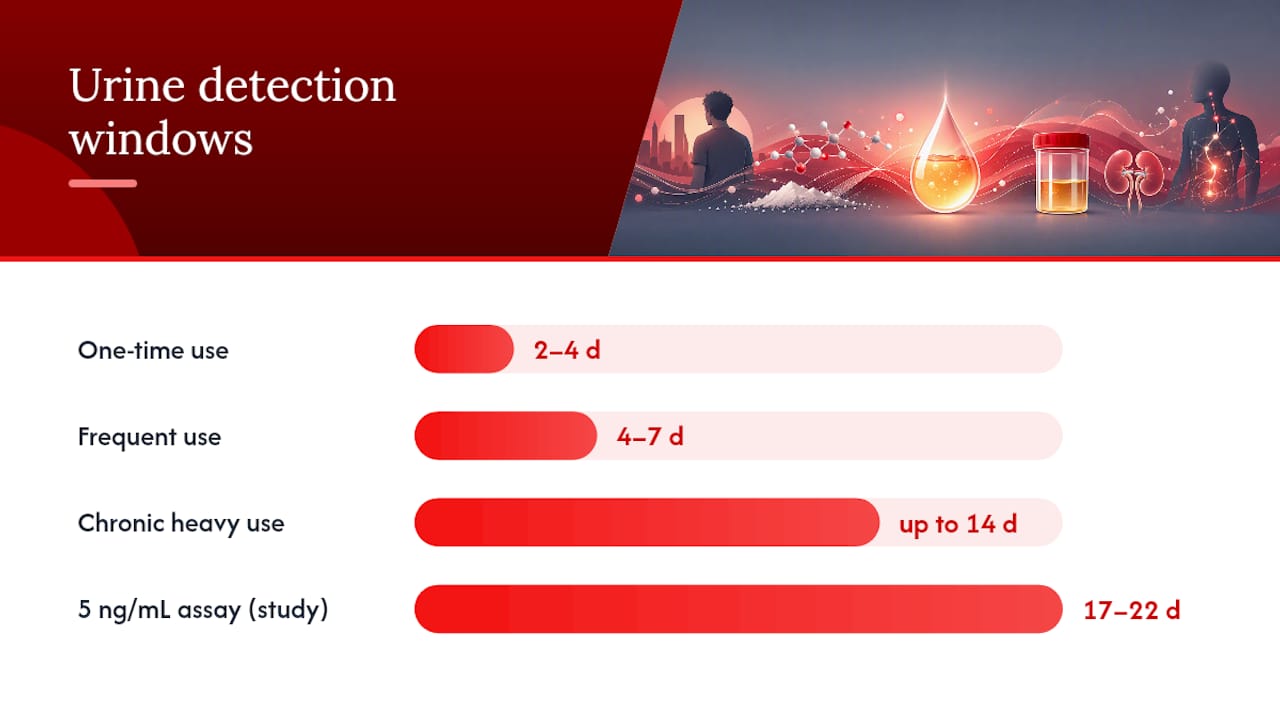
- One-time or occasional use: benzoylecgonine typically clears within 2 to 4 days.
- Frequent recreational use: metabolites can linger beyond 4 days, sometimes a full week, as the body works through a backlog of accumulated compound.
- Chronic, heavy use: urine screens can stay positive for up to two weeks, and monitoring data on chronic users shows the average time to a final negative result often runs well past the 48 hours many people assume is standard.
Standard confirmatory cutoffs sit around 100 ng/mL, but research-grade LC-MS/MS assays can detect benzoylecgonine down to 5 ng/mL. A validation study using that 5 ng/mL threshold found detectable benzoylecgonine in some subjects for 17 to 22 days after their last use. That’s not a typo or an outlier lab error. It’s what happens when you build a test sensitive enough to catch the tail end of the body’s slow elimination phase, the long, low-concentration decline that follows the initial rapid drop.
The takeaway: a low-level positive weeks after someone believes they stopped using isn’t necessarily wrong. It may just mean the lab used a far more sensitive cutoff than the person expected.
What Urine Tests Actually Measure, and Why Cutoffs Matter
Cocaine urine test accuracy comes down almost entirely to two things: which compound the test targets, and what concentration counts as positive. Labs and screening cups measure benzoylecgonine rather than cocaine itself for a simple reason: cocaine’s half-life in blood is around an hour, while benzoylecgonine sticks around in urine for days, making it a far more reliable marker of recent use. NIDA’s overview of cocaine pharmacology explains why testing programs standardized on this metabolite across urine, blood, and other matrices.
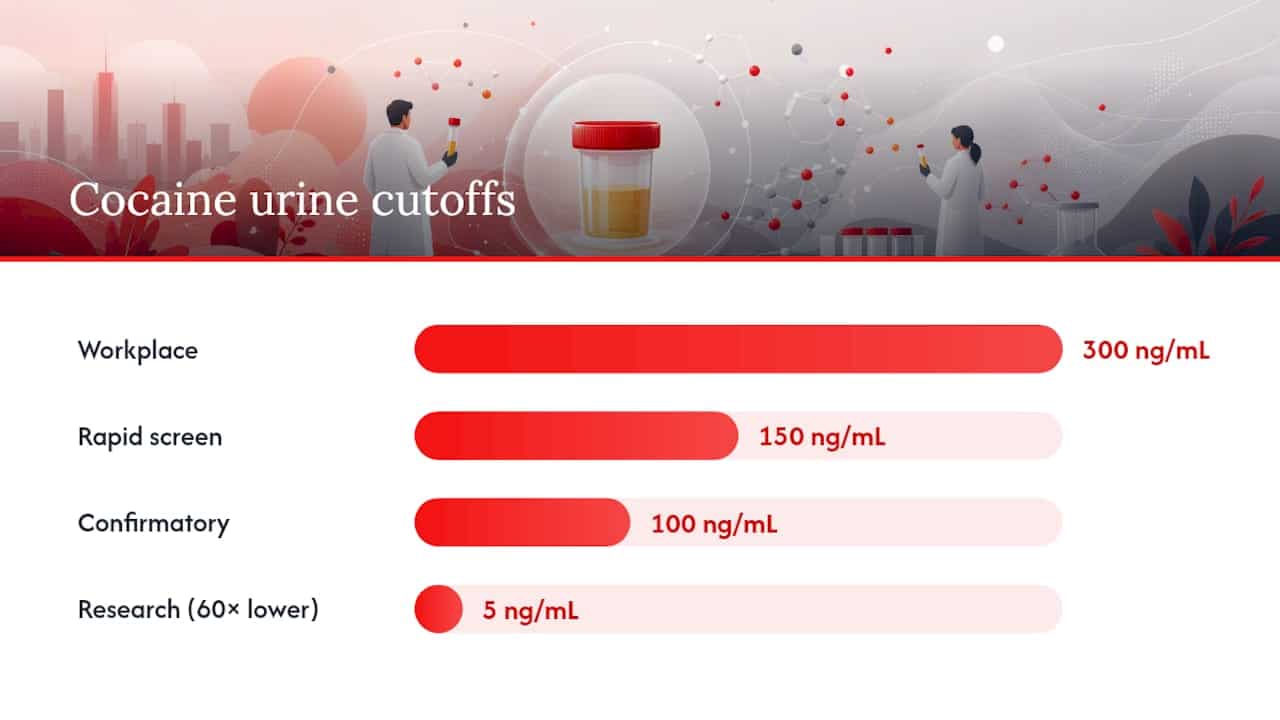
Cutoffs vary by setting and purpose:
- 150 ng/mL is a common immunoassay screening cutoff used by many rapid test cups and dip cards.
- 100 ng/mL is the typical confirmatory cutoff for GC-MS or LC-MS/MS analysis.
- 300 ng/mL shows up in some workplace or monitoring programs that want a higher bar before flagging a result.
- 5 ng/mL appears in research and specialized clinical settings using high-sensitivity LC-MS/MS.
The workflow itself is standard across the industry: a rapid immunoassay screen flags a presumptive positive, and if it comes back positive, the sample goes for GC-MS or LC-MS/MS confirmation to pin down the exact concentration. Dropping the cutoff to 5 ng/mL catches more true positives, but it also catches a lot of low-level results that reflect use from a week or two prior, not last night.
Pro Tip: If a screening result comes back positive but the timeline doesn’t match what you’d expect, ask specifically what cutoff the lab used. A positive at 300 ng/mL means something very different from a positive at 5 ng/mL.
What Changes Detection Time From Person to Person?
Two people who used the same amount of cocaine on the same night can get different results a few days later. Several variables drive that gap:
- Dose and frequency. Repeated high doses saturate the body’s elimination pathways, extending the slow clearance phase that keeps low levels of benzoylecgonine circulating.
- Route of administration and purity. Smoking or injecting tends to produce faster, higher peak concentrations than snorting, and purer product means more metabolite for the body to clear.
- Metabolism, liver function, and age. Slower metabolic rates, reduced liver function, or older age can all stretch out clearance time.
- Hydration and urine concentration. Heavily diluted urine can temporarily mask a positive, which is why creatinine normalization adjusts results for how concentrated or diluted a sample is.
- Assay sensitivity. A basic immunoassay and a lab-grade LC-MS/MS running on the same sample can produce different verdicts, purely because of cutoff differences.
Because benzoylecgonine can fluctuate near the tail end of its elimination curve, one negative result followed by a later positive isn’t necessarily evidence of new use. It might just be timing.
Why Rapid Screens Need Lab Confirmation
Rapid urine drug test cutoffs exist for speed, not precision. An immunoassay screen gives a fast yes-or-no answer, but it can’t tell you the exact concentration, and it’s vulnerable to cross-reactivity with certain medications. That’s why clinical guidance recommends sending every positive screen for laboratory confirmation using GC-MS or LC-MS/MS before treating the result as definitive, especially in workplace, legal, or clinical monitoring contexts.
Low-level positives deserve particular care in interpretation. A result sitting just above a sensitive 5 to 100 ng/mL cutoff is more consistent with use from days or weeks earlier than with a fresh dose, since that’s the concentration range the slow elimination phase produces.
If you’re dealing with an unexpected or borderline result, a few concrete steps help:
- Request confirmatory GC-MS or LC-MS/MS testing rather than relying on the screen alone.
- Ask whether any prescribed or over-the-counter medications could be causing a false positive.
- Ask for creatinine-normalized values if hydration is a concern.
- Discuss the specific timing of last use with the ordering clinician so they can weigh it against the cutoff used.
Pro Tip: For any monitoring situation, push for serial testing over multiple collections rather than judging someone on one isolated sample. A single result near a low cutoff tells you far less than a trend.
Occasional, Recreational, and Chronic Use: Three Real-World Pictures
Mapping detection windows to actual use patterns makes the numbers easier to apply.
- Occasional or one-time use: most standard immunoassays pick up metabolites within hours of use, and results commonly stay positive for 2 to 4 days depending on the cutoff.
- Recreational or frequent use: expect a longer tail, often past a week, with the possibility of an intermittent positive showing up even after an earlier negative.
- Chronic, heavy use: monitored patients have shown positives for 2 weeks or longer under sensitive assays, and that number climbs further when creatinine normalization is applied to correct for dilution.
None of these are guarantees. The exact cocaine urine test duration for any one person depends on the specific assay cutoff, hydration at the time of collection, and the individual factors covered earlier. Treat these as reasonable ranges, not a calendar you can circle a date on.
A Practical Read on Fluctuating and Late-Positive Results
Monitoring programs see this pattern often enough that it shouldn’t cause alarm on its own: a patient tests negative on one collection, then positive on the next, without any new use in between. Benzoylecgonine concentrations near the bottom of the elimination curve can bounce around that cutoff line, producing exactly this kind of flip.
Anyone dealing with a monitoring program, a workplace policy, or a legal requirement should ask what cutoff and confirmation method their testing uses before assuming a result means something it doesn’t. Policies differ widely between clinical, employment, and legal settings, and that context changes how a borderline number should be read.
— Justin
Choosing the Right Screening Tools for Your Situation
There are multi-panel urine test cups and single-analyte strips commonly used by clinics and monitoring programs, often available at prices suited for bulk ordering rather than one-off retail markups.
If you need broad coverage, the 18-panel drug test cup screens for cocaine alongside a wide range of other substances and adulterants in a single collection. Browsing the top urine drug test kits comparison is the fastest way to see cutoff levels and panel options side by side before ordering. And if you’re not sure which panel configuration fits your setting, the guide to selecting drug test kits walks through how to match a kit to your specific screening needs.
One thing worth repeating from earlier: any positive screen, whether it’s from a rapid cup or a dip card, should go to a certified lab for GC-MS or LC-MS/MS confirmation before anyone treats it as final. These kits are designed for reliable first-pass screening, not standalone diagnostic proof. Start by checking the panel options on the top urine drug test kits page to find the right fit for your screening volume.
This article is general information, not a substitute for advice from a qualified doctor. Consult a qualified healthcare professional about your own circumstances before acting on anything here.
Sources
- Cocaine Screen — URMC Rochester
- A sensitive assay for urinary cocaine metabolite benzoylecgonine (PMC5573903)
- Urinary elimination of cocaine metabolites in chronic cocaine users during cessation (JAT)
- NIDA — DrugFacts: Cocaine
FAQ
How Long Does It Take for Cocaine to Show Up in Urine?
Benzoylecgonine is often detectable within a few hours of use, since the body converts cocaine into this metabolite quickly and excretes it into urine well before symptoms fully wear off.
What Is the Standard Cutoff for a Cocaine Drug Test?
Most immunoassay screens use a 150 ng/mL cutoff, while confirmatory GC-MS or LC-MS/MS testing typically confirms at 100 ng/mL; some monitoring programs use higher thresholds like 300 ng/mL.
How Long Does It Take for a Drug Test to Detect Drugs in Urine?
Detection is essentially immediate once metabolite concentrations cross the test’s cutoff, which for cocaine’s metabolite benzoylecgonine can happen within hours and persist for 2 to 3 days in occasional users, or up to 2 weeks in heavy users.
Why Did I Test Positive for Cocaine Days After I Thought It Cleared?
A late or unexpected positive usually reflects a sensitive assay cutoff catching the tail end of the slow elimination phase, especially in frequent users, and it’s worth requesting confirmatory testing and asking what cutoff the lab applied.
Does Drinking More Water Reduce Cocaine Detection Time in Urine?
Hydration can dilute a sample enough to temporarily push a result below cutoff, but labs use creatinine normalization to catch overly dilute specimens and adjust results accordingly.