Blog
How Drug Test Results Are Read: A Clear Guide


TL;DR:
- Drug test results are classified as positive, negative, dilute, or invalid, each indicating different detection situations. Understanding how to interpret the control © and test (T) lines on at-home strips and recognizing cutoff levels are essential for accurate reporting; confirmatory testing with GC-MS or LC-MS/MS is crucial before taking action. Sample integrity factors like temperature, adulteration, and proper collection significantly influence the validity of results, emphasizing the importance of careful handling and understanding of test limitations.
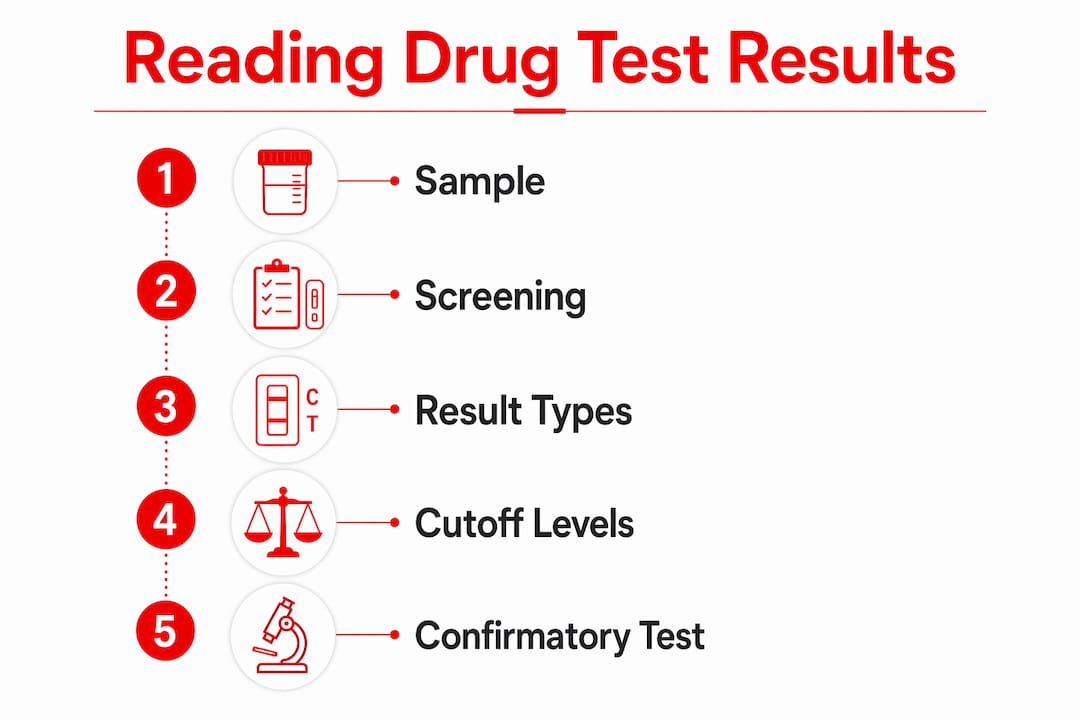
Drug test result interpretation is the process of determining whether a biological sample contains drug metabolites at or above a defined concentration threshold, reported as positive, negative, dilute, or invalid. Understanding how drug test results are read matters whether you are preparing for a pre-employment screen, monitoring a recovery program, or managing workplace compliance. This guide covers at-home test strips, laboratory reports, cutoff levels, and confirmatory testing so you can make sense of any result you encounter.
How drug test results are read: the four result types
Every drug test produces one of four outcomes. Knowing what each means is the foundation of accurate drug test result interpretation.

Positive means a drug or its metabolite was detected above the cutoff threshold. This does not automatically confirm current impairment or illicit use. A person taking prescribed opioids, for example, may test positive without any policy violation.
Negative means no drug was detected, or the concentration fell below the cutoff. A negative result does not guarantee the person is drug-free. As StatPearls notes, negative tests can occur when a drug was not included in the panel, levels were too low, or the sample was collected outside the detection window.
Dilute and invalid results require separate attention:
- Dilute: The sample shows abnormally low creatinine or specific gravity, usually from drinking excessive water before the test. Dilute results require retesting because metabolite concentrations are artificially suppressed.
- Invalid: The specimen failed quality checks, often due to improper collection, contamination, or tampering. An invalid result is not a positive. It means the test cannot be scored and the sample must be recollected.
Pro Tip: If you receive a dilute result, do not assume it clears you. Many employers treat a dilute positive the same as a confirmed positive and will require an observed retest.
What do the C and T lines mean on at-home test strips?
At-home urine test strips use two labeled zones: C (control) and T (test). Reading them correctly is where most people make mistakes.
- Check the C line first. The control line must appear on every valid test. If no C line appears, the test is invalid regardless of what the T zone shows. Discard it and retest.
- Look at the T line. The T line indicates whether drug metabolites are present. Two lines (C and T both visible) mean a negative result. One line (C only, no T) means a preliminary positive.
- Do not judge line intensity. A faint T line still counts as a negative result. Line color intensity does not reflect drug concentration. This is the single most common misreading error.
- Follow the timing window. Read results within the manufacturer’s specified window, typically 5 minutes. Reading results too early or too late produces evaporation lines or faded indicators that look like false positives.
- Treat any preliminary positive as unconfirmed. At-home strips are immunoassay screens. A positive on a strip is not a confirmed finding until a laboratory runs a confirmatory test.
Pro Tip: Photograph the test strip immediately after the reading window closes. If you need to dispute a result later, a timestamped image is far more useful than a verbal description.
Understanding drug metabolites and detection is also worth reviewing before you interpret any strip result, since what the T line actually detects is a metabolite, not the parent drug itself.
What are cutoff levels and why do they change the result?
A cutoff level is the minimum drug concentration, measured in nanograms per milliliter (ng/mL), that a test must detect before reporting a positive. Cutoff values differ by drug and lab, and they exist specifically to reduce false positives from incidental exposures.
Here is how standard federal workplace cutoffs compare to common lower-threshold alternatives:
| Drug | SAMHSA/DOT initial screen cutoff | Lower-threshold lab cutoff |
|---|---|---|
| THC (marijuana) | 50 ng/mL | 20 ng/mL |
| Cocaine metabolites | 150 ng/mL | 100 ng/mL |
| Opiates (morphine/codeine) | 2,000 ng/mL | 300 ng/mL |
| Amphetamines | 500 ng/mL | 200 ng/mL |
| Phencyclidine (PCP) | 25 ng/mL | 10 ng/mL |
The practical consequence of these differences is significant. At a 2,000 ng/mL opiate cutoff, eating a poppy seed bagel will almost never trigger a positive. At a 300 ng/mL cutoff, it might. Similarly, ibuprofen can cause PCP false positives on immunoassay screens when cutoffs are low, which is exactly why confirmatory testing exists.
Key points about cutoffs and their implications:
- Cutoffs protect against penalizing someone for passive exposure or legal food consumption.
- Employers and programs set their own thresholds. A substance abuse program may use lower cutoffs than a standard workplace screen to catch lower-level use.
- Knowing which screening panel and cutoff level applies to your test is the only way to correctly interpret a borderline result.
- A result just below the cutoff is still reported as negative, even if trace amounts are present.
What role does confirmatory testing play?
Confirmatory testing is the second-stage laboratory analysis that verifies a preliminary positive result before any legal or employment action is taken. The two standard methods are gas chromatography-mass spectrometry (GC-MS) and liquid chromatography-tandem mass spectrometry (LC-MS/MS). Both precisely identify substances and eliminate the cross-reactivity errors common in initial immunoassay screens.
Why this matters in practice:
- A positive immunoassay screen for amphetamines could reflect methamphetamine use, a prescribed ADHD medication, or a cold remedy containing pseudoephedrine. GC-MS separates all three.
- Federal workplace programs governed by the Department of Transportation (DOT) and the Substance Abuse and Mental Health Services Administration (SAMHSA) legally require confirmatory testing before any adverse employment action.
- Medical Review Officers (MROs) assess prescription drug presence to distinguish authorized use from illicit misuse. If you have a valid prescription, report it to the MRO before or during the review process.
- For individuals in recovery programs, understanding the difference between a screen and a confirmation is critical. A preliminary positive on a rapid cup does not mean a confirmed violation.
Pro Tip: If you test positive on a rapid screen and you take any prescription medication, request GC-MS confirmation immediately. Do not wait for an employer or program coordinator to initiate it.
For a deeper look at why screens sometimes get it wrong, the false positives accuracy guide from Rapidtestcup covers the most common cross-reactivity scenarios.
How does sample quality affect your result?
Sample integrity is the least discussed but most practically important factor in reading drug test results. A technically valid specimen is the prerequisite for any meaningful interpretation.
- Temperature: Urine must fall within 90 to 100 degrees Fahrenheit at collection. Temperature strips on test cups flag samples outside this range as potentially substituted.
- Creatinine and specific gravity: Labs measure these to detect dilution. A creatinine below 2 mg/dL indicates substitution. A reading between 2 and 20 mg/dL flags the sample as dilute.
- Chain of custody: Temperature strips and chain of custody documentation protect both the donor and the testing organization. A broken chain of custody can invalidate a result in a legal proceeding.
- Adulterants: Some individuals add bleach, vinegar, or commercial masking agents to samples. Adulteration test panels detect pH abnormalities, oxidants, and specific gravity anomalies that indicate tampering.
- Recollection: When a sample is flagged as invalid or dilute, the standard protocol is a supervised recollection. This is not punitive. It is a procedural requirement to obtain a scoreable specimen.
Factors like hydration level, collection timing, and storage temperature all affect how accurately a test reflects actual drug use. The factors that influence test accuracy guide from Rapidtestcup breaks down each variable in detail.
Key takeaways
Accurate drug test result interpretation requires understanding result types, cutoff thresholds, line reading rules, and the role of confirmatory testing together.
| Point | Details |
|---|---|
| Four result types | Positive, negative, dilute, and invalid each carry distinct meanings and next steps. |
| Faint T line equals negative | Line intensity on at-home strips does not indicate concentration; any visible T line is a negative. |
| Cutoffs determine positivity | Results just below the cutoff are reported negative even if trace amounts are present. |
| Confirmatory testing is required | GC-MS or LC-MS/MS must verify any positive screen before legal or employment action. |
| Sample integrity matters | Dilution, temperature, and adulteration all affect whether a result is valid and scoreable. |
What I’ve learned from years of watching people misread their own results
The most common and costly mistake I see is treating a preliminary positive as a final verdict. People lose jobs, get removed from recovery programs, and make panicked decisions based on a rapid immunoassay screen that a GC-MS confirmation would have overturned. The screen is a filter, not a verdict.
The second mistake is equally frustrating: people dismiss a faint T line as a positive because it looks “weak.” That faint line is a negative. The test is working exactly as designed. Misreading it in either direction creates real consequences.
What I find most overlooked is the panel scope problem. A negative drug test does not mean someone is drug-free. It means the specific substances on that panel were not detected above the cutoff at the time of collection. If the panel does not include fentanyl, a fentanyl user will test negative. If the sample was collected three days after use, a marijuana user may test negative. Context is everything.
For anyone in recovery, the emotional weight of a positive result can be destabilizing. Understanding that a positive screen requires confirmation, and that prescribed medications like Suboxone have specific testing implications, gives you the knowledge to respond calmly rather than react. Clarity about what a result actually means is the most useful thing you can have in that moment.
— Justin
Reliable drug testing products for accurate results
Getting the result right starts with using a test that meets professional standards. Rapidtestcup carries CLIA waived, FDA-approved test cups and strips designed for accurate, fast screening across a wide range of substances. The 12 Panel ADLTX Cup is one of the most popular options for workplace and recovery program screening, covering twelve drug classes with built-in adulteration detection. For labs and clinics that need broader coverage, the 22-panel drug test with adulterants screens for fentanyl analogs, Zaza, and xylazine alongside standard panels. Browse the full top drug testing products catalog to find the right fit for your volume and substance coverage needs.
FAQ
What does a positive drug test result actually mean?
A positive result means a drug or metabolite was detected above the cutoff level for that substance. It does not confirm current impairment or that the use was illicit, particularly if a prescription is involved.
Can a faint line on a drug test strip be a positive?
No. A faint T line still counts as a negative result. Only the complete absence of the T line, with the C line present, indicates a preliminary positive.
What happens after a positive rapid screen?
A confirmatory test using GC-MS or LC-MS/MS is required before any formal action. The confirmation identifies the exact substance and rules out cross-reactivity from medications or food.
Why would a drug test come back invalid?
An invalid result means the specimen failed quality checks due to improper collection, contamination, or suspected tampering. It is not a positive result. Recollection under observation is the standard next step.
Does a negative drug test mean someone is completely drug-free?
Not necessarily. A negative result means no substance on the panel exceeded the cutoff at the time of collection. Drugs not included in the panel, or use outside the detection window, will not appear regardless of actual use.