

Blog
What Does MTD Mean on a Drug Test?


MTD on a drug test stands for methadone. It shows up as a distinct result only when the panel specifically lists “MTD,” “Methadone,” or the metabolite EDDP, not on a standard 5-panel or 7-panel opiate screen. Most routine workplace immunoassays are built to catch morphine, codeine, and heroin metabolites, and methadone’s chemical structure slips past those antibodies entirely.
- Standard opiate screens usually miss methadone.
- Extended panels (often 10 to 18 panels) that explicitly list MTD or EDDP will catch it.
- Screening cutoffs commonly sit around a 300 ng/mL threshold for urine, though individual labs vary.
Any presumptive positive needs lab confirmation before it means anything for employment or legal decisions. That distinction, screening versus confirmation, drives almost every other decision in this article, from what to buy to what to say to HR.
Key Takeaways
Methadone detection on a drug test depends entirely on whether the panel explicitly lists MTD or EDDP, since standard opiate screens routinely miss it.
| Point | Details |
|---|---|
| MTD means methadone | It appears on a panel only when the product explicitly lists MTD, Methadone, or EDDP. |
| Standard panels miss it | 5-panel and 7-panel opiate screens target morphine, codeine, and heroin, not synthetic opioids. |
| Screening needs confirmation | A positive immunoassay is presumptive; GC-MS or LC-MS/MS confirms it for legal or employment use. |
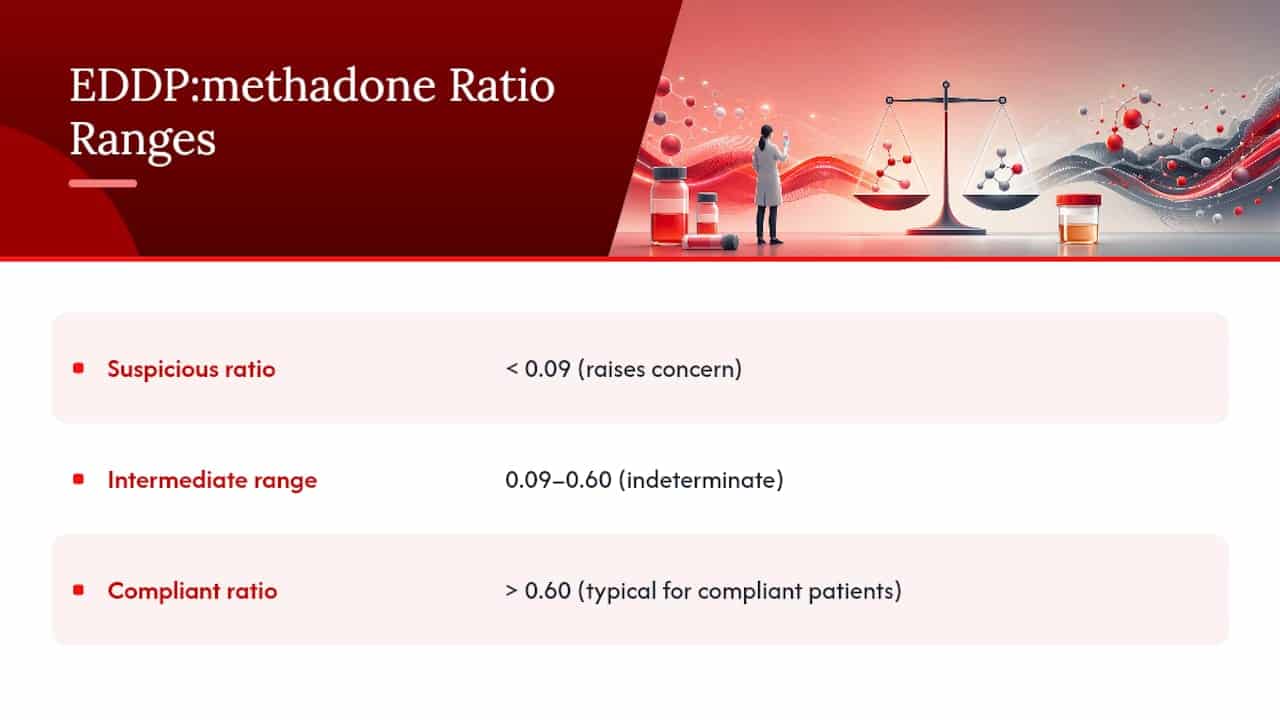
| EDDP ratio flags tampering | A ratio below 0.09 suggests specimen spiking, while above 0.60 is consistent with genuine use. |
| RapidTestCup sells labeled panels | Its cups and strips print MTD or Methadone/EDDP directly on the panel for verified coverage. |
Table of Contents
- Why MTD Doesn’t Show Up on Standard 5- or 7-Panel Tests
- Which Drug Tests Actually Detect Methadone?
- How Long Does MTD Stay in Your System?
- Screening vs. Confirmation: Why One Positive Isn’t the Final Word
- What Causes a False Positive, and How Do Labs Catch Tampering?
- What Are Your Rights if MTD Shows Up on a Workplace Test?
- What Should You Do Before and After an MTD Drug Test?
- Where to Find Methadone-Capable Test Cups and Panels
- Frequently Asked Questions
- Sources
Why MTD Doesn’t Show Up on Standard 5- or 7-Panel Tests
Methadone is a synthetic opioid, not a derivative of morphine, so the antibodies used in standard opiate immunoassays don’t reliably flag it. That’s the same reason fentanyl needs its own dedicated assay rather than riding along on a generic opiate panel.
A handful of terms come up constantly in lab reports and product descriptions:
- MTD: shorthand for methadone on a test strip or panel label.
- EDDP: the primary inactive metabolite methadone breaks down into, often measured alongside the parent drug.
- Immunoassay: the fast, antibody-based screening method used in most cups and dip cards.
- Cutoff (or LOQ): the concentration threshold a sample must exceed to register as positive.
A standard 5-panel test checks for marijuana, cocaine, opiates, amphetamines, and PCP. Add codeine and morphine specificity and you get a 7-panel, but methadone still isn’t part of that lineup unless the manufacturer built it in. According to a Drugs, methadone typically requires an extended or custom panel to appear at all.
Pro Tip: Before you order or administer any test, read the panel description line by line. “10-panel” or “12-panel” tells you the count, not the contents. Look for MTD or Methadone/EDDP printed explicitly.
Which Drug Tests Actually Detect Methadone?
A few formats reliably catch methadone, and a few don’t, no matter how many panels they claim to cover.
- CLIA-waived multi-panel urine cups and dip cards that print “MTD” directly on the strip, like RapidTestCup’s methadone test strips.
- Extended point-of-care cups, typically 15 to 18 panels or more, built specifically to include methadone alongside other synthetic and street drugs.
- Laboratory urine screens, such as the Siemens Atellica methadone assay used by many hospital labs, which target methadone directly rather than as a side effect of an opiate screen.
- Blood/serum, oral fluid, and hair assays, generally reserved for clinical monitoring or forensic cases rather than routine workplace screening.
Screening cutoffs cluster around 300 ng/mL for urine, while confirmation testing can quantify down to a much lower limit, often cited near 100 ng/mL. That gap matters: a specimen can screen negative yet still contain detectable methadone below the screening threshold but above the lab’s confirmation limit.
How Long Does MTD Stay in Your System?
Detection windows swing widely because methadone has an unusually long and variable half-life, often cited around 30 hours on average, but ranging much wider person to person.
- Urine: commonly detectable for up to about 7 days, though many screens are tuned closer to a 72-hour window depending on dose and frequency of use.
- Blood: roughly 24 hours in most cases, since methadone clears from plasma faster than it clears from urine.
- Saliva: anywhere from minutes to a few days, depending on collection timing relative to the last dose.
- Hair: up to around 90 days, useful for long-term monitoring rather than recent-use questions.
Dose size, how long someone has been on methadone maintenance, liver function, and other medications all shift these windows. Urine pH also affects excretion, which is part of why labs lean on the EDDP metabolite for a more stable read.
Pro Tip: If you’re facing a random workplace test rather than a scheduled clinic check, plan around the longer end of these windows. It costs nothing to be conservative and everything to be caught off guard.

Screening vs. Confirmation: Why One Positive Isn’t the Final Word
A positive result on a point-of-care cup or dip card is a screening result, not a verdict. Immunoassay screens are fast and cheap, but they’re built for speed, not precision, and cross-reactivity is a known limitation.
Confirmation testing, using GC-MS or LC-MS/MS, identifies and quantifies methadone and EDDP with a level of specificity immunoassays can’t match. That’s the standard clinical toxicology guidance recommends whenever a result will affect employment, legal standing, or medical treatment decisions.
- Screening: rapid and presumptive.
- Confirmation: definitive and quantitative.
- Chain-of-custody documentation matters most for confirmation samples used in employment or forensic cases.
Pro Tip: Ask the person administering your test, upfront, whether a positive automatically triggers lab confirmation or whether you have to request it. Some programs confirm by default; others only confirm if you push for it.
What Causes a False Positive, and How Do Labs Catch Tampering?
Not every unexpected positive means methadone use, and not every negative means a clean sample. A handful of over-the-counter products, including some antihistamines and PM sleep aids containing diphenhydramine, have been reported as cross-reactants on certain immunoassays, which is part of why confirmation exists in the first place.
Tampering shows up differently. Labs compare methadone to its EDDP metabolite because someone trying to spike a clean sample with raw methadone won’t have any corresponding metabolite in it.
- A compliant patient typically shows an EDDP:methadone ratio above 0.60.
- A ratio below 0.09 strongly suggests the sample was spiked rather than metabolized naturally.
- Specimen validity tests, creatinine, pH, and adulterant screens, catch dilution or substitution attempts that a simple positive/negative read would miss.
Pro Tip: If you’re in legitimate methadone treatment, keep your dosing records handy. A documented prescription paired with a normal EDDP ratio settles most disputes fast.
What Are Your Rights if MTD Shows Up on a Workplace Test?
Medication-assisted treatment with methadone is a recognized medical treatment, and patients often have protections under the Americans with Disabilities Act depending on the specific circumstances and applicable state law. That protection isn’t automatic or unconditional, but it exists as a real avenue if a positive result triggers employment consequences.
Most employers skip methadone entirely on standard panels simply because it costs more to test for and isn’t relevant to most job categories. That’s a business decision, not a legal exemption, and an employer can add methadone to a custom panel if they choose.
- Disclose your prescription or treatment status to HR or the testing administrator before testing, if your workplace policy requires it.
- Carry clinician documentation, current prescription information, dosage, and prescriber contact.
- Request confirmatory testing immediately if a screening result is unexpected or disputed.
Pro Tip: Get a treatment verification letter from your prescriber before a scheduled test, not after a positive result. It’s far easier to prevent a dispute than to resolve one retroactively.
What Should You Do Before and After an MTD Drug Test?
A little preparation avoids most of the stress here.
Before: Confirm the panel actually includes MTD or EDDP, not just a generic “opiate” line. Bring your prescription documentation. Ask whether confirmation happens automatically.
During: Follow specimen instructions exactly, and note the chain-of-custody paperwork if the result could affect your job or a legal matter.
After a positive screen: Request GC-MS or LC-MS/MS confirmation, hand over your treatment records, and loop in your clinic or an HR/labor contact if consequences are on the table.
Pro Tip: If you’re the one administering the test rather than taking it, whether at a clinic, a treatment program, or a workplace, verify your point-of-care device explicitly lists Methadone/EDDP before you rely on it for compliance monitoring.
A Practical Note on Verification Over Assumption
The single biggest mistake people make with methadone testing is assuming a “12-panel” or “extended” test automatically covers it. It usually doesn’t unless the manufacturer says so in plain language. Every recommendation in this piece, verify the panel, document your treatment, request confirmation when it matters, comes down to that same habit: check before you trust the result.
RapidTestCup stocks methadone-inclusive strip and cup formats specifically because so many buyers get burned by panels that quietly leave MTD off the list. If your panel description doesn’t explicitly say “Methadone” or “MTD,” assume it isn’t there.
Where to Find Methadone-Capable Test Cups and Panels
If you need a test that reliably flags methadone, the panel description has to say so, and that’s exactly what RapidTestCup builds around. Rather than guessing whether a generic multi-panel product covers MTD, you can order cups and strips where methadone and EDDP are printed directly on the panel list.
RapidTestCup carries CLIA-waived options built for point-of-care use, including extended cups like the 18-panel test with adulterants and clearance-priced 12-panel cups, both suited to clinics, treatment programs, and employers who need methadone coverage without paying lab-send-out prices for every screen. Bulk pricing is available for programs running high test volumes, and specimen collection accessories are sold separately for chain-of-custody situations.
Pro Tip: If you’re not sure which panel configuration covers your specific compliance need, contact RapidTestCup’s sales team directly. They can confirm methadone/EDDP coverage on any product before you order or build a custom panel around your exact requirements.
Frequently Asked Questions
What does MTD mean on a drug test?
MTD stands for methadone. It appears as a labeled result only on panels built to test for it specifically, not on generic opiate screens.
Does methadone show up on a standard drug test?
Usually not. Standard 5-panel and 7-panel tests target natural opiates like morphine and codeine, and methadone’s synthetic structure typically escapes those antibodies.
How long does MTD stay in your system for a urine test?
Commonly up to about 7 days, though many screening windows sit closer to 72 hours depending on dose, frequency, and metabolism.
What is a normal EDDP:methadone ratio?
Compliant patients generally show a ratio above 0.60; a ratio under 0.09 raises concern for specimen tampering.
Can I be fired for testing positive for methadone if I have a prescription?
Documented medication-assisted treatment often carries protections under the Americans with Disabilities Act, though outcomes depend on your specific situation and state law. Disclosing treatment and providing documentation proactively is the strongest safeguard.
This article is general information, not a substitute for advice from a qualified doctor. Consult a qualified healthcare professional about your own circumstances before acting on anything here.
Sources
- Methadone – Mayo Clinic Laboratories
- Methadone, Urine (Screen) Mclendon Clinical Laboratories | UNC Medical Center
- PubMed: On confirmation testing and mass spectrometry in toxicology (example reference)
- Drugs