Blog
Presumptive vs. confirmatory drug testing: Know the difference


TL;DR:
- Presumptive drug tests, like immunoassays, are rapid, cost-effective screening tools that detect drug class likelihood but cannot confirm specific substances. Confirmatory testing with methods such as GC-MS or LC-MS/MS provides definitive identification and quantification critical for legal, clinical, or forensic decisions. Proper protocols require understanding test limitations, documenting processes, and knowing when to bypass preliminary screens for direct confirmatory analysis.
A probationer tests positive for methamphetamine on a rapid urine screen. The case manager restricts treatment privileges immediately. Three days later, a lab report shows the result was a false positive triggered by a common cold medication. The damage, to trust, to treatment continuity, to a person’s standing in the program, is already done. False positives are a known risk with immunoassay-based presumptive tests, and misreading which result type you’re working with can trigger wrongful consequences across substance abuse programs, law enforcement investigations, and clinical settings. This guide cuts through the confusion so your team acts on the right information every time.
Table of Contents
- What is presumptive testing?
- How confirmatory testing works and why it matters
- Key differences: Presumptive vs. confirmatory testing
- When is confirmatory testing required?
- How to apply testing best practices in substance abuse programs
- Why “screen then confirm” isn’t enough: The real-world nuances
- Need reliable drug testing solutions?
- Frequently asked questions
Key Takeaways
| Point | Details |
|---|---|
| Presumptive tests screen quickly | They flag possible drug presence but do not confirm the exact compound. |
| Confirmatory tests provide proof | They definitively identify and often quantify substances, reducing error risk. |
| Legal and clinical actions need confirmation | Only confirmatory results support high-stakes decisions. |
| Know cutoff values | Screening and confirmation use different cutoffs that impact interpretation. |
| Follow context and guidelines | Use both testing types as required by program policy and patient or legal context. |
What is presumptive testing?
Presumptive testing is your first line of screening. It’s fast, cost-effective, and designed to flag samples that need closer attention. It is not designed to serve as a final answer. Presumptive drug testing is an initial screening that indicates the possible presence of a drug or metabolite, typically without definitive compound identification. Think of it as a smoke detector. It tells you something may be wrong; it doesn’t tell you exactly what’s burning or where.
Immunoassays are commonly used for presumptive screening because they’re inexpensive, rapid, and suitable for high-volume testing environments. These tests work by detecting antibody-antigen reactions. When a drug or structurally similar compound binds to the antibody on the test strip, it produces a visible result. The problem is that similar compounds can trigger the same reaction, which leads to cross-reactivity and false positives. Learn more about immunoassay screening principles if your program relies heavily on strip-based or cup-based screening.
Key characteristics of presumptive testing include:
- Speed: Results are typically available in 5 to 10 minutes at the point of collection.
- Cost: Lower per-test cost makes it practical for routine, large-scale screening.
- Technology: Primarily immunoassay-based (lateral flow strips, multi-panel cups).
- Limitations: Cannot differentiate between structurally similar compounds; cannot quantify analyte levels.
- Output: A positive result only means a threshold concentration may have been met or exceeded; it does not confirm the specific substance.
Important: A presumptive positive result is a flag, not a finding. Treating it as a confirmed result in a high-stakes situation is a procedural error that can expose your program to legal liability and harm the people you’re serving.
Pro Tip: When training new staff, use the phrase “presumptive means possible.” It’s a quick reminder that no action should be taken based solely on a screening result in any situation where consequences are serious.
Understanding rapid screening methods is essential for building a workflow that’s both efficient and defensible. The goal is speed at the front end, with confirmation capacity ready when the stakes rise.
How confirmatory testing works and why it matters
Once a sample is flagged, it may move to the next stage: confirmatory testing. This is where the chemistry gets serious. Confirmatory testing provides definitive identification and can quantify analytes, using specific instrumentation like gas chromatography-mass spectrometry (GC-MS) or liquid chromatography-mass spectrometry (LC-MS/MS). These methods don’t just detect whether something is present; they identify the exact molecular structure of the compound and measure its concentration.
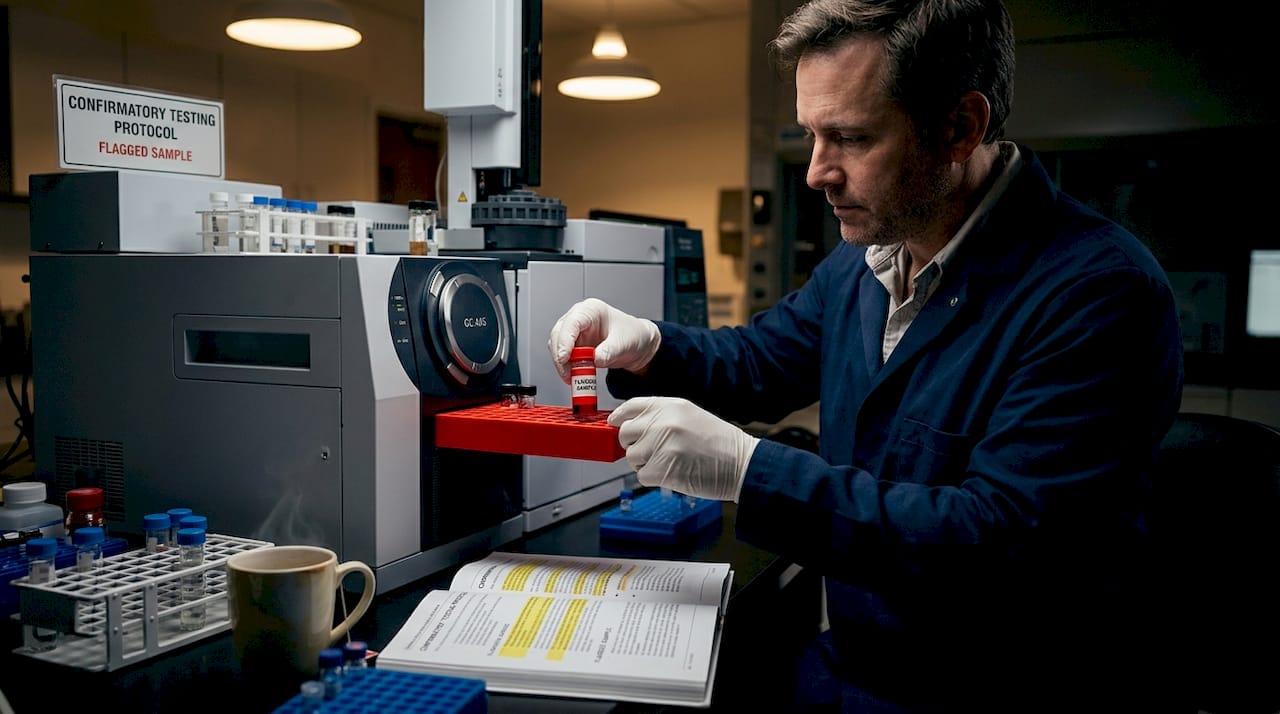
GC-MS separates compounds based on their volatility and then identifies them by their unique mass-to-charge ratio. LC-MS/MS is preferred when compounds are not easily volatilized or are thermally unstable, making it the go-to method for many opioids, benzodiazepines, and synthetic drugs. Both methods are highly specific, meaning they generate virtually no cross-reactive false positives when operated correctly.
Confirmatory analysis uses more specific instrumentation and is especially important when results are disputed or carry high-stakes consequences. This includes:
- Legal proceedings: Probation violations, DUI charges, child custody determinations.
- Employment decisions: Termination, safety-sensitive position disqualification, federal contractor compliance.
- Clinical treatment adjustments: Changing or terminating medication-assisted treatment based on drug test results.
- Forensic investigations: Evidence used in criminal prosecution or coroner inquiries.
Critical note: Why confirmatory drug testing matters isn’t just a policy question. It’s a chain-of-custody and defensibility question. Without confirmatory results, any challenged finding in a legal setting is likely to fall apart.
The turnaround time for confirmatory testing is longer, typically 24 to 72 hours when sent to a reference laboratory, and costs more per test. But that cost is negligible compared to the cost of a wrongful action, a lawsuit, or a patient harmed by an incorrect clinical decision. Understanding forensic drug testing key facts helps programs set realistic expectations for when lab-based results will be available and how to manage the time gap appropriately.
Pro Tip: Keep a clear documentation protocol for the gap between the presumptive screen and the confirmatory result. Note that no permanent action has been taken pending confirmation. This protects your program and the individual being tested.
Key differences: Presumptive vs. confirmatory testing
To clarify these stages, let’s look at their differences side-by-side.
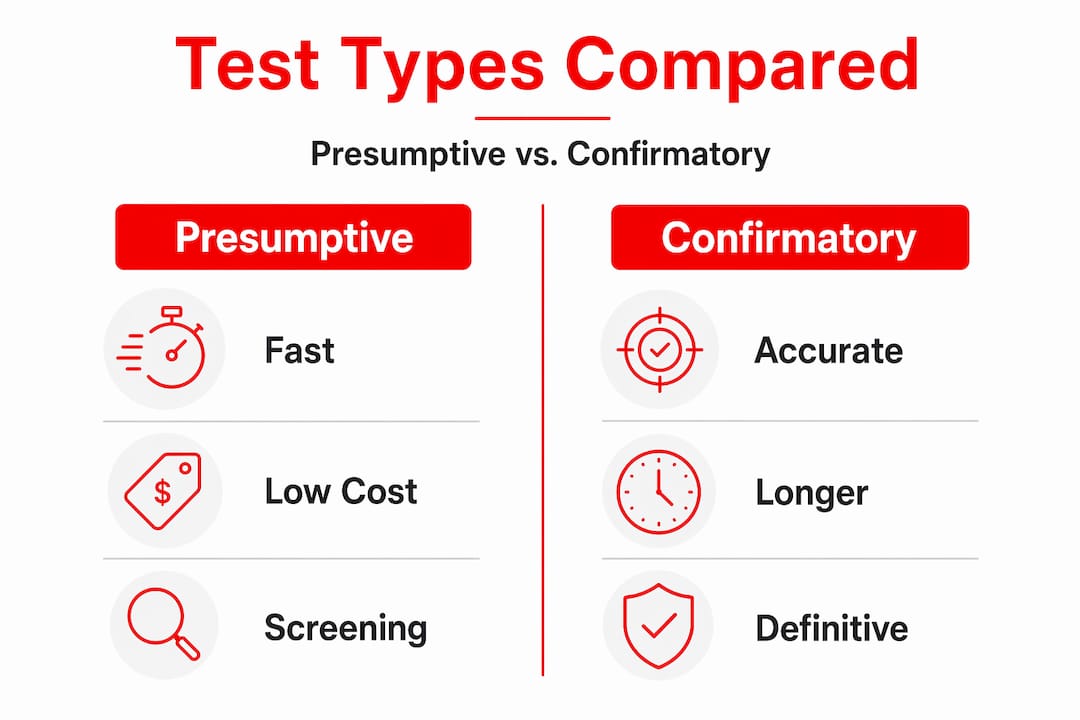
| Feature | Presumptive testing | Confirmatory testing |
|---|---|---|
| Technology | Immunoassay (lateral flow) | GC-MS, LC-MS/MS |
| Turnaround time | 5 to 10 minutes | 24 to 72 hours |
| Specificity | Moderate (cross-reactivity possible) | Very high (molecular identification) |
| Sensitivity | High (low false negatives for common drugs) | Very high (quantifies trace amounts) |
| Can quantify levels | No | Yes |
| Legally defensible | No | Yes |
| Cost per test | Low | High |
| CLIA waived | Often yes | No (requires laboratory) |
| Identifies new drugs | Limited | Broader capacity with targeted panels |
Comparing immunoassay-based presumptive approaches with definitive MS testing shows substantial rates of false positives and negatives with presumptive-only approaches, and critical substances, including fentanyl analogs and novel synthetic opioids, can be missed entirely. In polysubstance use cases, this gap can be the difference between an appropriate intervention and a life-threatening oversight.
The four most important distinctions to internalize are:
- Presumptive tests detect drug class; confirmatory tests identify specific compounds. An immunoassay may flag “opiates” without distinguishing heroin from hydrocodone from tramadol. GC-MS tells you exactly which compound is present.
- Presumptive results cannot be quantified; confirmatory results can. This matters when evaluating whether a medication is being taken as prescribed or diverted.
- False positive and false negative risks differ significantly. Review our false positives guide to understand which substances and conditions trigger misleading results on immunoassay screens.
- Legal and regulatory standards specify which method applies. Presumptive results cannot substitute for confirmatory results in disciplinary, forensic, or clinical contexts. Explore the full comparison in our detailed forensic drug testing methods resource.
When is confirmatory testing required?
Distinguishing the tests is foundational, but when is a definitive approach truly required? The answer depends on context, regulatory requirements, and the consequences attached to a result.
Federal workplace testing programs define both initial screening and confirmatory cutoffs, and specify when alternate technology rules apply. Under SAMHSA-certified laboratory standards, every initial positive must be confirmed before it can be reported as a verified positive result. These rules apply to all federal employees and federally mandated testing programs, including DOT-regulated industries like transportation and aviation.
Beyond federal programs, situations requiring confirmatory tests include the inability to identify a specific substance, inconsistent findings between screens, or scenarios where the analyte cannot be defined by the immunoassay panel in use. Here are the most common trigger conditions:
- The presumptive result does not match the patient’s clinical presentation or reported medication list.
- The individual disputes the result or requests a retest.
- The finding will be used in a legal proceeding, court order, or administrative hearing.
- You’re working with a substance that isn’t reliably detected by standard immunoassay panels (fentanyl, many synthetic cannabinoids, newer designer drugs).
- The result will directly affect custody, employment, or freedom.
Cutoff values are another layer of complexity. Initial screening tests are calibrated at higher cutoff thresholds to maximize sensitivity. Confirmatory tests use lower cutoff values to maximize specificity. A sample can technically screen negative initially and test positive on confirmation if the initial cutoff was set too high for the substance in question. This is especially relevant for marijuana metabolites in low-level exposure cases and for alcohol biomarker testing.
Pro Tip: Build a simple decision tree for your staff. If the result triggers any of the above conditions, the default action should be “send for confirmation.” Remove ambiguity from the decision-making process so you’re protected when results get challenged.
Using FDA-cleared drug tests as your presumptive screening layer ensures the immunoassay component meets recognized performance standards before anything moves forward in your workflow.
How to apply testing best practices in substance abuse programs
Understanding when to use each test empowers you to act confidently. Here’s how to apply this in practice.
The most effective substance abuse programs treat these two testing tiers not as alternatives but as a two-stage system with clearly defined roles. Treat presumptive results as screening flags for immediate action, but use confirmatory instrument methods for definitive conclusions. This principle should be embedded in your program’s written testing policy.
Practical steps for building a defensible testing workflow:
- Use presumptive testing for routine, high-volume monitoring. Multi-panel drug test cups are ideal for regular check-ins where you’re tracking overall compliance trends, not building a legal case.
- Define a confirmatory trigger list in writing. Document exactly which circumstances require a sample to proceed to LC-MS/MS or GC-MS confirmation.
- Maintain chain of custody from the start. Even if you initially intend a presumptive result for internal monitoring, circumstances can change. Proper specimen handling from the point of collection protects you.
- Train all staff on cross-reactivity risks. A counselor or case manager who doesn’t understand why a false positive occurs is a liability. Regular training reduces the chance of incorrect assumptions driving case decisions.
- Document every step. Date, time, collector ID, sample ID, method used, result observed, and action taken. If a result is ever challenged, your documentation is your defense.
- Communicate transparently with clients. Explaining that initial results are preliminary, and that confirmation is part of the process, reduces anxiety, builds trust, and models the procedural integrity that recovery programs depend on.
You can also review strategies to improve program outcomes through smarter testing integration, including how frequency and method selection affect both detection rates and therapeutic relationships.
Why “screen then confirm” isn’t enough: The real-world nuances
The standard guidance is sensible: screen first, confirm if positive, act on confirmation. But field experience reveals that this linear model breaks down in ways the guidelines don’t fully anticipate.
Consider a client in a medication-assisted treatment program who screens negative for fentanyl repeatedly but continues to show clinical signs of opioid intoxication. Standard immunoassay panels may not detect fentanyl at typical use levels because polysubstance and overdose cases are routinely missed or misclassified by immunoassays, requiring more robust approaches regardless of what the guidelines say. A program that waits for a presumptive positive before ordering confirmation will never catch this case on a screen alone.
The same logic applies to synthetic cannabinoids and novel psychoactive substances. These compounds are structurally unlike the cannabis metabolites that standard immunoassays target. A client can be using these substances daily and screen clean every time on a routine multi-panel cup. The presumptive result isn’t wrong; it’s just looking at the wrong target.
Experienced professionals don’t apply “screen then confirm” as a rigid rule. They layer it with clinical judgment. They factor in the client’s history, presentation, pattern of use, and the specific substances that are prevalent in their community. When those factors point toward a substance that standard panels don’t catch well, they skip the predictable negative screen and order targeted confirmation directly. That’s not inefficiency. That’s precision. Explore the forensic testing importance for deeper context on why protocol flexibility matters more than protocol rigidity in complex cases.
The professionals who do this best share one habit: they treat the testing result as one data point among many, not as the authoritative answer to a clinical or forensic question.
Need reliable drug testing solutions?
Whether you’re running a high-volume substance abuse program or managing specimen collection for law enforcement, having the right testing tools changes what’s operationally possible.
At RapidTestCup, we stock a full range of CLIA waived, FDA-approved presumptive testing products built for professional environments. The 18-panel drug test cup includes fentanyl, K2, kratom, ETG, and adulteration checks in a single collection, giving you broader presumptive coverage than standard panels. For high-frequency monitoring on tighter budgets, the 12-panel drug test cup covers the most commonly abused substances with fast turnaround and bulk pricing. If your workflow uses strips rather than cups, our guide to urine test strip types helps you select the right format for your collection environment. We offer custom quotes for high-volume programs.
Frequently asked questions
Can presumptive test results be used for legal or employment action?
No. Presumptive results are screening flags only. Confirmatory testing is required before any legal decision, employment termination, probation violation, or other high-stakes action can be justified.
Why do immunoassay presumptive tests sometimes give false positives?
Immunoassays detect molecular shapes, not specific drugs. Structurally similar compounds can bind to the same antibody, triggering a positive result. Cross-reactivity is the primary cause of false positives on standard immunoassay screens.
What instruments are used for confirmatory testing?
Confirmatory drug testing relies on GC-MS and LC-MS/MS instrumentation, which separates and identifies compounds by molecular weight and structure with very high specificity.
Do initial and confirmatory tests have different cutoff values?
Yes. Federal workplace testing protocols set distinct cutoff concentrations for initial immunoassay screens and confirmatory MS analysis, with confirmatory cutoffs generally lower to increase specificity.
When should you skip straight to confirmatory testing?
When the clinical picture doesn’t match the presumptive result, or when the suspected substance isn’t reliably detected by standard panels. Presumptive testing cannot always identify specific substances, and in those cases, moving directly to confirmation is the right call.