Blog
Counselors: What 5–18 Panel Probation Drug Tests Detect in the U.S.


Probation programs most often use 5, 7, 10, 12, 15, 17, or 18-panel urine tests, with urine remaining the dominant matrix for routine supervision. On-site cups and dip cards give a presumptive result in minutes, and anything positive typically moves to laboratory confirmation before it affects a case. Oral fluid and hair testing show up less often, usually for specific situations like shy bladder cases or longer lookback needs.
TL;DR:
- Expanded panels add fentanyl, buprenorphine, synthetic cannabinoids, or ETG; confirm the agency’s written analyte list because panel labels and county policies vary.
- Urine detects most drugs for roughly 1 to 4 days, while hair can show months of history but cannot detect very recent use.
- An on site positive is presumptive; request lab confirmation if disputed, especially with prescriptions or possible medication cross reactivity, before signing an admission.
- Local policy sets testing schedules and consequences; after a positive, agencies may increase testing or refer someone to treatment instead of seeking revocation.
Table of Contents
- Common Panel Sizes and What Each Typically Screens For
- Urine, Oral Swab, Hair, or Blood: Which Matrix Fits the Goal
- Collection Procedures, Specimen Validity, and Chain of Custody
- Screening vs. Confirmation: What a Positive Result Actually Means
- How Often Probation Tests, and Why Randomness Matters
- Counselor Tips That Hold Up Under Scrutiny
- Why Panel Selection Varies by Jurisdiction
- Legal and Privacy Considerations in Probation Testing
- Where False Positives and False Negatives Come From
- How Prescribed Medications Can Affect a Result
- From Positive Result to Sanction: What Happens Next
- Newer Technology Changing How Panels Work
- A Fair Testing Program Still Needs Treatment Behind It
- Operational Supplies for Agencies Running Their Own Testing Programs
- FAQ
- Sources
Common Panel Sizes and What Each Typically Screens For
The baseline in American drug testing traces back to the federal “NIDA five”: marijuana (THC), cocaine, opiates, amphetamines, and phencyclidine (PCP). Probation agencies rarely stop there, though. Guidance from the American Probation and Parole Association advises agencies to write their own testing policies and expand beyond the basic five when program goals call for it, which is why multi-panel cups dominate court-ordered testing today.
As panels grow, they typically add:
- 7-panel: adds benzodiazepines and barbiturates to the basic five, catching sedative misuse.
- 10-panel: layers in methadone, propoxyphene, and methaqualone for broader opioid and depressant coverage.
- 12-panel: often adds MDMA and oxycodone, reflecting rising prescription opioid concerns.
- 15-panel: frequently includes buprenorphine, tramadol, and fentanyl, targeting synthetic opioids directly.
- 17 to 18-panel: adds synthetic cannabinoids (K2), ketamine, and alcohol biomarkers like ETG, giving officers a near-complete substance picture in a single cup.
Fentanyl and ethyl glucuronide (ETG) deserve special mention. Fentanyl shows up in modern federal testing because it drives overdose deaths that older NIDA panels never anticipated, and the Mandatory Guidelines for Federal Workplace Drug Testing Programs now list fentanyl among the authorized analytes with a specified confirmatory cutoff. ETG detects recent alcohol consumption, which matters for probation conditions that require total abstinence rather than just sobriety at the moment of testing.
Urine, Oral Swab, Hair, or Blood: Which Matrix Fits the Goal
Matrix choice shapes what a test can actually tell a probation officer. Urine remains standard because it balances cost, detection window, and ease of collection, but each matrix has tradeoffs worth understanding before assuming one result tells the full story.
Typical detection windows vary by substance and individual metabolism, but general patterns include:
- Urine: most drugs detectable for roughly 1 to 4 days, with heavy cannabis use extending that window.
- Oral fluid: shorter window, often capturing only very recent use, useful for catching same-day impairment.
- Hair: the longest lookback, sometimes covering months, though it cannot detect very recent use due to growth time.
- Blood: narrow window, mainly used for confirming active intoxication rather than supervision screening.
Clinical guidance from the StatPearls review on drug testing recommends matching the matrix and testing approach to the program’s actual goal. Officers often switch to oral swabs when someone cannot produce a urine sample on demand, a situation commonly called “shy bladder,” or when they need a quick field check outside a collection facility. Hair testing appears less often in routine probation because of cost and the lag before new use becomes detectable, but it can matter when a court wants a longer history rather than a snapshot.
Collection Procedures, Specimen Validity, and Chain of Custody
Collection protocol matters as much as the panel itself, because a mishandled sample can undermine an otherwise accurate result. State practice varies, but the pattern is fairly consistent across jurisdictions.
- Observation: many agencies use same-sex observation or partial observation to deter substitution, following privacy safeguards described in state protocols like the West Virginia probation testing policy.
- Validity checks: temperature strips, creatinine levels, specific gravity, and adulterant test strips flag diluted, substituted, or tampered samples before screening even begins.
- Labeling and transport: every specimen gets sealed, labeled, and logged immediately to preserve a usable chain of custody.
- Documentation: each handoff from collector to courier to lab is recorded, since missing links in that chain can get a confirmed positive challenged or thrown out in a revocation hearing.
- Shy bladder procedures: when someone cannot produce urine, written policy typically allows extended time, fluids, or a switch to oral fluid collection as a documented alternative.
Administrators who want a closer look at validity testing can review this specimen validity guidance or a practical adulteration prevention checklist.
Screening vs. Confirmation: What a Positive Result Actually Means
An on-site cup or dip card is a presumptive screen, not a courtroom-ready result. It uses immunoassay technology that reacts to drug classes broadly, which means it can flag a positive from something other than the targeted substance.
- Confirmatory testing relies on gas chromatography-mass spectrometry (GC-MS) or liquid chromatography-tandem mass spectrometry (LC-MS/MS), methods the StatPearls review describes as the standard when results carry legal consequences.
- Cutoff values determine what counts as positive, and federal cutoffs published in the Mandatory Guidelines set the benchmark many programs reference.
- Cross-reactivity from certain medications can trigger a false screen positive, which is exactly why confirmation exists before any sanction gets imposed.
- Signed admissions at the time of an on-site positive often carry real weight administratively, sometimes reducing the need for lab confirmation unless the person disputes the result.
How Often Probation Tests, and Why Randomness Matters
Most programs start with a baseline test at intake, then move to random testing throughout supervision, increasing frequency if someone tests positive or shows other risk factors. The logic is straightforward: a predictable schedule lets someone time their use around the test, while random call-in or color-code systems close that gap.
- Intake testing establishes a baseline before supervision conditions take effect.
- Random re-testing throughout the term prevents probationers from learning and exploiting a pattern, a point echoed in federal guidance on substance abuse testing during supervised release.
- Escalated frequency after a positive result is common practice, often paired with a treatment referral rather than an automatic violation.
- Officer discretion under agency policy, as described in APPA guidelines, means two people on probation in different counties can face very different testing schedules for similar conditions.
Counselor Tips That Hold Up Under Scrutiny
A signed admission after an on-site positive carries real procedural weight, so counselors should document it clearly and explain what it means before anyone signs. When a client disputes a result, the right steps are: request lab confirmation, review current prescriptions for cross-reactivity, and verify the chain-of-custody paperwork matches the specimen.
For administrators, a simple operational habit prevents most avoidable errors: check kit expiration dates, store cups and strips per manufacturer instructions, and keep chain-of-custody forms on hand before collection day, not after. Specification sheets for multi-panel cup options are useful references when setting up these checks.
Pro Tip: Keep a dated log of every kit lot number used in a collection, so a disputed result can be traced back to a specific batch rather than argued in the abstract.
Why Panel Selection Varies by Jurisdiction
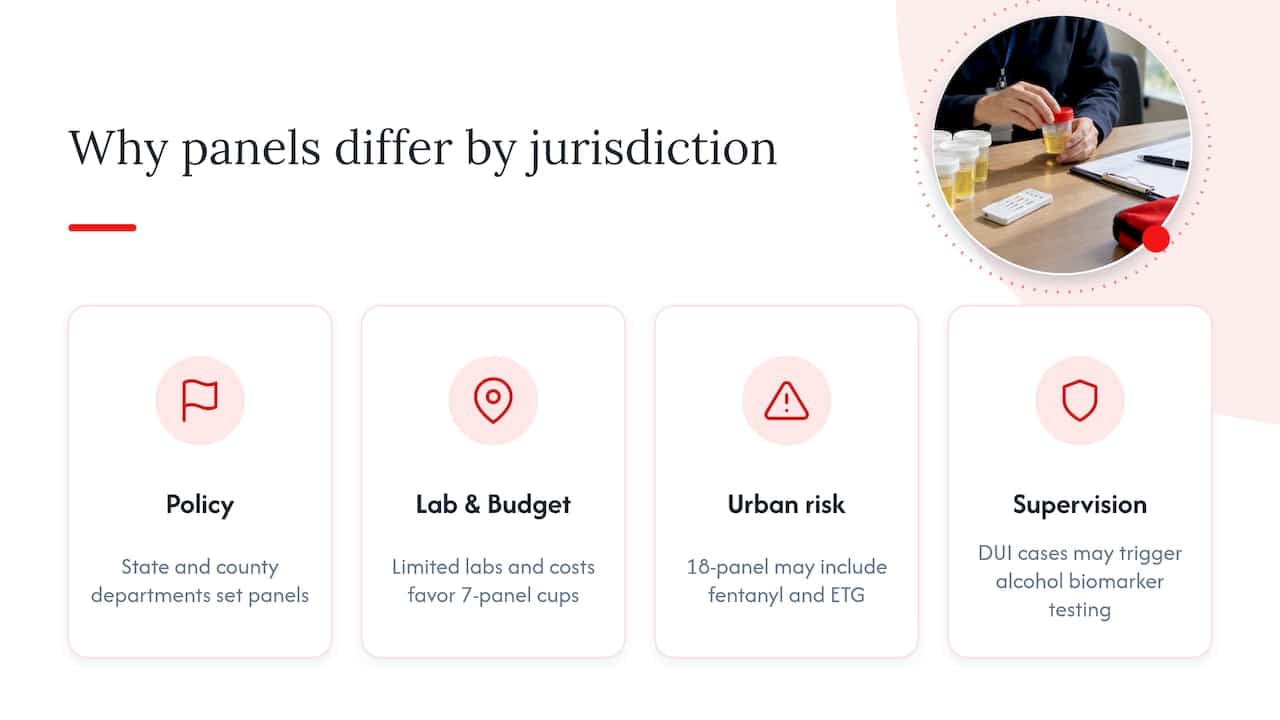
There is no single national standard dictating which panel a probation office must use, and that gap explains a lot of confusion for people moving between counties or states. Federal guidelines set analyte lists and cutoffs for federal programs, but state and county probation departments write their own policies within that framework, as seen in the difference between West Virginia’s statewide protocol and county-level policies like San Bernardino County’s drug screening procedures.
A rural county with limited lab access might lean on a simple 7-panel cup for cost reasons, while an urban office dealing with fentanyl-related cases might require an 18-panel cup with fentanyl and ETG built in. Conditions of supervision matter too: someone on probation for a DUI may face alcohol biomarker testing that someone on probation for a property crime never encounters. Budget constraints shape this as much as policy does, since expanded panels cost more per test and agencies have to justify that expense against caseload and risk level.
The APPA’s own guidance acknowledges this variation is intentional rather than a flaw, since local agencies understand their population and risk profile better than a one-size-fits-all federal list could. For someone on probation, this means the honest answer to “what panel will I be tested with” is “it depends on your county and your specific conditions,” and asking a probation officer directly is more reliable than assuming based on what a friend in another jurisdiction experienced.
Legal and Privacy Considerations in Probation Testing
Drug testing as a probation condition sits on fairly solid legal ground in the United States, since courts have generally upheld testing as a reasonable condition of supervised release tied to public safety and rehabilitation goals. That said, how testing is conducted still carries privacy obligations that agencies are expected to follow.
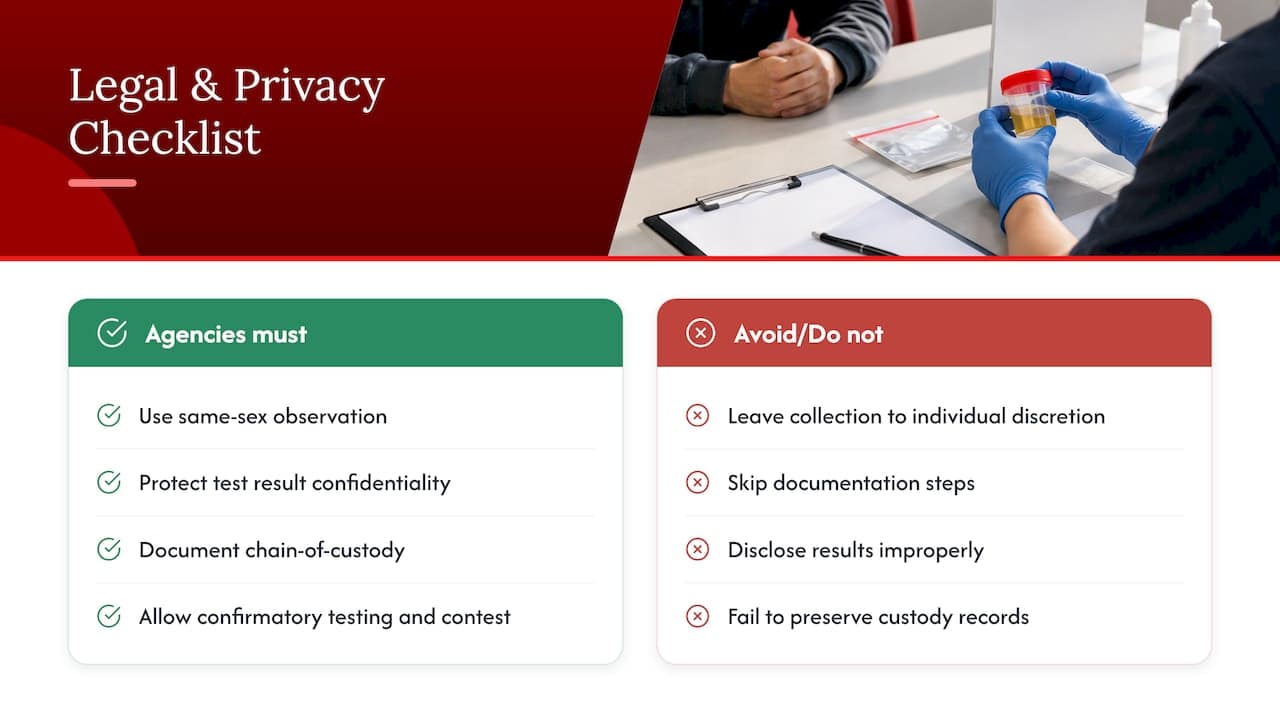
Observed collection procedures are designed to prevent sample substitution while limiting unnecessary intrusion, which is why written policies like the West Virginia protocol specify same-sex observation and procedural safeguards rather than leaving collection methods to individual discretion. Results are also typically protected under confidentiality rules that limit who can access testing records, since a positive result can affect not just the current case but potentially employment or housing if disclosed improperly.
Due process matters when a positive result leads to a violation hearing. A person on probation generally has the right to know what they tested positive for, to request confirmatory testing, and to contest a result before a sanction is imposed. Agencies that skip documentation steps or fail to preserve chain-of-custody records risk having results challenged successfully, which is part of why the procedural details covered earlier in this piece are not just bureaucratic formality. Anyone facing a drug-related charge that intersects with probation conditions should understand how possession statutes and related bail considerations can compound the stakes of a failed test in states with strict drug laws.
Where False Positives and False Negatives Come From
No drug test panel is perfect, and probation programs that treat a single screen as absolute proof of use or sobriety are setting themselves up for disputes. Immunoassay screens are built for sensitivity, which means they sometimes flag a result that confirmatory testing later clears.
Common causes of a false positive include certain antibiotics, decongestants, and some antidepressants cross-reacting with the antibody strips used in rapid cups. Poppy seed consumption can trigger an opiate flag. Secondhand marijuana smoke exposure almost never produces a true positive at standard cutoffs, but people still raise it as a concern worth addressing directly with clients.
False negatives happen too, often from diluted samples, whether intentional or from someone simply drinking excessive water before a test. Specific gravity and creatinine checks exist specifically to catch this, and a sample that fails validity testing is typically treated as a separate issue from a negative result rather than proof of sobriety. Detection window limitations also create a kind of false negative: a substance used just outside the window, or metabolized unusually fast in a particular person, will not show up even though use occurred. None of this means testing is unreliable overall, but it does mean a single data point deserves context before it drives a major decision in someone’s case.
How Prescribed Medications Can Affect a Result
Prescription medications are one of the most common sources of confusion in probation drug testing, and they deserve a direct explanation rather than a vague warning. Certain prescribed opioids, benzodiazepines, and stimulant medications for ADHD will legitimately trigger a positive on a panel designed to catch those drug classes, because the test cannot distinguish a legal prescription from illicit use at the screening stage.
This is exactly why documentation matters before testing day, not after a positive comes back. Someone with a valid prescription should disclose it to their probation officer in advance when possible, and bring documentation such as a pharmacy printout or prescriber’s note to the testing appointment. When a prescribed medication explains a positive, confirmatory testing combined with medical review can usually resolve the issue without it counting as a violation, though the exact process depends on the agency’s written policy.
Medical Review Officer (MRO) review, standard in many workplace testing programs and increasingly referenced in criminal-justice settings, exists specifically to separate legitimate medical use from prohibited substance use before a result gets reported as a violation. Probation conditions sometimes restrict specific medications outright, particularly controlled substances with abuse potential, so a prescription does not automatically guarantee no consequences. It does mean the conversation should happen with documentation in hand rather than as a dispute after the fact.
From Positive Result to Sanction: What Happens Next
A positive drug test rarely triggers an automatic, severe punishment on its own, though outcomes vary significantly by jurisdiction and the terms of someone’s specific supervision. The typical sequence moves from the field result to confirmation, then to a documented review before any sanction takes effect.
First-time positives, particularly for substances tied to addiction rather than new criminal activity, often result in a treatment referral, increased testing frequency, or a warning rather than immediate revocation. Many probation departments, informed by survey findings like those in the Illinois statewide probation testing study, use a mix of punitive and treatment-oriented responses rather than defaulting to the harshest option available. Repeated positives, or a positive combined with other violations, raise the likelihood of a formal violation hearing, which can lead to extended probation, additional conditions, or in more serious cases, revocation and a return to incarceration.
The written admission someone signs at the time of an on-site positive often plays a central role in how quickly a case moves, since it can function as an acknowledgment that reduces the need for a full confirmatory dispute. People who believe a result is wrong should understand that contesting it is a normal, available step, not an act of defiance, and that requesting confirmation before signing anything is a reasonable response rather than an automatic admission of guilt.
Newer Technology Changing How Panels Work
Drug testing panels have evolved considerably from the original NIDA five, largely driven by shifts in what substances actually show up in the field. Fentanyl’s addition to federal authorized panels, formalized in the 2026 Mandatory Guidelines update, reflects years of synthetic opioids outpacing older test designs built around heroin and prescription opioids alone.
Oral fluid testing has also gained ground as lab infrastructure and cutoff standards catch up to urine testing’s maturity, giving officers a less invasive collection option for situations where observed urine collection feels excessive. Expanded multi-panel cups now routinely combine 15 to 18 analytes with built-in adulterant strips in a single device, reducing the number of separate tools an officer needs to carry into the field. Faster-reading strips and clearer cutoff indicators have also cut down on ambiguous readings that used to require a second screen before confirmation. None of this replaces laboratory confirmation for contested results, but it does mean a routine check-in test today catches a far broader range of substances, in less time, than the same check-in would have a decade ago.
A Fair Testing Program Still Needs Treatment Behind It
Testing tells you what happened, not why. A panel result that gets treated purely as a trigger for punishment misses the point for people struggling with substance use, while a program that pairs testing with real treatment referrals and transparent documentation actually supports recovery. Good case management means explaining results clearly, keeping records straight, and tying a positive to next steps rather than just a consequence.
— Justin
Operational Supplies for Agencies Running Their Own Testing Programs
For probation offices, clinics, and treatment programs handling collection in-house, we supply the practical tools that make consistent testing possible. Our catalog covers multi-panel urine cups built for criminal-justice programs, ETG alcohol strips, oral swabs for shy-bladder or field situations, fentanyl-specific strips, and adulterant detection supplies that support the chain-of-custody steps described above.
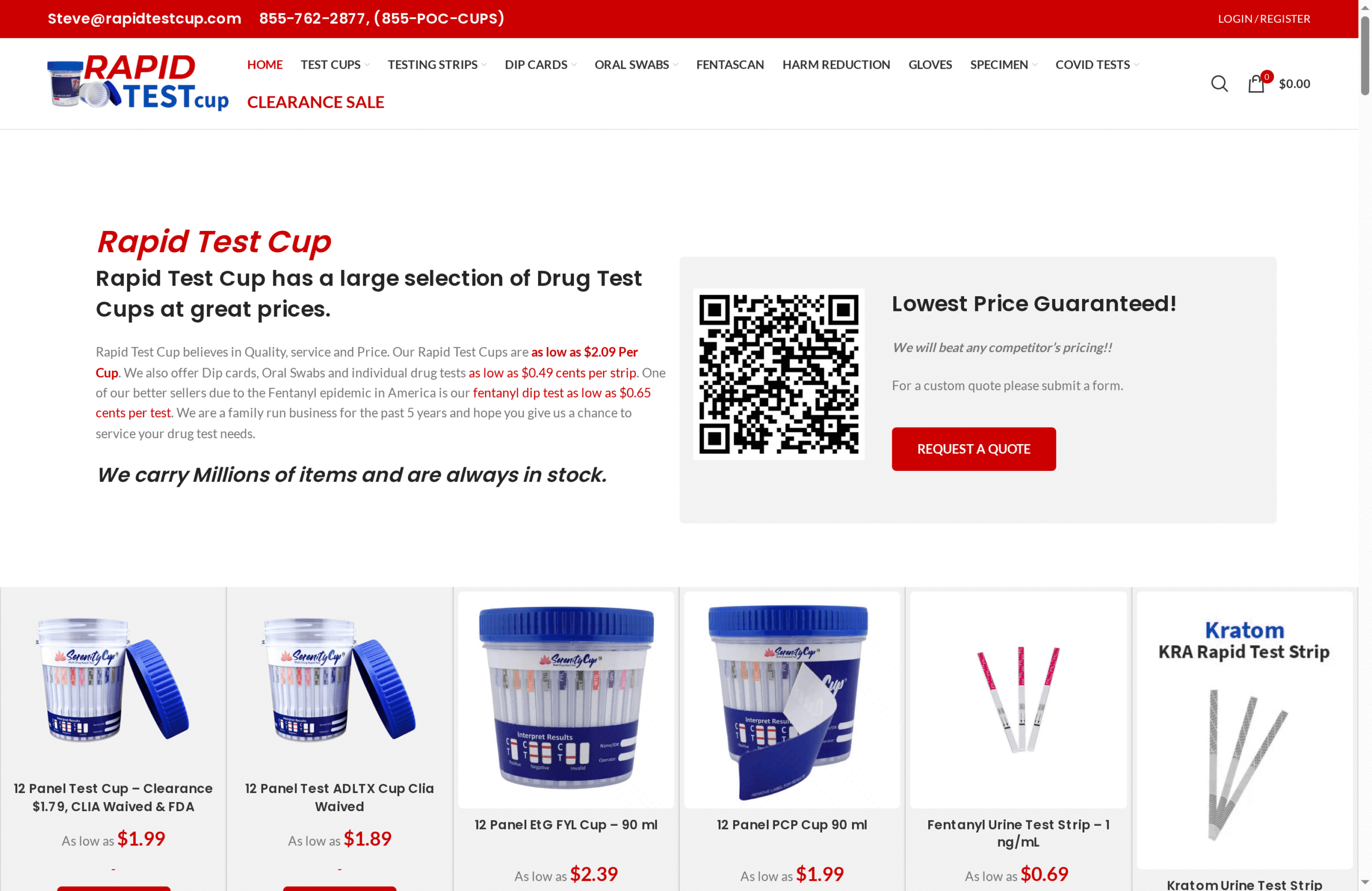
- Multi-panel cups ranging from basic configurations to expanded 15- and 18-panel options with fentanyl and ETG built in.
- Dip cards for programs that prefer a simpler collection format, including 10-panel and 12-panel versions.
- Oral swabs for field checks or shy-bladder alternatives, plus standalone fentanyl strips and ETG strips for alcohol monitoring.
We offer competitive prices on drug test cups and supplies, with same-day shipping and bulk discounts for agencies ordering at volume. Procurement staff ready to compare specs or request a custom quote can browse our full drug testing supply catalog.
This article is general information, not a substitute for advice from a qualified lawyer. Consult a qualified legal professional about your own circumstances before acting on anything here.
FAQ
What panel drug test do they use for probation?
Probation programs most commonly use 5, 7, 10, 12, 15, 17, or 18-panel urine tests, selected based on agency policy and program goals rather than a single national standard. Expanded panels increasingly add fentanyl and alcohol biomarkers like ETG to match current substance use patterns.
What drugs are tested on a 26-panel drug test?
There is no standard definition across agencies for panel sizes beyond those commonly described, and panel naming conventions vary by manufacturer and program. Larger expanded panels generally build on the standard drug classes (opioids, amphetamines, cocaine, THC, benzodiazepines, PCP) and add synthetic opioids, synthetic cannabinoids, and alcohol or adulterant markers, so checking the specific program’s written policy is the only reliable way to confirm exact coverage.
What shows up on a 6-panel drug test?
Tests that expand beyond the basic NIDA five (THC, cocaine, opiates, amphetamines, PCP) add one or more additional drug classes, commonly benzodiazepines or related sedatives depending on the manufacturer. The exact additional analytes vary by product, so the specific cup or card’s documentation determines the precise list.
How far back does a 10-panel urine test go?
Detection windows depend on the substance and the person’s metabolism, but most drugs on a 10-panel urine test are detectable for roughly 1 to 4 days after use, with heavy or chronic cannabis use extending that window further. Clinical guidance on drug testing matrices notes that individual variability makes exact windows difficult to pin down precisely.
Sources
- Mandatory Guidelines for Federal Workplace Drug Testing Programs—Authorized Testing Panels
- Clinical Drug Testing – StatPearls – NCBI Bookshelf
- APPA drug testing guidelines and practices for adult probation and parole agencies
- Probation Drug Testing Policy and Protocol, Supreme Court of Appeals of West Virginia