Blog
Setting Up Random Drug Tests: HR Guide for 2026


TL;DR:
- Effective workplace drug testing requires building an accurate, current testing pool and implementing scientifically valid, computer-based selection methods to ensure legal defensibility. Proper execution involves spreading random draws throughout the year, immediate confidential employee notification, meticulous documentation, and strict chain-of-custody procedures to maintain result integrity. Consistently managing records, avoiding managerial interference, and conducting regular audits are essential for program compliance and effectiveness.
Workplace drug use costs U.S. employers billions annually in lost productivity, accidents, and liability. Setting up random drug tests is one of the most legally defensible and operationally effective tools available, but only when structured correctly. A program built on guesswork invites legal challenges, fails audits, and undermines employee trust. This guide walks you through every phase — from building a compliant testing pool to verifying results and managing records — so your program holds up in court and in practice.
Table of Contents
- Key takeaways
- Setting up random drug tests: what to do before day one
- Executing the selection and notification process
- Managing specimen collection, labs, and result verification
- Follow-up actions, compliance audits, and record-keeping
- My honest take on where programs go wrong
- Get the testing supplies your program actually needs
- FAQ
Key takeaways
| Point | Details |
|---|---|
| Build your pool first | Accurate, current employee pool lists are the foundation of a defensible program. |
| Use computer-based selection | Scientifically valid selection methods protect against legal challenges; manual selection does not. |
| Meet federal testing rates | DOT agencies have specific 2026 minimum rates; FMCSA and FTA require 50% annually. |
| Document every step | Chain-of-custody records and timing documentation can make or break a legal defense. |
| Spread draws throughout the year | Quarterly or dispersed selections maintain unpredictability and meet regulatory requirements. |
Setting up random drug tests: what to do before day one
The most common mistake employers make is jumping straight to scheduling tests without completing the legal groundwork. You will spend far less time defending your program if you spend more time building it correctly upfront.
Define your testing pool with precision
Your random testing pool is the list of employees eligible for selection. Pool management errors are one of the most frequent causes of audit failure. New hires must be added immediately upon starting in a safety-sensitive role. Terminated or transferred employees must be removed just as fast. Treat this list like a compliance dataset, not a static spreadsheet you update once a quarter.
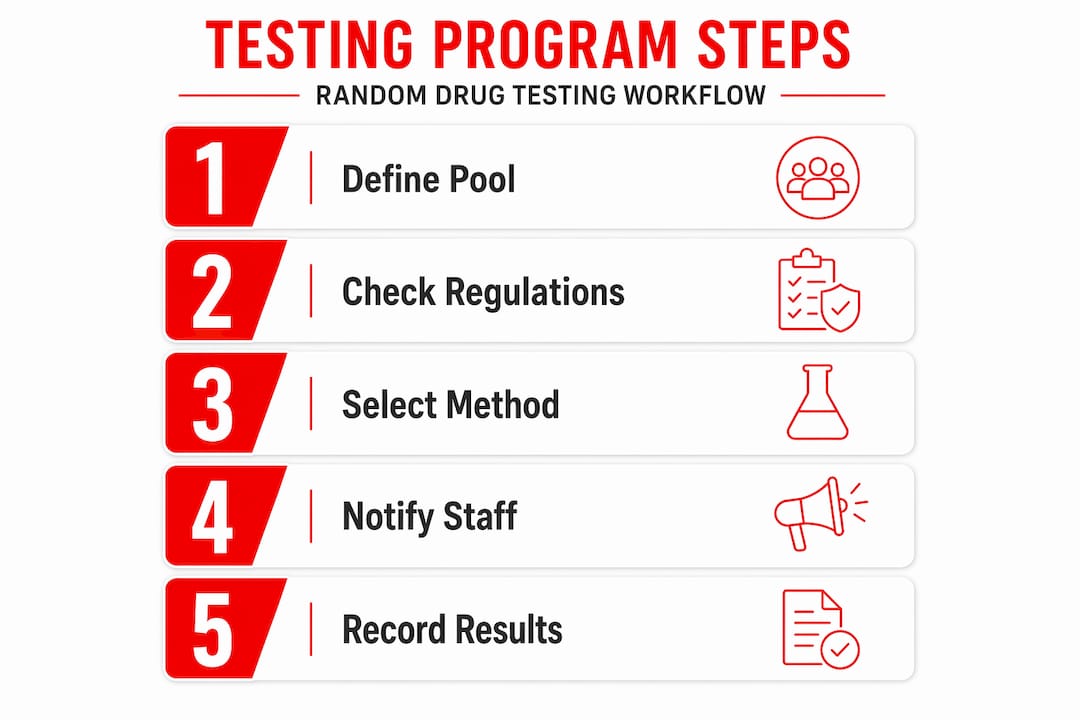
Know your regulatory requirements
If your employees are covered under Department of Transportation regulations, your testing rates are not optional. For 2026, FMCSA and FTA require a minimum 50% annual drug testing rate, while FAA and FRA are set at 25%. PHMSA mirrors FMCSA at 50%. If you are a non-DOT employer, check your state laws, because many states regulate random testing frequency, consent requirements, and which substances can be included.
Pro Tip: Random testing must not substitute for reasonable suspicion testing. These two programs operate independently, and conflating them creates compliance gaps.
Write a formal drug testing policy
Before a single employee is selected, you need a written policy that has been reviewed by legal counsel. It should spell out the following:
- Which employees are subject to testing and why
- What substances are included in the panel
- How random selections are made and by whom
- What happens when an employee is selected and notified
- Consequences for positive results and refusals
- How records are stored and for how long
Get signed acknowledgment from every employee. That signature is your first line of legal defense. For a deeper look at staying legally secure, the workplace drug testing compliance guide from Rapidtestcup covers federal regulations and best practices in detail.
Choose a scientifically valid selection method
This is where many programs quietly fail. Manual or alternating selection methods are not considered scientifically valid and will not survive legal scrutiny. You need a computer-based random number generator, either through your own HR software or via a Consortium/Third Party Administrator (C/TPA). A C/TPA manages pool membership and generates selections on your behalf, which removes any possibility of bias or managerial influence creeping in.
Executing the selection and notification process
Once your policy is written and your pool is accurate, you move into the operational phase. Execution is where programs succeed or fall apart in real time.
Here is the process in order:
-
Schedule your draws throughout the year. Spreading selections quarterly or across multiple draws prevents clustering and keeps the program genuinely unpredictable. If every selection happens in January, you lose the deterrence effect for the other eleven months.
-
Run the selection through your validated system. The algorithm generates a list. That list does not get adjusted, reviewed for convenience, or changed by a manager. The selection is the selection. Managerial interference in this process is one of the fastest ways to invalidate your program.
-
Notify selected employees immediately and privately. The word “immediately” has legal weight here. Immediate notification means the employee stops what they are doing and proceeds to the collection site. They do not finish a shift, go home to change, or stop for lunch. Document the exact time of notification.
-
Provide clear instructions for reporting. Tell the employee which collection site to go to, how to get there, and what to bring. Most programs give employees a two to four hour window to report, depending on travel distance and site availability.
-
Document everything in real time. Write down the selection date, notification time, employee acknowledgment, and the time they arrived at the collection site. Do not reconstruct this record later from memory.
Pro Tip: Use a standardized notification form that captures all timestamps in a single document. This small investment in process discipline pays off enormously if a result is ever challenged.
One operational detail that trips up even experienced HR teams: if a selected employee is on approved leave during a draw, most programs require them to be tested when they return. Your policy should address this scenario explicitly, because failing to test them or removing them from the pool without documentation creates a gap.
Managing specimen collection, labs, and result verification
Getting a positive result that cannot be used in court is worse than not testing at all. The specimen collection and verification phase is where legal defensibility is either built or destroyed.
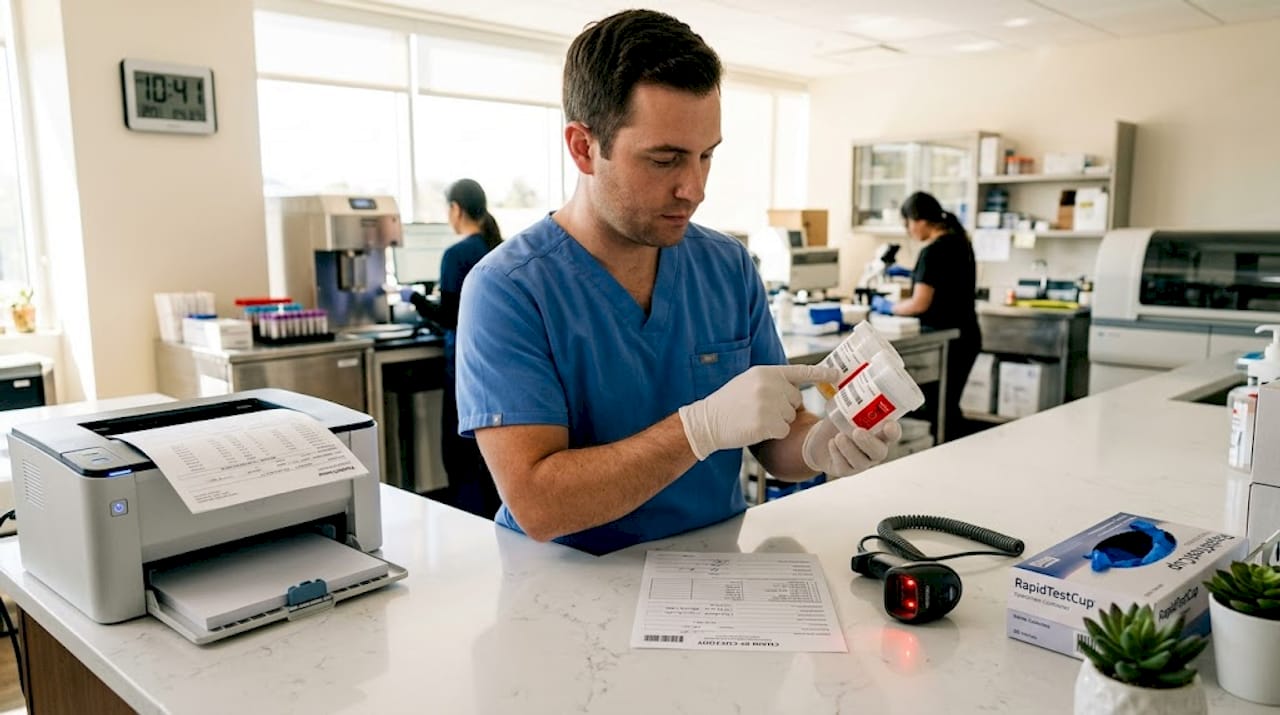
What happens at the collection site
Approved collection sites follow federal chain-of-custody procedures. The process uses a split-specimen design where the urine sample is divided into Container A and Container B. Container A is sent to the laboratory for initial testing. Container B is held in reserve, sealed and intact, in case the employee requests a retest. This design protects both employer and employee.
Here is a summary of the testing stages and their purpose:
| Stage | Method | Purpose |
|---|---|---|
| Initial screen | Immunoassay | Fast, cost-effective preliminary result |
| Confirmation test | GC-MS or LC-MS/MS | Definitive identification of substance |
| MRO review | Medical Review Officer | Evaluate legitimate medical explanations |
| Split specimen retest | Secondary lab analysis | Employee right to contest a positive result |
The Medical Review Officer’s role
A positive laboratory result does not automatically become a confirmed positive. A Medical Review Officer (MRO) reviews the result and contacts the employee to determine whether there is a legitimate medical explanation. If there is, the result may be reported as negative. If there is not, it stands as confirmed positive.
Split specimen testing and MRO verification exist specifically to protect fairness and reliability. Skipping or shortcutting either step exposes your organization to legal liability and undermines employee confidence in the program. For a complete breakdown of how split specimen protocols work, Rapidtestcup’s guide on split specimen procedures is a practical reference.
Chain of custody and timing records
Incomplete chain-of-custody documentation can invalidate a positive result entirely. Record the time the specimen was collected, who handled it, how it was sealed, and when it was shipped to the lab. These details seem bureaucratic until you need them. Then they are everything.
Follow-up actions, compliance audits, and record-keeping
Testing is not the end of the process. What you do after results come in determines whether your program actually changes behavior and survives regulatory scrutiny.
When a confirmed positive result arrives, your next steps should follow a documented protocol:
- Immediately remove the employee from safety-sensitive duties pending review
- Refer the employee to your Employee Assistance Program (EAP) if applicable
- Follow your written policy on suspension, termination, or return-to-duty requirements
- For DOT-regulated employers, a Substance Abuse Professional (SAP) evaluation is mandatory before any return to duty
Refusal to test carries the same consequences as a confirmed positive under DOT regulations. Your policy needs to say that plainly, and your managers need to know it cold. Uncertainty about refusal handling is a compliance risk on its own.
Pro Tip: Schedule at least one internal compliance audit per year to review pool accuracy, draw records, notification logs, and MRO communications. Audits catch drift before regulators do.
For record retention, most DOT programs require keeping drug testing records for two to five years depending on the result type. Non-DOT employers should consult state law. Regardless of jurisdiction, keep records in a secure, access-controlled system with clear documentation of who retrieved what and when. For ongoing guidance on managing test results compliantly, Rapidtestcup has a dedicated resource that covers this phase in full.
My honest take on where programs go wrong
I have worked through enough compliance scenarios to say this clearly: most random drug testing programs fail not because employers chose the wrong testing panel, but because they treated their program as a set-it-and-forget-it process.
The biggest recurring problem I see is pool management. An employee gets promoted into a non-safety-sensitive role and nobody updates the pool. A new driver starts and gets missed for three months. Accurate and current testing pools are not glamorous work, but they are the practical linchpin of the entire system.
The second issue is managerial influence. I know managers with good intentions who quietly swap a selected employee for another because the timing was inconvenient. That single act, however well-meaning, can render your entire program indefensible. The selection algorithm exists precisely to remove that discretion.
Documentation is the third place I see employers cut corners. They test. They get results. They act on them. But when an employee challenges a termination six months later, the notification log is missing, the collection time was never recorded, and the chain-of-custody form has a gap. Thorough chain-of-custody documentation is not a formality. It is your proof that everything happened the way it was supposed to.
My recommendation: treat every draw like it will be audited, because eventually, one will be.
— Justin
Get the testing supplies your program actually needs
If your program framework is solid but your testing supplies are not, you are still exposed. Rapidtestcup provides CLIA waived, FDA-approved urine drug test kits designed for professional workplace screening programs. Whether you need a standard panel for a general workforce or a multi-substance kit that covers synthetic cannabinoids, fentanyl, and adulterants, the catalog is built for compliance-focused buyers.
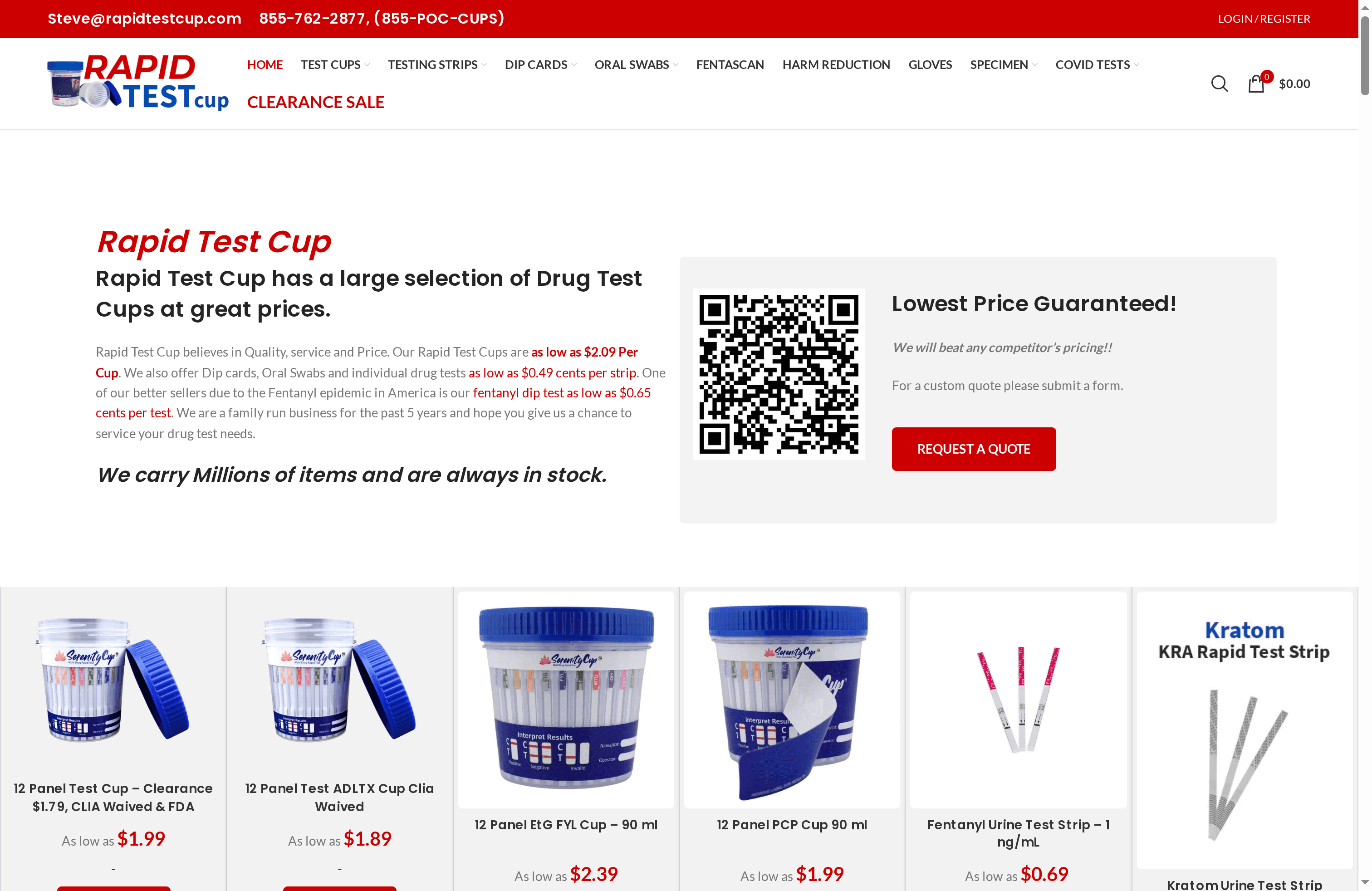
Start with the top urine drug test kits comparison to identify which panel and cup design fits your program. For programs that need broad substance detection, the 18-panel drug test cup includes built-in adulterant testing and covers substances from kratom to fentanyl. Bulk pricing and fast shipping mean you can keep your supply chain consistent without scrambling before each draw.
FAQ
What is the minimum random drug testing rate for DOT employers?
It depends on the agency. FMCSA, FTA, and PHMSA all require a minimum 50% drug testing rate annually, while FAA and FRA require 25%.
How should employees be notified when selected for random testing?
Notification must be immediate and confidential. The employee should report to the collection site without finishing tasks or leaving the worksite first, and you must document the exact time of notification.
Can a manager swap out a randomly selected employee for someone else?
No. Allowing managerial substitution invalidates the scientific validity of the selection process and can make your entire program legally indefensible.
What happens if an employee refuses a random drug test?
Under DOT regulations, refusal is treated the same as a confirmed positive test result. Your written policy should state this explicitly and outline the consequences.
How long should drug testing records be kept?
DOT programs generally require retention of two to five years depending on result type. Non-DOT employers should verify state-specific requirements, but a minimum of three years is a reasonable baseline.