
Blog
Forensic Drug Testing Tips for Law Enforcement Pros


TL;DR:
- Effective forensic drug testing depends on proper specimen collection, confirmatory testing, advanced analytical techniques, and strict regulatory compliance. Maintaining a robust chain of custody and proactively addressing adulteration are essential for legal defensibility. Regular staff training, workflow audits, and high-quality tools ensure results withstand courtroom scrutiny.
Forensic drug testing sits at the intersection of science, law, and public safety. Get it wrong, and the consequences extend well beyond a failed lab result. Evidence gets excluded. Cases collapse. Careers take hits. Whether you work in law enforcement, a clinical setting, or a substance abuse treatment program, applying the right forensic drug testing tips is what separates results that hold up in court from results that fall apart under cross-examination. This article covers the procedural, scientific, and regulatory factors that determine whether your testing program is defensible or vulnerable.
Table of Contents
- Key takeaways
- 1. Forensic drug testing tips start with airtight specimen collection
- 2. Know the difference between presumptive and confirmatory tests
- 3. Use advanced analytical techniques to strengthen evidentiary value
- 4. Comply with SAMHSA and HHS guidelines at every step
- 5. Lock down chain of custody from collection to reporting
- 6. Address specimen adulteration directly and proactively
- 7. Comparison of forensic drug testing methods
- What I have learned from getting forensic drug testing right and wrong
- How Rapidtestcup supports your forensic testing program
- FAQ
Key takeaways
| Point | Details |
|---|---|
| Specimen integrity starts at collection | Temperature must read 90–100°F within four minutes or the sample is flagged as invalid. |
| Presumptive tests are not conclusions | Screening positives require GC-MS or equivalent confirmation before any legal action. |
| Chain of custody is your legal backbone | Every transfer, signature, and timestamp must be documented to survive courtroom scrutiny. |
| MROs add a critical review layer | Medical Review Officers catch false positives and protect both the tester and the tested. |
| Technology alone is not enough | Validated instruments plus rigorous workflows produce legally defensible forensic results. |
1. Forensic drug testing tips start with airtight specimen collection
The collection moment is where most forensic testing failures are seeded. By the time a result comes back positive, any break in procedure at the source has already compromised the outcome.
Urine specimen temperature must be measured within four minutes of collection and should fall between 90–100°F to be valid. Readings outside that range indicate possible substitution or tampering. This single check is one of the most reliable early indicators you have.
Use collection containers with built-in temperature strips. Assign every specimen a unique alphanumeric ID at the point of collection. Collectors should document the time, date, and their signature on the chain-of-custody form before the sample leaves their sight.
Pro Tip: Build a physical checklist that collectors complete at the collection point, covering temperature reading, specimen ID assignment, seal condition, and collector signature. Reviewing this checklist at the end of every shift catches gaps before they become legal liabilities.
Common failures include delayed handoffs, unsigned forms, and specimens stored without tamper-evident seals. Many legal challenges target procedural gaps rather than the chemical analysis itself, meaning your paperwork is often more vulnerable than your science.
2. Know the difference between presumptive and confirmatory tests
One of the most costly mistakes in forensic toxicology is treating a screening result as a conclusion. It is not. Presumptive tests are starting points, not endpoints.
Immunoassay-based tests, including standard urine test cups, are designed for speed and cost efficiency. They catch probable positives across a broad panel of substances. However, screening positives require confirmation to support any prosecution or formal adverse action. Courts expect it. Regulations require it.
Confirmatory testing methods include:
- GC-MS (Gas Chromatography-Mass Spectrometry): The gold standard for forensic identification. Separates compounds chemically and identifies them by molecular weight with high specificity.
- HPLC (High-Performance Liquid Chromatography): Effective for thermally unstable substances that GC-MS cannot analyze reliably.
- LC-MS/MS: Increasingly common in clinical and forensic labs for high sensitivity and selectivity on complex matrices.
Your workflow should treat every presumptive positive as a hypothesis, not a finding. The confirmatory result is the finding. Explicitly separating these two stages in your written protocols protects you from the argument that a screening result was misrepresented as a definitive identification.
3. Use advanced analytical techniques to strengthen evidentiary value
When the stakes are high, technique selection matters as much as execution. The combination of FT-IR and GC-MS is becoming standard practice in serious forensic drug analysis because each method covers weaknesses in the other.
FT-IR (Fourier Transform Infrared Spectroscopy) enables rapid screening and mixture identification without destroying the sample. GC-MS then provides gold-standard confirmation on the same or parallel specimen. Together, they produce results with far greater court defensibility than either method alone.
Practical steps for integrating advanced techniques:
- Validate every instrument before deploying it in a forensic context. NIST guidance on validation requires that forensic methods follow ISO/IEC 17025 principles, including documented validation plans and reports.
- Use software with multi-component search algorithms. Advanced search software can identify drug mixtures rapidly without requiring deep operator expertise on every compound.
- Archive all instrument output, including raw spectral data, for every case where results may be cited in legal proceedings.
- Cross-train staff on at least two analytical methods. Over-reliance on a single operator for a single technique is a vulnerability.
Pro Tip: Subscribe to journals like the Journal of Analytical Toxicology or follow NIST updates directly. New synthetic compounds and novel psychoactive substances enter circulation faster than most lab libraries are updated, and being six months behind on your reference database is a real risk.
4. Comply with SAMHSA and HHS guidelines at every step
Regulatory compliance is not an administrative formality. For federally regulated testing programs, it determines whether your results are legally usable at all.
SAMHSA requires federally regulated testing to be performed by HHS-certified laboratories, with specimen validity testing and Medical Review Officer involvement built into the process. If your program falls under federal oversight and you skip any of these requirements, your results will not survive scrutiny.
Key compliance markers to audit in your current program:
- HHS-certified laboratory: Confirm your lab holds current certification. Certification status can change, and periodic verification is your responsibility.
- Specimen validity testing: Beyond temperature, labs should test for pH levels, creatinine concentration, and the presence of common adulterants like bleach, nitrites, or oxidizing agents.
- MRO review: Medical Review Officers review all confirmed positive results, giving donors a chance to report legitimate prescriptions before a result is finalized as positive.
- Internal policy alignment: Your written policies should mirror federal guidelines. Any discrepancy between what your policy says and what SAMHSA mandates creates a gap that opposing counsel will find.
The MRO’s role in testing is frequently underestimated. They are not a bureaucratic step. They are the filter that prevents false positives from reaching formal action. Cutting this step, even in a low-volume program, is a significant liability.
5. Lock down chain of custody from collection to reporting
Chain of custody is not just a form. It is the legal story of your specimen’s life from the moment it was collected to the moment results were reported. Any chapter with missing information becomes a point of attack.
Every transfer of a specimen between individuals or facilities requires a signature, a timestamp, and a notation of the seal condition at the time of transfer. Unique specimen IDs must match across every document in the file. Chain-of-custody failures are frequently the root cause for evidence exclusion. Not analytical errors. Paperwork errors.
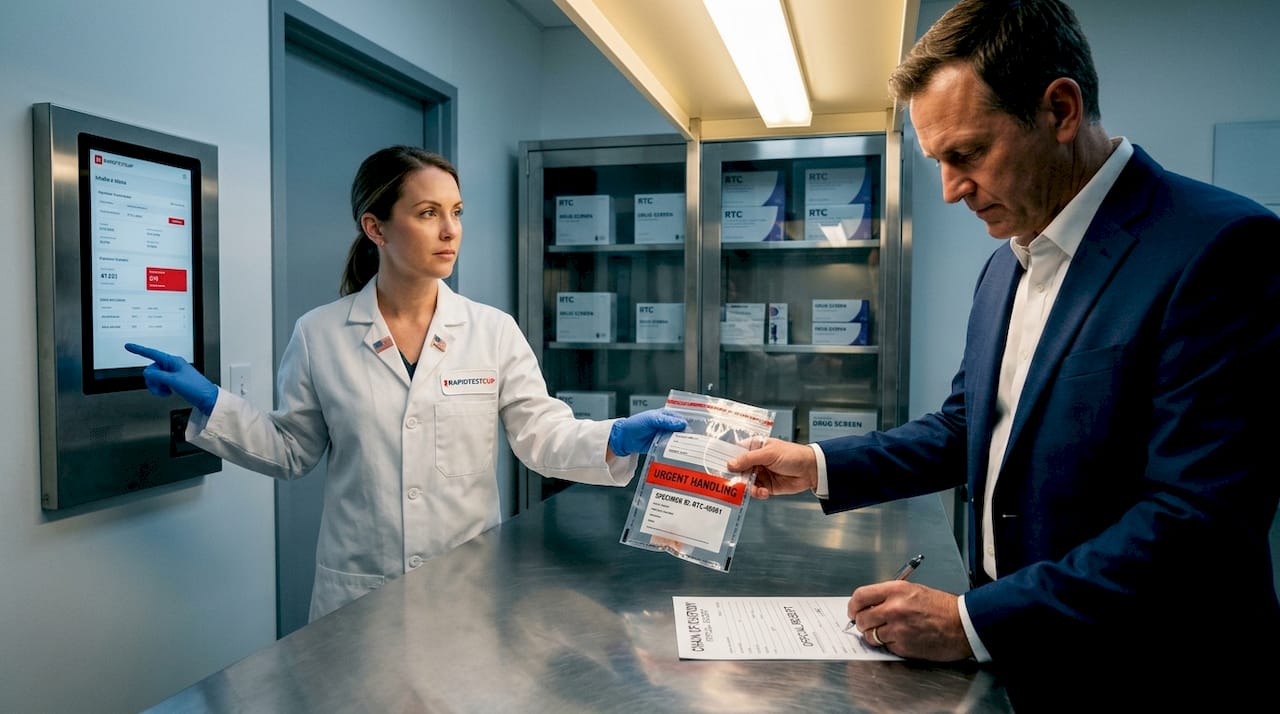
Pro Tip: Conduct internal chain-of-custody audits quarterly, not just when something goes wrong. Pull five to ten random case files and trace each specimen from the collection form through to the final report. Gaps you find internally are far less damaging than gaps an attorney finds in court.
Tamper-evident seals should be applied immediately after collection and verified intact at every transfer point. If a seal is broken without documentation of who broke it and why, the specimen’s integrity is legally suspect.
6. Address specimen adulteration directly and proactively
Adulteration is a real, common, and increasingly sophisticated problem. Testing for it should not be an afterthought. It should be a built-in component of your forensic testing strategies.
Temperature failures often result from delayed specimen handover or environmental factors rather than intentional tampering, but your protocol cannot assume innocence without data. Collect specimens promptly. Do not allow donors unaccompanied access to water sources before collection.
Standard adulteration markers to test for include:
- Creatinine below 2 mg/dL indicates substitution with water or a non-urine substance
- pH outside the 4.5 to 8.5 range suggests chemical tampering
- Presence of nitrites, bleach, or oxidizing agents points to deliberate adulteration
- Specific gravity outside the 1.003 to 1.030 range indicates dilution or substitution
Specimen cups that incorporate validity test strips alongside the drug panel are worth the marginal cost increase. You catch adulteration at the collection site, before the sample is sent to a lab. That saves time and prevents a fraudulent result from entering the chain.
7. Comparison of forensic drug testing methods
Choosing the right method depends on your context, resources, and legal requirements. This table gives you a practical overview of the most common forensic approaches.
| Method | Speed | Cost | Legal acceptance | Best use case |
|---|---|---|---|---|
| Immunoassay (cup/dip) | Very fast | Low | Screening only | Initial workplace or field screening |
| GC-MS | Moderate | High | Gold standard in court | Confirmatory identification in legal cases |
| FT-IR | Fast | Moderate | Strong with GC-MS backup | Rapid screening with mixture identification |
| HPLC | Moderate | Moderate to high | Accepted in most jurisdictions | Thermally unstable compound analysis |
| LC-MS/MS | Moderate | High | High specificity accepted widely | Clinical and complex matrix analysis |
| Color/presumptive tests | Very fast | Very low | Presumptive only | Field identification, not courtroom use |
The pattern here is consistent: speed and cost decrease as legal defensibility increases. Your testing strategy should start with a fast, affordable screening method and escalate to a confirmatory technique when results will be used for legal action. See the forensic drug testing methods guide for how certified procedures affect admissibility at each stage.
What I have learned from getting forensic drug testing right and wrong
I have reviewed enough failed testing programs to spot the pattern immediately. The problem is almost never the instrument. It is the assumption that a good instrument makes a good program.
The labs and agencies I have seen get this right treat every specimen as if it will be subpoenaed. They do not cut corners when caseloads are heavy. They run their chain-of-custody audits even when nothing has gone wrong recently. Their staff can explain the difference between a screening result and a confirmed result without hesitation, because that distinction has been drilled into every orientation and every refresher training.
What I have seen go wrong consistently: collectors who skip temperature checks when they are busy, coordinators who assume the lab will catch any procedural gaps, and supervisors who confuse regulatory training with actual regulatory compliance. Training a staff member once, two years ago, is not a compliance program.
My honest take is that most agencies would benefit more from a rigorous two-hour workflow audit than from any new piece of technology. Validation, as NIST frames it, is an independent evidence-generation process, not a one-time checkbox. Build that mindset into your team, and your results will hold up where it counts.
— Justin
How Rapidtestcup supports your forensic testing program
When your protocols are solid and your team understands the stakes, your tools need to match that standard.
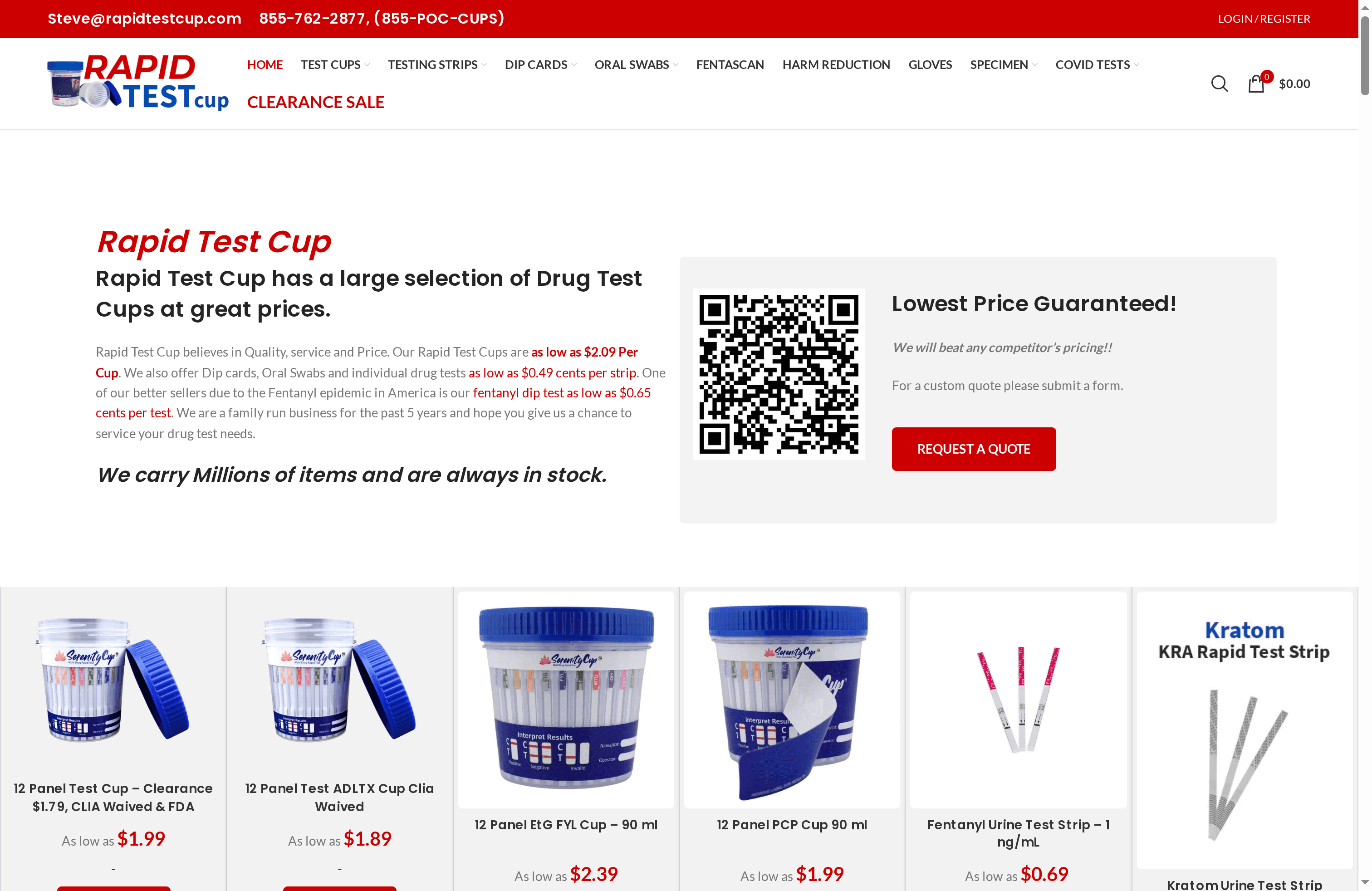
Rapidtestcup offers FDA-approved, CLIA waived multi-panel test cups with built-in adulterant detection and temperature strips, purpose-built for professional forensic screening. From 18-panel cups that cover emerging substances to dip cards for high-volume programs, the catalog is designed for labs, clinics, law enforcement agencies, and substance abuse treatment programs that cannot afford test failures. If you are selecting or upgrading your current kit, the drug test kit guide at Rapidtestcup walks through panel selection, compliance criteria, and accuracy ratings to help you match the right product to your program requirements.
FAQ
What temperature should a urine specimen read at collection?
A urine specimen must read between 90 and 100°F when checked within four minutes of collection. Readings outside this range indicate possible tampering or substitution and require further investigation before the specimen is processed.
Can a presumptive positive be used in court?
No. Presumptive positives from immunoassay screens are not legally sufficient on their own. A confirmatory test such as GC-MS must validate the result before it can support prosecution or formal adverse employment action.
What does an MRO do in a drug testing program?
A Medical Review Officer reviews all confirmed positive results and contacts donors to verify legitimate prescriptions or medical explanations. This step prevents false positives from reaching formal action and is required by SAMHSA for federally regulated programs.
How do I detect specimen adulteration on-site?
Use collection cups with built-in validity test strips that check creatinine, pH, specific gravity, and common adulterant markers like nitrites or oxidizing agents. On-site detection at collection prevents fraudulent samples from entering the testing chain.
What is the biggest chain-of-custody mistake professionals make?
The most common failure is incomplete documentation during specimen transfers, specifically missing signatures or timestamps at handoff points. Courts regularly exclude evidence based on these procedural gaps rather than any flaw in the chemical analysis itself.