Blog
Specimen Collection Site Audit: A Practical Checklist


A specimen collection site audit is a structured review of whether a site collects, seals, documents and ships urine or oral fluid specimens the way the rules require. You do it by checking four things: the facility and its security, the collector’s training, the handling of each specimen, and the paperwork and records that prove it. For DOT-regulated testing, the employer is on the hook for what the site does, so the audit is your job even when a third party runs the collection.
This guide walks through who audits, what to inspect, which errors turn up most often, and how to document and correct findings. It is written for employers, occupational health providers, clinics and program managers who send donors to a collection site or run one.
TL;DR
- An audit compares what the site actually does with the federal procedures: facility security, collector qualifications, specimen handling, the Custody and Control Form (CCF) and record retention.
- For DOT testing, compliance is attributed to the employer, not the service agent, so you cannot hand off the responsibility.
- Check the site three ways: review paperwork, interview collectors about anomalies, and visit in person, ideally unannounced.
- Write findings down, set a correction deadline, and keep the report with your vendor file.
- Non-DOT programs can use the same checklist as a model, but DOT forms and DOT tests must stay separate from non-DOT ones.
Table of Contents
- What a collection site audit is and when to run one
- DOT and non-DOT audits: what changes
- Auditing the facility and security
- Auditing collector training and identification
- Auditing specimen handling, temperature and the CCF
- Common errors an audit should expect to find
- Documenting findings and getting corrections
- Records the site should be able to show
- Our perspective
- Stocking a site for the next audit
- FAQ
- Sources
What a collection site audit is and when to run one
The collection site is where the donor meets the testing program. Everything the laboratory does afterward depends on what happened in that room: who was identified, whether the specimen was protected, whether the seal and form are right. A flaw at the site cannot be repaired in the lab.
An audit is how you find out whether the site is doing it right. The HHS/SAMHSA collection site checklist is used during onsite inspections and self-evaluations, and it evaluates compliance with subparts D, E, F, G and H of the Mandatory Guidelines. That tells you the same document works for an outside inspector and for your own internal review.
When should you run one?
- Before you sign with a new collection provider or open a new site.
- On a recurring schedule, set by your written program.
- After a spike in cancelled tests, correctable flaws or donor complaints.
- After a collector change, a move, or a remodel of the collection area.
- When a regulator, consortium or third-party administrator asks for evidence of oversight.
Who audits, and how often
Federal agencies must inspect 5 percent of the collection sites they use each year, capped at 50 sites, to evaluate performance and document compliance with federal requirements. Private employers are not bound by that exact figure, but it is a sensible benchmark for how much of your network to touch each year.
The FTA describes three levels of monitoring in its training material: paperwork review, interviews, and site visits. An audit can include unannounced inspections, interviews with collectors about how they would handle anomalies such as shy bladder or evidential breath testing failure, and reviews of employer copies of CCFs for errors.
DOT and non-DOT audits: what changes
DOT-regulated testing follows 49 CFR Part 40. Two rules from that part shape how you audit a site that handles both kinds of tests:
- DOT tests must be kept completely separate from non-DOT tests, and employers must not use DOT CCFs or Alcohol Testing Forms for non-DOT testing.
- DOT tests take priority and must be completed before a non-DOT test begins.
So in a mixed-use site, an auditor should look at the form stock on the shelf, how the collector decides which form to pull, and the order in which donors are processed. A DOT form in a non-DOT collection is a finding. So is a non-DOT donor served first while a DOT donor waits.
For non-DOT programs, there is no federal inspection schedule that applies automatically. Many employers still adopt the HHS checklist as their standard because it is specific, current and written for exactly this purpose. If your policy says you follow federal procedures, the audit should measure you against them.
Auditing the facility and security
Start with the room, because it is the easiest part to verify and the part most often skipped.
According to the SAMHSA Collection Site Manual, sites must maintain a restricted access area to prevent unauthorized entry, perform only one donor collection at a time, and make sure that only the collector and donor handle the unsealed specimen.
Walk the site as a donor would, then as someone trying to get around the controls:
- Access. Can someone walk into the collection area unescorted? Is the specimen storage point lockable and out of public reach?
- One at a time. Is there any chance two donors are in the process simultaneously? Look at the waiting area and the paperwork flow.
- The restroom. Are bluing agents in the toilet, and are other water sources secured or removed? Are soaps, cleaners and anything usable for adulteration out of reach?
- Donor belongings. Is there a clear, consistent place where coats and bags are left?
- Supplies. Are collection kits sealed and stored securely, and is the current federal CCF stocked?
If you are setting up or revising a site, our collection site procedures field guide covers the layout and sequence in more detail, and the PPE checks for specimen collection page covers staff and sample protection.
Auditing collector training and identification
A clean room means little if the collector is improvising. Ask for training records and compare them with the DOT requirements in Section 40.33:
- Initial qualification training covering CCF completion, problem collections, and fatal and correctable flaws.
- A proficiency demonstration made of five error-free mock collections.
- Refresher training at least every five years.
- Error-correction training within 30 days if the collector made a mistake that caused a test cancellation.
The audit question is not only whether the certificate exists but whether the dates line up. A collector who had a cancelled test three months ago and no error-correction record is a clear finding.
Then test the knowledge. Interviews are effective because collectors who memorized the form can still stumble when something unusual happens. Ask:
- What do you do if the donor cannot provide enough specimen?
- What do you do if the temperature is out of range?
- What do you do if the donor refuses to sign or leaves?
- Where does each copy of the CCF go?
- What do you do if you notice the specimen ID on the label does not match the form?
A good collector answers without hesitation and in the order the procedures prescribe. Our drug specimen collection guide for professionals is a reasonable reference for building those interview questions.
Donor identification
Watch at least one collection, if the site allows it, and see how the collector verifies who the donor is. The auditor should confirm that the collector checks photo identification, records it on the form, and handles the situation consistently when a donor arrives without it. Also confirm the collector explains the process to the donor before it starts. Explaining the procedure is one of the most commonly skipped steps (more on this below).
Auditing specimen handling, temperature and the CCF
This is the core of the audit. The SAMHSA manual says the collector must maintain and document chain of custody, seal and label specimens correctly, use the correct federal CCF, and check urine temperature within 4 minutes. It also expects all CCF copies to be legible and complete.
Use this sequence when you observe or review a collection:
| Step | What the auditor confirms |
|---|---|
| Preparation | Site secured, bluing in toilet, no adulterants within reach, current federal CCF available |
| Donor check-in | Identification verified, process explained, belongings handled consistently |
| Specimen provided | Collector present for custody, one donor at a time, donor hands over the specimen |
| Temperature | Measured within 4 minutes and recorded |
| Sealing | Donor present, bottle sealed with tamper-evident seals, labels dated and initialed as required |
| Paperwork | CCF completed in every required field, donor signs and dates where required, collector prints name and signs |
| Shipping | Specimen and the correct CCF copy packaged for the laboratory without delay, custody documented |
| Copies | Collector, employer and medical review officer copies distributed to the right parties |
If you want a plain step-by-step reference to hand to new staff before an audit, see our step by step drug test collection guide and the step by step urine test guide.
The fatal flaws auditors should know cold
Some errors are not fixable. Under 49 CFR 40.83, the laboratory must document its findings and stop testing in cases such as:
- no CCF, or no specimen submitted with the CCF
- no printed collector name and no collector signature
- two collections on one CCF
- mismatched specimen ID numbers
- a broken or tampered specimen bottle seal
- insufficient specimen in the primary bottle for analysis, unless redesignation is possible
For an auditor, each of these maps to a question about a specific habit at the site. Mismatched ID numbers point to a labeling routine. A missing signature points to end-of-collection review. An insufficient primary bottle points to how the collector pours and divides the specimen.
Common errors an audit should expect to find
The FTA’s compliance monitoring presentation gives a useful picture of where sites actually fail. Among sites reviewed, collectors not explaining procedures appeared at 74% of sites, donors not signing and dating steps correctly at 69%, incorrect instructions on bottle seals at 55%, and failure to secure collection areas at 44%.

None of these are exotic. They are small, repeated habits, which is why a paperwork-only audit misses them and an observed collection catches them. Plan your visit so you can see at least one start-to-finish collection and one end-of-day closing routine.
When you find a recurring error, trace it to its cause before you write the correction:
- Procedure not explained: the collector may be rushing. Check scheduling and volume.
- Signatures or dates missing: the collector may not review the CCF before the donor leaves.
- Seal instructions wrong: the training may be out of date, or the collector may be copying a colleague.
- Area not secured: the layout or door hardware may not support the rules.
For a deeper look at how mistakes in the collection step can distort a result, see how collection methods shape drug test validity.
Documenting findings and getting corrections
An audit that does not end in a written report with deadlines has not changed anything. The FTA suggests treating audits as a way to “Document and Demand”: clear written reports used to secure corrective action as a condition of continuing the business relationship.
For reference, in an FTA collection-site inspection that results in a notice of correction, the site has 60 days to respond with descriptions, documents and photos showing how it corrected its process. You can borrow that structure for your own program.
A workable report has five parts:
- Scope. Site, date, auditor, collectors interviewed, collections observed, documents reviewed.
- Findings. Each tied to the specific requirement it fails, with what you saw or read.
- Severity. Separate issues that can cancel a test from those that are procedural slips.
- Required correction. What must change, who owns it, and the due date.
- Evidence of closure. Photos, revised procedures, training certificates or sample forms.
Follow up. Closing a finding on a promise is how the same error comes back next year.
Records the site should be able to show
Records are what an auditor, or a regulator, will ask for first. Under the SAMHSA manual, collection sites must store records, including the collector’s copy (Copy 3) of the federal CCF, securely for at least two years. Records must be stored in a way that protects donor confidentiality, and hardcopy records may be converted to electronic form with the original discarded after six months.
When you inspect retention, check:
- Is Copy 3 filed by date and retrievable on request?
- Who has access to the storage, and is it locked or access-controlled?
- If records are scanned, is the scan complete and legible, and is the six-month rule followed rather than ignored?
- Are collector training records kept alongside, so you can match a collection to a qualified collector?
If your own team keeps electronic records for audits, it helps to understand FDA audit trail requirements as a general model for who changed what and when, even though collection-site retention is governed by the federal drug testing rules above.
Our perspective
We sell drug test cups, dip cards, strips and collection supplies, and we see the same pattern from the people who buy them: the product is rarely where a program goes wrong. The procedure around it is.
That is why we think an audit should start with the checklist and end with the supply shelf. When a collector has the right cups, sealed kits, current forms and a tidy, secure room, the steps the regulations call for become easy to follow. When supplies run short, people improvise.
Our approach as a family business is to keep a large inventory in stock, ship the same day, and offer bulk pricing so a site never has to stretch a kit or delay a collection. Our CLIA waived, FDA-approved options are designed to give labs, clinics, employers and treatment programs a dependable starting point for onsite testing.
Use the audit to find your gaps, then make sure the supplies and training behind each step are in place.
Justin
Stocking a site for the next audit
Most findings are easier to prevent than to correct. Before your next review, make sure the site has what its procedures assume: enough collection cups for peak days, an ordered process for the panels you use, and supplies for adulterant checks and oral fluid collections where your policy allows them.
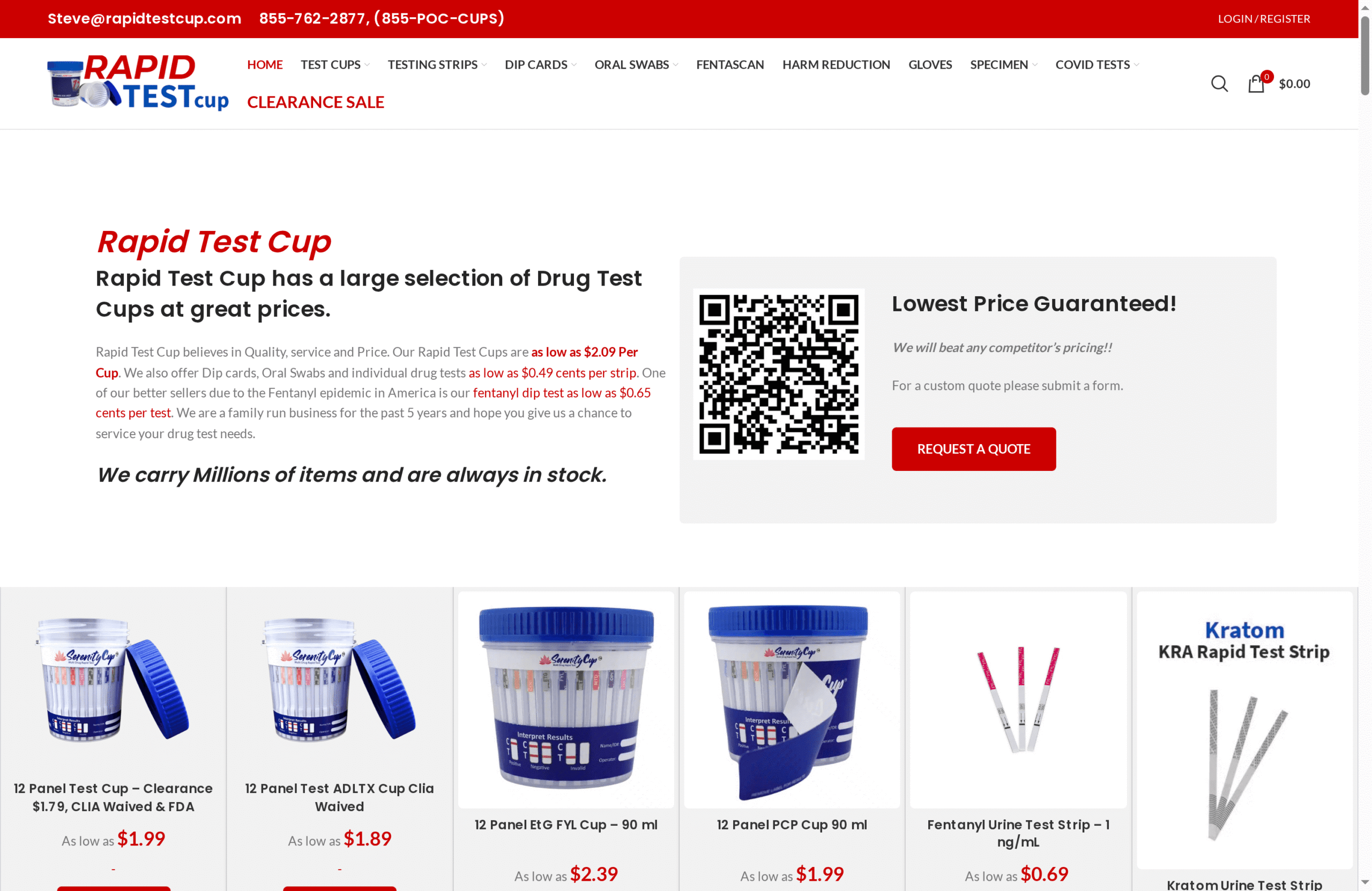
We carry multi-panel test cups, dip cards, urine test strips, oral swabs, fentanyl and adulterant detection options and specimen collection supplies, with bulk pricing and custom quotes available. Browse the full range in our shop, or look at a configuration such as the 15 panel drug test cup with adulterants if you are standardizing across locations.
If you are building an internal checklist alongside the audit, our 7-step drug screening checklist is a good companion. For the supplies themselves, see our guide to specimen collection tools.
FAQ
Who is responsible for auditing a DOT collection site?
The employer. Federal guidance attributes compliance to the employer rather than the service agent, so you remain responsible for confirming that the collection sites you use follow the DOT rules, even when a third-party administrator arranges the collections.
How often should a collection site be audited?
The rules we cite set a benchmark for federal agencies, not a fixed schedule for private employers: they inspect 5 percent of the sites they use each year, up to 50. Many programs audit new sites before first use and then on a recurring schedule set in their written policy, plus after any pattern of errors.
Can I use a DOT form for a non-DOT test?
No. DOT tests must be completely separate from non-DOT tests, and employers must not use DOT CCFs or Alcohol Testing Forms for non-DOT testing. If both kinds happen at one site, the DOT test is completed first.
How long must collection records be kept?
The SAMHSA manual calls for the collector’s copy of the federal CCF and other records to be stored securely for at least two years, in a way that protects donor confidentiality. Paper records can be converted to electronic form, and the original discarded after six months.
Sources
- Collection Site Manual 2024 – Urine (SAMHSA)
- Collection Site Checklist 2024 – Urine (SAMHSA)
- How to Monitor Collection Site Compliance, 2026 (FTA)
- How to Monitor Collection Site Compliance, 2023 (FTA)
- FTA Drug and Alcohol Newsletter, Issue 51
- 49 CFR Part 40 (eCFR)
- 49 CFR 40.33 (US DOT)
- 49 CFR 40.83 (Cornell LII)