

Blog
One Page Checklist: Urine Sample Stability Rules Labs Can Trust


If testing will be delayed, refrigerate the specimen at 2–8°C immediately. Most routine urine tests stay reliable for 24 to 48 hours under refrigeration, but treat 24 hours as your working limit unless your lab has validated longer holds. Room temperature is only safe for a few hours. Anything destined for confirmatory GC-MS or LC-MS work, or long-term archiving, belongs in a freezer at −20°C or colder.
TL;DR:
- Most routine urine tests remain reliable for up to 24 hours when refrigerated at 2–8°C, but holding times longer than that require validation.
- Urine specimens left at room temperature for more than 8 hours risk bacterial overgrowth, pH elevation, and analyte degradation, especially beyond 24 hours.
- Preservatives like boric acid and thymol are useful for extending stability during transport, but stronger acids require strict safety precautions and explicit patient instructions.
- Freezing samples at -20°C is suitable for confirmatory testing, but multiple freeze-thaw cycles beyond two can degrade metabolite integrity.
- For uneven analyte stability, water-soluble compounds tend to last longer at refrigerator temperatures, while lipophilic drug metabolites degrade faster at room temperature.
Table of Contents
- Urine Sample Stability at Room Temperature vs. Refrigeration
- Preservatives: Boric Acid, Thymol, and Safe Handling
- Freezing Rules: −20°C, −80°C, and Freeze-Thaw Limits
- Why Some Analytes Break Down Faster Than Others
- Transport and Chain-of-Custody: Keeping Temperature Documented
- A Point-of-Care Handling Checklist
- Publisher Perspective: The Equipment You Use Matters More Than People Admit
- Sources
Urine Sample Stability at Room Temperature vs. Refrigeration
Refrigeration at 2–8°C (roughly 36–46°F) is the default hold for any urine specimen that won’t reach the analyzer within two hours. That range matches a standard clinical refrigerator setting, not a special unit, which makes compliance easy for busy collection sites.
Room temperature is where things get risky faster than most staff expect. A specimen sitting on a counter is generally fine for 1 to 8 hours. Beyond that window, bacterial growth accelerates, pH climbs, and glucose and other labile compounds start breaking down. Some analytes hold up to 24 hours at room temperature, but the metabolomics evidence shows a clear split: stable at 22°C for 24 hours, not for 48.
If a specimen has been sitting at room temperature past the recommended window, don’t guess. Here’s what to do:
- Refrigerate it immediately, even if the delay already happened. Some stability is better than none.
- Log the actual elapsed time and temperature exposure on the requisition.
- Flag the sample for the receiving lab so they can decide whether results need a stability caveat or a recollection.
- For urgent toxicology or forensic chain-of-custody work, request a recollection rather than risk a challenged result.
Preservatives: Boric Acid, Thymol, and Safe Handling
Chemical preservatives buy time when refrigeration isn’t practical, particularly for 24-hour collections or long courier transport. Boric acid remains the default for routine 24-hour urine collections because it’s cheap, widely stocked, and effective against bacterial overgrowth. Thymol, though, outperformed boric acid in some metabolomics testing conditions, so labs running biomarker or metabolite panels should match the preservative to the downstream assay rather than defaulting out of habit.
Preservatives typically get used for:
- 24-hour urine collections where the patient can’t refrigerate between voids.
- Nonrefrigerated transport exceeding a few hours.
- Specific biomarker or hormone assays where the manufacturer specifies a preservative.
Some 24-hour collection containers use strong acids, and these require real precautions. Staff dispensing acid-preserved containers need gloves, clear labeling identifying the preservative, and explicit patient instructions warning against direct skin contact or removing the cap unnecessarily.
Pro Tip: Never assume a patient read the preservative warning label. Walk through it verbally, especially for acid-based containers going home with someone unsupervised.
Freezing Rules: −20°C, −80°C, and Freeze-Thaw Limits
Freezing is appropriate whenever a sample is intended for confirmatory testing or long-term storage, and following recommended peptide storage temperature guidelines can help maintain sample integrity. Routine confirmatory work typically uses −20°C storage. Research biobanking aiming for very long preservation employs −80°C to reduce degradation.
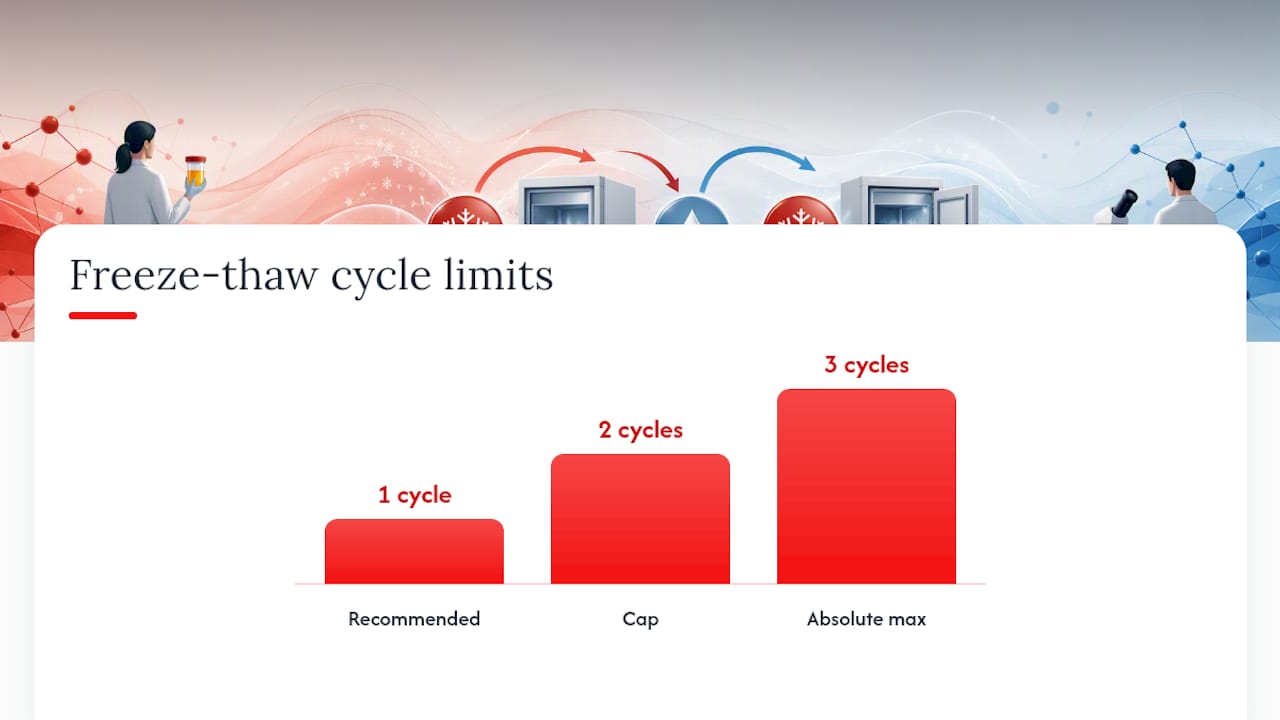
The freeze-thaw cycle is a critical factor where otherwise good specimens may degrade. Targeted metabolomics research found that repeated freeze-thaw cycles beyond two altered concentrations for a subset of metabolites, even when the sample looked and smelled fine.
- Aliquot every sample before its first freeze. One thaw, one test, no exceptions where possible.
- Cap freeze-thaw cycles at two, three at the absolute most, for any specimen tied to a quantitative result.
- Default to frozen storage for anything bound for GC-MS or LC-MS confirmatory analysis.
Why Some Analytes Break Down Faster Than Others
Stability isn’t uniform across a urine sample. Some compounds hold steady through days of mishandling; others start degrading within hours. This is the piece most generic storage advice skips entirely, and it’s the piece that actually determines whether your result holds up.
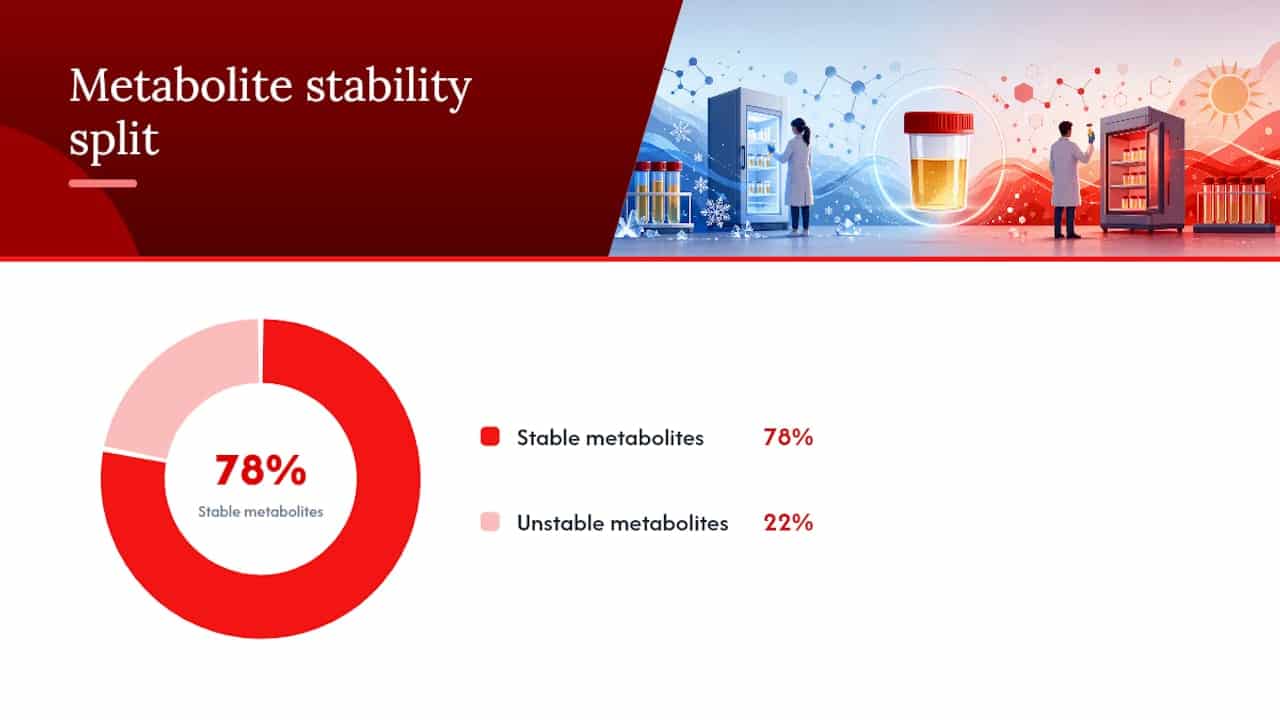
Targeted metabolite studies found that roughly 78% of tested metabolites remained stable across common storage conditions, which sounds reassuring until you look at the other 22 percent. Certain amino acids dropped off measurably at room temperature within 24 hours. THC-COOH and other lipophilic drug metabolites behave differently from water-soluble compounds, and a systematic review of drugs-of-abuse stability found that cathinones, cannabis metabolites, morphine, codeine, and cocaine all lose stability faster at room temperature than refrigerated or frozen counterparts.
Most metabolites tolerate 4°C storage for 24 to 48 hours without meaningful change. The exceptions are what separate a defensible result from a disputed one. When you’re running an assay you don’t handle daily, pull the manufacturer’s stability table before assuming your standard SOP covers it. Generic guidance is a starting point, not a substitute for analyte-specific data.
Transport and Chain-of-Custody: Keeping Temperature Documented
A specimen can be stored perfectly at the collection site and still fail once it’s in transit. Courier gaps are where stability data gets thrown out the window, mostly because nobody tracked what happened between pickup and drop-off.
- Attach a temperature indicator or data logger for any shipment longer than a couple of hours; don’t rely on memory or assumption.
- Treat a single cool pack as good for roughly 8 hours, not a full day. Beyond that, insulation fails and the pack warms to ambient.
- Record collection time, the moment refrigeration or freezing began, and any temperature readings taken along the route. Ship this documentation with the specimen, not separately.
- Reject or flag specimens with unexplained delays, missing temperature logs, or visible signs of spoilage such as unusual odor or cloudiness.
Pro Tip: If your courier can’t confirm cold-chain continuity in writing, treat the shipment as compromised, not just questionable. A verified temperature monitoring approach protects both your results and your chain-of-custody documentation if a result is ever challenged.
A Point-of-Care Handling Checklist
Most stability problems trace back to the first ten minutes after collection, not the storage that follows. Get this part right and everything downstream gets easier.
- Label the container, seal it, and record the exact collection time before doing anything else.
- Run a quick temperature strip check if your collection cup includes one, confirming the sample is within physiological range and hasn’t been substituted.
- If testing won’t happen within 2 hours, move the sample to 2–8°C refrigeration immediately and log the start time on the requisition.
- For samples requiring long-term storage, aliquot before freezing and record every freeze-thaw event on the specimen log.
Following a step-by-step handling sequence rather than winging it site-by-site is what keeps a lab’s stability outcomes consistent across shifts and staff.
Publisher Perspective: The Equipment You Use Matters More Than People Admit
Storage temperature gets all the attention, but the collection cup and container quality set the ceiling for everything that follows. A validated cup with a reliable temperature strip catches problems at the point of collection, before a bad specimen ever reaches refrigeration or a courier. Rapidtestcup builds its 12 panel and multi-panel test cups with that first checkpoint in mind, alongside adulteration test strips and specimen collection guidance built for exactly this workflow.
Write your SOP around manufacturer stability data, not generic assumptions, and freeze-thaw problems and disputed results both drop sharply.
— Justin