Blog
95% vs 21%: Oral Swab Accuracy Explained for Clinics and Labs


Oral swab accuracy typically lands in the 80% to 95%+ sensitivity and specificity range for well-validated drug screening devices, but pathogen detection is more variable: SARS-CoV-2 sensitivity runs about 0.80 to 0.82 versus nasopharyngeal swabs, and TB oral swabs swing anywhere from 36% to 91% sensitivity. The real number depends heavily on the device, the analyte, and whether a lab confirms the result.
TL;DR:
- Oral swab accuracy for drug testing often exceeds 80%, but performance varies significantly depending on the analyte and the device used.
- SARS-CoV-2 oral swab tests typically have close to 0.80 to 0.82 sensitivity, with sensitivity decreasing at lower viral loads and in asymptomatic cases.
- Tuberculosis oral swab sensitivity ranges from 36% to 91%, primarily influenced by collection protocol and processing methods.
- Collection technique, handling, and assay thresholds greatly affect test sensitivity and specificity, making quality control essential.
- Confirmatory testing is necessary for high-stakes results, as device variability and protocol deviations can significantly impact accuracy.
Table of Contents
- What Do Oral Swab Accuracy Numbers Actually Mean?
- Does Oral Swab Accuracy Change by Use Case?
- What Factors Change Oral Swab Test Accuracy the Most?
- Oral Swabs vs. Urine, Blood, and Nasopharyngeal Swabs: Which Wins?
- How Do You Get the Most Reliable Oral Swab Results?
- Why Oral Swab Accuracy Claims Deserve More Scrutiny, Not Less
- Where to Get Validated Oral Swab and Confirmation Supplies
- Sources
What Do Oral Swab Accuracy Numbers Actually Mean?
Sensitivity tells you how often a test correctly flags a true positive. Specificity tells you how often it correctly clears a true negative. Neither number alone tells you whether a positive result on your specific swab is trustworthy, because that depends on positive predictive value (PPV) and negative predictive value (NPV), which shift with how common the condition or drug use actually is in the population being tested.
A test with 90% sensitivity and 90% specificity looks great on paper. Run it on a population where actual drug use is rare, and PPV drops fast, meaning a chunk of “positive” results are false alarms. Run the same test where use is common, and PPV climbs. This is why device-evaluation reports rarely hand out a single accuracy figure and call it done.
- Well-validated oral fluid drug screens often report sensitivity and specificity above 80% for common analytes, with some devices exceeding 95%.
- SARS-CoV-2 molecular oral swab testing shows adjusted sensitivity around 0.80 to 0.82 compared with nasopharyngeal swabs in some studies.
- TB oral swab sensitivity ranges from 36% to 91% in adults, with specificity usually above 90%.
Statistic Callout: One DOT device-evaluation study found sensitivity for certain analytes dropping as low as 21% to 37% on specific devices, even while other models on the same panel topped 95%. Confidence intervals matter here too; a reported sensitivity of 0.82 with a 95% CI of 0.72 to 0.89 is a meaningfully different claim than a flat “82% accurate.”
Does Oral Swab Accuracy Change by Use Case?
Yes, and the gap between drug screening and pathogen detection is bigger than most buyers expect. A device that performs well for opioids might stumble on benzodiazepines, and a swab protocol built for viral RNA doesn’t automatically transfer to bacterial DNA.
Drug screening. Device-evaluation data shows many oral fluid cups and cartridges exceed 80% sensitivity and specificity across several drug classes, but performance is analyte-specific. Benzodiazepines and certain THC assays tend to underperform relative to opioids and stimulants on the same device. That inconsistency is exactly why confirmatory LC-MS/MS testing exists as a backstop for presumptive positives, especially in workplace or legal contexts where a wrong call has consequences.
SARS-CoV-2 and respiratory pathogens. Multicenter research puts oral swab adjusted sensitivity around 0.82 compared with provider-collected nasopharyngeal swabs, while saline gargle samples reached closer to 0.90 sensitivity. Performance also tracks with viral load: high Ct values (low viral load) are where oral swabs are most likely to miss a case, and asymptomatic carriers with lower shedding are harder to catch than symptomatic patients.
Tuberculosis. This is the widest accuracy range of any use case covered here. Systematic review data shows adult sensitivity anywhere from 36% to 91%, with specificity generally above 90% regardless of the sensitivity swing. The variable isn’t the disease, it’s the collection: tongue swabbing and optimized processing protocols consistently push sensitivity toward the higher end of that range.
| Use case | Reported sensitivity | Reported specificity | Main accuracy driver |
|---|---|---|---|
| Drug screening (multi-analyte) | Often >80%, some devices >95% | Often >80%, some devices >95% | Device and analyte selection |
Oral swabs are well suited to recent drug use detection and self-collected respiratory screening. They’re a weaker standalone choice for TB without an optimized protocol, and any presumptive positive in a high-stakes setting still belongs in a lab for confirmation.
What Factors Change Oral Swab Test Accuracy the Most?
Accuracy isn’t fixed at the device level. It moves based on how the swab is collected, handled, and processed, sometimes by a wide margin.
- Collection technique. Tongue swabbing versus cheek swabbing, and single versus double swabbing, changes how much biological material actually reaches the test strip. TB studies specifically show higher sensitivity with tongue-focused collection and greater biomass capture.
- Assay technology. Rapid immunoassay screens trade sensitivity for speed; molecular NAAT-based tests take longer but generally detect lower concentrations of target material.
- Analyte and cutoff thresholds. A cutoff set too high misses low-level recent use; set too low, and cross-reactivity produces false positives. Benzodiazepines and certain THC formulations are the most cutoff-sensitive analytes in device evaluations.
- Device manufacturing variability. Evaluation data documented failure rates exceeding 25% for specific models on specific analytes, which is a reminder that “oral swab” isn’t one product, it’s a category with real quality spread.
- Pre-analytical handling. Storage temperature, transport time, freezing, and oral contaminants like food, mouthwash, or acidic drinks right before sampling can all skew a result before the test even runs.
- Operational QA. Staff training and lot verification catch problems that a single device spec sheet never will.
Pro Tip: If a testing program sees an unexplained cluster of negatives, check collection technique and timing before blaming the device. Improper swab volume or technique is a well-documented, low-visibility cause of false negatives in point-of-care oral testing.
Rapidtestcup’s breakdown of factors that influence drug test accuracy goes deeper on cutoff thresholds and collection standards for programs building out formal protocols.
Oral Swabs vs. Urine, Blood, and Nasopharyngeal Swabs: Which Wins?
None of these specimen types wins across the board, and picking the wrong one for the goal is a common, avoidable mistake.
- Detection window: oral fluid is best for recent use, typically hours to a couple of days; urine catches metabolites over a longer window, often several days.
- Adulteration resistance: oral swabs are harder to tamper with under direct observation than urine, which is why forensic and workplace programs often favor them for on-site collection.
- Drug-class trade-offs: paired-sample research found urine prevalence higher for drugs like cocaine and methadone, while oral fluid performed as well or better for buprenorphine and tramadol.
- Respiratory pathogens: nasopharyngeal swabs remain the most sensitive standard in clinical settings, but self-collected oral or combined oral-nasal swabs are acceptable substitutes in many outpatient and at-home scenarios.
Rapidtestcup’s comparison of urine versus saliva drug tests walks through these trade-offs by drug class for programs deciding between matrices. For a broader specimen-type comparison outside drug testing, Total Tox’s hair follicle versus urine breakdown is a useful outside reference on why programs mix matrices rather than rely on one.
How Do You Get the Most Reliable Oral Swab Results?
Getting reliable numbers out of an oral swab program is less about buying the “best” device and more about controlling the handful of variables that actually move accuracy.
- Observe collection and control timing. Require patients or donors to avoid food, drink, and mouthwash for at least 10 to 15 minutes before sampling, and observe the swab process directly when possible.
- Use tongue or double-swab technique where supported. Evidence from TB testing shows this materially improves sensitivity when biomass collection is the limiting factor.
- Select assays with published validation data. Don’t assume every device on a panel performs the same; check analyte-specific sensitivity and specificity before deploying at scale.
- Confirm presumptive positives. Route anything with legal, employment, or clinical stakes through LC-MS/MS for drugs or NAAT for pathogens before acting on it.
- Run QA on staff, lots, and storage. Document temperature control, train collectors consistently, and set clear repeat-testing triggers when results look inconsistent.
Pro Tip: Keep a simple log of device lot numbers against results. If a specific lot starts producing outlier negatives or positives, that pattern shows up in the log long before anyone notices it anecdotally.
Rapidtestcup’s guide to choosing accurate drug test kits and its best-practices resource both walk through this checklist in more operational detail for programs setting up formal protocols.
Why Oral Swab Accuracy Claims Deserve More Scrutiny, Not Less
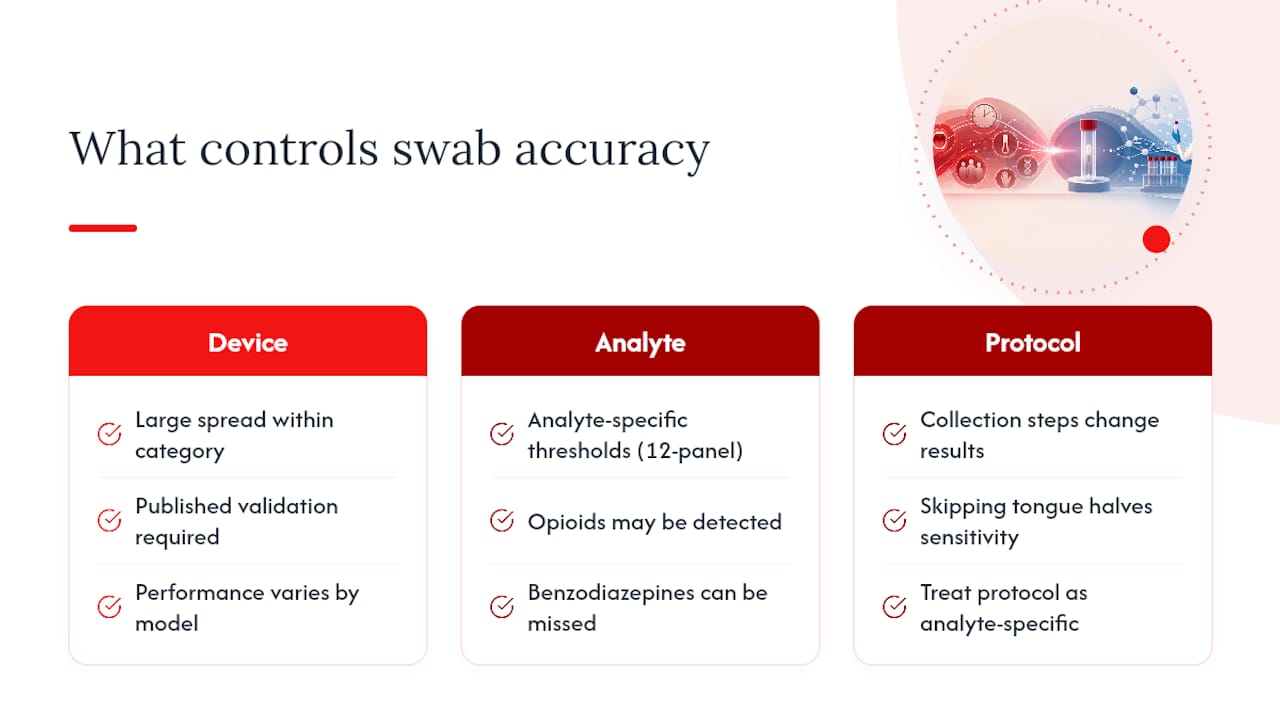
The biggest misconception about oral swab accuracy is that it’s a fixed property of the specimen type. It isn’t. It’s a property of the specific device, the specific analyte, and the specific collection protocol, and the spread between the best and worst performers in the same category is larger than most buyers assume.
Justin’s take, drawing on device-evaluation data across drug and pathogen testing: the programs that get burned aren’t the ones using oral swabs, they’re the ones treating every oral swab as interchangeable. A device that nails opioids can still miss benzodiazepines. A TB protocol that skips tongue swabbing can cut sensitivity by half. Rapidtestcup’s own 12-panel mouth swab product page lists analyte-specific detection thresholds precisely because that granularity is what separates a defensible result from a guess. The honest recommendation, always, is to choose devices with published validation for your target analytes and confirm anything that matters before you act on it.
— Justin
Where to Get Validated Oral Swab and Confirmation Supplies
Rapidtestcup is built for buyers who need consistent, analyte-specific accuracy rather than a one-size-fits-all screening cup. That means CLIA-waived, FDA-listed oral swab and multi-panel options with published detection thresholds, plus the adulteration and confirmation supplies that let a program actually follow through on a presumptive positive instead of guessing.
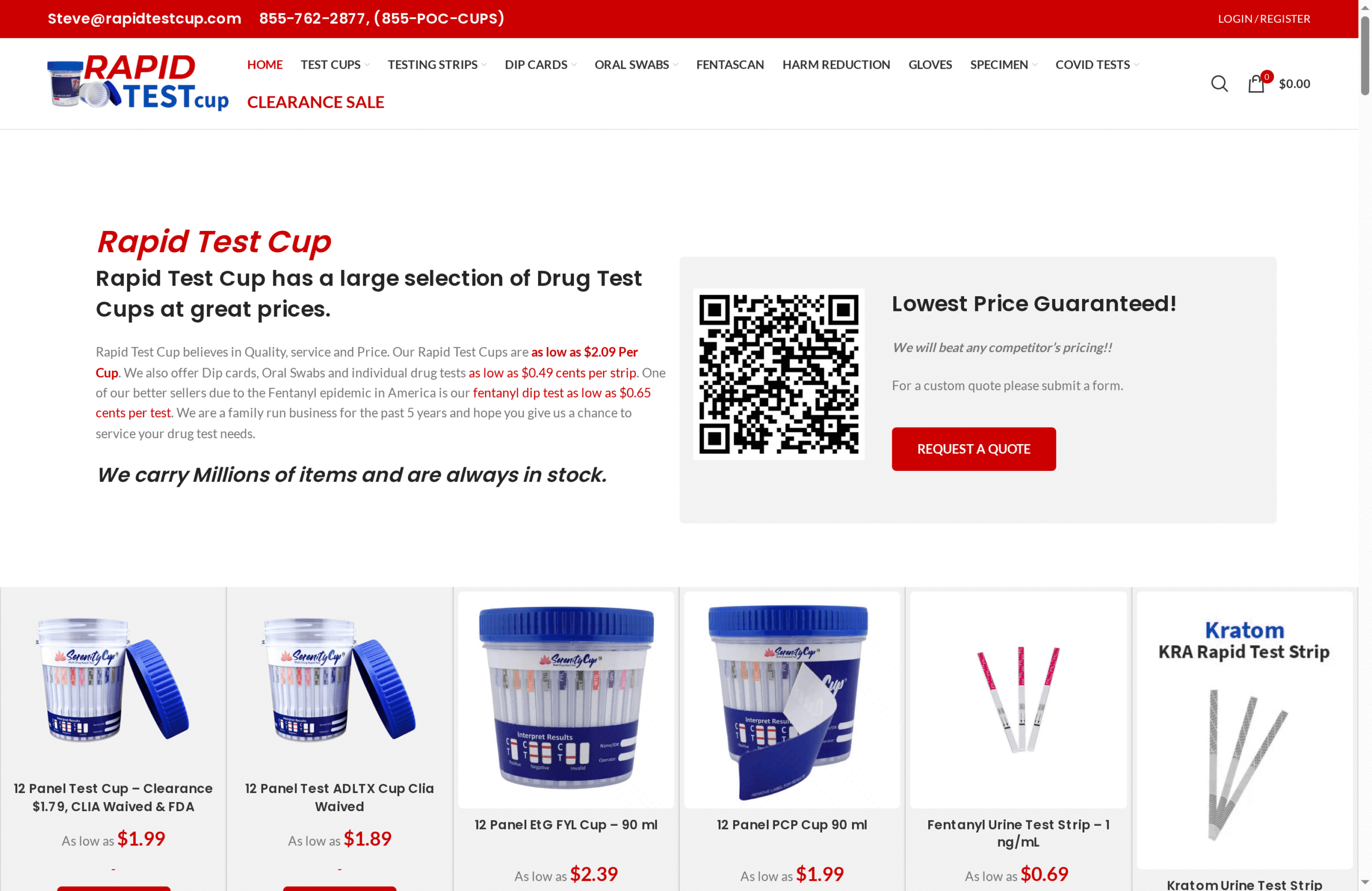
The catalog covers multi-panel test cups, oral swab panels, adulterant detection strips, and specimen collection tools sized for everything from a single clinic to a bulk forensic order. Laboratories and treatment programs get volume pricing and custom quotes; individual buyers get the same validated devices without a minimum order wall. If a testing program needs to standardize on devices with documented sensitivity and specificity instead of whatever’s cheapest that week, the 18-panel drug test cup with adulterant screening is a practical starting point to check availability and pricing today.
This article is general information, not a substitute for advice from a qualified doctor. Consult a qualified healthcare professional about your own circumstances before acting on anything here.