Blog
Stop Mislabeling Devices: FDA Cleared vs Approved for U.S. Buyers


FDA cleared and FDA approved are not interchangeable terms. Clearance (510(k)) means the FDA agreed a device is substantially equivalent to a product already on the market; approval (PMA) means the agency reviewed original evidence and found reasonable assurance of safety and effectiveness. Most moderate-risk (Class II) devices go through clearance, while higher-risk (Class III) devices need approval. You can verify either status directly through Devices@FDA.
TL;DR:
- A device labeled as FDA cleared may not have undergone rigorous clinical evaluation, unlike FDA approved devices which require substantive evidence of safety and effectiveness.
- Confirm the specific submission number and predicate device for 510(k) clearances, as a weak or outdated predicate can lead to extended review cycles or unintended classification pathways.
- The FDA approval process for Class III devices involves extensive clinical trials and inspections, often taking years, compared to the shorter clearance process for lower-risk devices.
- Verifying a device’s true regulatory status through the FDA database is quick, essential, and protects against false advertising and regulatory misrepresentation.
- Using imprecise language claiming FDA approval for a cleared device can lead to legal and enforcement actions, so accurate terminology is crucial for compliance.
Table of Contents
- FDA Cleared vs Approved: Comparing the Regulatory Pathways
- Understanding the 510(k) Clearance Pathway
- Understanding the PMA Approval Pathway
- De Novo, EUA, and Registration: What They Actually Mean
- How to Verify a Device’s Regulatory Status
- Why the Cleared vs Approved Distinction Actually Matters
- What to Ask Before You Buy or Recommend a Device
- Why Getting This Terminology Right Matters More Than People Think
- Where to Verify FDA Status Yourself
- Sources
FDA Cleared vs Approved: Comparing the Regulatory Pathways
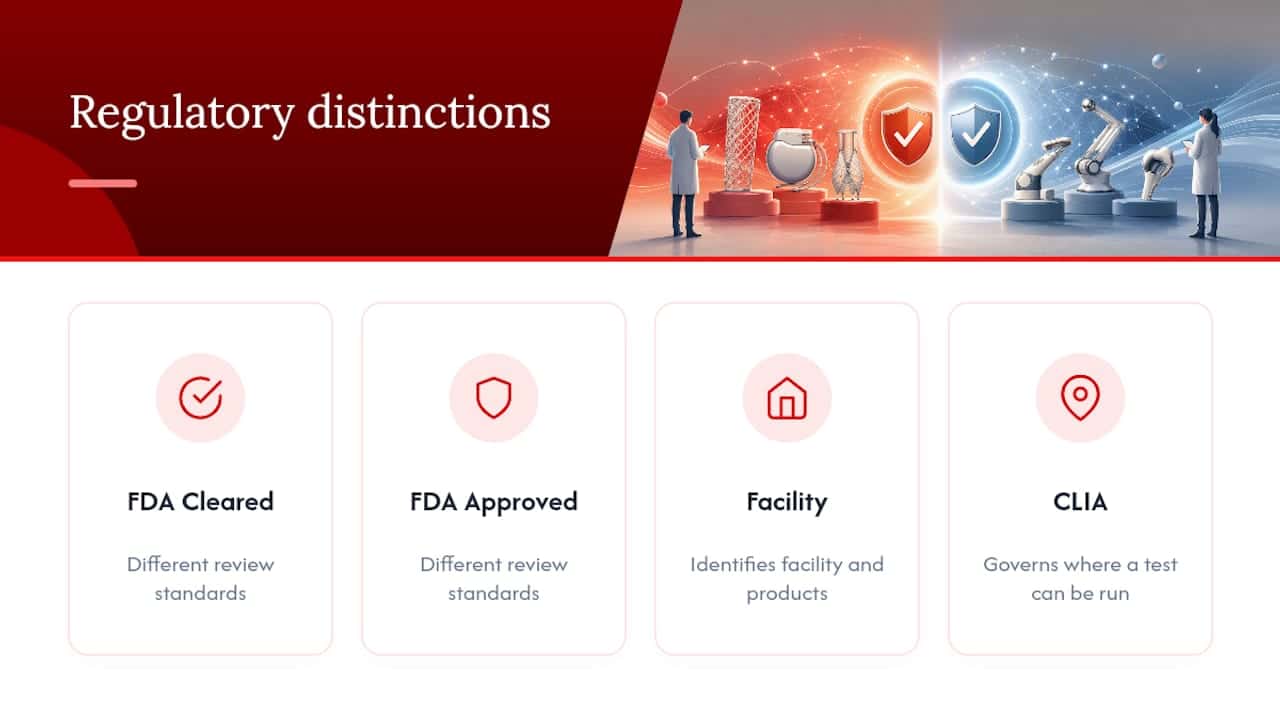
The two terms describe entirely different review standards, not two flavors of the same approval.
Registration and listing simply tell the FDA a facility exists and what it makes. The agency has confirmed it does not issue “FDA registered” or “FDA certified” status for devices, so that phrase alone tells you nothing about safety review. For diagnostic tests specifically, a CLIA waiver is a separate designation from CMS that governs where a test can be run, not whether the FDA reviewed it.
Understanding the 510(k) Clearance Pathway
Clearance rests on one legal question: is this device substantially equivalent to a predicate device already legally marketed in the U.S.? The predicate does most of the heavy lifting. If a manufacturer can show similar intended use and similar technological characteristics, the FDA typically does not require a new clinical trial.
Evidence packages usually include:
- Bench testing data comparing performance to the predicate
- Biocompatibility and electrical safety testing where applicable
- Limited clinical data, only when bench testing can’t resolve a safety question
Review generally runs 3 to 6 months, assuming the submission is complete. The most common pitfall is choosing a weak or outdated predicate. A poor predicate choice can trigger extended review cycles or force a manufacturer into a De Novo or PMA pathway it never planned for.
Pro Tip: When evaluating a supplier’s cleared device, ask for the actual 510(k) number and the name of the predicate device. If they can’t produce either, treat the “FDA cleared” claim as unverified.
Understanding the PMA Approval Pathway
PMA applies almost exclusively to Class III devices, the category tied to sustaining life or presenting significant injury risk. The evidentiary bar is fundamentally different from clearance: instead of comparing a device to something already on the market, the manufacturer has to independently prove reasonable assurance of safety and effectiveness.
That proof typically involves:
- Clinical trials conducted under an Investigational Device Exemption (IDE)
- Facility inspections and, for some submissions, an FDA advisory panel review
- Post-approval study commitments the manufacturer must honor after launch
PMA review often stretches across many months or multiple years, reflecting the depth of clinical evidence involved. Once approved, changes to the device, its labeling, or its manufacturing process usually require a new supplement filing, not a quiet update. That regulatory rigidity is the tradeoff for the stronger safety claim “approved” carries.
De Novo, EUA, and Registration: What They Actually Mean
Not every FDA status fits neatly into cleared or approved. Three other terms show up constantly and get misread just as often.
- De Novo: used for novel, low to moderate risk devices with no existing predicate. A granted De Novo request creates a brand-new device classification, which future products can then use as a predicate for their own 510(k).
- Emergency Use Authorization (EUA): a temporary authorization tied to a declared public health emergency. It is not approval, and it typically expires or requires a full submission once the emergency ends.
- Registration and listing: purely administrative. A company registers its facility and lists its products, but the FDA has not reviewed anything at that point.
How to Verify a Device’s Regulatory Status
Don’t take a label’s word for it. Confirming a claim takes minutes.
- Search Devices@FDA using the exact product name, company name, or submission number rather than a general keyword.
- Confirm the submission type listed. 510(k), PMA, De Novo, and EUA all show up differently, and the summary documents note any conditions or limitations attached to the clearance or approval.
- Check for recalls or reclassifications. The FDA has removed problematic predicates and reclassified device types when new safety data emerged, so a clearance from five years ago may not reflect current standing.
- Document what you found, including the submission number and date checked, in your procurement file.
Why the Cleared vs Approved Distinction Actually Matters
Clinical confidence should scale with the evidence behind a claim. A PMA-approved device carries independent trial data; a 510(k)-cleared device carries a comparison argument. Neither is automatically the wrong choice, but conflating the two skews how much certainty a clinician or purchaser should assume.
The legal stakes are real, too:
- Calling a 510(k)-cleared device “FDA approved” in marketing material can expose a company to false advertising claims under the Lanham Act and state consumer protection statutes.
- The FDA treats inaccurate terminology as a potential misbranding issue, not a marketing quirk.
- Vendors can face FDA and FTC enforcement action over advertising that overstates regulatory status.
Regulatory reality check: the FDA itself states plainly that registration does not equal approval, clearance, or authorization of any kind, which is exactly the gap most marketing copy tries to blur.
What to Ask Before You Buy or Recommend a Device
The difference between a smart purchase and a liability starts with a short list of questions.
- Ask for the specific 510(k), PMA, or De Novo number, not just a checkbox claim.
- Ask what the predicate device was, if the product is 510(k)-cleared.
- Ask whether post-market surveillance or a post-approval study is ongoing.
- For diagnostics, confirm CLIA-waived status separately from FDA status, since the two programs are not the same thing.
In high-stakes clinical settings, lean toward PMA-approved devices when independent trial data genuinely matters to the outcome. For routine, lower-risk applications, a well-supported 510(k) clearance is often the practical and appropriate choice.
Pro Tip: Small clinics without a dedicated regulatory staffer should keep a one-page log of submission numbers for every device or test kit in use. It takes ten minutes and saves hours if a recall notice ever lands in your inbox.
Why Getting This Terminology Right Matters More Than People Think
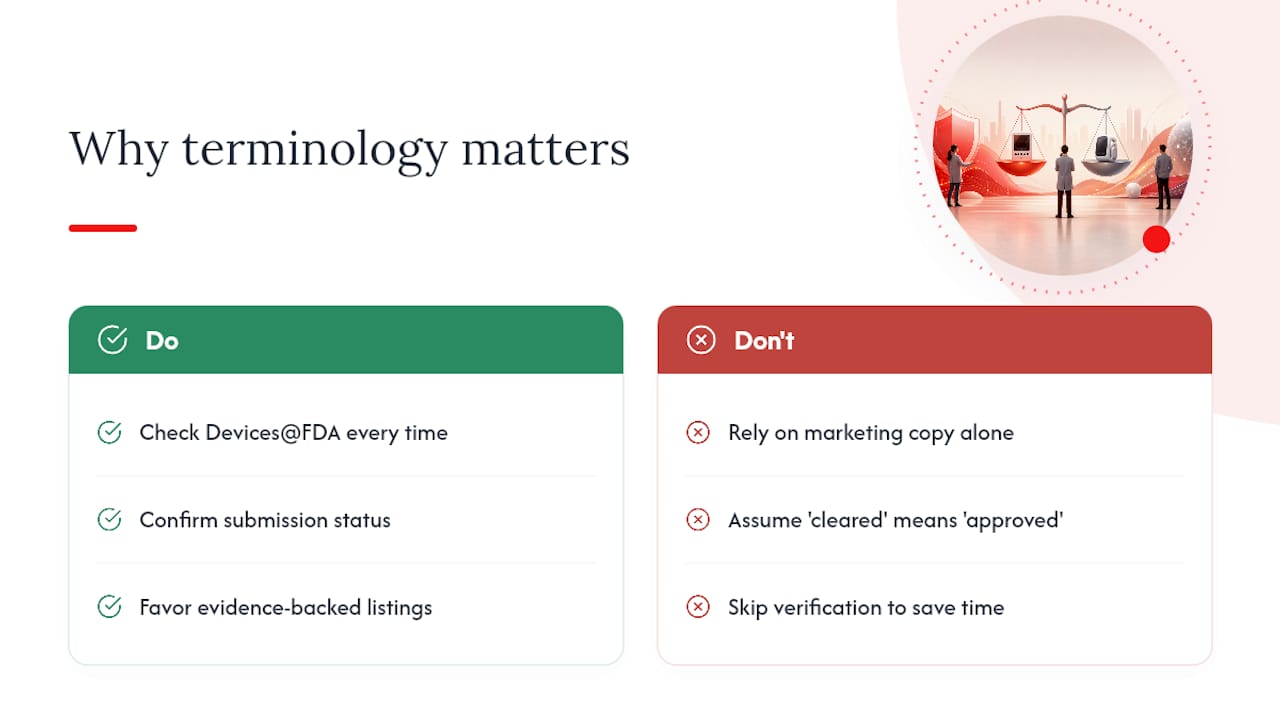
Precise language around FDA status is not a compliance formality. It is the difference between a purchasing decision grounded in evidence and one grounded in marketing copy that sounds more official than it is. The client emphasizes the importance of aligning product listings with the actual submission status of each item, because a mislabeled claim creates risk for the buyer, not just the seller.
The habit worth building is simple: check Devices@FDA before you trust a label, every single time, whether you are a hospital procurement lead or a parent buying an at-home test. The five minutes it takes is cheaper than the alternative.
— Justin
Where to Verify FDA Status Yourself
Ready to buy compliant testing supplies? Browse Rapidtestcup’s 18 panel drug test cup with fentanyl and adulterant detection for workplace and clinical programs that need documented, verifiable regulatory status.
This article is general information, not a substitute for advice from a qualified doctor. Consult a qualified healthcare professional about your own circumstances before acting on anything here.
Sources
- Premarket Approval (PMA) | FDA
- FDA approved vs FDA cleared in advertising: False advertising implications | NYS STLC