Blog
Why compliance matters in drug testing: Critical insights


TL;DR:
- Compliance with federal drug testing laws is an ongoing process, not a one-time check.
- Proper procedures include certified labs, chain-of-custody, MRO review, and five-year recordkeeping.
- Leadership involvement and proactive audits are key to ensuring effective and compliant drug testing programs.
Drug testing compliance is not a formality you check off once a year and forget. For healthcare employers, substance abuse program administrators, and safety-sensitive industry operators, non-compliance with federal drug testing regulations can trigger fines, audits, operational shutdowns, and civil liability. The gap between organizations that treat compliance as a living process and those that treat it as paperwork is exactly where regulatory exposure lives. This guide breaks down the legal frameworks, financial risks, procedural requirements, and gray areas that every compliance-minded professional needs to understand in 2026.
Table of Contents
- Understanding drug testing compliance: Laws, agencies, and essentials
- Why compliance matters: Legal, financial, and operational risks
- What compliance looks like: Procedures, testing panels, and recordkeeping
- Special insights: Gray areas, challenges, and contested policies
- The compliance mindset: What most organizations miss
- Bringing compliance to life: Tools and resources that help
- Frequently asked questions
Key Takeaways
| Point | Details |
|---|---|
| Legal risks | Non-compliance with drug testing regulations can lead to serious fines and operational shutdowns. |
| Financial impact | Substance abuse and compliance failures cost employers thousands per employee each year. |
| Essential procedures | Correct panels, certified labs, and accurate records are critical for avoiding costly mistakes. |
| Continuous updates | Federal guidelines and best practices evolve; annual review is required for robust compliance. |
Understanding drug testing compliance: Laws, agencies, and essentials
Two federal frameworks anchor virtually every workplace drug testing obligation in the United States. The first is DOT 49 CFR Part 40, which governs testing procedures for safety-sensitive transportation workers. The second is the SAMHSA Mandatory Guidelines, which set standards for federal workplace drug testing programs. Both are enforceable, regularly updated, and non-negotiable for covered employers.
The Department of Transportation (DOT) and the Substance Abuse and Mental Health Services Administration (SAMHSA) are the primary agencies enforcing these standards. DOT oversees testing for commercial drivers, pilots, railroad workers, and other federally regulated roles. SAMHSA certifies the laboratories that process those tests and publishes the cutoff levels and panel requirements that labs must follow.
For a program to be fully compliant in practice, it must include several interconnected components. According to DOT employer requirements, programs need DOT-qualified collection sites, SAMHSA-certified laboratories, Medical Review Officer (MRO) review of results, Substance Abuse Professional (SAP) evaluation after violations, documented chain-of-custody, and a minimum of five years of recordkeeping.
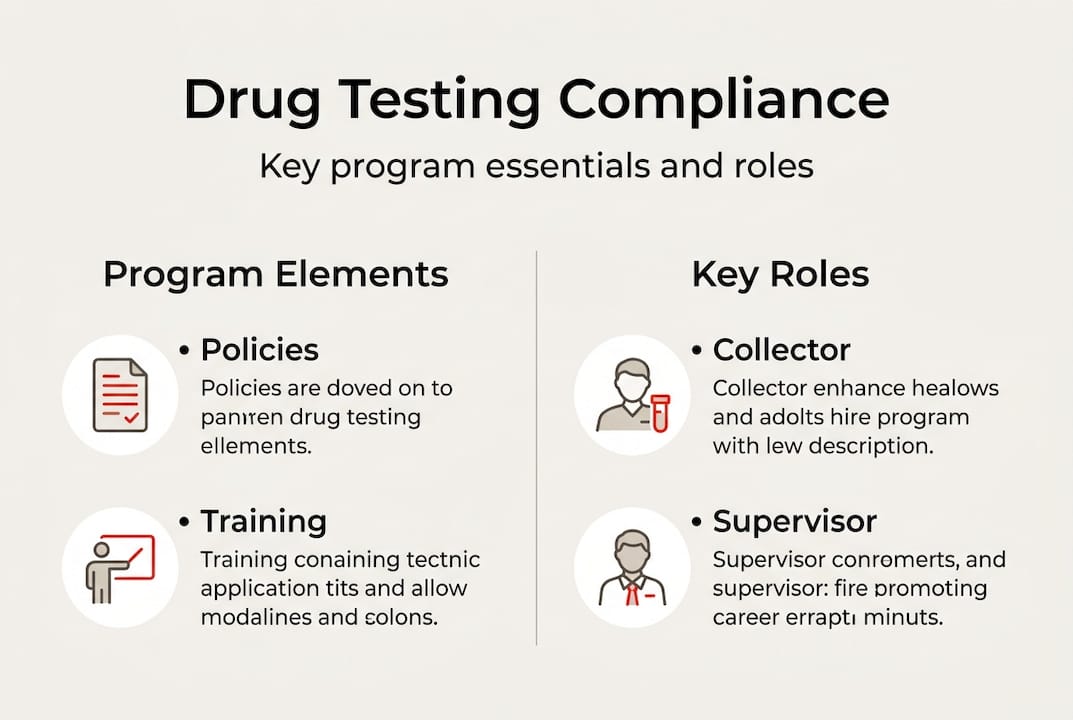
Key compliance responsibilities by role
| Role | Primary responsibility |
|---|---|
| Employer | Policy development, service agent oversight, recordkeeping |
| Healthcare administrator | Specimen integrity, staff training, MRO coordination |
| Collector | Chain-of-custody documentation, proper collection procedures |
| Certified laboratory | Immunoassay screening, GC/MS confirmation, result reporting |
Even organizations with solid policies make avoidable mistakes. Watch for these common compliance pitfalls:
- Using non-SAMHSA-certified laboratories for federally regulated testing
- Failing to document chain-of-custody at every handoff
- Skipping MRO review before reporting a positive result to the employer
- Relying on outdated testing panels that no longer meet current SAMHSA cutoff standards
- Incomplete or missing five-year records during an audit
- Not verifying the credentials of third-party service agents before contracting with them
Each of these errors can independently trigger a regulatory violation. Together, they can expose an organization to serious liability.
Why compliance matters: Legal, financial, and operational risks
Compliance is not just about following rules. It is about protecting your organization from financial and legal exposure that compounds quickly when ignored. The numbers are stark.
Substance abuse costs employers over $7,000 per affected employee annually, driven by absenteeism averaging 25 days versus 13 for unaffected workers, healthcare costs running 300% higher, and elevated turnover. Nationally, the total economic burden ranges from $81 billion to $400 billion per year.
Cost of non-compliance and substance abuse: Data snapshot
| Category | Impact |
|---|---|
| Per-employee annual cost | $7,000+ above baseline |
| Absenteeism difference | 25 days vs. 13 days per year |
| Healthcare cost increase | 300% higher for affected employees |
| National economic burden | $81B to $400B annually |
| DOT violations reported since 2020 | 326,795 |
“Since 2020, the DOT Clearinghouse has recorded 326,795 drug and alcohol violations, with 81% being positive drug tests. Marijuana accounts for over 55% of those positives, and 184,400 drivers have been prohibited from operating commercial vehicles.”
Those numbers reflect the scale of the problem, but they also underscore why compliant testing programs reduce risk. Organizations with active testing and employee assistance programs (EAPs) see measurable reductions in turnover and healthcare spend. The benefits of compliance-driven testing go well beyond regulatory adherence.
Here are immediate steps to reduce your organization’s exposure:
- Audit your current service agent contracts and verify all credentials
- Confirm your laboratory holds active SAMHSA certification
- Review your MRO’s qualifications and current certification status
- Update your written drug testing policy to reflect 2026 panel and cutoff changes
- Conduct a mock audit using DOT inspection criteria before your next scheduled review
Pro Tip: Don’t wait for an actual audit to find gaps. Run a mock audit internally every six months, and cross-check your service agents’ credentials against the current SAMHSA-certified lab list. Catching a lapsed certification before an inspector does is the difference between a corrective action and a shutdown.
The financial and policy case for compliance is well established. What separates high-risk organizations from low-risk ones is how consistently they execute on it. A practical compliance framework is not optional for covered employers.
What compliance looks like: Procedures, testing panels, and recordkeeping
Knowing the rules matters. Executing them correctly is where organizations succeed or fail. A compliant drug test follows a specific sequence, and any break in that chain creates legal exposure.
Here is how a fully compliant test runs from start to finish:
- The employee is directed to a DOT-qualified collection site with proper notice and identification
- The collector follows federal protocols for specimen collection, including temperature verification and tamper-evident sealing
- Chain-of-custody documentation is completed at every handoff, from collector to courier to lab
- A SAMHSA-certified lab performs immunoassay screening, followed by GC/MS confirmation for any presumptive positive
- The MRO reviews confirmed positives, contacts the donor for legitimate medical explanations, and reports the final result
- If a violation is confirmed, the SAP evaluates the employee and recommends a treatment or education program
- All records are stored securely for a minimum of five years
For panel selection, SAMHSA’s updated mandatory guidelines specify required substances and cutoff concentrations. The standard federal 5-panel urine test covers amphetamines, cocaine, marijuana metabolites, opioids, and PCP. These panels are updated annually, and using an outdated version in a federal program is a direct compliance failure.
What makes a panel compliant under SAMHSA standards:
- Substances tested must match the current authorized panel list
- Cutoff concentrations must meet published SAMHSA thresholds
- Screening method must be immunoassay; confirmation must be GC/MS or equivalent
- Urine is the preferred specimen for federal programs
- Any presumptive positive must be confirmed before reporting
Healthcare professionals selecting test methods should note that immunoassay screening combined with GC/MS confirmation is the standard for defensible results. Cross-reactivity in immunoassay tests can produce false positives, which is exactly why MRO review exists. Skipping confirmation and reporting a raw screen result is one of the most common and costly procedural errors in clinical settings.
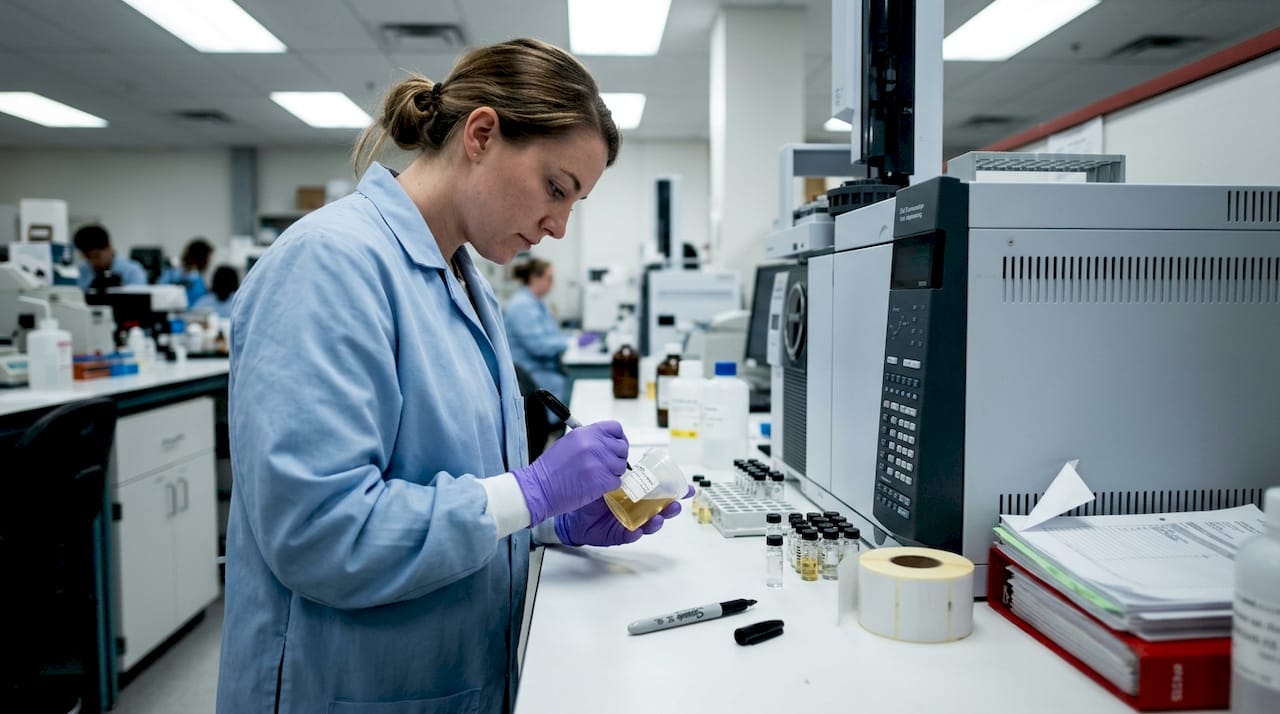
Pro Tip: Always verify that your point-of-care test cups are used for screening only. Any positive result that will affect employment or program participation must be confirmed by a SAMHSA-certified lab before the MRO communicates it. Use accurate panel selection as a starting point for building a defensible testing protocol, and integrate it with your clinic’s testing workflow to reduce procedural gaps.
Special insights: Gray areas, challenges, and contested policies
Even experienced compliance officers run into situations where the rules are genuinely unclear. These gray areas are where organizations face the most unexpected liability.
One of the most underappreciated risks is employer liability for third-party service agent errors. If your contracted collector improperly documents chain-of-custody, or your lab loses a specimen, the regulatory exposure does not fall entirely on the service agent. Employers remain liable for errors made by the agents they hire. That means verifying SAMHSA lab certification, conducting mock collections, and reviewing collector training records are employer responsibilities, not optional extras.
Marijuana law creates another layer of complexity. Federal testing programs still classify marijuana as a prohibited substance regardless of state law. An employee in a state where recreational marijuana is legal can still be removed from a safety-sensitive role for a positive federal test. This disconnect between state and federal law is a source of genuine confusion, and organizations that fail to communicate it clearly in their written policies face both legal and employee relations risks.
“While workplace drug testing is broadly supported for safety reasons, some critics argue that mandatory testing in public benefit programs like TANF represents poor use of public funds. The evidence on workplace testing, however, consistently supports its role in deterring use and reducing costs in safety-sensitive environments.”
Top gray areas that compliance professionals frequently misread:
- Assuming state marijuana legalization overrides federal DOT testing requirements (it does not)
- Believing service agent errors are solely the agent’s legal problem
- Treating point-of-care screening results as final without MRO confirmation
- Misunderstanding when a return-to-duty test is required versus a follow-up test
- Confusing DOT-regulated testing with non-DOT employer testing, which has different rules
Understanding how to handle positive results correctly within the compliance framework is essential for any program administrator navigating these issues.
The compliance mindset: What most organizations miss
Most organizations do not fail compliance audits because they ignored the rules. They fail because they treated compliance as an administrative function rather than a strategic one. The policy exists, the forms are filed, the lab is certified. But nobody checked whether the collector’s training lapsed, or whether the MRO’s certification was renewed, or whether the written policy reflects the 2026 panel updates.
The organizations that consistently pass audits and avoid liability share one trait: leadership is actively involved. Compliance is not delegated entirely to HR or a third-party administrator. It is reviewed in leadership meetings, built into onboarding, and audited internally before external inspectors arrive.
The benefits of proactive workplace drug testing extend beyond legal protection. They signal to employees, insurers, and regulators that your organization takes safety seriously as a core value, not a checkbox.
Pro Tip: Assign a named compliance owner at the leadership level, not just an HR coordinator. When accountability lives at the top, gaps get closed faster and the program stays current.
Bringing compliance to life: Tools and resources that help
Compliance does not happen in policy documents alone. It happens at the point of collection, in the documentation you keep, and in the supplies you choose.
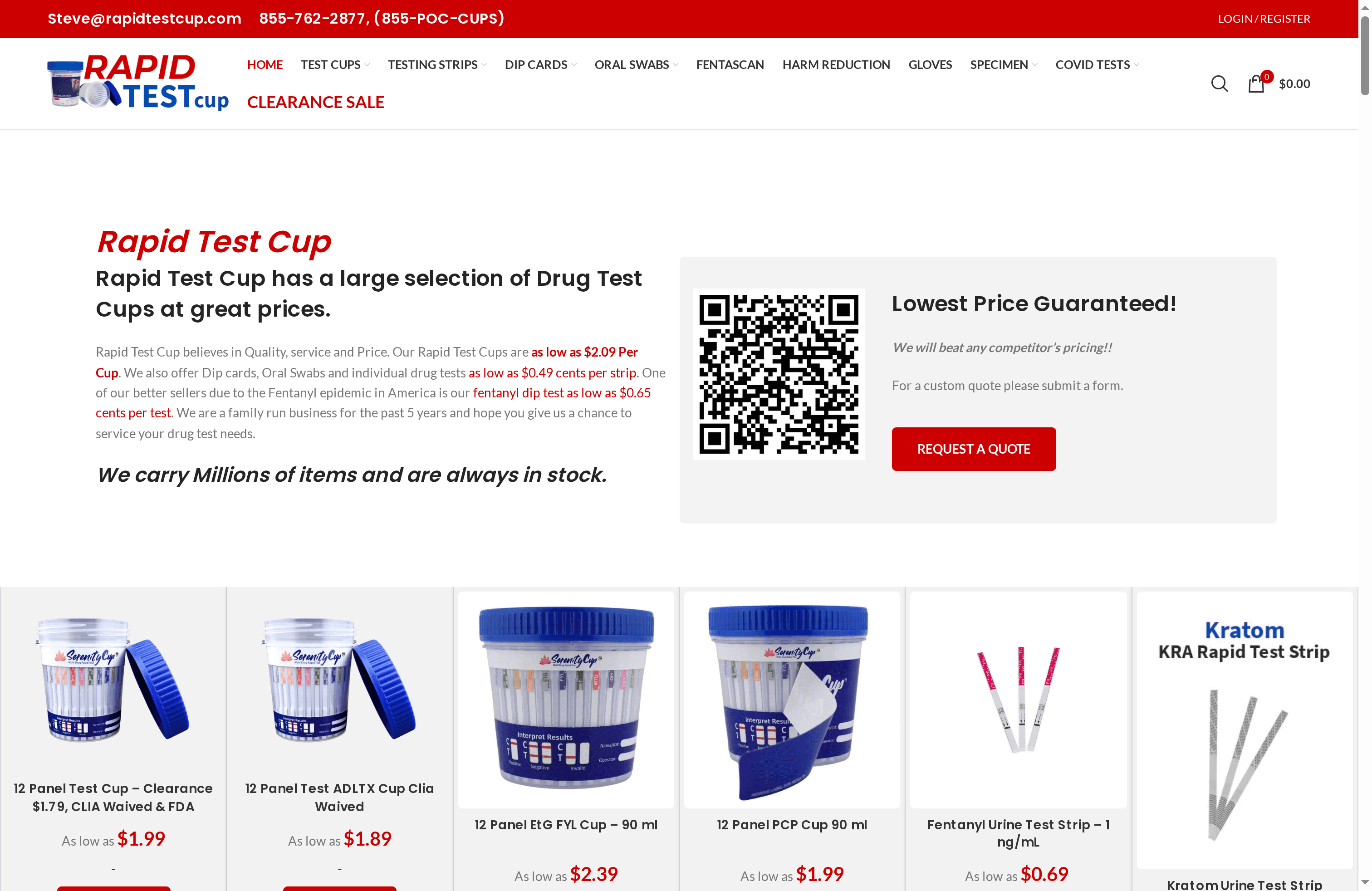
At rapidtestcup.com, we supply healthcare organizations, clinics, and substance abuse programs with CLIA waived, FDA-approved testing products built for professional compliance workflows. Our 18-panel drug test cup supports broad-spectrum screening with adulterant detection built in. Pair it with our urine specimen cups for proper collection, and use our forensic drug testing checklist to document each step for audit-ready recordkeeping. The right tools make compliance repeatable, not reactive.
Frequently asked questions
What are the main federal regulations governing drug testing compliance?
DOT 49 CFR Part 40 and SAMHSA Mandatory Guidelines set the primary U.S. compliance requirements for safety-sensitive workplaces and federal programs. Both frameworks are enforceable and updated regularly.
What steps ensure a compliant drug testing process?
Use DOT-qualified collection sites, SAMHSA-certified labs, MRO review of all confirmed positives, and maintain chain-of-custody records for at least five years. Every step in that chain must be documented.
How do compliant drug testing programs reduce risk for employers?
They directly cut costs from absenteeism, turnover, and fines, since substance abuse costs employers $7,000+ per affected employee annually. Compliant programs combined with EAPs produce measurable reductions in those costs.
What testing panels are required for compliance?
Federal programs require SAMHSA-specified panels updated annually. The standard 5-panel urine test covers amphetamines, cocaine, marijuana, opioids, and PCP, with defined cutoff concentrations for each substance.