Blog
Workplace drug test compliance: A practical 2026 guide


TL;DR:
- Employers must understand layered federal, state, and local drug testing laws to ensure compliance.
- Updating drug testing policies regularly is essential due to legal changes like fentanyl inclusion and marijuana restrictions.
- Proper training, specimen selection, and documentation are critical to effective and compliant workplace drug testing.
Compliance failures in workplace drug testing cost employers more than just fines. A single procedural mistake, like skipping chain of custody or missing a policy update, can expose your organization to wrongful termination lawsuits, lost federal contracts, or failed DOT audits. With fentanyl now added to federal testing panels as of July 2025 and oral fluid testing now a recognized standard, the rules have shifted in ways that catch many HR teams off guard. This guide walks you through every critical step, from understanding the regulatory framework to training your supervisors and selecting the right test methods, so you can build a program that holds up under scrutiny.
Table of Contents
- Understanding federal, DOT, and state drug testing requirements
- Setting up a compliant drug testing policy
- Selecting testing methods and managing the process
- Implementing, training, and troubleshooting your compliance program
- Why getting drug test compliance right is harder and more critical than you think
- Workplace drug testing made simple: Solutions for your compliance needs
- Frequently asked questions
Key Takeaways
| Point | Details |
|---|---|
| Stay updated annually | Update drug testing policies each year to address new rules and substances. |
| Tailor to federal, DOT, and state | Federal, DOT, and state laws all impact what your policy must cover. |
| Choose the right method | Select urine, oral fluid, or hair testing based on your workplace needs and compliance. |
| Train and document | Train staff and keep records to ensure fair, defendable implementation. |
| Mitigate legal risks | Thorough policies reduce litigation risk as laws on substances like marijuana shift. |
Understanding federal, DOT, and state drug testing requirements
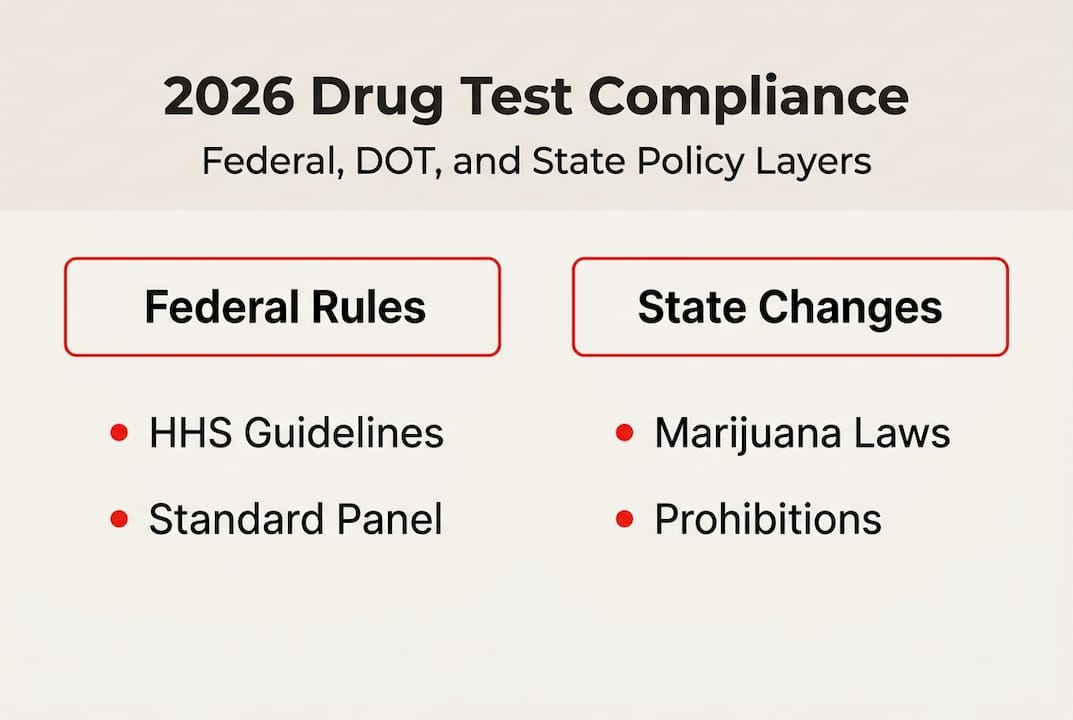
Before you write a single line of your drug testing policy, you need to understand which rules apply to your organization. The regulatory landscape is layered, and missing one level can unravel everything else.
At the federal level, the Department of Health and Human Services (HHS) sets the baseline through its Mandatory Guidelines, which cover both urine testing (UrMG) and oral fluid testing (OFMG). The authorized testing panels effective July 7, 2025 now include fentanyl and norfentanyl, a significant update that most private employers have not yet incorporated into their policies. If your organization holds federal contracts or grants, these guidelines are not optional.
For transportation and safety-sensitive industries, the Department of Transportation (DOT) adds another layer. DOT-regulated employers must follow specific 2025 guidelines covering testing types, collection procedures, and implementation timelines. This includes rules for direct observation collections, return-to-duty testing, and follow-up testing after a violation.
State laws add a third layer, and they diverge sharply. Some states restrict or outright prohibit pre-employment marijuana testing, while others have strong drug-free workplace incentives. State laws vary widely, and what is legal in Texas may expose you to liability in New Jersey. Local ordinances in some cities add yet another layer on top of that.
Here is a quick overview of the regulatory layers most employers must navigate:
| Regulatory level | Who it applies to | Key 2025 or 2026 change |
|---|---|---|
| HHS federal guidelines | Federal contractors and grantees | Fentanyl and norfentanyl added to panels |
| DOT regulations | Transportation, aviation, rail, pipeline | Oral fluid testing now authorized |
| State law | All private employers | Marijuana restrictions expanding |
| Local ordinance | Varies by city or county | Some cities ban pre-hire THC testing |
The key substances now covered under updated federal panels include:
- THC (marijuana metabolites)
- Cocaine metabolites
- Opiates (codeine, morphine, heroin)
- Amphetamines and methamphetamine
- Phencyclidine (PCP)
- Fentanyl and norfentanyl (new as of July 2025)
“Employers who operate across multiple states need to layer their federal obligations on top of each applicable state law. Ignoring either level creates legal exposure on both ends.”
Understanding federal workplace drug testing law is the starting point. From there, review your state requirements and consult your legal team before finalizing any policy. You can also review legal drug testing rules for a practical breakdown of how these layers interact.
Setting up a compliant drug testing policy
With the regulatory groundwork set, move on to building a robust, up-to-date policy that will stand up to audits.
A compliant drug testing policy is not a one-page memo. It is a living document that defines who gets tested, when, how, and what happens with the results. Best practices include a written policy, use of certified labs, documented chain of custody, Medical Review Officer (MRO) verification, strict confidentiality protocols, and supervisor training.
Here is a step-by-step process for building your policy:
- Define the scope. Decide whether testing applies to all employees or only safety-sensitive positions. Document your reasoning.
- Identify applicable regulations. List every federal, state, and local rule that applies to your industry and locations.
- Choose your testing triggers. Pre-employment, random, reasonable suspicion, post-accident, and return-to-duty are the most common types.
- Select certified labs and MROs. Only HHS-certified labs are acceptable for federal testing. MROs must be licensed physicians trained in drug testing interpretation.
- Draft the policy language. Keep it plain, specific, and updatable. Avoid locking in substance lists that will need annual revisions.
- Have legal counsel review it. Federal law requires protections for employees under the Americans with Disabilities Act (ADA) and the National Labor Relations Act (NLRA). Your policy must account for both.
- Communicate it clearly. Distribute the policy before it takes effect. Require signed acknowledgment from all covered employees.
Here is a comparison of testing types and their best use cases:
| Test type | Best use case | Notes |
|---|---|---|
| Pre-employment | New hires in safety-sensitive roles | Some states restrict marijuana testing |
| Random | Ongoing deterrence for regulated industries | Must use truly random selection process |
| Reasonable suspicion | Observed behavior or performance issues | Requires trained supervisor documentation |
| Post-accident | After workplace incidents | Follow DOT thresholds for regulated industries |
| Return-to-duty | After a violation or treatment program | MRO and follow-up testing required |
Pro Tip: Write your policy with modular substance lists. Instead of naming every drug in the main body, reference your current authorized panel in an appendix. That way, when fentanyl gets added or a new substance emerges, you update the appendix, not the entire policy.
For more guidance on drug testing best practices and reducing compliance risks, review your current policy against the drug testing policy resources published by SAMHSA.
Selecting testing methods and managing the process
Once your policy is set, determine which testing methods fit your compliance, operational goals, and risk levels.
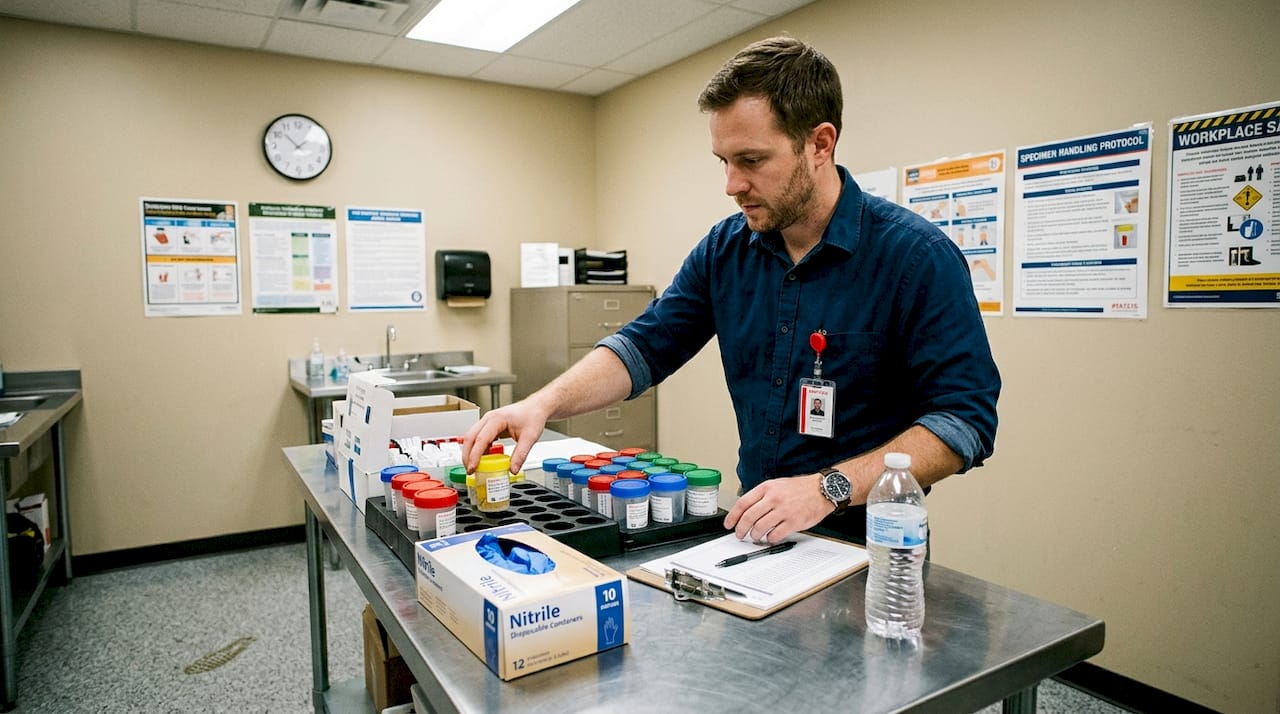
Not all drug tests are created equal. Each method has a different detection window, cost profile, and regulatory acceptance level. Choosing the wrong method for your situation can produce unreliable results or create legal problems.
Here is a breakdown of the main options:
- Urine testing: Detects most substances from 1 to 30 days depending on frequency of use. It is the most widely accepted method for federal and DOT testing. Split specimens are required under federal guidelines.
- Oral fluid testing: Best for detecting very recent use, typically within the past 24 to 48 hours. DOT now authorizes oral fluid testing alongside urine for regulated industries, making it a strong option for post-accident or reasonable suspicion situations.
- Hair testing: Captures a 90-day window of drug use history. It is not currently accepted for federal or DOT testing but is widely used by private employers for pre-employment screening.
- Impairment testing: Newer technology that measures cognitive function rather than metabolite presence. It is not yet federally standardized but is gaining traction in marijuana-legal states.
All specimens for federally mandated testing must go through HHS-certified labs. Using an uncertified lab for a DOT-covered employee is a compliance violation regardless of the test result.
Pro Tip: Use hair testing for pre-employment screening when you want a longer history, and oral fluid for post-accident or reasonable suspicion situations where recent use is the concern. Pairing both methods gives you the most complete picture.
According to 2025 drug positivity rates, fentanyl detections in workplace testing have risen sharply, reinforcing why the new federal panels matter. Ignoring fentanyl in your panel is no longer a defensible gap.
| Method | Detection window | Federally accepted | Best for |
|---|---|---|---|
| Urine | 1 to 30 days | Yes (HHS and DOT) | Standard compliance testing |
| Oral fluid | 24 to 48 hours | Yes (DOT, 2025) | Recent use, post-accident |
| Hair | Up to 90 days | No (private use only) | Pre-employment history |
| Impairment | Real-time only | No | Marijuana-legal state environments |
For a detailed workflow for drug testing and step-by-step guidance on workplace testing steps, review your current process against these benchmarks.
Implementing, training, and troubleshooting your compliance program
Now, apply your policy in the real world. Train your team, and be prepared for edge cases, disputes, and audits.
A policy that lives in a drawer is worthless. Execution is where most compliance programs succeed or fail. Start with supervisor training, because supervisors are your first line of defense.
Here is a structured rollout sequence:
- Train all supervisors on reasonable suspicion identification, proper documentation, and how to initiate a test without bias.
- Train HR staff on chain of custody procedures, MRO communication, and confidentiality requirements.
- Communicate the policy to all employees before it takes effect. Post it in visible locations and include it in onboarding materials.
- Establish a testing vendor relationship with a certified collection site and lab before you need it.
- Create a documentation system for every test initiated, including the reason, result, and any follow-up actions.
Supervisors require specific training for equal application and identifying reasonable suspicion. Without it, inconsistent enforcement becomes a discrimination claim waiting to happen.
Edge cases you need to plan for:
- Prescription medications: If an employee tests positive, the MRO reviews any valid prescription before the result is finalized. Do not make employment decisions before MRO review is complete.
- ADA considerations: ADA protects employees from discrimination based on disability. Slurred speech or unsteady movement may indicate a medical condition, not drug use. Train supervisors to document specific observed behaviors, not conclusions.
- Unionized workforces: Drug testing policies in union environments may require bargaining. Consult labor counsel before implementing changes.
- Marijuana in legal states: State-specific drug testing law may restrict pre-employment THC testing even if your federal policy allows it. Safety-sensitive exceptions often still apply.
“In one real-world scenario, an employer in a marijuana-legal state terminated a warehouse worker based on a pre-employment THC positive. The state’s new restriction on pre-hire marijuana testing resulted in a costly settlement that a simple policy review would have prevented.”
Pro Tip: Document every decision, every training session, and every deviation from standard procedure. If you are ever audited or face litigation, your documentation is your defense. For more on handling positive tests and managing test results, build your process around these documented steps.
Why getting drug test compliance right is harder and more critical than you think
Compliance programs have a dangerous failure mode: they work well at launch, then quietly fall apart as laws change and staff turns over. Most employers do not realize there is a gap until an audit or lawsuit reveals it.
There is no federal mandate for private employers to test at all, but a strong compliance program significantly reduces litigation risk. That creates a false sense of security. Because testing is optional for many private employers, some treat their policy as a one-time setup task. That is exactly the wrong approach.
The addition of fentanyl to federal panels, the expansion of oral fluid testing, and the rapid spread of state marijuana protections all happened within the last 18 months. A policy written in 2023 is almost certainly outdated today. Annual reviews are not bureaucratic overhead. They are your safe harbor against claims that your policy was arbitrary or discriminatory.
The most effective programs we see involve cross-functional review teams, including HR, legal, safety, and operations. Advanced compliance best practices call for peer review from outside your organization as well, particularly when THC testing legislation is shifting in your operating states. Build the review into your annual HR calendar, not as a reaction to a problem, but as a standing practice.
Workplace drug testing made simple: Solutions for your compliance needs
For employers who want ready-to-go compliant solutions, here is how to get started.
Updating your compliance program should not mean starting from scratch. The right testing supplies make a real difference in how smoothly your program runs, especially when you need to detect emerging substances like fentanyl.
Our 22-panel drug test kit is one of the most requested products for employers updating their panels to meet 2025 and 2026 requirements, covering fentanyl detection alongside the full standard panel. If you are sorting out which format fits your workflow, our guide on urine test types breaks down the differences clearly. Ready to upgrade your compliance program? Explore our full range of compliance test solutions built for HR teams, clinics, and safety-sensitive industries.
Frequently asked questions
What drugs are included in the standard federal workplace testing panels in 2026?
The standard panels now include THC, cocaine, opiates, amphetamines, PCP, fentanyl, and norfentanyl, with fentanyl and norfentanyl added to panels effective July 7, 2025.
Can private employers exclude marijuana from pre-employment drug tests?
In many states like California, New York, and New Jersey, employers are restricted or prohibited from pre-employment marijuana testing, though state laws vary and safety-sensitive roles may still require it.
What is the most reliable method for detecting recent drug use?
Oral fluid testing is currently the best option for detecting very recent use, while hair testing captures longer histories, as outlined in drug testing resources from SAMHSA.
How should employers handle positive tests for employees with a prescription?
Employers must have a Medical Review Officer review valid prescriptions and medical explanations before finalizing any result, as required under federal workplace protections.
How often should workplace drug testing policies be reviewed for compliance?
Experts recommend at least annual reviews, and the 2026 policy checklist from Current Consulting Group specifically highlights fentanyl and marijuana law changes as reasons to review now.